In the petrochemical industry, compressors are known as the “heart” of the process system, widely used in feed gas boosting, process gas circulation, air separation for nitrogen/oxygen production, flare gas recovery, LPG transportation and other critical links. Petrochemical working conditions are characterized by complex media (flammable, explosive, sulfur-containing, corrosive), wide pressure range, high continuous operation requirements and strict explosion-proof standards. Incorrect selection will not only lead to high energy consumption and frequent maintenance, but also cause safety accidents and production shutdown losses. This article provides a practical selection method from six dimensions: medium characteristics, process parameters, equipment types, safety explosion protection, energy efficiency standards and life-cycle cost, and introduces mature solutions of MINNUO compressors in the petrochemical industry.
1. Define the Medium First: The Foundation of All Selection
Petrochemical gas media determine materials, seals, lubrication methods and explosion-proof levels, which must be clarified first:
Flammable/explosive gases: Methane, ethane, propane, LPG, hydrogen, ethylene, etc. — oil-free lubrication + explosion-proof motor (Ex d IIB T4 and above) + reliable seals (dry gas seal/labyrinth seal) are mandatory.
Corrosive gases: Containing H₂S, CO₂, Cl₂, NH₃, etc. — 316L stainless steel, duplex steel or Hastelloy shall be used for media-contacting parts to avoid corrosion and perforation.
Dust/impurity-containing gases: Catalyst powder, coke powder, heavy hydrocarbon droplets — multi-stage pre-filters + high-efficiency separators must be equipped to protect rotors and seals.
High-purity/oil-free requirements: Oxidation reactions, polymerization, catalyst protection — absolute oil-free (oil content ≤0.1mg/m³) is required, with priority given to diaphragm or oil-free screw models Minnuo Compressor.
MINNUO Advantage: For petrochemical media, we provide special material library + customized sealing solutions, including spare filters/separators, adapting to working conditions of 7–10m³/min, 8–10bar, 55kW IE3/IE4 motor Minnuo.
2. Process Parameters: Accurate Matching of Flow and Pressure
2.1 Flow Rate (Displacement)
- Unit: m³/min or Nm³/h (standard condition: 0℃/1atm)
- Common in petrochemicals: 7–10m³/min (420–600Nm³/h) for instrument air, small air separation, flare gas recovery.
- Selection Principle: Rated flow ≥ maximum air demand × 1.1 (10% margin reserved) to avoid long-term full-load or low-load operation (sharp efficiency drop).
2.2 Pressure (Discharge Pressure)
- Instrument air/plant air: 0.7–1.0MPa (7–10bar)
- Process gas boosting: 1.6–4.0MPa
- High/ultra-high pressure: 10–100MPa (hydrogen, CO₂, LPG filling).
2.3 Power and Motor Energy Efficiency
- Medium and small petrochemical plants: 55kW is the main power segment
- Motor Standard: IE3 (High Efficiency)/IE4 (Super High Efficiency), compatible with EU/Spain industrial voltage 400V/50Hz.
- Variable Frequency Priority: Variable frequency motor + PLC intelligent control, 15%–25% energy saving under partial load.
3. Compressor Types: Choose the Right Model According to Working Conditions
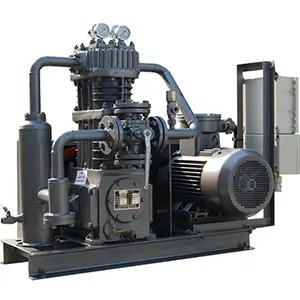
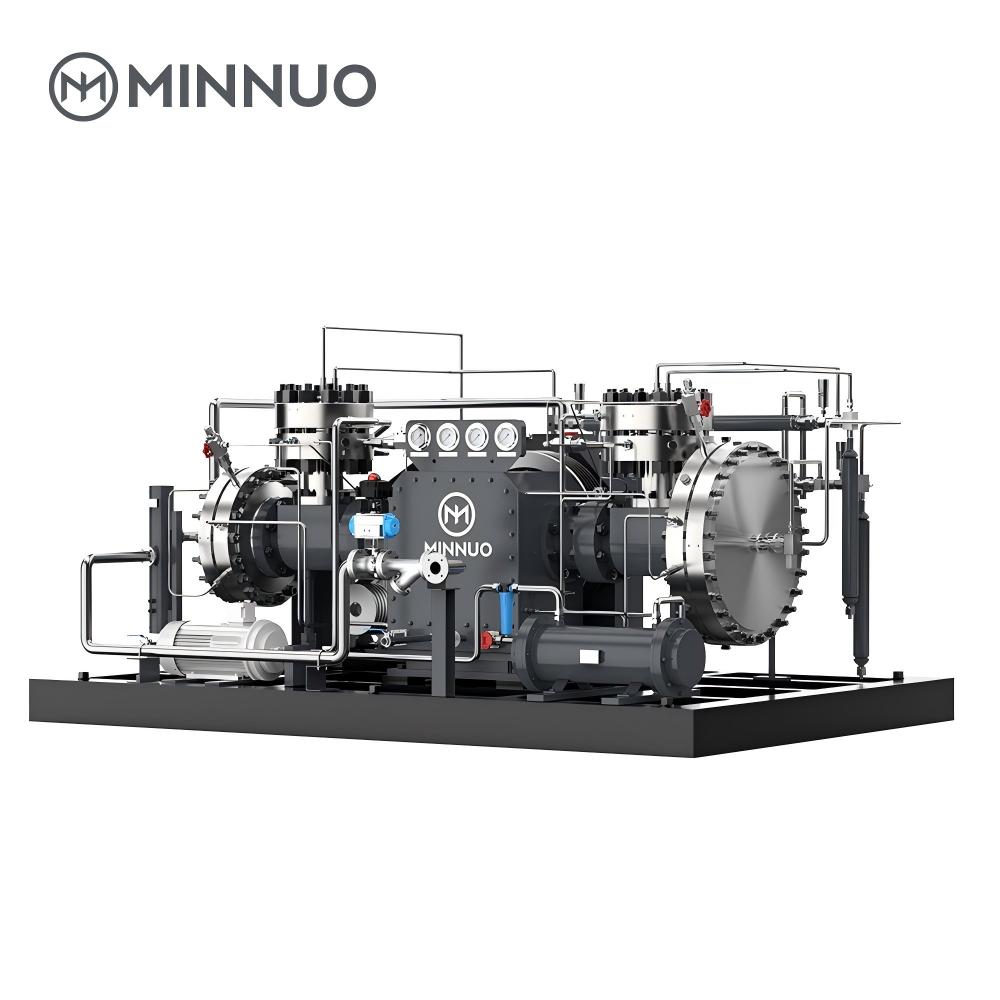
Three mainstream types in petrochemicals, fully covered by MINNUO:
| Type | Applicable Flow | Applicable Pressure | Core Advantages | Typical Petrochemical Scenarios |
| Screw (Oil-Injected/Oil-Free) | 3–40m³/min | 0.7–2.5MPa | Stable continuous operation, low noise, easy maintenance | Instrument air, air separation, nitrogen production, plant air |
| Diaphragm | 0.1–10m³/min | 1.0–100MPa | 100% oil-free, zero leakage, high-purity gas | Hydrogen, oxygen, chlorine, high-purity process gas Minnuo Compressor |
| Reciprocating Piston | 1–20m³/min | 1.0–50MPa | High cost-performance at high pressure, shock load resistance | LPG, ammonia, CO₂, high-pressure feed gasMinnuo Compressor |
MINNUO Recommendation: For 7–10m³/min, 8–10bar, 55kW, two-stage oil-injected screw is preferred (high efficiency, stability, cost advantage); for high-purity/flammable media, choose oil-free screw or diaphragm Minnuo Compressor.
4. Safety and Explosion Protection: Non-Negotiable Bottom Line for Petrochemicals
- Explosion-Proof Level: Motors in petrochemical explosion-proof areas (Zone 1/2) must be Ex d IIB T4 and above, compatible with methane, ethane and other media.
- Sealing System: Dry gas seal + labyrinth seal double insurance for flammable/toxic gases, leakage rate ≤10⁻⁶mbar·L/s.
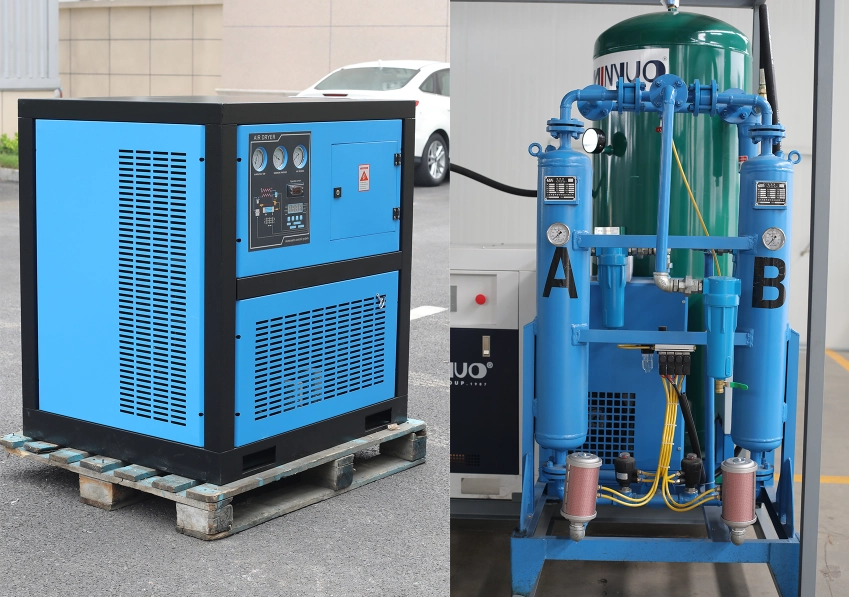
- Filtration and Separation: Standard equipped with three-stage filters (pre + intermediate + precision) + oil-gas separator, including spare filters/separators to ensure clean air and protect downstream equipment.
- Material Safety: Corrosion-resistant design for shell/rotor/valves against H₂S, CO₂ and other corrosive media, extending service life and avoiding leakage.
5. Energy Efficiency and Environmental Protection: IE4 + Variable Frequency, Cost Reduction and Efficiency Improvement
Motor Energy Efficiency: Prioritize IE4 super high-efficiency motor, 3%–5% more energy-saving than IE3, significantly reducing electricity costs in long-term operation.
Variable Frequency Control: Automatically adjust speed according to air demand fluctuations, 15%–25% energy saving under partial load, adapting to large load variations in petrochemicals.
Waste Heat Recovery: High-temperature exhaust waste heat can be recovered for heating or power generation, supporting carbon neutrality.
Low Noise Design: Overall noise ≤75dB, meeting environmental protection requirements of petrochemical workshops Minnuo Compressor.
6. Life-Cycle Cost (LCC): Beyond Purchase Price
Selection must calculate LCC = procurement cost + installation + energy consumption + maintenance + spare parts + shutdown loss:
- Low price but poor quality: 10% initial cost saving, but 30% higher energy consumption, frequent maintenance and large shutdown losses in later stages.
- MINNUO Solution: IE4 motor + high-efficiency mainframe + long-life seals + remote monitoring, 20%–30% lower 5-year LCC than ordinary brands Minnuo Compressor.
- Service Guarantee: 24/7 remote monitoring + localized service + 48-hour spare parts delivery to reduce shutdown risks Minnuo Compressor.
7. MINNUO Petrochemical Compressor Recommended Configuration (7–10m³/min, 8–10bar, 55kW)
Model: Two-Stage Oil-Injected Screw Compressor (MN-55-Ⅱ)
Flow Rate: 7–10m³/min
Pressure: 8–10bar
Motor: 55kW IE4 Super High-Efficiency Explosion-Proof Motor (400V/50Hz)
Filtration: Three-stage filters + spare filter + high-efficiency oil-gas separator
Control: PLC intelligent control + variable frequency speed regulation + remote monitoring
Materials: Ductile iron mainframe + stainless steel rotor + corrosion-resistant alloy seals
Applications: Instrument air, air separation for nitrogen production, flare gas recovery, LPG transportation
Conclusion
Petrochemical compressor selection is a comprehensive decision of safety, efficiency, cost and reliability: define media and materials first, then match flow/pressure and IE3/IE4 motors, select the right model and explosion-proof configuration, and finally calculate life-cycle cost. With years of deep involvement in gas compression, MINNUO has a full range of screw, diaphragm and piston compressors, providing customized solutions + stable equipment + full-cycle services to help petrochemical enterprises operate safely, efficiently and cost-effectively.
Need a customized petrochemical compressor solution? Contact MINNUO engineers for free selection calculation and quotation.
FAQ – Frequently Asked Questions
1. What compressor type is best for flammable & explosive petrochemical gases?
For flammable, explosive, or toxic gases such as hydrogen, methane, and LPG, we recommend oil-free screw or diaphragm compressors with explosion‑proof motors (Ex d IIB T4 or higher) and double sealing systems (dry gas seal + labyrinth seal) to ensure zero leakage.
2. What flow and pressure should I choose for general petrochemical use?
Most common working conditions (instrument air, nitrogen generation, flare gas recovery) use:
- Flow rate: 7–10 m³/min
- Discharge pressure: 8–10 barAlways reserve 10% extra flow to avoid overloading.
3. Why is IE4 motor better than IE3 for petrochemical compressors?
IE4 is super high efficiency, saving 3%–5% more energy than IE3. For long‑running petrochemical plants, it significantly reduces power costs and lowers life‑cycle cost (LCC).
4. How to select the right material for corrosive gases (H₂S, CO₂)?
Parts in contact with media must use 316L stainless steel, duplex steel, or Hastelloy to resist corrosion and prevent leakage. MINNUO provides custom material solutions for harsh corrosive conditions.
5. Can MINNUO compressors run 24/7 continuously?
Yes. All MINNUO petrochemical models are designed for long‑term, uninterrupted operation with high stability, low failure rate, and remote monitoring to ensure safe, continuous production.
6. How long is the payback period for a high-efficiency compressor?
With energy savings from IE4 motors and VFD control, plus lower maintenance, most users recover the extra investment within 1–2 years and enjoy much lower LCC over 5–10 years.
 Email
Email sales:+86 15366749631