Buy an air dryer that matches the compressor nameplate CFM and you should be fine. That is what many first-time buyers assume. Sometimes the assumption holds. More often, it leads to a dryer that is slightly undersized — still running, still removing some moisture, but not delivering the dew point it was specified to achieve. The excess water travels downstream. It condenses in the piping. It reaches the tools, the valves, and the product. The dryer is not broken. It was simply the wrong size from the start.
Sizing an air dryer correctly means understanding that a compressor rated at 100 CFM does not always deliver 100 CFM of air to the dryer inlet. The actual flow, temperature, and pressure vary with site conditions. The dryer rating on the datasheet is based on standard reference conditions that may not match your installation. This article explains how to match a dryer to your compressor using corrected flow, not catalog flow, and how to avoid the most common sizing mistakes.
I. Why Dryer Sizing Starts with the Compressor — But Does Not End There
The relationship between compressor FAD and dryer inlet flow
A compressor’s free air delivery is the volume of air it draws in at inlet conditions — typically 20 degrees Celsius, 1 bar absolute, and 0 percent relative humidity. The dryer sits downstream of the compressor, after the aftercooler and often after an air receiver. The air arriving at the dryer inlet is hotter and denser than ambient air. Its water content is close to saturation. The dryer must handle this specific air stream, not the theoretical ambient air the compressor ingested. The mass flow of air is the same, but the volume flow at the dryer inlet conditions can differ enough to affect the dryer sizing if not accounted for.
What the dryer datasheet reference conditions actually mean
Air dryer manufacturers rate their equipment at standard reference conditions per ISO 7183. For refrigerated dryers, the standard inlet conditions are typically 100°F (38°C) inlet temperature, 100 PSI (7 bar) operating pressure, and 100°F ambient temperature — the “three 100s.” For desiccant dryers, the reference is usually 100°F inlet temperature and 100 PSI. These are not arbitrary numbers. They represent a realistic worst-case operating condition that the dryer can handle while delivering its rated outlet dew point. When your actual inlet temperature, pressure, or ambient temperature deviates from these reference points, the dryer’s effective capacity changes. A dryer rated at 100 CFM under reference conditions may only handle 70 CFM under more demanding site conditions — or may handle 120 CFM under easier ones.
The consequence of getting the size wrong
An undersized dryer runs with a higher inlet flow than it is designed for. The air velocity through the heat exchanger or desiccant bed is too high. Residence time is too short. Moisture removal suffers. The outlet dew point rises above specification, and water appears downstream. An oversized dryer costs more to purchase and, for refrigerated models, may cycle its refrigeration compressor excessively, reducing its service life. The goal is to hit the sweet spot — a dryer that is sized for the actual, corrected flow at the installation site, with a reasonable margin for summer conditions and future load growth.
II. Step One: Determine the Actual Flow at the Dryer Inlet
Start with the compressor’s actual FAD, not the nameplate
The compressor nameplate may say 100 CFM. The actual delivered flow depends on the compressor’s operating pressure, its inlet filter condition, and its overall mechanical health. For a new, well-maintained compressor running at its design pressure, the nameplate FAD is a reasonable starting point. For an older compressor or one running at a higher discharge pressure, the actual FAD may be lower. Use the manufacturer’s performance curve for the compressor at the actual operating pressure. If a flow meter is installed, use the measured value. An assumed flow that is 10 percent too high translates directly into an oversized dryer. One that is 10 percent too low leads to an undersized dryer.
Correct for the operating pressure
Dryer capacity is directly affected by operating pressure. Higher pressure increases air density. A dryer sized for 100 PSI that operates at 125 PSI can handle more mass flow — the correction factor is roughly the ratio of absolute pressures. At 125 PSI, the correction factor is (125 + 14.5) / (100 + 14.5) = 139.5 / 114.5 = 1.22. A 100 CFM-rated dryer can handle approximately 122 CFM at this higher pressure. Lower pressure has the opposite effect. At 80 PSI, the correction factor is (80 + 14.5) / (100 + 14.5) = 94.5 / 114.5 = 0.83. The same 100 CFM-rated dryer can only handle 83 CFM. The correction is straightforward but frequently overlooked.
Correct for the inlet air temperature
The air entering the dryer should be as cool as possible. The compressor aftercooler should reduce the discharge temperature to within 10 to 15 degrees Fahrenheit above the ambient air temperature. If the aftercooler is undersized or fouled, the dryer inlet temperature will be higher. A refrigerated dryer rated at 100°F inlet temperature that receives air at 110°F will lose approximately 15 to 20 percent of its effective capacity. A desiccant dryer receiving hotter air will saturate its bed more quickly, reducing the effective drying capacity. The temperature correction factor is available from the dryer manufacturer’s engineering data. If the aftercooler is not delivering air at or below the dryer’s rated inlet temperature, either the aftercooler needs service or the dryer must be upsized.
The table below summarizes the key correction factors that affect dryer sizing.
Table: Air Dryer Sizing Correction Factors
| Variable | Reference Condition | Site Condition | Effect on Dryer Capacity |
| Operating pressure | 100 PSI (7 bar) | Lower (80 PSI) | Capacity decreases (~0.83 factor) |
| Operating pressure | 100 PSI (7 bar) | Higher (125 PSI) | Capacity increases (~1.22 factor) |
| Inlet air temperature | 100°F (38°C) | Higher (110°F / 43°C) | Capacity decreases (~0.80-0.85 factor) |
| Inlet air temperature | 100°F (38°C) | Lower (85°F / 29°C) | Capacity increases (~1.10-1.15 factor) |
| Ambient temperature (refrigerated) | 100°F (38°C) | Higher (110°F / 43°C) | Capacity decreases (~0.85-0.90 factor) |
| Ambient temperature (refrigerated) | 100°F (38°C) | Lower (70°F / 21°C) | Capacity increases (~1.15-1.20 factor) |
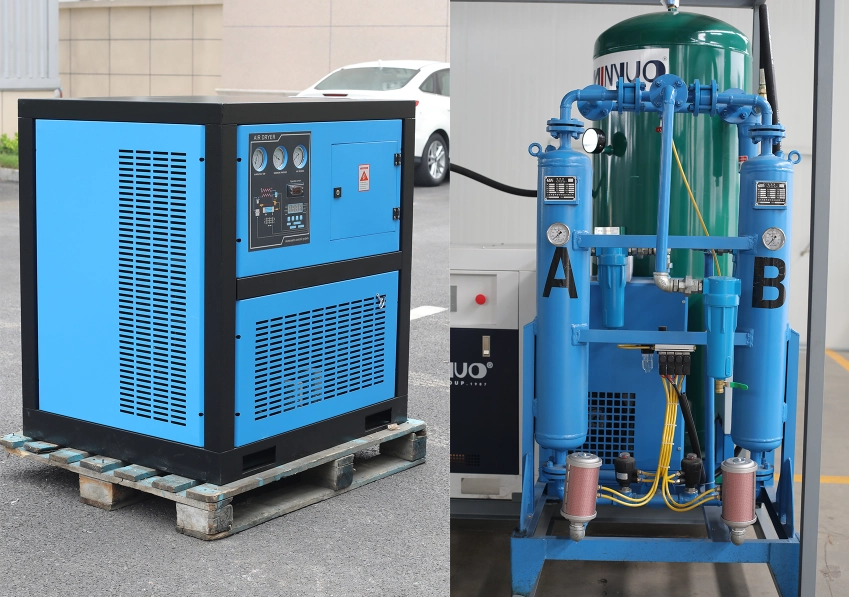
III. Step Two: Select the Dryer Type and Apply the Right Sizing Rules
Refrigerated dryers: sizing for pressure dew point of 3°C to 10°C
Refrigerated dryers are the most common type in general industrial service. They cool the compressed air to a temperature just above freezing — typically 2 to 5 degrees Celsius — causing water vapor to condense. The condensate is separated and drained. The air leaving the dryer has a pressure dew point of 3 to 10 degrees Celsius, which is adequate for most general manufacturing, pneumatic tools, and simple automation. When sizing a refrigerated dryer, apply the pressure and temperature correction factors to the compressor’s actual FAD. Select a dryer whose corrected capacity exceeds the corrected flow. A 10 to 15 percent margin is sufficient. Oversizing a refrigerated dryer by more than 20 percent is not recommended — the refrigeration compressor may cycle too frequently, leading to temperature instability and reduced moisture removal during the off-cycle.
Desiccant dryers: sizing for pressure dew points below freezing
Desiccant dryers use adsorbent media — activated alumina, silica gel, or molecular sieve — to remove water vapor to very low levels. They are specified when the application demands a pressure dew point of -20°C, -40°C, or -70°C. These dew points are typical for outdoor piping in cold climates, electronics manufacturing, pharmaceutical production, and critical instrumentation air. Desiccant dryers are less forgiving of inlet conditions than refrigerated models. Hot inlet air drastically reduces capacity. Oil carryover from a lubricated compressor can coat the desiccant and render it ineffective. A desiccant dryer should always be preceded by a coalescing filter and, for high-inlet-temperature applications, an aftercooler. When sizing, apply the pressure, temperature, and any additional moisture load factors from the manufacturer’s data. A 15 to 20 percent margin is standard.
Cycling vs. non-cycling refrigerated dryers and the sizing implications
Non-cycling refrigerated dryers run the refrigeration compressor continuously. They control the dew point by bypassing a portion of the refrigerant flow. They work well at steady, predictable loads. Cycling dryers turn the refrigeration compressor on and off based on the heat load from the incoming air. They save energy at partial loads but do not handle sudden flow increases as gracefully. If the compressed air demand varies significantly — a plant with large intermittent users like blast cabinets or bulk material conveyors — a cycling dryer may struggle to maintain dew point during flow surges unless it is sized for the peak load plus an appropriate buffer.
FAQ
Q1: Should I size my air dryer to match the compressor CFM exactly?
A1: Not necessarily. The dryer should be sized to the compressor’s actual free air delivery at the operating pressure, corrected for the dryer inlet temperature and the site ambient conditions. A dryer that exactly matches the compressor nameplate CFM without these corrections may be undersized. Always apply the manufacturer’s correction factors to the compressor’s actual output before selecting the dryer size.
Q2: What happens if my air dryer is undersized?
A2: An undersized dryer cannot remove enough moisture to meet its rated dew point. The outlet air carries more water vapor than specified. This water condenses in the downstream piping, at tools, and on the product. The dryer may appear to be working — it is still cooling or adsorbing — but the air quality at the point of use is compromised. An undersized refrigerated dryer will also experience higher heat loads, reducing the life of the refrigeration compressor.
Q3: What is the difference between pressure dew point and atmospheric dew point?
A3: Pressure dew point is the temperature at which water vapor begins to condense at the actual system pressure. Atmospheric dew point is the temperature at which condensation begins at ambient pressure. Because compressed air holds less water vapor at higher pressure, the pressure dew point is higher than the atmospheric dew point for the same air sample. Dryer specifications always refer to pressure dew point. When comparing dryer performance, ensure both dew points are referenced to the same pressure.
Q4: Can I oversize an air dryer for extra capacity?
A4: A moderate oversize of 10 to 20 percent is acceptable and provides a margin for future load growth or seasonal temperature increases. Oversizing beyond 20 percent is generally not recommended, particularly for refrigerated dryers. A significantly oversized refrigerated dryer cycles its refrigeration compressor too frequently. This causes temperature instability in the heat exchanger, reduces moisture removal efficiency, and shortens the compressor service life. For desiccant dryers, moderate oversizing is less problematic but still wastes capital and increases purge air consumption.
Q5: How doe altitude affect air dryer sizing?
A5: Altitude affects the cooling capacity of air-cooled refrigeration systems because thinner air removes less heat from the condenser. A refrigerated dryer rated at sea level may need to be derated by 3 to 5 percent per 1,000 feet of elevation above sea level, depending on the manufacturer. Desiccant dryers are less directly affected by altitude, but the compressor feeding them delivers less mass flow at altitude, which reduces the effective dryer load. The compressor and dryer should both be specified using site-corrected flow data.
IV. Common Sizing Mistakes That Lead to Wet Air
Ignoring the aftercooler condition
The compressor aftercooler is part of the drying system. If the aftercooler is not reducing the discharge air temperature to within 10 to 15 degrees Fahrenheit of ambient, the dryer inlet temperature will be higher than the dryer was sized for. The dryer capacity drops. The dew point rises. Before upsizing or replacing a dryer that is not meeting specification, check the aftercooler. A fouled air-cooled aftercooler or a scaled water-cooled aftercooler can raise the dryer inlet temperature by 20 degrees Fahrenheit or more. Cleaning the aftercooler costs far less than replacing the dryer.
Forgetting about future expansion
A dryer sized exactly for today’s compressor leaves no room for tomorrow’s expansion. If a second compressor is added to the system, the dryer must handle the combined flow. Installing a dryer with a 20 to 30 percent capacity margin on day one costs marginally more than a dryer without margin. Retrofitting or replacing an undersized dryer when production expands costs significantly more. If expansion is planned within the equipment’s expected service life, the margin should be built in at the initial purchase.
Neglecting the ambient conditions in the dryer room
The dryer itself is installed in a room. That room has a temperature. If a refrigerated dryer is installed in a hot compressor room where the ambient temperature regularly exceeds 100°F, the dryer’s condenser cannot reject heat effectively. The dryer capacity drops. The same applies to desiccant dryers to a lesser extent. The dryer room should be ventilated. The dryer’s cooling air intake should draw from the coolest available source. A dryer rated for 100°F ambient that is installed in a 110°F room is undersized from the moment it is commissioned.
Sizing based on average flow instead of peak flow
Compressed air demand varies. A dryer sized for the average daily flow will be undersized during periods of peak demand. The moisture removal deficit accumulates. Over time, the downstream piping loads with water, and the point-of-use air quality degrades. Size the dryer for the peak sustained demand — the highest flow the system must deliver for a period longer than a few minutes — not the daily average. Short-duration peaks can be buffered by the air receiver upstream of the dryer, but sustained peaks must be handled by the dryer itself.
V. Putting It Together: A Dryer Sizing Example
A plant operates a 75 kW rotary screw compressor rated at 350 CFM at 100 PSI. The compressor runs at 110 PSI actual discharge pressure. The aftercooler delivers air to the dryer at 95°F. The ambient temperature in the compressor room reaches 100°F in summer. The plant needs a refrigerated dryer delivering a pressure dew point of 3°C.
Start with the compressor FAD. At 110 PSI, the compressor delivers its rated 350 CFM — a small pressure increase does not materially reduce the flow for a well-maintained machine. Apply the pressure correction factor for the dryer: (110 + 14.5) / (100 + 14.5) = 124.5 / 114.5 = 1.09. The equivalent flow at the dryer reference pressure is 350 / 1.09 = 321 CFM. The dryer inlet temperature is 95°F, which is below the 100°F reference — no derating needed. The ambient temperature matches the 100°F reference — no additional derating. The corrected flow at dryer reference conditions is approximately 321 CFM. Add a 15 percent margin for summer extremes and measurement uncertainty: 321 × 1.15 = 369 CFM. The next available dryer size above 369 CFM is selected — likely a 400 CFM model. This is larger than the simple nameplate match of 350 CFM would have suggested, and for good reason. The margin protects the dew point on the hottest days of the year when the dryer is working against the highest ambient temperature and the highest cooling load.
Conclusion
Matching an air dryer to a compressor is not a one-number comparison. The compressor FAD is the starting point. The operating pressure, the dryer inlet temperature, and the ambient conditions in the dryer room all modify the effective dryer capacity. Applying the manufacturer’s correction factors — every reputable dryer manufacturer publishes them — converts the site conditions into an equivalent flow at the dryer reference conditions. Select the dryer that exceeds this corrected flow with a moderate margin, and the system will deliver its rated dew point across the full range of operating conditions.
At MINNUO, we supply compressed air treatment equipment including refrigerated and desiccant dryers matched to our compressor packages. We work with clients to apply the correction factors for their specific installation site — pressure, temperature, ambient conditions, and future expansion plans — so that the dryer is sized correctly from the day it is commissioned. A properly sized dryer protects the entire downstream system. One that is sized by guesswork protects nothing reliably.

 Email
Email sales:+86 15366749631