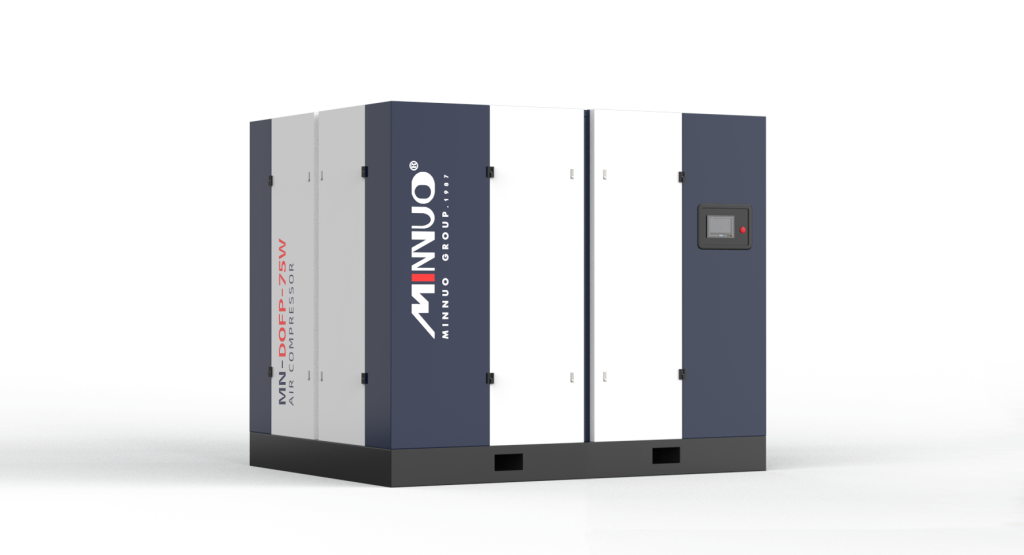
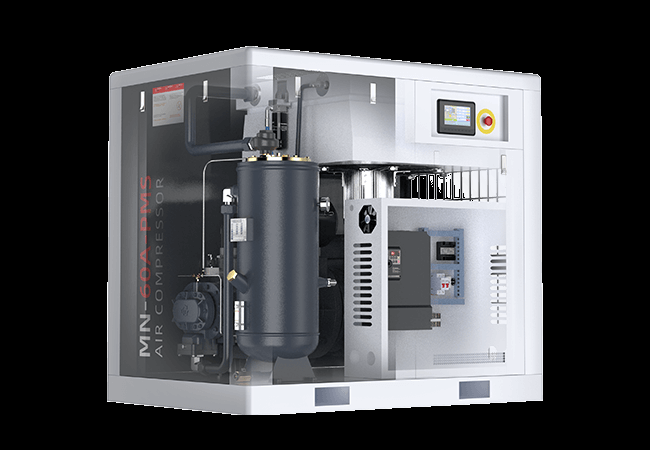
Both a dry screw and a water-injected rotary screw air compressor can be supplied for ISO 8573-1 Class 0 air, so the purity class alone will not decide the purchase. Either way you are buying an oil-free screw compressor; what separates the two designs is water. A water-injected machine needs a treated-water circuit and a cooling loop, and in return the published sheets show it delivering more air at the same rated motor power.
Matched at the same rated motor power, the water-injected model delivers 8.1% to 15.2% more air at 0.8 MPa across the six sizes where both ranges are quoted. Floor area falls by 24.8% at 200 kW and above. Against that, the machine needs a cooling-water circuit carrying up to 53 m³/h at 250 kW, and treated water in the airend. If the site has no treated water, the comparison ends there.
How do dry screw and water-injected compression differ inside the airend?
Both designs turn two intermeshing rotors inside a casing and push air from the suction port to the discharge port. The difference is not in how the rotors are held apart, which is where buyers most often guess wrong.
What holds the rotors apart: timing gears in both designs
Neither design lets the rotors touch each other. In both a dry screw airend and a water-injected one, a timing gear pair on the rotor shafts keeps the male and female rotors synchronised and holds a working gap between the flanks. A water-injected machine is not a machine whose rotors ride on a film of water. Water is a poor boundary lubricant, and rotor-to-rotor contact would wear the profile out.
What the water does change is what happens inside that gap.
What fills the clearance between the rotors: air against a water film
In a dry airend the working gap is filled by the gas being compressed, and gas leaks back across the flanks from the high-pressure side to the low-pressure side. That internal leakage grows as discharge pressure rises, which is one reason a dry machine’s delivered air falls as you ask it for more pressure.
In a water-injected airend the injected water fills the same gap. It seals the flanks and the clearances far better than gas can, so less air leaks back and more of what the rotors displace reaches the discharge port. This is the mechanism behind the air-delivery difference in the comparison table below.
What carries the compression heat away: casing against injected water
Compression heat has to leave the airend. In a dry machine it can only travel out through the rotors and the casing wall, so the rotors run hot, the discharge air leaves hot, and the rotor coatings have to survive that. In a water-injected machine the water absorbs the heat where it is generated. Compression stays close to isothermal and the discharge air leaves the airend cool, which is part of why the design covers 10 bar in a single stage in our own range.
What else circulates through the machine: nothing against treated water
Oil-free describes the air path, not the whole machine, and this is true of both designs. In a dry screw airend the timing gears and bearings are oil lubricated behind shaft seals that keep that oil out of the compression chamber. Water-injected designs vary here. Some use water-lubricated bearings in the airend; others keep an oil circuit for the gears and bearings and confine the water to the rotor chamber and its own loop. The two are both sold as oil-free compressors, and they do not have the same maintenance list. Ask which bearings and gears on the quoted model are water lubricated.
How much more air does a water-injected compressor deliver at matched power?
Both ranges publish air delivery at 0.7, 0.8 and 1.0 MPa. The table below matches them at the same rated motor power. The six rows are the sizes where both ranges publish matched motor ratings. The water-injected figures are a range because those models are inverter driven, and the upper figure is full-speed delivery.
| Rated power | Dry screw model | Air at 0.8 MPa | Water-injected model | Air at 0.8 MPa, full speed | Water vs dry: 0.8 / 1.0 MPa |
|---|---|---|---|---|---|
| 55 kW | MN-DOFP-55A | 8.94 m³/min | MN-75A-WLPM | 10.30 m³/min | +15.2% / +9.9% |
| 110 kW | MN-DOFP-110W | 18.31 m³/min | MN-150A-WLPM | 20.20 m³/min | +10.3% / +4.1% |
| 132 kW | MN-DOFP-132W | 21.66 m³/min | MN-180A-WLPM | 23.52 m³/min | +8.6% / +2.7% |
| 200 kW | MN-DOFP-200W | 32.60 m³/min | MN-270A-WLPM | 36.75 m³/min | +12.7% / +9.5% |
| 220 kW | MN-DOFP-220W | 35.10 m³/min | MN-300A-WLPM | 39.60 m³/min | +12.8% / +10.2% |
| 250 kW | MN-DOFP-250W | 41.64 m³/min | MN-340A-WLPM | 45.00 m³/min | +8.1% / +7.2% |
To read these in other units: 1 m³/min is 35.3 cfm, 0.8 MPa is about 116 psi and 1.0 MPa about 145 psi. Both ranges are built in the same plant, so either design can be quoted against the same duty point.
Why the air-delivery gap is not a single number
The advantage is not one number. It runs from 8.1% to 15.2% at 0.8 MPa and from 2.7% to 10.2% at 1.0 MPa. A gap that moves with both size and pressure is what you should expect from two specification sheets that were not measured on one test bench under ISO 1217. Read the row that matches your size and pressure, and do not carry a figure from one row to another.
One caution on how to use these numbers. Air delivery per rated motor power is not specific energy. Motors are normally rated above the power the airend actually absorbs, so the difference in running cost between the two designs is smaller than the percentages above and has to be measured. If running cost is the deciding factor, ask for both models quoted at the same discharge pressure, the same ambient temperature and the same relative humidity, and for the test data behind the quotation.
Floor space and weight at 200–250 kW: 4.86 m² against 6.46 m²
At the sizes where both sheets publish a single footprint per model, the water-injected unit is the smaller machine.
- Dry screw, 200 to 250 kW: 3400 × 1900 mm, 6.46 m² of floor area.
- Water-injected, 200 to 250 kW: 2700 × 1800 mm, 4.86 m² of floor area, 24.8% less.
- Weight: 4,200 to 4,800 kg for the water-injected models against 4,500 to 5,200 kg for the dry ones, between 6.7% and 12.0% lighter.
Below 200 kW the water-injected sheet publishes two footprints for most models, one for the air-cooled version and one for the water-cooled version marked with a (W). We have quoted only the sizes where a single footprint is published, so the comparison above is unambiguous.
What does a water-injected compressor need on site?
This is the machine many buyers call a water-lubricated screw compressor. Both names point at the same cost centre: what the water has to be before it is allowed into the airend.
Cooling water: 12 m³/h at 55 kW, 53 m³/h at 250 kW
The sheet states cooling-water flow at a 32 °C inlet temperature. It scales with machine size:
- 55 kW, MN-75A-WLPM: 12 m³/h through a 2 inch connection
- 110 kW, MN-150A-WLPM: 24 m³/h
- 200 kW, MN-270A-WLPM: 42 m³/h
- 250 kW, MN-340A-WLPM: 53 m³/h
That is the flow the circuit has to carry, and whether the loop is once-through or closed and recirculated through a chiller or cooling tower is a site decision that changes the running cost by a wide margin. Confirm it with the quotation rather than with the catalogue. The dry series lists no cooling-water connection at all, so for a plant with no existing cooling circuit this one line can outweigh the air-delivery difference above.
Water quality: reverse osmosis and a stainless circuit
A water-injected screw compressor injects the same water that seals the rotor gap, so the water is treated before it reaches the airend. The usual arrangement is a reverse osmosis unit fed from the site tap water, held in a stainless steel tank with stainless filtration. Ceccato’s datasheet for its water-injected range lists an integrated reverse osmosis system plus a stainless steel water tank and filter, with the stated reason being premature wear from water aggressiveness.
The internal charge of water is modest: 90 litres at 45 kW, 120 litres at 110 kW, 200 litres at 250 kW. The treated water that replaces it, and the RO membrane and filters, are maintenance items on a schedule.
What the specification sheets leave out: noise and specific energy
The dry sheet carries no noise column. The water-injected sheet does, listing 68 dB(A) at 45 kW and 79 dB(A) at 250 kW, all measured on water-injected models only. There is therefore no like-for-like sound figure for the two designs in the published data, and a claim that one is quieter needs a measurement of both machines in the same room. If sound pressure at the operator position is part of your purchase specification, ask for it before the order.
When is a dry screw compressor the better choice?
A dry screw oil-free rotary screw air compressor removes an entire utility from the project. It is normally the right choice when one of these three conditions applies.
Sites without a treated-water supply
No RO skid, no stainless circuit, no cooling loop, no water treatment on the site. The dry machine has no water to analyse, top up or replace, and on a site where the water circuit would have to be built from scratch the capital cost of that circuit is part of the purchase price.
Processes that cannot tolerate water carry-over
Water injection puts liquid into the compression chamber by design. Where the downstream process is sensitive to moisture beyond what the dryer handles, or where a water slug is a batch failure, the dry design removes the question.
Rotor coating as a scheduled item instead of a water bill
Dry screw rotors run hot and depend on their coating. That coating wears, and its condition is an inspection item you eventually renew. Plants that already run that inspection comfortably tend to stay with the dry design.
Do dry screw and water-injected compressors both meet ISO 8573-1 Class 0?
ISO 8573-1:2010 defines Class 0 not as a number but as air specified by the equipment user or supplier and more stringent than Class 1. Class 1 itself caps oil content at 0.01 mg/m³. A Class 0 claim is therefore a statement about a particular machine and a particular measurement, not a property of a technology.
Both a dry screw and a water-injected oil-free air compressor can be supplied against a Class 0 requirement, and water-injected ranges in the industry are certified to it. When you compare quotations, ask each supplier for the certificate that names the model number you are buying, rather than accepting the class name on the leaflet.
How does dry screw maintenance differ from water-injected maintenance?
The dry design spends its maintenance budget on the airend and the gearbox: rotor coating inspection, air filters, and the oil charge in the gear and bearing circuit, which sits behind shaft seals and does not affect air purity.
The water-injected design moves that budget to the water circuit: RO membrane and filter replacement, water quality checks, and hygiene of a circuit that holds standing water between shifts. Where the airend bearings are water lubricated they still see contact at start and stop, so describing either design as having no wear parts would be wrong.
Both share the parts that dominate any compressed-air maintenance plan: the intake filter, the separator and dryer, the drain traps and the cooler. Those are usually larger line items than the differences between the two airends.
How do you choose between dry screw and water-injected?
Four questions decide it, in this order.
Is there a treated-water supply and a cooling loop?
If not, the dry screw ends the comparison. Everything below this line only matters once water is available.
What is your air demand at the pressure you actually run?
Read the row in the table above at your size and your pressure. Do not size for 1.0 MPa using the 0.8 MPa column, because the gap between the two designs narrows as pressure rises.
How much floor area and weight can the room take?
From 200 kW up the water-injected unit is about a quarter smaller in footprint and up to 12% lighter.
What is the cost per m³/min over five years?
Matched air delivery from test data, plus water treatment and cooling, plus the maintenance profile, against the price difference between the two quotations.
Frequently asked questions
Were both ranges measured on the same test bench?
No. The figures above are read from two published specification sheets at matched rated motor power, not from a back-to-back test. That is why the gap moves between sizes and between 0.8 MPa and 1.0 MPa, and why every figure in the table should be confirmed against test data for the models you are actually buying.
Is a water-injected compressor completely oil-free?
In the compressed-air path, yes. Water replaces oil as the sealing medium in the compression chamber, so no oil enters the air stream. In some designs the airend bearings are water lubricated as well, while in others an oil circuit remains for the gears and bearings, separated from the air path by shaft seals. Ask which applies to the model you are quoted.
Which gives better air quality, dry screw or water-injected?
Neither, on purity class. Both can meet Class 0. The difference is in moisture behaviour. A water-injected machine leaves the airend with a low compressed air temperature and a correspondingly low pressure dew point, which can reduce the duty on the downstream dryer.
What water quality does a water-injected compressor need?
Treated water, normally from a reverse osmosis unit, held in a stainless steel circuit. Untreated or hard water causes scaling and corrosion inside the airend and the water tank, and those repairs cost far more than the RO skid. Ask the supplier for the water specification in writing before you order.
Does a dry screw compressor also use oil?
Yes, in its gears and bearings, which sit behind shaft seals and are separated from the compression chamber. The compressed air never contacts that oil, which is why the design is still described as oil-free.
Which costs less to run, dry screw or water-injected?
It depends on the matched duty point, not on the table above. The water-injected models deliver more air for the same rated motor power, but rated motor power is not the power the airend absorbs, so the percentages here overstate the energy difference. Set the two models against a measured specific energy figure at your own pressure and load profile, then add cooling water, RO consumables and water circuit upkeep.
Need a like-for-like quotation? Send us your required pressure, your air demand in m³/min and whether the site has treated water and a cooling loop. We will quote both designs at the same operating point so the comparison is on equal terms.