Walk into a pharmaceutical plant and ask where compressed air touches the product. The list is longer than most people expect. It moves capsules through filling machines. It powers tablet presses. It aerates fermentation broths. It cleans bottles before filling. It dries vials after washing. It actuates valves on clean-in-place systems. In every one of these applications, the air either contacts the product directly or touches a surface the product will later touch.
If that air carries oil, water, or bacteria, the batch is compromised. The cost is not just a rejected lot. It is a deviation investigation. A regulatory finding. A possible recall. This is why pharmaceutical manufacturers specify compressed air quality with a level of rigor that other industries rarely match. This article explains what that quality looks like, what standards apply, and how to configure a compressed air system that meets pharmaceutical GMP requirements without over-engineering the solution.
I. Why Pharmaceutical Compressed Air Is Regulated Differently
Compressed air is a utility, not an excipient — but it is treated like one
Compressed air is not listed as an ingredient in a drug product. It is a utility. But regulators expect it to be controlled with the same discipline as any other material that contacts the product. The European Union GMP Annex 1, which governs the manufacture of sterile medicinal products, states that gases coming into contact with the product must be of appropriate quality and must be filtered at the point of use. The US FDA Current Good Manufacturing Practice regulations require that equipment and utensils be clean and suitable for their intended use, which extends to the compressed air that powers and cleans that equipment. In practice, this means the compressed air system must be validated, monitored, and documented.
Direct contact, indirect contact, and non-contact: the risk categories
Not all compressed air in a pharmaceutical plant needs the same quality. The International Society for Pharmaceutical Engineering and other industry bodies recognize three broad categories. Direct contact air touches the product itself — air used for tablet coating, fluid bed drying, or aseptic filling line actuation where the exhaust vents into the cleanroom. Indirect contact air touches surfaces that later contact the product — air used to clean vials, to dry stoppers, or to actuate valves on product-contact piping. Non-contact air runs general plant equipment — conveyors, packaging machinery, building automation systems. The quality requirements are most stringent for direct contact air, moderately stringent for indirect contact, and aligned with general industrial practice for non-contact air. A plant that treats all three categories the same way overspends. One that treats them all as general industrial air invites a regulatory observation.

II. The Standards That Define Pharmaceutical Compressed Air Quality
ISO 8573-1: the compressed air purity standard
ISO 8573-1 is the international standard for compressed air purity. It defines classes for three contaminants: solid particles, water, and oil. Each class has a numerical limit. For particles, Class 1 allows no more than 20,000 particles per cubic meter in the 0.1 to 0.5 micron size range. For water, Class 1 specifies a pressure dew point of -70°C or better. For oil, Class 1 allows no more than 0.01 milligrams of oil per cubic meter. Class 0 is defined not by a numerical limit in the standard but by the equipment manufacturer’s specification — it means the air contains less oil than Class 1, with the exact limit agreed between the manufacturer and the user. For pharmaceutical direct contact applications, Class 0 for oil is the baseline expectation. The air must be technically oil-free at the source, not oil that has been filtered down to Class 1.
Pharmacopoeia requirements for medicinal air
When compressed air is used as a medicinal product — administered to a patient, as in respiratory therapy — it must meet pharmacopoeia standards. The European Pharmacopoeia monograph for medicinal air specifies limits for oxygen, carbon dioxide, carbon monoxide, oil, water, and sulfur dioxide. Medicinal air is typically supplied by a dedicated oil-free compressor with pharmacopoeia-compliant post-treatment. Most pharmaceutical manufacturing compressed air is not medicinal air. It is process air. But the distinction matters, because a plant that accidentally treats process air as medicinal air incurs unnecessary testing and compliance costs, while one that fails to recognize when medicinal air is required faces a serious regulatory gap.
GMP guidance and the “validated state” concept
GMP regulations do not prescribe a specific compressed air purity class. They require that the manufacturer demonstrate that the compressed air is suitable for its intended use and that the system is in a validated state. This means the manufacturer must define the quality requirements based on a risk assessment, install equipment capable of meeting those requirements, monitor the critical parameters — typically dew point, oil content, and microbial load — and document that the parameters remain within specification over time. The freedom to define your own specification comes with the obligation to justify it and to prove you are meeting it. An auditor will ask to see the risk assessment, the monitoring records, and the corrective actions taken when a parameter went out of specification. If those documents do not exist or are incomplete, the compressed air system becomes a finding, regardless of how well the equipment itself is running.
III. What Each Contaminant Means for Pharmaceutical Manufacturing
Oil: the zero-tolerance contaminant
Oil is the most tightly controlled contaminant in pharmaceutical compressed air for good reason. It is a process-derived impurity with no place in a drug product. Oil carryover from a lubricated compressor introduces hydrocarbons that can react with the product, degrade active pharmaceutical ingredients, or simply contaminate the product in a way that is visible in stability testing. Even a well-maintained filtration system on a lubricated compressor leaves a residual oil concentration that must be defended to an auditor. The simpler, more defensible approach — and the one adopted by the majority of pharmaceutical manufacturers — is to eliminate the oil at the source with an oil-free compressor. The air leaving the compressor contains no oil because no oil was introduced. The validation burden shifts from proving the filters work to proving the compressor is inherently oil-free.
Water: the vector for microbial growth
Water in compressed air piping creates an environment where microorganisms can survive and multiply. Pharmaceutical compressed air specifications almost always include a pressure dew point of -40°C or lower. At -40°C dew point, the air is dry enough that liquid water cannot condense in the piping under normal indoor ambient conditions. This denies microorganisms the water they need to proliferate. For sterile manufacturing areas, the dew point specification may be even more stringent — -70°C is common for air that enters an aseptic filling zone. The dryer is therefore not just a moisture control device. It is part of the microbial control strategy.
Particles and microorganisms: the filtration barrier
Particles in compressed air come from the compressor intake — atmospheric dust — and from the piping itself — rust, scale, or polymer shed. Microorganisms are also drawn in with the ambient air, and some species can survive the compression process. The defense against both is filtration. A sterile-grade filter at the point of use, rated at 0.2 microns or finer, removes bacteria and particulate matter. The filter must be integrity-tested, typically by bubble point or water intrusion test, and replaced on a validated schedule. Filtration is the final barrier. It works best when the upstream air is already clean and dry, because a filter loaded with water or oil loses efficiency.
FAQ
Q1: What ISO 8573-1 class does pharmaceutical compressed air need to meet?
A1: For direct contact applications, the typical specification is ISO 8573-1 Class 1.2.1 for particles, water, and oil respectively — or Class 0 for oil where the manufacturer specifies more stringent limits. For indirect contact, Class 1.4.1 or better is often acceptable. For non-contact utility air, Class 1.4.2 or similar may be sufficient. The exact specification must be determined by a product-specific risk assessment. The key principle is that direct contact air should be technically oil-free at the source.
Q2: Can I use a lubricated compressor with filtration instead of an oil-free compressor in a pharmaceutical plant?
A2: From a purely technical standpoint, a well-maintained lubricated compressor with coalescing and carbon filtration can achieve oil levels below 0.01 mg/m³. From a regulatory standpoint, this approach requires continuous monitoring and documented proof that the filtration is working. Many pharmaceutical manufacturers choose oil-free compressors not because filtration cannot achieve the required purity, but because an oil-free compressor makes validation simpler and eliminates the risk of a filtration failure event that could contaminate product manufactured over days or weeks before detection. The audit defense is stronger when the oil was never there.
Q3: What dew point does pharmaceutical compressed air require?
A3: Most pharmaceutical applications specify a pressure dew point of -40°C or lower. This prevents liquid water condensation in the piping and removes the moisture that microorganisms need to grow. For sterile manufacturing areas and aseptic processes, a dew point of -70°C is commonly specified. The dryer technology — typically a desiccant dryer — must be sized and maintained to deliver this dew point at the maximum expected inlet conditions.
Q4: How often should I test pharmaceutical compressed air quality?
A4: Testing frequency is determined by the risk assessment and the system’s performance history. Typical schedules include dew point monitoring in real time via an online sensor, oil content testing quarterly or semi-annually via detector tubes or laboratory analysis, particle counts quarterly, and microbial testing monthly or quarterly depending on the application and the cleanroom grade of the production area. Newly commissioned systems should be tested more frequently until sufficient data establishes a reliable performance baseline.
Q5: What documentation do I need for a compressed air system audit?
A5: An auditor will expect to see the compressed air system risk assessment, the defined quality specification with justification, the system design qualification, installation and operational qualification records, routine monitoring data with trend analysis, maintenance and calibration records for monitoring instruments, filter integrity test results, and any deviation reports with corrective actions for out-of-specification events. The documentation must demonstrate that the system is in a validated state and that it has remained in control since the last audit.
IV. Configuring a Pharmaceutical Compressed Air System
The compressor: oil-free as the baseline choice
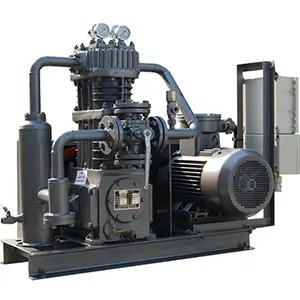
The compressor is the starting point. An oil-free rotary screw compressor eliminates oil from the compression chamber. No oil enters the air path. This does not mean the air is pure enough to use directly — it still contains water vapor and atmospheric particulates — but the most problematic contaminant is gone at the source. The compressor should be sized for the facility’s total air demand, with the pharmaceutical direct contact air typically being a subset of the total demand. Some plants install a dedicated oil-free compressor for the critical air circuits and a separate system for general utility air. This segregation limits the validated system boundary to the equipment that actually requires validation.
The dryer: desiccant for the required dew point
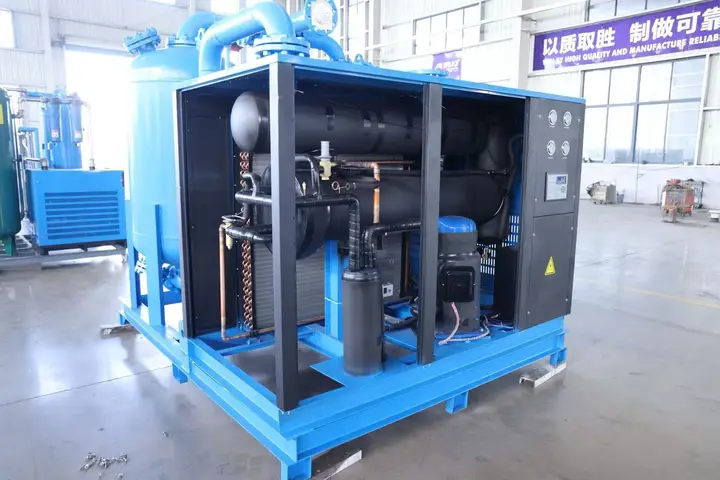
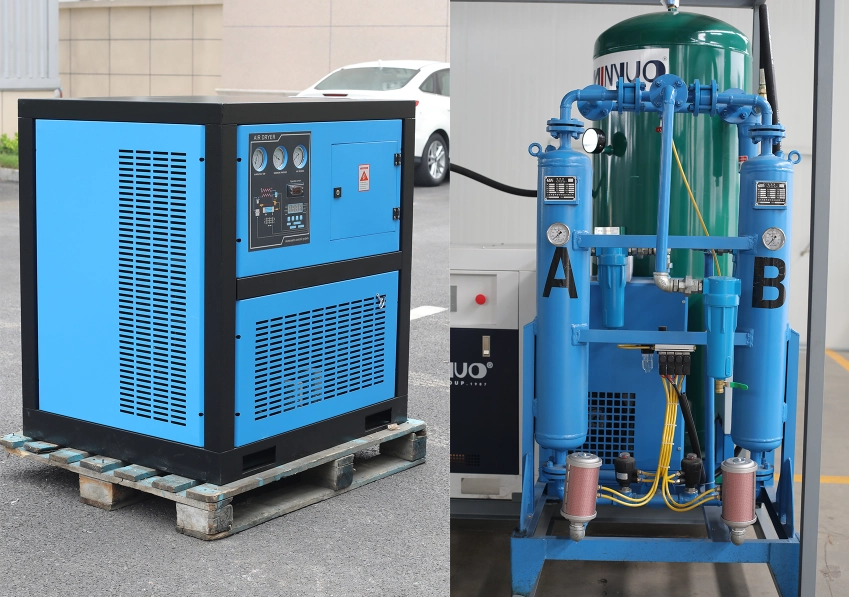
A refrigerated dryer achieves a pressure dew point of 3°C to 10°C. This is adequate for general industrial air but not for pharmaceutical direct contact air. A desiccant dryer — either heatless, heated, or blower-purge — is required to achieve -40°C or -70°C dew points. The desiccant dryer should be duplex, with two towers alternating between drying and regeneration, so that a failure in one tower does not immediately compromise the air quality. The dryer should be equipped with a dew point transmitter that provides a continuous signal to the building management system or the plant’s environmental monitoring system.
Filtration and sterilization at the point of use
A sterile-grade filter at the point of use is the final barrier. The filter housing should be installed as close as practical to the application — ideally at the equipment connection. The filter element should be rated at 0.2 microns or finer, validated for bacterial retention, and integrity-tested after installation and at defined intervals thereafter. A pharmaceutical compressed air system without point-of-use sterile filtration is incomplete, regardless of how clean the air is at the compressor outlet. The piping between the compressor room and the point of use is a potential contamination pathway, and the filter closes that pathway.
Materials of construction: stainless steel for product-contact circuits
The piping for pharmaceutical compressed air circuits that serve direct contact applications is typically stainless steel — 304L or 316L — with sanitary fittings. The piping should be sloped to drain points, and the drain points should be accessible for sampling. Threaded fittings are avoided in favor of orbital welding or hygienic compression fittings that leave no crevices where water or microorganisms can collect. For indirect contact and utility circuits, copper or clean aluminum piping is often acceptable. The material specification flows from the risk assessment.
V. Validation and Ongoing Compliance
Risk assessment: the foundation of the specification
A compressed air system for pharmaceutical manufacturing begins with a documented risk assessment. The assessment identifies every point where compressed air contacts the product or product-contact surfaces. It evaluates the consequence of contamination at each point. It defines the air quality specification required to manage that risk to an acceptable level. The risk assessment is a living document, updated when new products are introduced or when the system is modified. It is the document that connects the equipment selection to the regulatory requirement. Without it, the equipment is just equipment. With it, the equipment is part of the validated state.
Routine monitoring and trending
The critical parameters — dew point, oil content, microbial count, and particle count — are monitored on a defined schedule. The data is trended over time. A rising dew point trend, even if still within specification, prompts a maintenance inspection of the dryer. A microbial count that is consistently at the upper end of the acceptable range triggers an investigation into the sampling procedure or the filter integrity. Trending is the tool that catches problems before they become deviations.
Responding to an out-of-specification result
When a compressed air quality parameter goes out of specification, the response follows the same deviation management process as any other GMP deviation. The event is documented. The affected product is assessed. The root cause is investigated. Corrective and preventive actions are implemented. The system is returned to a validated state, and the effectiveness of the corrective actions is verified through increased monitoring. A compressed air deviation is a serious event because it calls into question the quality of every batch manufactured since the last acceptable monitoring result. The time and cost of a thorough deviation investigation far exceed the cost of the monitoring and maintenance that prevent most deviations from occurring.
VI. Energy and Cost Considerations
Oil-free compression and desiccant drying are energy-intensive
An oil-free compressor typically consumes slightly more energy than an equivalent lubricated machine at full load because the compression process relies on inter-stage cooling and tighter clearances rather than oil injection for heat removal. A desiccant dryer consumes a portion of the compressed air for regeneration — 5 to 15 percent of the total flow, depending on the dryer type. These energy costs are the price of the air quality required. The cost should be understood and budgeted, not discovered on the first electricity bill after commissioning.
Matching the system to the actual demand
A pharmaceutical compressed air system that is sized for hypothetical future demand wastes energy for years until the demand materializes, if it ever does. The system should be sized for the validated demand of the processes it serves, with a reasonable margin for expansion. Variable-speed compressors and cycling desiccant dryers that adjust their energy consumption to the actual demand can significantly reduce operating costs in facilities where the air demand varies between production campaigns.
The cost of compliance vs. the cost of non-compliance
A properly designed, well-maintained pharmaceutical compressed air system costs more to install and operate than a general industrial system of equivalent flow capacity. The incremental cost includes the oil-free compressor, the desiccant dryer, the stainless steel piping, the sterile-grade filters, the monitoring instruments, and the validation documentation. This cost is measurable. The cost of non-compliance — a regulatory finding, a consent decree, a product recall, or a patient harmed by a contaminated product — is harder to quantify but far larger. The pharmaceutical industry does not invest in compressed air quality because it is required to. It invests because the alternative is unacceptable.
Conclusion
Pharmaceutical compressed air quality is defined by the product it touches and the risk it carries. Direct contact air must be oil-free, dry to -40°C or lower, and sterile-filtered at the point of use. Indirect contact air demands similar stringency with some room for risk-based adjustment. Non-contact utility air follows industrial norms. The standards — ISO 8573-1, pharmacopoeial monographs, and GMP guidance — provide the framework. The manufacturer provides the risk assessment that turns the framework into a specific, defensible specification.
At MINNUO, we design oil-free rotary screw compressor packages and desiccant air dryers for pharmaceutical manufacturers who need compressed air that meets the quality standards their products and their regulators demand. We understand that a pharmaceutical compressed air system is not just a piece of utility equipment. It is part of the quality system, subject to the same validation, monitoring, and documentation discipline as the rest of the manufacturing process. We provide the equipment and the engineering support to help our clients achieve and maintain that validated state.

 Email
Email sales:+86 15366749631