Introduction: The Power Heart of the Underwater World
In the vast depths of the ocean, the safety and operational efficiency of divers largely depend on a reliable underwater breathing system. As the core power source of this system, diving compressors bear the crucial mission of providing divers with high-purity, stable-pressure air. Whether in marine scientific research, underwater engineering construction, or emergency rescue operations, the performance of diving compressors directly affects the success and safety of underwater operations. With growing deep-sea exploration and marine economic expansion, technical standards for diving compressors keep rising, representing both equipment performance challenges and life-safety technical commitments.
I. Special Technical Requirements for Diving Compressors
1.1 Extreme Environmental Adaptability
Diving compressors run steadily in high-pressure, low-temperature, highly humid marine environments. They adopt specialized sealing technology to resist seabed pressure and corrosion. The main body uses 316L stainless steel or special alloy materials with multi-layer anti-corrosion surface treatment, maintaining structural integrity and stable performance during long-term marine service.
1.2 Precise Pressure Control
Underwater diving demands ultra-stable air pressure. Multi-stage compression structures and precision regulators equipped with digital PID control limit pressure fluctuation within ±0.1 bar, guaranteeing safe, comfortable breathing at all water depths.
1.3 Multi-Stage Air Purification System
Breathing gas meets top international diving purity standards. Integrated purification modules including activated carbon adsorption, molecular sieve filtration and catalytic treatment eliminate oil, moisture, CO and other contaminants, delivering air purity up to 99.999%.
II. Core Technological Breakthroughs
2.1 Fully Enclosed Waterproof Design
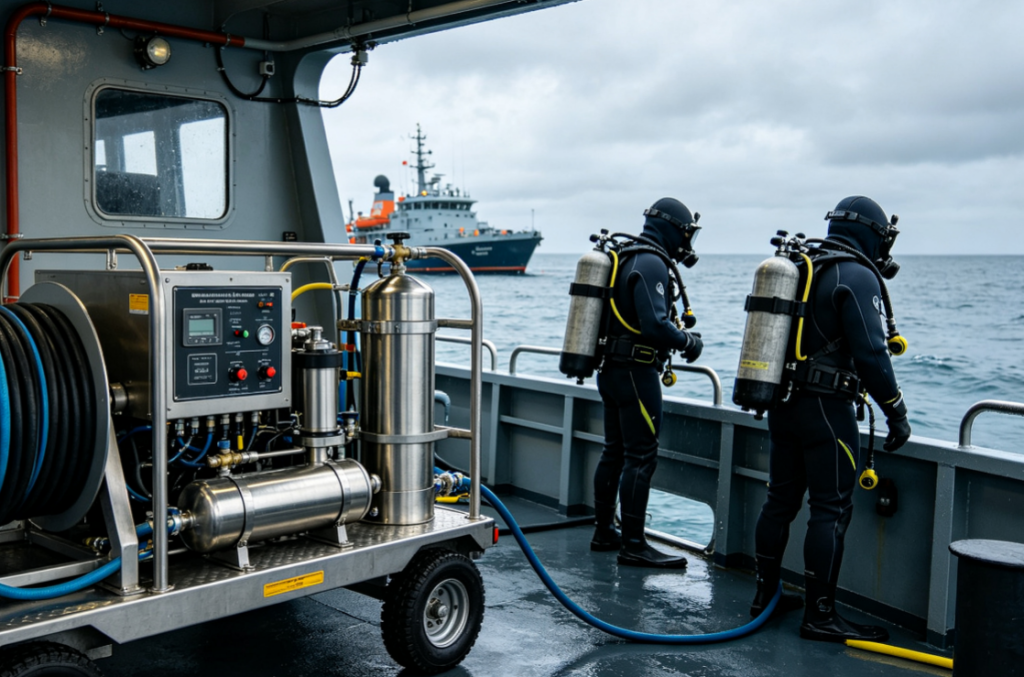
Fully sealed housings enclose all moving parts to block seawater ingress while lowering operational noise and reducing disturbance to marine organisms. Custom heat dissipation systems prevent overheating and performance drop during non-stop operation.
2.2 Real-Time Intelligent Monitoring System
Built-in sensor networks continuously track pressure, temperature and flow data, with embedded algorithms optimizing compression efficiency automatically. The system triggers full protection protocols instantly upon detecting abnormal operating parameters to safeguard divers and equipment.
2.3 Independent Emergency Backup System
Premium diving compressors feature redundant backup units, separate power supplies and emergency exhaust valves. Backup modules activate within seconds if the main system fails to sustain uninterrupted breathable air supply.
III. Application Field Analysis
3.1 Commercial Offshore Diving
Ideal for offshore oil exploitation, subsea pipeline installation and offshore wind farm maintenance. Commercial diving compressors support 12+ hours of continuous operation and simultaneous air supply for multiple divers to handle complex underwater construction tasks.
3.2 Marine Scientific Research
Research-grade diving compressors supply clean breathing air and power underwater testing instruments. Custom low-pressure high-flow configurations match the unique gas quality and flow demands of deep-sea sampling and equipment deployment.
3.3 Underwater Emergency Rescue
Mobile diving compressor units support rapid on-site deployment for shipwreck salvage and dive rescue missions. Simple operation and convenient maintenance enable fast response in urgent maritime incidents.
3.4 Military Diving Operations
Navy and special forces diving compressors add low-noise, low-magnetic and anti-interference capabilities. Heavy-duty variants maintain stable performance in ultra-low temperature and high-salinity seawater environments.
IV. Comprehensive Safety Performance Design
4.1 Multi-Layer Automatic Safety Protection
Complete protection mechanisms cover overpressure, overtemperature, overload and water leakage detection. Alarms pop up on the main control panel for abnormal readings, with quick-release valves for manual pressure relief in critical emergencies.
4.2 Advanced Anti-Corrosion Technology
Combined electrochemical protection, special anti-rust coatings and cathodic protection systems counteract saltwater corrosion. Key pressure-bearing components adopt titanium alloy or high-grade stainless steel for extended service life in salt spray conditions.
4.3 Human-Centered Ergonomic Layout
Simplified, intuitive control panels enable fast emergency operation. All maintenance ports are easily accessible to cut inspection and repair time, with anti-misoperation locks to avoid dangerous pressure-handling accidents.
V. Technological Innovation Trends
5.1 IoT & AI Intelligent Upgrade
Next-gen diving compressors adopt IoT remote monitoring, AI parameter optimization and digital twin predictive fault diagnosis to boost energy efficiency and realize unattended status tracking.
5.2 Lightweight New Material Adoption
Carbon fiber composite materials cut equipment weight for better mobility; self-lubricating wear-resistant alloys extend component lifespan; smart self-repair materials lower routine maintenance frequency.
5.3 Low-Carbon New Energy Solutions
Lithium battery and fuel cell power modules reduce noise, vibration and carbon emissions. Solar auxiliary charging supports energy supplement during surface docking operations for eco-friendly marine work.
5.4 Universal Modular Architecture
Standardized interchangeable modules allow flexible function customization, fast faulty component replacement and low-cost equipment upgrades, slashing long-term operation expenses.
VI. Standardized Operation & Preventive Maintenance
6.1 Certified Professional Operation Training
Operators must complete systematic training covering equipment principles, startup/shutdown procedures, safety inspection, fault troubleshooting and emergency response, passing theoretical and practical assessments before independent operation.
6.2 Scheduled Preventive Maintenance
Mandatory regular checks include seal tightness testing, pressure calibration, safety valve verification and control system debugging. Full maintenance logs are retained for equipment life tracking, with proactive replacement of wearing parts to avoid sudden breakdowns.
6.3 Global Certified Quality Standards
All diving compressors comply with ISO 9001, international diving equipment safety certifications and third-party periodic audits. Full technical documents and after-sales support are provided throughout the equipment service cycle.
VII. Economic & Environmental Sustainability
7.1 Long-Term Cost-Benefit Analysis
Though the upfront procurement cost is relatively high, premium diving compressors reduce maintenance fees, production downtime and energy consumption, bringing substantial long-term economic gains while securing diver life safety.
7.2 Eco-Friendly Low-Impact Design
Low-noise operation minimizes disruption to marine wildlife; high-efficiency compression cuts carbon footprints; recyclable structural materials align with circular marine economy requirements.
7.3 Manufacturer Social Responsibility
Suppliers deliver full after-sales service, on-site technical guidance and operator training, while participating in industry safety standard formulation to drive overall diving equipment technology upgrades.
VIII. Future Industry Outlook
8.1 Cross-Technology Integrated Innovation
Deep integration with underwater ROVs, remote monitoring platforms and new energy systems will reshape diving workflows, with intelligence and full automation becoming mainstream development directions.
8.2 Improved Global Safety Standard System
International organizations, industry associations and maritime authorities will jointly upgrade unified design, manufacturing and operation standards to standardize diving compressor safety specifications worldwide.
8.3 Professional Industry Talent Cultivation
Colleges, vocational training institutes and manufacturers will build joint training programs to cultivate skilled technicians with solid theoretical knowledge and field operation experience to support industry expansion.
Conclusion: The Reliable Partner in Deep Sea Safety
As indispensable core gear for all underwater missions, diving compressors are vital to diver safety. Amid booming marine industries and deep-sea exploration, equipment technical standards will keep rising. Sustained R&D innovation, strict quality control and complete service systems form the foundation of trustworthy diving air supply equipment.
Manufacturers, end users and regulators need joint efforts to advance compressor technology and safety benchmarks. Through innovation, standardized rules and talent training, the industry can build safer, greener, more efficient diving equipment to underpin humanity’s blue ocean exploration.
High-performance diving compressors represent far more than equipment investment — they are a fundamental guarantee for diver life safety and a critical support for all marine undertakings. Industry participants will continue advancing diving compressor technology to facilitate sustainable ocean exploration and marine ecological protection.
FAQ
Q1: What are the main application scenarios of diving compressors?
A1: They serve commercial offshore diving, marine scientific deep-sea research, maritime emergency rescue and military underwater operations, providing stable high-purity breathing air for divers in all marine environments.
Q2: What purity level of air can a professional diving compressor produce? Does it meet international diving standards?
A2: Premium diving compressors deliver air purity up to 99.999% via multi-stage purification, fully compliant with global official diving breathing gas standards to eliminate oil, moisture and toxic gas hazards.
Q3: Can diving compressors work stably in high-salinity, corrosive seawater environments?
A3: Yes. Key components use 316L stainless steel, titanium alloy and multi-layer anti-corrosion coatings with electrochemical protection, resisting salt spray and long-term marine corrosion.
Q4: What safety protection functions do diving compressors come with?
A4: Equipped with overpressure, overtemperature, overload and water leakage auto-protection, independent emergency backup air supply systems and quick pressure relief valves to avoid diving safety accidents caused by equipment failure.
 Email
Email sales:+86 15312799623