1. Introduction
LPG (liquefied petroleum gas) compressors are critical pressure-boosting equipment widely used in LPG filling stations, storage terminals, petrochemical plants, cylinder filling, tank unloading, and gas recovery systems. This guide from MINNUO Compressor explains the working principle, structure, common failures, troubleshooting, and routine maintenance of LPG compressors to ensure safe, stable, and efficient operation.
2. Working Principle of LPG Compressor
Most industrial LPG compressors use reciprocating piston structure with explosion-proof design. The working cycle includes four stages:
① Suction Stroke
The motor drives the crankshaft and connecting rod to move the piston downward. The cylinder volume increases, pressure decreases, the suction valve opens, and LPG gas enters the cylinder.
② Compression Stroke
The piston moves upward, cylinder volume decreases, and gas is compressed. Both suction and discharge valves are closed during compression.
③ Discharge Stroke
When cylinder pressure reaches the set discharge pressure, the discharge valve opens, and high-pressure LPG gas is delivered to pipelines or storage tanks.
④ Expansion Stroke
A small amount of residual gas in the cylinder expands to lower pressure before the next suction, protecting valves and pistons from impact.
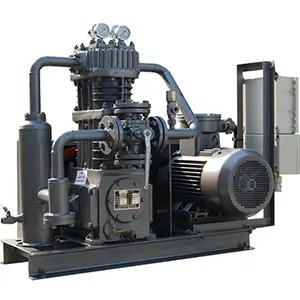
3. Core Components (MINNUO Standard Design)
- Explosion proof motor (Ex d IIC T4)
- Crankshaft, connecting rod, piston, piston rings
- Suction & discharge valve assemblies
- Stuffing box & shaft seal system
- Gas liquid separator, safety valve
- Cooling system (air / water cooling)
- Lubrication system
- Pressure & temperature interlock protection
4. Common Failures & Troubleshooting Methods
1). Insufficient Discharge Capacity / Low Pressure
- Causes: Clogged filter; faulty valves; worn piston rings; pipeline leakage; low motor speed
- Solutions: Clean or replace filter; repair valves; replace piston rings; fix leaks; check drive system
2). High Discharge Temperature
- Causes: Dirty cooler; insufficient cooling; poor lubrication; oversized compression ratio
- Solutions: Clean cooler fins; check cooling system; change oil; adjust working conditions
3). Abnormal Noise & Vibration
- Causes: Loose bearings; loose connecting rod bolts; liquid hammer; loose foundation
- Solutions: Stop to inspect; tighten fasteners; check piston clearance; reinforce base
4). Liquid Hammer (High Risk)
- Causes: Liquid LPG entering cylinder; failed gas liquid separator
- Solutions: Shut down immediately; check separator; ensure dry gas suction; add anti liquid hammer protection
5). Gas Leakage
- Causes: Worn packing; damaged piston rod; aged gaskets; loose flanges
- Solutions: Replace packing; repair piston rod; replace gaskets; torque fasteners
6). Low Oil Pressure / Poor Lubrication
- Causes: Low oil level; oil pump failure; clogged oil passage; deteriorated oil
- Solutions: Refill oil; repair pump; clean oil lines; replace oil and filter
7). Motor Overload / Tripping
- Causes: Unstable voltage; mechanical seizure; overheating; faulty valves
- Solutions: Check power supply; inspect rotation; improve cooling; repair valves
8). Unstable Pressure Fluctuation
- Causes: Bad valve performance; pipeline condensate; faulty sensor
- Solutions: Replace valves; drain condensate; calibrate sensor
9). Poor Cooling / Overheating
- Causes: Clogged cooler; fan/water pump failure
- Solutions: Clean cooler; repair cooling components
10). Gas Detector Alarm
- Causes: Seal failure; pipeline cracks; valve leakage
- Solutions: Stop & ventilate; detect leaks; replace seals; repair pipelines
5. Routine Maintenance (MINNUO Suggestion)
- Before startup: Check oil level, cooling, leakage, and safety valves
- During operation: Monitor pressure, temperature, current, noise, and leakage
- Weekly: Clean filters, drain separators, check for leaks
- Monthly: Inspect valves, seals, and lubrication system
- Quarterly/Yearly: Overhaul, change oil, calibrate safety interlocks
6. Why Choose MINNUO LPG Compressors
- Full explosion proof design: Ex d IIC T4 for hazardous gas areas
- Special valve & sealing system: low leakage, long service life
- High-efficiency cooling & forced lubrication for continuous operation
- Multiple safety interlocks: pressure, temperature, oil pressure, anti liquid hammer
- Suitable for tank unloading, cylinder filling, gas recovery, and boosting systems
- Genuine spare parts + fast technical support
Conclusion
Understanding the working principle helps operators master equipment logic; correct troubleshooting reduces downtime; standard maintenance greatly extends service life.
For LPG compressor selection, installation, maintenance, or customized solutions, contact MINNUO Compressor — we provide safe, reliable, and high-efficiency LPG compression systems for global customers.
FAQ
Q1: What’s the main structure of industrial LPG compressors?
A1: Most adopt explosion-proof reciprocating piston design, consisting of explosion-proof motor, crankshaft connecting rod assembly, suction/discharge valves, sealing system, cooling, lubrication and safety interlock parts.
Q2: Why does LPG compressor suffer liquid hammer?
A2: Mainly liquid LPG enters cylinders due to ineffective gas-liquid separator; shut down the machine instantly and repair separator to avoid severe component damage.
Q3: How to fix insufficient outlet pressure & low gas output?
A3: Clear blocked filter, replace worn piston rings, repair failed valves and eliminate pipeline leakage accordingly.
Q4: How often should regular maintenance be done on LPG compressors?
A4: Daily pre-start inspection, weekly filter cleaning, monthly seal & valve check, quarterly or annual full machine overhaul per MINNUO maintenance standard.

 Email
Email sales:+86 15366749631