Ask a maintenance manager what destroys a rotary screw compressor, and most will answer without hesitation: wear. Bearings fatigue, rotors lose clearance, and eventually the airend seizes or loses efficiency. That narrative is so deeply embedded in the industry that few question it. But when a pattern of premature failures started showing up across a range of installations — some with fewer than 15,000 hours — the usual explanation no longer fit.
Over a two-year period, we collected 50 rotary screw airends that had been removed from service due to catastrophic failure. Each unit was disassembled, documented, and categorized by root cause. The findings upended several assumptions about what actually kills a screw compressor. The leading cause of failure was not the gradual wear everyone talks about. It was condensate-induced corrosion attacking internal surfaces while the compressor sat idle between cycles or during extended shutdown. This article walks through what those 50 autopsies revealed, why moisture kills faster than friction in many duty profiles, and what you can do to keep your own compressor out of the failure statistics.
I. What We Found Inside 50 Failed Rotary Screw Airends
The inspection methodology
Each airend went through a standardized teardown process. The inlet and discharge ports were photographed before disassembly. End covers were removed first to inspect bearing condition and lubricant residue. Rotors were extracted and examined for contact marks, corrosion patterns, and coating integrity. Bearing races and rolling elements were inspected under magnification. Lubricant samples, when available, were analyzed for water content, total acid number, and wear metals. Every failure was assigned a primary root cause and documented with photographs.
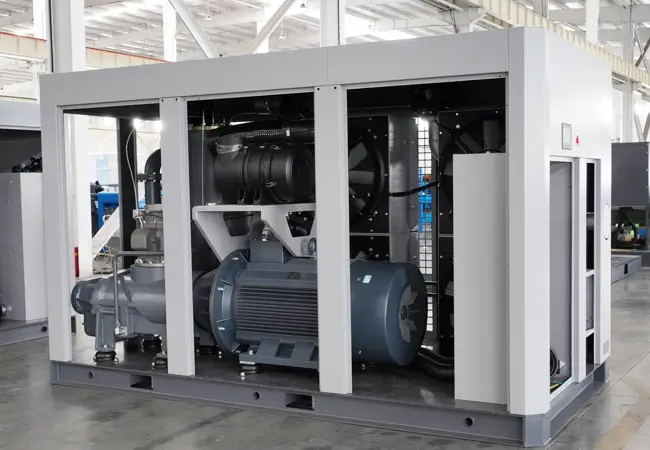
Failure categories we expected vs. what we actually discovered
Before the analysis began, we expected the dominant failure mode to be bearing-related: fatigue spalling, loss of radial clearance, or lubricant starvation leading to rotor contact. Those failures were present, but they accounted for a smaller share than anticipated. What stood out instead was the number of airends showing clear evidence of corrosion — rust-colored staining on bearing raceways, pitting on rotor lobe surfaces, and water-emulsified oil residues. Many of these units had logged relatively low hours. Something other than runtime was driving the damage.
The statistic that reshaped our understanding
Out of 50 failed airends, 31 showed corrosion as the primary root cause of failure. That is 62%. Wear-related failures — including bearing fatigue, inadequate lubrication, and gradual clearance loss — accounted for 14 units. The remaining five failures traced back to contamination from ingested debris or mechanical overload. The numbers made the conclusion unavoidable. When a rotary screw compressor fails early, the odds are better than even that moisture, not mechanical wear, set the destruction in motion. The next section explains why.
II. The Expected Suspects: Why Mechanical Wear Wasn’t the Primary Killer
Normal bearing wear patterns and their expected lifespan
Rolling element bearings in rotary screw airends are designed for a calculated L10 life that often exceeds 30,000 to 50,000 hours under rated load and proper lubrication. In clean, dry, well-maintained conditions, bearings gradually develop subsurface fatigue that eventually leads to spalling. This is a slow, predictable process that gives warning through rising vibration and increasing noise levels. It rarely produces a sudden, catastrophic seizure without detectable precursors.
Contact fatigue and why it rarely causes sudden catastrophic failure
Even when bearing spalling begins, the progression from initial pitting to complete loss of rolling contact function usually takes hundreds or thousands of hours. Regular oil analysis and vibration monitoring can catch these signs early enough for a planned airend rebuild. In the units we inspected where wear was identified as the primary root cause, the failure tended to be end-of-life degradation rather than a sudden event. The hours logged were high, and the wear patterns were consistent with long-term service.
When wear is secondary, not the root cause
A critical distinction emerged during the autopsies. In many of the 31 corrosion-dominant cases, bearing wear was present — but it was a consequence, not a cause. Corrosion pits on bearing raceways created stress risers. Once the compressor restarted, these pits propagated into spalls, which generated debris that circulated through the lubricant. The debris then scored rotor surfaces and accelerated wear throughout the airend. The initial trigger was moisture sitting on the steel during idle periods. The wear was collateral damage, not the origin of the problem.
III. The Real Killer: Condensate-Induced Corrosion During Shutdown Cycles
How moisture enters and remains inside an idle airend
Every compression cycle generates heat. When a rotary screw compressor runs, the airend reaches temperatures high enough to keep water in vapor form. At shutdown, the metal cools rapidly. The moisture-laden air inside the airend and oil separator condenses as the temperature drops below the dew point. This condensation forms water droplets that settle on bearing surfaces, rotor lobes, and housing walls. Because the airend is a sealed cavity with limited ventilation, the water stays trapped. It does not evaporate. It sits in direct contact with precision-ground steel surfaces until the next startup — which could be hours, days, or weeks away.
The electrochemical process that attacks bearing races and rotor surfaces
Standing water on bearing steel initiates an electrochemical corrosion process. The water acts as an electrolyte, and even trace amounts of dissolved contaminants lower its pH enough to accelerate pitting. Bearing raceways are especially vulnerable because their superfinished surfaces present large, uninterrupted areas for water films to form. Once corrosion pits appear, the microscopic craters act as initiation points for fatigue cracking under rolling contact stress. Rotor lobe surfaces suffer similarly. Pitting on the rotor profile disrupts the sealing gap between rotors and between rotor tips and the housing bore, reducing volumetric efficiency even before mechanical failure occurs.
Why intermittent-duty and backup compressors suffer most
Compressors that run continuously or near-continuously tend to keep internal temperatures above the dew point. Moisture never gets a chance to condense in significant quantities. The machines most vulnerable to condensate corrosion are those that cycle frequently or sit as backups. A compressor in a shop that runs one shift per day goes through 365 thermal cycles of heating and cooling per year. Each cycle creates a fresh opportunity for condensation. A backup compressor that runs only during maintenance windows or peak demand periods may sit idle for weeks, accumulating moisture that corrodes internal surfaces undisturbed. The failures we documented disproportionately came from these intermittent-duty profiles — exactly the machines owners thought were under less stress.
The corrosion-wear feedback loop after restart
When a compressor with corrosion-damaged bearings restarts, several things happen simultaneously. The lubricant film must re-establish across pitted surfaces that no longer provide smooth rolling contact. Corrosion debris — which is harder than the surrounding bearing steel — circulates with the oil, embedding in softer cage materials and acting as a grinding compound. Bearing vibration increases, which transmits to the rotor shaft and begins altering the running clearances between rotors. Over successive start-stop cycles, this feedback loop accelerates until the airend experiences a sudden seizure or rotor contact. What appeared to be an abrupt failure was actually set in motion weeks or months earlier, the first time water condensed on a bearing race and sat there long enough to etch the steel.
IV. Other Significant Failure Contributors We Identified
Lubricant degradation from heat and condensation
Moisture in the lubricant triggers chemical changes that go beyond simple dilution. Water reacts with compressor oil additives, depleting anti-wear and anti-oxidation packages. In some of the units we opened, the oil had turned acidic enough to chemically etch bearing cages made of brass or phenolic material. Oil analysis reports from these units often showed elevated total acid numbers and water content above 500 ppm — levels that are corrosive to steel over weeks of exposure. Even synthetic compressor oils, which resist oxidation better than mineral oils, cannot protect against the physical displacement of lubricant film by liquid water on a bearing surface at rest.
Inlet filtration failures and ingested particulates
Airborne dust, metal particles, and process debris enter the airend when inlet filters are damaged, improperly seated, or neglected. Once inside the compression chamber, particulates embed in the soft rotor coating or directly score the steel. In five of the 50 units, ingested debris was the primary failure cause. The damage was visually distinct from corrosion — linear scratches along rotor lobes matching the direction of rotation, and abrasive wear patterns on bearing rolling elements consistent with hard particle contamination. Unlike corrosion, which develops during idle periods, particulate damage accumulates during running hours, making it easier to diagnose from the wear pattern alone.
Misalignment from improper installation or foundation settling
Rotary screw compressor packages that are not properly leveled or that sit on foundations that settle over time develop misalignment between the drive motor and the airend input shaft. Coupling flex elements and belts can compensate for minor angular offset, but beyond their design limits, misalignment transmits cyclic bending loads to the airend input bearing. The resulting fretting corrosion and uneven race loading appeared in three of the 50 failures we examined. The telltale sign was one-sided bearing wear at the drive end, with the non-drive end bearing showing comparatively little damage.
Overspeeding and its effect on bearing life
Variable-speed compressors that operate above their rated maximum RPM for extended periods multiply bearing loads beyond design limits. Rolling element centrifugal forces increase with the square of speed. In one failure attributed to overspeeding, the bearing cage had collapsed catastrophically, and the freed rolling elements had circulated through the rotor chamber, destroying both rotor profiles and the housing bore. The root cause was traced to a VFD parameter setting that allowed the motor to exceed the airend manufacturer’s published speed limit during rapid demand changes.
V. How to Protect a Rotary Screw Compressor During Extended Shutdown
Proper shutdown and isolation procedures
The single most effective measure against condensate corrosion is to isolate the airend from moisture sources immediately at shutdown. Close the discharge isolation valve to prevent wet air from the tank and piping from migrating back into the airend as it cools. If the compressor will be idle for more than a few days, consider removing the oil fill cap briefly after the unit has cooled to equalize pressure and reduce the vacuum effect that draws in humid ambient air. Some operators install desiccant breathers on the oil reservoir vent to capture moisture before it enters the system.
Oil conditioning and protective film preservation
Run the compressor at normal operating temperature for at least 15 to 20 minutes before a planned shutdown. This drives off dissolved water in the oil and ensures that all internal surfaces receive a fresh, protective lubricant film. For extended storage periods measured in months, some maintenance programs specify changing the oil before shutdown so that no acidic, moisture-laden lubricant remains in the airend. The small cost of an oil change before storage is negligible compared to the cost of an airend replacement triggered by corrosion during the idle period.
Periodic rotation and inspection routines
If a backup or seasonal compressor cannot be run under load regularly, at minimum rotate the airend by hand once every two to four weeks. This redistributes oil across bearing surfaces and breaks up any water film that may have begun to form. Document these rotations in the maintenance log. During the same interval, check the condition of the desiccant breather if installed, and inspect the airend exterior for signs of condensation. A compressor that sits unattended for months without any rotation is the highest-risk candidate for the failure pattern documented in this article.
Environmental controls: humidity, temperature, and ventilation
Compressor rooms in humid climates or coastal locations present an elevated corrosion risk. Keeping the ambient relative humidity below 60% significantly reduces the rate of condensation inside the airend during cooling. A small dehumidifier in the compressor room costs a fraction of an airend rebuild. Temperature swings are equally important. Rooms that heat up during the day and cool sharply at night create internal condensation even in compressors that have not run. Stabilizing the compressor room environment is one of the simplest, most overlooked protections against corrosion-related rotary screw compressor failure causes.
FAQ
What is the most common rotary screw compressor failure cause?
Based on the 50-unit teardown analysis, the most common root cause is condensate-induced corrosion attacking bearing races and rotor surfaces during shutdown periods. This accounted for 62% of the failures, surpassing mechanical wear, lubricant degradation, and particulate contamination. The pattern is especially prevalent in compressors that operate intermittently or serve as backup units.
How does moisture get into a rotary screw airend during shutdown?
Warm, moisture-laden air inside the compressor condenses as the metal cools below the dew point after shutdown. The resulting water settles on bearing surfaces and rotor lobes. Because the airend is a sealed cavity, the water remains trapped until the next startup. Each thermal cycle — from operating temperature to ambient and back — creates a fresh opportunity for condensation to form.
Can synthetic compressor oil prevent corrosion during storage?
Synthetic oils resist oxidation and acid formation better than mineral oils, but no oil can prevent corrosion if liquid water displaces the protective film on a bearing surface at rest. The best approach is to run the compressor at operating temperature before shutdown to evaporate dissolved water from the oil, then isolate the airend from moist system air. For long-term storage, fresh oil with a full corrosion-inhibitor package gives the best protection.
How long can a rotary screw compressor sit idle before corrosion becomes a risk?
There is no single safe threshold, because risk depends on ambient humidity, temperature swings, and the condition of the oil at shutdown. In humid environments, corrosion pits can begin forming on unprotected bearing steel within days. A practical rule is to rotate the airend by hand every two to four weeks and to keep the compressor room relative humidity below 60%. Units left unattended for months without any rotation are at high risk.
Are variable-speed compressors more or less vulnerable to shutdown corrosion?
The vulnerability depends more on the duty cycle than on the drive type. A VSD compressor that runs near-continuously stays above the dew point and faces low corrosion risk. A VSD unit that starts and stops frequently experiences the same thermal cycling as a fixed-speed machine in intermittent service. The key variable is how often the airend cools to a temperature that allows internal condensation, not whether the motor speed is variable.
What are the early warning signs of airend corrosion damage?
High vibration readings at startup that diminish as the compressor warms up can indicate pitted bearing raceways. Rising iron or chromium levels in oil analysis without a corresponding increase in other wear metals may point to corrosion rather than mechanical wear. Unusual noise during the first minutes of operation after a shutdown period is another signal worth investigating before a small corrosion site progresses to catastrophic failure.
Conclusion
Fifty failed rotary screw airends told a consistent story. The top killer is not the wear that accumulates over tens of thousands of running hours — it is the corrosion that develops silently during the hours, days, and weeks when the compressor sits still. Moisture enters during cooling, pools on bearing steel, and etches the superfinished surfaces that rolling element bearings and screw rotors depend on. When the compressor restarts, what began as a small pit accelerates into spalling, debris circulation, and eventual catastrophic seizure. This failure mechanism is preventable with the right shutdown procedures, oil conditioning, periodic rotation, and a dry compressor room environment — protections that treat the idle period as a distinct operating condition with its own risks.
At MINNUO, we have spent years working with compressed air systems across industries, and the lessons from these 50 airend teardowns have shaped how we advise our clients on equipment protection. An airend protected from condensate corrosion is an airend that will reach the full service life its bearings and rotors were designed to deliver.


 Email
Email sales:+86 15366749631