As core equipment for industrial refrigeration and environmental temperature control, chillers are indispensable “temperature regulators” in modern manufacturing, commercial buildings, new energy, and scientific research fields. From the constant temperature control of precision manufacturing workshops and heat dissipation guarantee of data centers, to the central air conditioning of hotels and office buildings and low-temperature storage of food and medicine, the refrigeration efficiency, operational stability, energy consumption level, and adaptability of chillers directly affect production efficiency, product quality, operating costs, compliance, and safety.
Driven by the “dual carbon” goal, the high-end transformation of industry, and the explosive growth of the new energy industry, the chiller industry is rapidly iterating towards high efficiency and energy saving, green environmental protection, intelligent control, and customized specialization. As the two mainstream categories, air-cooled chillers and water-cooled chillers have formed clear market divisions due to differences in heat dissipation principles, structural design, and performance characteristics. This article will deeply analyze the technical characteristics and development trends of the two types of chillers from four dimensions: core differences, scenario applications, industrial pattern, and upgrade direction, and combine the in-depth practice of Jiangsu Minnuo Group in the chiller field to show the technical advantages and advancement path of local enterprises.
I. Core Technical Differences: Heat Dissipation Principle Determines Performance and Structure
The fundamental difference between air-cooled and water-cooled chillers lies in the heat dissipation medium and method. This difference directly determines the energy efficiency level, structural complexity, installation conditions, and operation and maintenance costs of the equipment, forming a technical pattern of “the same origin but different paths”.
(I) Air-Cooled Chillers: Air Heat Dissipation with Integrated and Convenient Design
Air-cooled chillers use air as the heat dissipation medium. They force air to flow through finned condensers through built-in fans to directly discharge the heat of the refrigerant into the atmosphere. The core is an integrated structure of “compressor + fan + finned condenser”.
Structural Characteristics: The whole machine has a high degree of integration, without the need for cooling towers, cooling water pumps, and supporting water pipelines. Its appearance is similar to a large air conditioner outdoor unit, which can be directly installed on the outdoor roof, ground, or ventilation machine room, occupying a small area. Installation only requires connecting cold water pipelines and power supply, realizing plug-and-play.
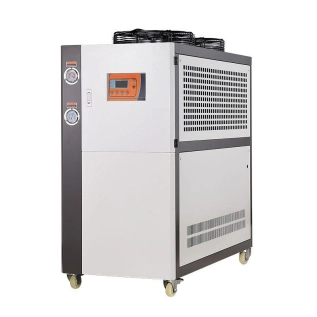
Energy Efficiency Characteristics: The COP (Coefficient of Performance) is usually 3.0-4.0. The heat dissipation efficiency is significantly affected by the ambient temperature. In high temperatures in summer (>35℃), the condensing pressure increases, energy consumption increases by 15%-20%, and the cooling capacity slightly decreases.
Energy Consumption Composition: The main power-consuming components are the compressor + fan motor, with no additional energy consumption of the water system. Under low-load conditions, the no-load loss can be further reduced through frequency conversion adjustment.
Operation and Maintenance Characteristics: The structure is simple, no water treatment is required. Daily maintenance only needs to clean the fan fins and check electrical components, with low maintenance costs. No professional operation and maintenance team is needed, making it suitable for unattended scenarios.
Core Advantages: Convenient installation, no water dependence, small space occupation, and simple operation and maintenance. It has extremely strong adaptability to water-scarce, poor water quality, or space-constrained scenarios.
(II) Water-Cooled Chillers: Water as Medium, High Efficiency and Stability but Complex System
Water-cooled chillers use water as the intermediate heat dissipation medium. The heat of the refrigerant is transferred to the cooling water through shell-and-tube condensers. The hot water is transported to the cooling tower by the cooling water pump, and then circulates back after heat dissipation through spray evaporation. The core is a combined structure of “host + cooling tower + water pump + water treatment system”.
Structural Characteristics: The host needs to be installed in an indoor machine room, and the cooling tower is placed outdoors, with supporting circulating water pipelines, water pumps, softened water, and filtering devices. The system is large, occupying 2-3 times the area of air-cooled machines. Installation requires a professional team to design the pipeline layout.
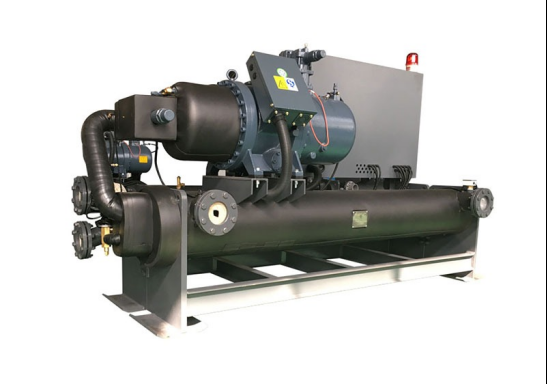
Energy Efficiency Characteristics: The COP (Coefficient of Performance) can reach 5.0-6.5. The specific heat capacity of water is about 4 times that of air, with high evaporative heat dissipation efficiency and stable condensing temperature. It is less affected by ambient temperature, can maintain efficient operation under high-temperature conditions, and the long-term energy consumption is more than 30% lower than that of air-cooled machines.
Energy Consumption Composition: The power-consuming components include the compressor + cooling water pump + cooling tower fan. Although there is additional energy consumption of the water pump and fan, its high COP value makes the comprehensive energy consumption lower in large-load scenarios.
Operation and Maintenance Characteristics: The system is complex, requiring regular water treatment (anti-scaling, anti-corrosion), cleaning of cooling towers and condensers, and inspection of water pump conditions. The maintenance cost is high, requiring professional team on duty for management.
Core Advantages: Extremely high energy efficiency, stable operation, strong adaptability to high temperatures, and wide coverage of cooling capacity. It is suitable for large-scale, high-load, and year-round continuous operation industrial and commercial scenarios.
(III) Comparison Table of Key Indicators
| Comparison Dimension | Air-Cooled Chillers | Water-Cooled Chillers |
| Heat Dissipation Medium | Air | Water (requiring cooling tower circulation) |
| Coefficient of Performance (COP) | 3.0-4.0 | 5.0-6.5 |
| Installation Conditions | Outdoor/ventilated place, no machine room required, simple installation | Indoor machine room +outdoor cooling tower required, complex installation |
| Floor Area | Small (integrated design) | Large (host + cooling tower + pipelines) |
| Initial Investment | Low (no water system required) | High (cooling tower + water pump + water treatment) |
| Operating Energy Consumption | High (significant high-temperature attenuation) | Low (long-term energy saving of 30%+) |
| Maintenance Cost | Low (only cleaning fins and checking electrical components) | High (water treatment, component cleaning) |
| Environmental Adaptability | Mild/cool areas, water-scarce scenarios | Hot and humid areas, water-rich scenarios |
| Noise Level | High (fan noise >85dB) | Low (machine room isolation, <75dB) |
II. Scenario-Based Applications: On-Demand Selection to Adapt to Diverse Needs
Based on the differences in technical characteristics, air-cooled and water-cooled chillers have formed clear scenario divisions. The core of selection depends on four factors: refrigeration scale, environmental conditions, budget planning, and operation and maintenance capabilities.
(I) Air-Cooled Chillers: First Choice for Small-to-Medium-Scale, Flexible and Convenient Scenarios
Small-to-Medium-Scale Commercial Scenarios: Supermarkets, restaurants, small office buildings, convenience stores, etc., with a refrigeration load of 50-500kW. Limited space and moderate budget, no complex machine room is needed. Air-cooled machines installed on the roof can meet the central air conditioning needs.
Industrial Small-to-Medium Load Scenarios: Injection molding, mold cooling, precision machine tools, food processing, laboratories, etc. A single device has a cooling capacity of 10-100kW, requiring flexible arrangement and rapid installation. In factories with water scarcity or poor water quality, air-cooled machines can avoid scaling and corrosion problems.
Mobile/Temporary Cooling Scenarios: Temporary construction site cooling, exhibition temperature control, mobile laboratories, etc. Air-cooled machines have built-in casters and an integrated design, which can be quickly moved without external water sources.
Special Environmental Scenarios: Water-scarce areas such as plateaus, water-scarce regions, and islands. Air-cooled machines completely get rid of water dependence and ensure the stable operation of the refrigeration system.
(II) Water-Cooled Chillers: Core for Large-Scale, High-Load, Continuous Operation Scenarios
Large-Scale Commercial Complexes: Hotels, shopping malls, exhibition centers, hospitals, etc., with a refrigeration load of more than 1000kW and year-round continuous operation. The high energy efficiency ratio of water-cooled machines can greatly reduce long-term operating costs, and centralized machine room management facilitates maintenance.
High-Heat Industrial Scenarios: Data centers, chemical plants, metallurgical plants, lithium battery production workshops, etc. The equipment has high heat density and requires 24-hour uninterrupted refrigeration. Water-cooled machines have stable heat dissipation and sufficient cooling capacity, which can ensure the safe operation of equipment and avoid high-temperature shutdown risks.
High-Temperature and Hot Area Scenarios: High-temperature areas (>38℃) in South China and East China in summer. Water-cooled machines are less affected by ambient temperature and have stable refrigeration efficiency, which can avoid insufficient refrigeration caused by high-temperature attenuation of air-cooled machines.
High-Precision Temperature Control Scenarios: Semiconductor manufacturing, photovoltaic industry, precision instrument manufacturing, etc., requiring stable low temperature (±0.5℃). Water-cooled machines have small condensing temperature fluctuations and higher temperature control precision, ensuring product yield.
III. Industrial Development Pattern: Dual-Driven by Energy Efficiency Upgrade and Domestic Replacement
The global chiller market is growing steadily. With a complete industrial chain, huge downstream demand, and technological breakthroughs, China has become the world’s largest producer, consumer, and exporter of chillers. The industry presents a pattern of continuously increasing energy efficiency thresholds, accelerated high-end replacement, and technological upgrading towards energy saving and intelligence.
(I) Policy-Driven Energy Efficiency Upgrade, High-Efficiency Models Become Mainstream
National mandatory energy efficiency standards continue to tighten, eliminating high-energy-consuming old models. First-class energy efficiency, permanent magnet frequency conversion, two-stage compression, and high-efficiency heat exchange technologies are rapidly popularized. For industrial enterprises, replacing with high-efficiency frequency conversion chillers can reduce comprehensive energy consumption by 25%-40%, and the investment payback period is generally 12-24 months, with significant economic benefits. Air-cooled machines are upgrading towards frequency conversion, low noise, and high-efficiency fins, while water-cooled machines focus on high COP, intelligent operation and maintenance, water saving and energy saving. Permanent magnet frequency conversion screw and scroll chillers are gradually replacing traditional fixed-speed models.
(II) Accelerated Domestic Replacement in the High-End Market, Minnuo Group Sets a Benchmark with Years of In-Depth Cultivation
In the past, the high-end chiller market (high pressure, explosion-proof, high precision, oil-free and clean) was long monopolized by international brands. Represented by Jiangsu Minnuo Group, local enterprises have been deeply engaged in the refrigeration field for more than 30 years. Relying on the accumulation of compressor technology and R&D investment, they have formed four core advantages in the chiller field, promoting the high-endization of domestic replacement.
Homologous Technology and Independent Core R&D: With more than 30 years of experience in the compressor field, Minnuo Group has mastered the core technologies of scroll, screw, and piston compressors. The core components of chillers (compressor, heat exchanger, control system) are independently developed and produced, with high matching degree and strong compatibility, avoiding adaptation defects of purchased components. The refrigeration efficiency and stability are comparable to those of international first-line brands.
Full Product Category Coverage and Scenario Customization: It has built a complete product matrix of two series: air-cooled and water-cooled, with a cooling capacity range of 10-5000kW, covering all models of scroll, screw, and piston, adapting to multiple scenarios such as industry, commerce, new energy, and scientific research. For emerging fields such as new energy lithium batteries, semiconductors, and hydrogen energy, it has developed special explosion-proof, anti-corrosion, high-precision, oil-free and clean chillers to meet the needs of extreme working conditions.
High Efficiency and Energy Saving, Leading Performance: The whole series is equipped with a permanent magnet frequency conversion control system as standard. Combined with the independently optimized heat exchange structure and control algorithm, the COP of air-cooled machines reaches 3.8-4.5, and the COP of water-cooled machines reaches 5.5-6.8, which is 10%-15% higher than the industry average, with outstanding energy-saving benefits. High-quality copper tubes and high-efficiency finned condensers are adopted, which increase the heat exchange efficiency by more than 20%, with fast refrigeration speed and sufficient cooling capacity.
Reliable Quality and Global Service: It has established a full-process quality control system, implementing strict standards from raw material procurement, automated production to factory inspection. The products have passed ISO9001, CE and other certifications. Equipped with Siemens PLC intelligent control system, it supports remote monitoring, fault early warning and predictive maintenance. The whole machine has multiple protections such as overload, high and low pressure, and anti-freezing, and can operate stably under harsh working conditions. With the advantages of cost performance and global service network, the products are exported to more than 100 countries and regions around the world, winning wide recognition from domestic and foreign customers.
IV. Industrial Upgrade Direction: Minnuo Group’s Advancement Path and Industry Trends
Looking forward to the future, the chiller industry will upgrade along five core directions: energy saving, cleanliness, intelligence, specialization, and globalization. Local enterprises need to break through core technologies, make up for shortcomings, strengthen differentiated competitiveness, and move from “domestic replacement” to “global leadership”. As an industry benchmark, Jiangsu Minnuo Group needs to continue to make efforts in four dimensions while deeply engaging in the chiller field to promote high-quality development of the industry.
(I) In-Depth Technology: Breaking Core Bottlenecks, Leading High Efficiency, Energy Saving and Special Customization
Iteration of High-Efficiency and Energy-Saving Technologies: Increase R&D investment in cutting-edge technologies such as ultra-high-efficiency heat exchange, new refrigerants, and magnetic levitation bearing compressors to further improve COP value and reduce energy consumption; optimize frequency conversion control algorithms to realize intelligent adjustment under full working conditions, increasing energy-saving efficiency from 30% to more than 40% to meet the extreme energy-saving needs under the “dual carbon” goal.
Breakthrough in Special Scenario Technologies: Focus on high-end fields such as new energy (hydrogen energy, lithium batteries, photovoltaics), semiconductors, medical care, and aerospace, develop special high-pressure explosion-proof, ultra-low temperature, oil-free and clean, corrosion-resistant chillers, overcome technical difficulties such as low leakage, high-precision temperature control, and extreme environment adaptation, break the monopoly of international brands, and fill the gap in the domestic high-end market.
Independent Controllability of Core Components: Continue to increase R&D investment in core components such as compressors, heat exchangers, and intelligent control systems, optimize material processes and structural design, improve the service life and reliability of core components, reduce dependence on imported components, realize independent controllability of the entire industrial chain, and consolidate the dual advantages of cost and technology.
(II) Product Upgrade: Enriching the Matrix to Adapt to Segmented Scenarios and Green Needs
High-End Upgrade of Air-Cooled Machines: For small-to-medium-scale high-end scenarios, develop low-noise, small-sized, integrated air-cooled chillers. Adopt silent fans and shock absorption technologies to control noise below 60dB; optimize structural design to reduce floor area by 30%, adapting to precision laboratories, high-end medical care and other scenarios with strict requirements on space and noise.
Water-Saving Innovation of Water-Cooled Machines: In response to water scarcity and environmental protection requirements, develop closed cooling towers, efficient utilization of circulating water, and intelligent water treatment technologies to reduce water consumption by more than 50%; optimize pipeline design to reduce scaling and corrosion, extend equipment service life, reduce operation and maintenance costs, and adapt to large-scale industrial scenarios in water-scarce areas.
Green Environmental Protection Adaptation: Fully promote environmentally friendly refrigerants such as R410A, R134a, and CO2 to replace high-pollution refrigerants; optimize the sealing design of the unit to reduce refrigerant leakage rate, meet global environmental protection regulations, and help the industry’s green and low-carbon transformation.
(III) Intelligent Integration: Digital Empowerment to Build an Intelligent Operation and Maintenance Ecosystem
Upgrade of Intelligent Control System: Deepen the integration of Internet of Things, big data, and artificial intelligence technologies, develop a new generation of intelligent control systems, and realize full-process intelligence of remote monitoring, fault early warning, automatic diagnosis, parameter optimization, and maintenance reminders; support access to factory DCS and SCADA systems to achieve data intercommunication and collaborative control, creating an unattended intelligent refrigeration system.
Construction of Digital Service System: Establish a customer-specific digital service platform to provide one-stop services such as real-time viewing of equipment operation data, remote troubleshooting of faults, intelligent generation of maintenance plans, and online purchase of spare parts; provide customized energy-saving optimization plans through big data analysis of customer working conditions, improving customer stickiness and service added value.
(IV) Market Expansion: Deeply Cultivating the Domestic Market, Layout the Global Market, and Build an International Brand
Sinking and Deepening the Domestic Market: Seize the opportunities of high-end manufacturing and explosive growth of new energy, deeply cultivate industrial intensive areas such as the Yangtze River Delta, Pearl River Delta, and Beijing-Tianjin-Hebei, launch cost-effective standardized products for small and medium-sized enterprises, and provide customized solutions for large enterprises to increase domestic market share.
Accelerating Global Layout: Relying on the existing overseas market foundation, increase investment in the international market, establish localized service centers and warehousing bases in Southeast Asia, the Middle East, Europe, the Americas and other regions to shorten the delivery cycle and improve the service response speed; participate in the formulation of international industry standards, promote Chinese chiller technologies and standards to the world, and shift from “product export” to “brand export”, building a globally competitive Chinese chiller brand.
V. Conclusion: Chillers are the Cornerstone of Industrial Temperature Control, Minnuo Grows with the Industry
From the precision temperature control of industrial production to the comfortable environment of commercial buildings, from the safety guarantee of the new energy industry to the low-temperature support of scientific research fields, chillers, as indispensable core equipment in the modern industrial system, are the “temperature control heart” that ensures production efficiency, product quality, and operational safety. The convenience and flexibility of air-cooled chillers and the high efficiency and stability of water-cooled chillers form a complementary and symbiotic market pattern, jointly supporting the refrigeration needs of various industries.
Under the tide of the “dual carbon” goal and the high-end transformation of manufacturing, the chiller industry is undergoing profound changes. High efficiency and energy saving, green environmental protection, intelligent control, and customized specialization have become an irreversible trend. With more than 30 years of experience in the refrigeration field, Jiangsu Minnuo Group has established a domestic benchmark in the chiller field with independent core technology R&D, a full-category product matrix, high-efficiency and energy-saving performance, reliable quality, and global services, promoting the process of domestic replacement in the high-end market.
Looking forward to the future, Minnuo Group will take technological innovation as the core, market demand as the orientation, and reliable quality as the bottom line, continuously break through key technologies such as high efficiency and energy saving, special customization, and intelligent integration, enrich the product matrix, improve the digital service system, and accelerate the global layout. It will promote the chiller industry to upgrade towards more energy-saving, greener, more intelligent, and more professional directions, help China transform from a major chiller country to a powerful chiller country, and let Chinese refrigeration equipment shine more value on the global stage.
 Email
Email sales:+86 15366749631