Single-stage screw compressors are the workhorses of industrial compressed air. They are simple, reliable, and cost-effective for countless applications. But when discharge pressure climbs above 100 PSIG, their efficiency begins to erode. The reason lies in thermodynamics: compressing air from atmospheric pressure to 125 PSIG in a single step generates intense heat, and heat is the enemy of compression efficiency. Two-stage screw compressors address this fundamental limitation by dividing the work between two rotorsets with an intercooler between them. The result is meaningful energy savings, lower discharge temperatures, and a compressor that pays back its additional first cost through reduced electricity bills.
I. The Thermodynamic Problem with Single-Stage Compression
To understand why two-stage compression is more efficient, it helps to visualize what happens inside a single-stage screw compressor. Air enters the compression chamber at atmospheric pressure and ambient temperature. As the rotors turn and the trapped volume decreases, the air is compressed. This compression generates heat. By the time the air reaches discharge pressure, its temperature has risen to 350°F to 450°F, depending on the final pressure and compressor design.
This high temperature is not merely a material challenge—it is a thermodynamic penalty. The work required to compress a gas is proportional to its absolute temperature. Hotter gas requires more work to compress further. In a single-stage machine, the latter portion of the compression stroke occurs on gas that has already been heated by the earlier portion. This self-heating effect means the compressor invests energy not just to raise pressure, but to fight against its own generated heat.
A further penalty arises from thermal expansion. The screw compressor’s internal clearances—the microscopic gaps between rotors and between rotors and housing—are designed to be as tight as possible to minimize internal leakage. But at elevated temperatures, the rotors expand and clearances change. The compressor must be built with cold clearances loose enough to accommodate this expansion without contact. This means that at startup and during part-load operation when temperatures are lower, internal leakage is higher than it would be in a machine designed for a narrower temperature range.
The practical consequence for operators is straightforward: every 10 PSI increase in discharge pressure adds approximately 5% to 7% to specific power consumption above 100 PSIG in a single-stage machine. This incremental efficiency penalty makes two-stage compression increasingly attractive as operating pressures rise.
II. How Two-Stage Compression Solves the Heat Problem
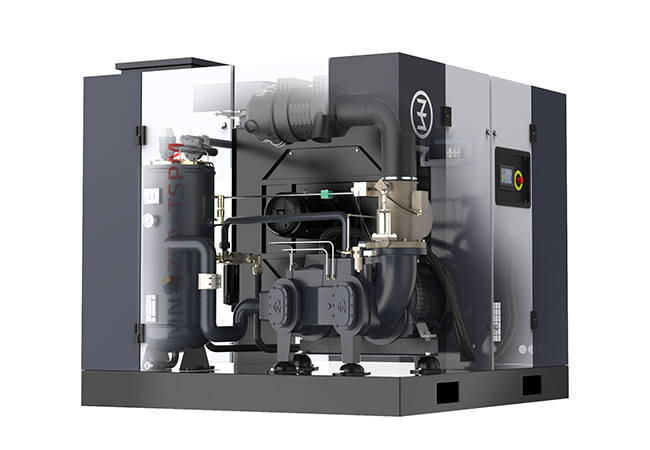
A two-stage screw compressor divides the total compression task between two distinct rotorsets. The first stage compresses incoming air to an intermediate pressure—typically 30 to 50 PSIG. This partially compressed air, now heated to perhaps 250°F to 300°F, then passes through an intercooler. The intercooler removes heat from the air stream, reducing its temperature and volume before it enters the second stage. The second stage then compresses the cooled, denser air from intermediate pressure to final discharge pressure.
The thermodynamic benefit of this arrangement is substantial. For the same total pressure ratio, two-stage compression with intercooling reduces the total compression work by bringing the actual compression path closer to the ideal isothermal path. Isothermal compression—compression at constant temperature—represents the theoretical minimum work. No real compressor achieves it, but intercooling between stages moves the process meaningfully closer to this ideal.
The intercooler provides additional practical benefits. By reducing the air temperature entering the second stage, it also reduces the thermal load on the second-stage rotors and bearings. The second stage operates across a narrower temperature range than a single-stage machine handling the full pressure ratio. Thermal expansion is less extreme, internal clearances can be optimized more tightly, and internal leakage throughout the operating range is reduced.
The efficiency advantage is not merely theoretical laboratory data. For a compressor delivering air at 125 PSIG, two-stage compression typically consumes 10% to 15% less power than an equivalent single-stage machine. At 150 PSIG, the advantage grows to 15% to 18%. At 175 PSIG—the upper end of typical industrial screw compressor pressures—two-stage compression can require 20% less power. These savings translate directly to reduced electricity costs for the operator.
III. The Intercooler’s Critical Role
The intercooler is not an accessory bolted onto a two-stage compressor; it is fundamental to the efficiency advantage. Its performance directly determines how much of the theoretical two-stage benefit is actually realized. An undersized or fouled intercooler reduces the temperature drop between stages, which shrinks the efficiency gain and increases the thermal load on the second stage.
In a well-designed two-stage compressor, the intercooler reduces the air temperature approaching the second stage to within 15°F to 20°F of the cooling medium temperature. For a water-cooled machine with 85°F cooling water, the air entering the second stage should be approximately 100°F to 105°F. For an air-cooled machine on a 95°F day, the intercooled air temperature should be approximately 110°F to 115°F.
Moisture removal is a secondary intercooler function that provides an often-overlooked benefit. As the compressed air cools between stages, water vapor condenses. This condensate is separated and drained before the air enters the second stage. The result is that the second stage receives drier air, reducing the risk of liquid water damage and delivering air with lower dew point to downstream equipment. In humid environments, a significant fraction of the total water removal occurs in the intercooler rather than in the aftercooler.
Intercooler maintenance directly affects compressor efficiency. A fouled intercooler reduces the interstage temperature drop, which means the second stage processes hotter, less dense air and consumes more power. The efficiency advantage of two-stage compression can be partly or largely negated by a neglected intercooler. Monitoring the interstage temperature provides a direct indication of intercooler condition—a rising trend signals that cleaning is needed.
IV. Mechanical Design Differences
Two-stage screw compressors differ from their single-stage counterparts in several mechanical aspects beyond simply having two sets of rotors.
The most common configuration integrates both rotorsets within a single airend housing, driven by a common motor through gears that set the appropriate speed ratio between stages. The first stage typically uses larger rotors running at lower speed, optimized for high volume flow at low pressure. The second stage uses smaller rotors running at higher speed, optimized for the lower volume flow at higher pressure. The gear ratio between stages establishes the speed relationship and is fixed by design.
An alternative configuration uses two separate airends, each driven by its own motor or coupled through a gearbox. This arrangement provides flexibility in matching rotor profiles and speeds to each stage’s specific operating conditions. It also allows independent service of each stage. The trade-off is higher cost, larger footprint, and additional mechanical complexity.
Two-stage machines typically operate with lower discharge temperatures than single-stage equivalents, even at higher final pressures. A single-stage machine delivering 150 PSIG may see discharge temperatures above 400°F, while a two-stage machine at the same pressure operates with discharge temperatures around 300°F to 350°F. This lower temperature extends oil life, reduces thermal stress on seals and bearings, and simplifies downstream air treatment.
The initial cost premium for two-stage compression is real but should be evaluated against energy savings over the expected equipment life. For a 100 HP compressor operating 6,000 hours annually with electricity at $0.10 per kWh, each percentage point of efficiency improvement saves approximately $450 per year. The 12% to 15% efficiency advantage of two-stage compression at 125 PSIG therefore saves $5,400 to $6,750 annually. Over a 10-year service life, these savings far exceed the incremental first cost, making two-stage compression the economically rational choice for continuous-duty, higher-pressure applications.
V. When Two-Stage Compression Makes Economic Sense
Two-stage compression is not the optimal choice for every application. The decision depends on operating pressure, utilization hours, and electricity cost.
Discharge pressure is the primary driver. For pressures below 100 PSIG, the efficiency advantage of two-stage compression is relatively modest—typically 5% to 8%. At these pressures, the additional capital cost may not justify the energy savings unless utilization is very high and electricity is expensive. Between 100 and 125 PSIG, the advantage grows to 10% to 15%, and the economic case strengthens considerably. Above 125 PSIG, two-stage compression is strongly preferred for any continuous-duty application, and above 150 PSIG it is essentially mandatory for reasonable operating cost.
Annual operating hours amplify the energy savings. A compressor running one shift per day, five days per week, accumulates roughly 2,000 hours annually. The energy savings from two-stage compression may not recover the capital premium within an acceptable payback period. The same compressor running 24 hours per day, seven days per week, accumulates over 8,000 hours annually. At this utilization level, the capital premium is typically recovered within two to three years.
Electricity cost is the final variable. At a utility rate of $0.06 per kWh, energy savings accumulate slowly. At $0.15 per kWh—common in many regions—the same efficiency advantage generates more than double the annual savings. Facilities in high-electricity-cost regions benefit most from two-stage technology.
Some applications should consider two-stage compression regardless of the economic calculation. Processes requiring very stable pressure at elevated levels benefit from the inherently lower pulsation of two-stage designs. Applications where discharge temperature matters—because hot compressed air degrades downstream filters or dryers—benefit from the lower operating temperatures. And facilities planning for future pressure increases should consider installing two-stage capability initially rather than replacing a single-stage machine later.
FAQ
Q1: Can I retrofit a single-stage compressor to two-stage?
No. The two-stage design is fundamentally different in its mechanical arrangement, requiring two rotorsets with specific sizing and an intercooler integrated into the flow path. Retrofitting a single-stage compressor is not practical. The choice between single-stage and two-stage is made at the time of equipment purchase.
Q2: Does a two-stage compressor require more maintenance?
Two-stage compressors have more components—two rotorsets, an intercooler, additional seals and bearings—and therefore have more items requiring periodic attention. However, the lower operating temperatures in two-stage machines extend oil life and reduce thermal stress on components, which partially offsets the additional maintenance points. Overall maintenance cost is moderately higher but should be weighed against energy savings rather than considered in isolation.
Q3: Is a two-stage compressor louder than a single-stage?
Not significantly. The dominant noise source in screw compressors is typically the inlet, not the compression process itself. Two-stage machines may have slightly different acoustic signatures due to the additional rotorset and gearing, but the difference is generally small and both configurations require similar sound enclosure treatment.
Q4: How does part-load efficiency compare between single-stage and two-stage?
At part load, the efficiency advantage of two-stage compression narrows but does not disappear. With VSD control, two-stage machines maintain good part-load efficiency although the relative advantage over single-stage is smaller than at full load. With load-unload or modulation control, both configurations lose efficiency at part load, with the two-stage advantage persisting but at reduced magnitude.
Q5: Can a two-stage compressor replace a single-stage at the same pressure?
Yes. A two-stage compressor designed for the same flow and pressure as an existing single-stage machine will deliver the same compressed air output with lower energy consumption. The physical dimensions may be larger due to the additional components, so installation space should be verified.
Q6: What is the typical payback period for choosing two-stage over single-stage?
Payback depends on operating pressure, utilization, and electricity cost. For a 100 HP compressor at 125 PSIG operating 6,000 hours annually with $0.10 per kWh electricity, the two-stage premium of 20% to 30% over single-stage capital cost typically pays back in two to four years. Higher pressure, more operating hours, or higher electricity rates shorten the payback period.
Conclusion
Two-stage screw compressors solve the fundamental thermodynamic inefficiency of compressing air to elevated pressures in a single step. By dividing the work between two rotorsets with intercooling between stages, they reduce the total energy required, lower discharge temperatures, and narrow internal clearances for reduced leakage. The energy savings are not marginal—they represent a 10% to 20% reduction in electricity consumption depending on operating pressure, translating to thousands of dollars annually for typical industrial machines.
At MINNUO, our two-stage screw compressors are engineered for applications where efficiency at elevated pressures matters most. We offer both single-stage and two-stage configurations, and our application engineers can analyze your specific pressure requirements, utilization profile, and electricity costs to recommend the technology that minimizes your total cost of compressed air ownership. Whether your application runs at standard plant air pressures or demands reliable high-pressure air for specialized processes, MINNUO provides the compressor configuration that balances first cost against long-term operating efficiency. Every MINNUO compressor includes detailed performance data to verify the efficiency advantage of your selected configuration.
 Email
Email sales:+86 15366749631