Ask an automotive engineer where oil-free compressed air matters most, and the answer is usually immediate. The paint shop. A compressed air line that carries oil into a spray booth creates fisheyes, cratering, and gloss variations on finished body panels. The cost of rework in a high-volume paint shop is measured in thousands of dollars per hour of line downtime. Everyone in the plant knows this. The paint shop gets the oil-free compressor. The rest of the plant gets whatever is left.
That division made sense when paint was the only operation sensitive to oil contamination. It makes less sense now. Modern automotive assembly lines are dense with pneumatic automation. Robots with pneumatic grippers handle body panels. Air-powered torque tools fasten critical joints. Leak test stations pressurize engines and transmissions with compressed air. If that air carries oil, the oil deposits on the parts being assembled. It interferes with leak test accuracy. It contaminates surfaces that will later be bonded or sealed. The assembly line does not need oil-free air because of a regulatory requirement. It needs it because oil in the wrong place creates problems that are expensive to diagnose and more expensive to fix.
I. Where Compressed Air Touches Automotive Assembly
Robotic tooling and pneumatic automation
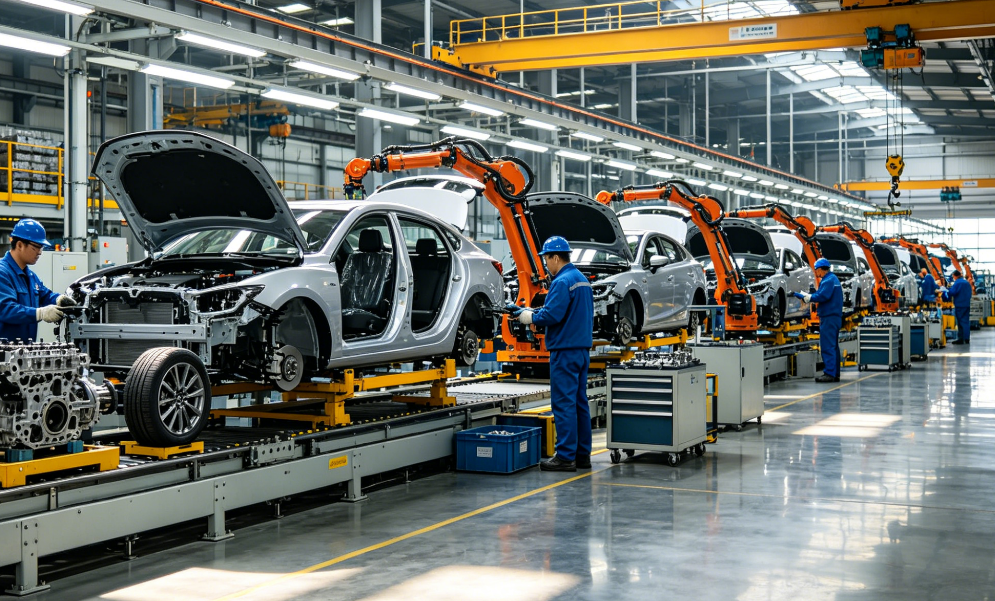
A modern automotive assembly plant contains hundreds of robots. Many of them use pneumatic end effectors — grippers, clamps, vacuum cups, and positioning cylinders. These devices cycle thousands of times per shift. The compressed air that powers them is exhausted into the plant atmosphere, directly above the vehicle bodies moving down the line. If that air carries oil aerosol, the oil settles on every surface within the exhaust plume. Body panels. Glass. Interior trim components. The oil film is microscopic, but it is enough to cause problems when those surfaces later receive adhesive, sealant, or a bonded component.
Pneumatic fastening tools
Torque wrenches, nut runners, and impulse tools on the assembly line are powered by compressed air. The air motor inside each tool spins at high speed. Oil in the air stream deposits on the motor vanes and bearings. Over time, the oil attracts dust and metallic wear particles, forming a sludge that increases internal friction. The tool’s output torque drifts. A fastening joint that was specified at 80 Newton-meters with a tolerance of ±5 percent may be delivered at 75 or 85 Newton-meters because the tool’s internal condition has changed. The torque drift is gradual. It is often undetected until a quality audit catches it or a joint failure occurs in the field.
Leak testing and pressure decay testing
Engines, transmissions, fuel systems, and brake components are leak-tested on the assembly line. The test involves pressurizing the component with compressed air, isolating it, and measuring the pressure decay over a timed interval. A leak is indicated by a pressure drop that exceeds the pass-fail threshold. If the compressed air contains oil, the oil can temporarily seal a small leak path during the test. The part passes. It ships. It leaks in service. Alternatively, oil residue in the test lines can cause erratic pressure readings that fail good parts, creating false rejects that stop the line for investigation.
Instrument air for process control
Pneumatic valve actuators, positioners, and pressure transmitters throughout the assembly plant use compressed air as their operating medium. These instruments require clean, dry air to function reliably. Oil in the instrument air deposits on the fine clearances of spool valves and the sensing diaphragms of pressure transmitters. A sticking valve actuator on a paint circulation system or a conveyor diverter can stop a section of the assembly line. The maintenance response is to replace the valve. The oil that caused the sticking is still in the air, still entering every replacement valve the technician installs.
II. How Oil Contamination Affects Assembly Line Operations
Adhesive and sealant bonding failures
Modern vehicles are assembled with structural adhesives that bond aluminum panels, carbon fiber components, and mixed-material joints. These adhesives require clean surfaces to achieve their specified bond strength. An oil film on a bonding surface — deposited by pneumatic exhaust or by oil-laden plant air that blows across the part — acts as a release agent. The adhesive does not bond to the metal. It bonds to the oil film. The joint is weaker than the engineering specification. The failure may not be detected in the plant. It may appear later as a squeak, a rattle, or a structural issue in service. Tracing the root cause back to compressed oil contamination is a process that takes months and costs far more than the compressor that prevented the problem would have cost.
Sensor contamination and false readings
Assembly lines are instrumented with sensors that verify part presence, measure gap and flushness, and check torque. Optical sensors, laser profilometers, and capacitive proximity sensors all have a tolerance for environmental contamination. An oil mist in the plant atmosphere condenses on sensor lenses and housings. The sensor output drifts. The line control system receives false readings. The response is often to slow the line while a technician troubleshoots the sensor. The oil that caused the false reading is not visible on the sensor surface, and the technician replaces a working component while the root cause remains suspended in the plant air.
The cumulative effect on first-time-through quality
Automotive assembly plants measure first-time-through quality — the percentage of vehicles that pass final inspection without requiring a repair. Every defect that is detected and corrected on the line is a cost. Oil contamination contributes to FTT in ways that are hard to isolate because oil is not listed as a defect category. It appears as a bond failure, a torque discrepancy, a sensor fault, or a surface blemish. The defects are attributed to the component or the process step where they are discovered, not to the compressed air that caused them. A plant that switches to oil-free compressed air across the entire assembly line often observes an improvement in FTT that cannot be fully explained by any single correction. The improvement is the sum of many small problems that no longer occur.
III. Why the Paint Shop Gets Oil-Free Air and the Rest of the Plant Often Does Not
The visible cost of paint defects vs. the hidden cost of assembly defects
Paint defects are visible. A fisheye on a hood is seen immediately by the inspector. The panel is marked for rework. The cost is recorded. Assembly defects from oil contamination are distributed across the line in ways that make them hard to count. A sensor fault causes a five-minute line stoppage. A torque tool is recalibrated. A leak test returns a false positive. These events are small and frequent. They are absorbed into the daily maintenance workload. They are not aggregated into a monthly cost that can be compared against the price difference between an oil-flooded and an oil-free compressor. The paint shop cost is visible. The assembly line cost is dispersed. This visibility difference has historically driven investment decisions.
Incremental expansion of the compressed air system
Many automotive plants grew incrementally. The original plant had a compressor room sized for the initial production capacity. As the plant expanded, more compressors were added. The paint shop, as a distinct facility or a segregated area, received dedicated oil-free compressors because the paint specification required it. The general assembly area continued to run on the existing lubricated compressor infrastructure. This division became institutionalized. The cost of converting the entire plant to oil-free air — replacing working equipment, rerouting piping, and managing the transition during production — appeared larger than the cost of maintaining the status quo. The plant continued to run two air systems: oil-free for paint, lubricated for everything else.
The shift toward unified air quality standards
The two-system model is changing. Automotive manufacturers are increasingly specifying a single compressed air quality standard for the entire plant. ISO 8573-1 Class 0 for oil — technically oil-free at the source — is being written into specifications for new assembly plants and major refurbishments. The reasons include the proliferation of adhesive bonding, the increased density of sensors and automation, and the operational simplicity of maintaining one air system instead of two. A plant that runs a single oil-free compressed air system does not need to segregate piping networks, manage separate maintenance schedules for different compressor types, or worry about cross-contamination between the two systems. The trend is toward unification.
IV. The Air Quality Demands of Specific Assembly Operations
Windshield and glass bonding
A windshield is bonded to the vehicle body with a urethane adhesive. The bond must be strong enough to retain the windshield during a collision and watertight for the life of the vehicle. The glass and the body flange must be clean at the moment of adhesive application. Oil contamination from compressed air — whether from the pneumatic dispensing system that applies the adhesive or from plant air that has settled on the surfaces — compromises the bond. A windshield that leaks or detaches in service is a safety defect. The cost of a recall for windshield bonding failure is catastrophic compared to the cost of the compressor that provides clean air to the glass bonding cell.
Powertrain assembly and testing
Engine and transmission assembly involves multiple compressed air applications. Pneumatic tools fasten bearing caps, cylinder heads, and oil pans. Compressed air is used for parts cleaning and blow-off. The assembled engine is leak-tested with compressed air. Oil in any of these air streams creates the problems described earlier — torque drift, surface contamination, and false leak test results. An engine that passes a leak test due to oil-sealed leak paths may fail in the vehicle, requiring a costly repair that erodes the manufacturer’s warranty reserve and customer satisfaction ratings.
Interior trim and electronics
Interior trim components — instrument panels, door panels, headliners — are assembled with a combination of mechanical fasteners, clips, and adhesives. Many of these components incorporate electronic elements: touchscreens, switchgear, sensors, and wiring harnesses. Oil contamination on electrical connectors can cause intermittent contact. Oil on a decorative surface creates a stain that the final inspection will flag. These components are assembled late in the process, close to the end of the line. A defect here has a high rework cost because the vehicle is nearly complete. Clean compressed air in the trim shop protects the investment already made in the body shop, paint shop, and chassis line.
FAQ
Q1: Does the entire automotive assembly plant need oil-free compressed air, or just the paint shop?
A1: The paint shop has the most visible need. But adhesive bonding, leak testing, robotic pneumatics, and instrument air all benefit from oil-free air. A growing number of automotive manufacturers are specifying oil-free air for the entire assembly plant, particularly in new facilities. The operational simplicity of a single air quality standard across the plant and the avoidance of cross-contamination between segregated systems are driving this trend.
Q2: Can a lubricated compressor with sufficient filtration meet automotive assembly air quality requirements?
A2: Technically yes, with proper filtration and rigorous maintenance. The risk is that a filter failure or maintenance gap allows oil to reach the production line. In a high-volume assembly plant, a contamination event that is not detected for hours can affect hundreds of vehicles. The cost of investigating and correcting a systemic contamination event, plus the potential for field failures if contaminated vehicles ship, often exceeds the price difference between lubricated and oil-free compression.
Q3: What air quality standard applies to automotive assembly compressed air?
A3: ISO 8573-1 Class 0 for oil — technically oil-free at the source — is increasingly specified for automotive assembly, particularly for adhesive bonding, painting, and instrument air applications. For water, a pressure dew point of -20°C to -40°C is common to prevent condensation in the piping and at the point of use. For particles, Class 1 or better protects pneumatic components and instrument air systems.
Q4: How does oil in compressed air affect leak testing results?
A4: Oil in the compressed air used for pressure decay leak testing can temporarily seal a small leak path by depositing a liquid film across the opening. The part passes the test but leaks in service when the oil film is displaced. Oil residue in the test lines can also cause erratic pressure readings that fail good parts, creating false rejects that slow production and require investigation. Clean, oil-free air is essential for accurate and repeatable leak testing.
Q5: Is it practical to convert an existing automotive plant from lubricated to oil-free compressed air?
A5: Yes, and many plants have done it. The conversion is typically phased. One assembly area is converted at a time, with the oil-free compressor installed and the distribution piping to that area isolated from the existing lubricated air network. The conversion can be scheduled around planned shutdowns or model changeovers to minimize production disruption. The piping that previously carried lubricated air must be cleaned or replaced, as oil residue in the existing piping will continue to contaminate the air stream even after the compressor is changed.
V. Specifying an Oil-Free Compressed Air System for Automotive Assembly
Sizing for a high-volume assembly plant
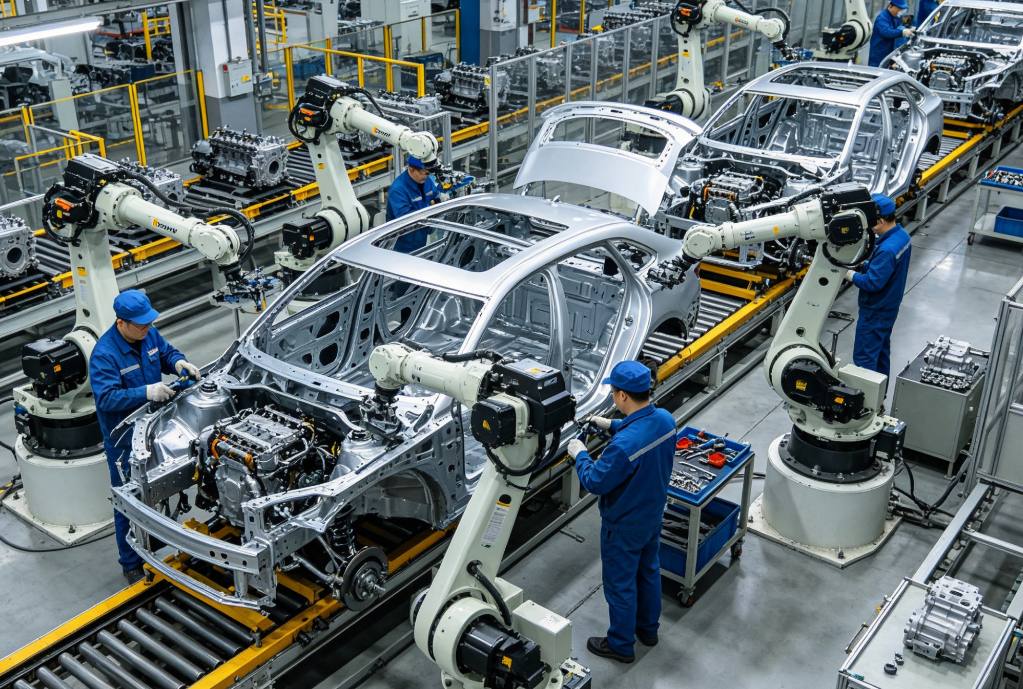
An automotive assembly plant producing 250,000 to 500,000 vehicles per year consumes compressed air across thousands of points of use. The total plant air demand is typically 500 to 2,000 Nm³/h, with the paint shop accounting for 20 to 30 percent of the total. The compressor sizing must account for the simultaneous peak demand across all production areas, plus a margin for leaks — which can account for 15 to 25 percent of total consumption in an aging plant. A compressed air audit that measures actual flow and pressure across a representative production week provides the most reliable basis for sizing.
Air treatment and distribution
An oil-free compressor eliminates oil. The air still requires drying and particulate filtration. Desiccant dryers with a pressure dew point of -20°C to -40°C are standard for automotive assembly air. The distribution piping should be stainless steel or aluminum to prevent corrosion that would introduce particulate into the air stream. Point-of-use filtration at each critical application — leak test stations, adhesive dispensing cells, instrument air drops — provides a final barrier against any contamination picked up in the distribution piping.
System redundancy and backup
An automotive assembly plant cannot tolerate a compressed air outage. The system should include N+1 redundancy on the compressor and dryer capacity, so that a single machine failure does not reduce the plant air supply below the required minimum. The compressed air control system should sequence the compressors to balance operating hours and should provide automatic switchover if a running compressor trips. A compressed air system failure that stops an automotive assembly line costs tens of thousands of dollars per minute. The cost of redundancy is a fraction of the cost of the downtime it prevents.
VI. The Operational Case for a Unified Oil-Free Air System
One system to maintain instead of two
A plant that runs separate oil-free and lubricated compressed air systems has two sets of maintenance schedules, two sets of spare parts, two sets of operating procedures, and two sets of air quality monitoring. Combining both into a single oil-free system reduces the maintenance overhead. The technicians maintain one compressor type. The spare parts inventory covers one machine family. The air quality monitoring is consistent across the plant.
Reduced risk of cross-contamination
Segregated air systems rely on the segregation being maintained. A valve in the wrong position, a pipe crossover installed during a plant modification, or a temporary hose connecting the two systems can introduce oil into the oil-free network. A single cross-connection event can contaminate the entire oil-free system, requiring a purge and cleaning that may take days. A unified oil-free system eliminates this risk. There is no oil anywhere in the plant air network to cross-contaminate anything.
The trend in new plant specifications
New automotive assembly plants being built today are increasingly specified with plant-wide oil-free compressed air. The incremental cost of oil-free compression over lubricated compression, when calculated as part of the total plant investment, is small relative to the total project budget. The operational benefits — simplified maintenance, eliminated cross-contamination risk, and consistent air quality across all applications — are documented in plants that have already made the transition. The specification trend is clear. The question for existing plants is not whether to convert, but when and in what sequence.
Conclusion
Oil-free compressed air in automotive assembly is not just about paint. It is about the adhesive bonds that hold the vehicle structure together. It is about the leak tests that verify engines and transmissions are sealed. It is about the pneumatic tools that fasten critical joints to specified torque. It is about the sensors that control the line and the instruments that keep the process running. Every one of these functions is compromised by oil in the compressed air, and the cost of the compromise — scattered across the maintenance budget, the rework stations, and the warranty claims — is larger than it appears.
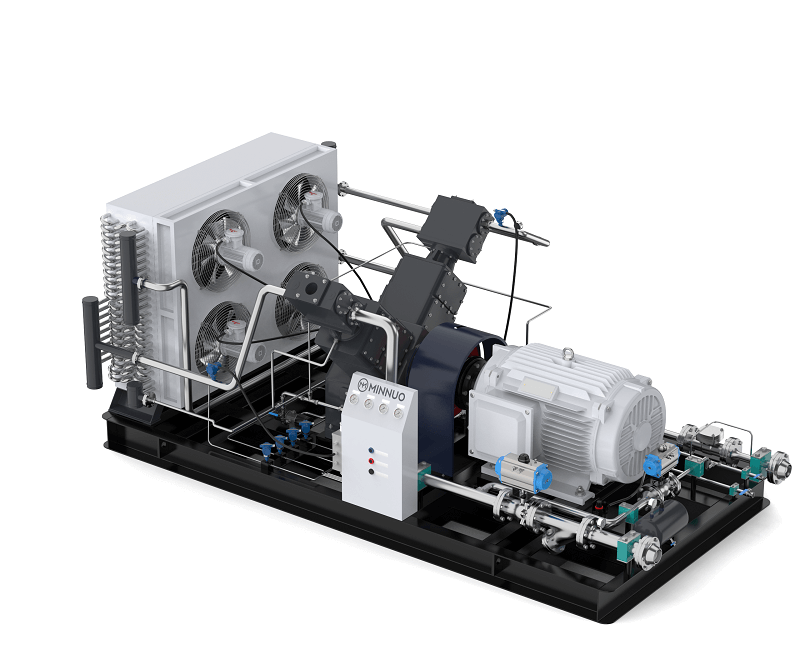
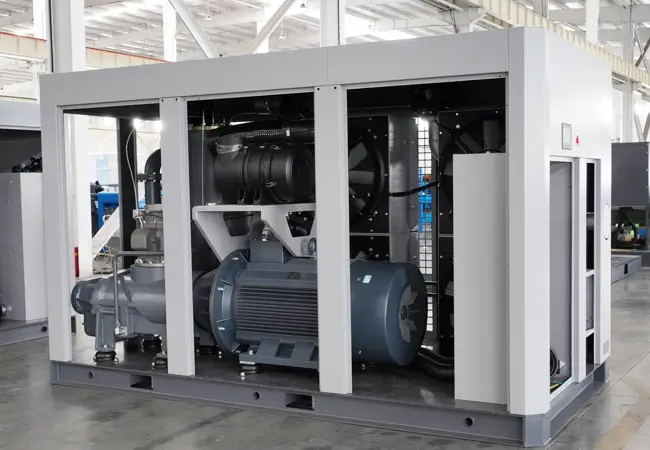
At MINNUO, we design oil-free rotary screw compressor packages for automotive manufacturers and their suppliers. We understand the compressed air quality demands of modern automotive assembly, from the paint shop to the trim line, and we work with our clients to specify a system that delivers the required air quality at the lowest total cost of ownership. A plant-wide oil-free compressed air system is not an expense to be deferred. It is an investment in the first-time-through quality, the maintenance efficiency, and the long-term reliability that define a competitive automotive assembly operation.
 Email
Email sales:+86 15366749631