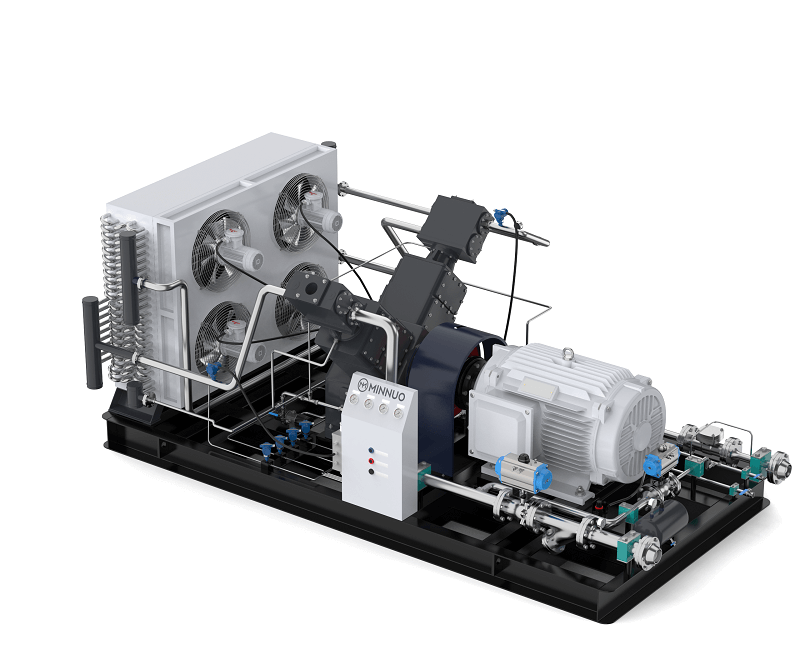
In high-pressure and heavy-duty working conditions such as petrochemical, new energy, and industrial gases, heavy-duty industrial piston compressors serve as core power equipment. Their design rationality and performance stability directly determine production efficiency, operational safety, and comprehensive energy consumption. With years of experience in the compressor field, MINNUO creates heavy-duty piston compressors suitable for extreme working conditions through precise design, material innovation, and intelligent optimization technology, balancing high-pressure output, energy efficiency, and long-term durability to lay a solid power foundation for industrial production.
I. Core Design Principles: Precisely Coordinated Power Architecture
The core logic of heavy-duty industrial piston compressors is to change the cylinder volume through the reciprocating movement of mechanical structures to realize gas suction, compression, and discharge. Their design focuses on three core aspects: high-pressure resistance, stable transmission, and leak-proof sealing.
1. Transmission System: Power Core for Heavy-Duty Conditions
It adopts a crankshaft-linkage mechanism to convert the rotational motion of the motor into the linear reciprocating motion of the piston. The precise cooperation between the forged steel crankshaft and split connecting rod greatly improves transmission efficiency and structural strength. MINNUO optimizes the crankshaft balance weight design and combines dynamic load simulation analysis to effectively offset the reciprocating inertia force of the piston, reduce unit vibration, adapt to high-frequency working conditions above 1200 cycles per minute, and ensure long-term stable operation under high pressure and heavy load. The crosshead slideway is inlaid with Babbitt alloy to reduce friction loss and extend the service life of transmission components.
2. Cylinder and Piston Assembly: Pressure-Resistant Design for Diverse Media
The cylinder is made of high-strength alloy steel or cast iron, with the inner wall strengthened by chrome plating and nitriding to enhance wear resistance. It integrates water-cooled/oil-cooled channels to precisely control compression temperature, adapting to corrosive gases such as hydrogen sulfide and carbon dioxide as well as supercritical working conditions. The piston assembly adopts a multi-material customization scheme: 316L stainless steel piston crown for sulfur-containing media, ceramic coating for high-temperature environments, and graphite/PTFE composite sealing rings to achieve a sealing efficiency of over 92%, effectively inhibiting high-pressure gas leakage. MINNUO innovatively designs a detachable cylinder liner, which avoids the need to replace the entire cylinder after wear and significantly reduces maintenance costs.
3. Valve and Sealing System: Key Guarantee for Efficient Leakage Prevention
The air valve adopts a spring-loaded reed valve or ring valve structure, with valve plates made of high-strength alloy steel or PEEK material, precision ground to ensure sealing performance and fatigue resistance during high-frequency opening and closing. For flammable and explosive media, it is equipped with dry gas seal or labyrinth seal technology, combined with leak detection holes for real-time early warning, complying with ATEX/IECEx explosion-proof standards. MINNUO’s intelligent valve system can dynamically adjust opening and closing timing and lift, adapting to different compression ratio requirements from 1.5:1 to 15:1, while balancing flow rate and pressure stability.
II. Performance Optimization Strategies: MINNUO’s Efficient Upgrade Solutions
Focusing on the goals of “energy saving and consumption reduction, service life extension, and adaptation to diverse working conditions”, MINNUO achieves performance breakthroughs in three aspects: structure, materials, and intelligent control, making heavy-duty piston compressors more competitive in high-pressure, corrosive, and high-frequency working conditions.
1. Multi-Stage Compression and Interstage Cooling: Energy-Saving Core Approaching Isothermal Compression
2-6 stage series compression design is adopted for high-pressure working conditions, with a single-stage pressure of up to 40-250 bar. Interstage cooling devices reduce gas temperature, making the compression process approach isothermal state, saving 15%-30% energy compared with traditional single-stage compression. MINNUO customizes interstage coolers and oil-water separation systems, with dew point controlled below -40℃, avoiding lubricating oil carbonization and medium pollution, and adapting to high-end process requirements such as synthetic ammonia and ethylene plants.
2. Material Innovation and Structural Optimization: Enhancing Durability and Adaptability
A smooth curved auxiliary piston is adopted on the top of the piston to reduce motion resistance and stress concentration, alleviating failure risks under high temperature and pressure. The axial width of the connecting rod bearing shell is optimized to 2-8 times the thickness of the connecting rod, increasing contact area, reducing pressure, improving resistance to tilting torque, and reducing vibration and wear. Non-pressure-bearing components use carbon fiber composite materials to achieve lightweight while ensuring strength, adapting to special scenarios such as offshore platforms.
3. Intelligent Monitoring and Precise Regulation: Realizing Full-Life Cycle Optimization
Integrated with IoT sensors and edge computing modules, it collects real-time operating parameters such as vibration, temperature, and pressure, and predicts potential faults such as valve plate fracture and seal failure through AI algorithms, reducing unplanned downtime. Equipped with variable frequency drive and clearance volume control technology, it can flexibly adjust flow rate and pressure to adapt to different working conditions, while reducing no-load energy consumption. MINNUO’s cloud collaboration system supports remote monitoring and parameter optimization, realizing full-life cycle management of equipment.
III. Core Application Scenarios: Adapting to Extreme Industrial Needs
With precise design and performance optimization, MINNUO heavy-duty industrial piston compressors are widely used in petrochemical, industrial gas, new energy, refrigeration and other fields:
- Petrochemical: Gas boosting in catalytic cracking and hydrotreating processes, resistant to hydrogen sulfide corrosion, with working pressure up to 15-40MPa;
- Industrial Gas: Medical oxygen filling and electronic-grade nitrogen compression, meeting dual requirements of high pressure and high cleanliness;
- New Energy: Compression in supercritical carbon dioxide heat pump systems, withstanding 12MPa high pressure and adapting to extreme temperature conditions;
- Refrigeration: Two-stage compression for ammonia refrigeration units, with a COP of 4.5, equipped with emergency release devices to ensure safety.
IV. MINNUO Advantages: Customized High-Pressure Power Solutions
MINNUO heavy-duty industrial piston compressors take “precise design, efficient performance, and full-life cycle service” as core competitiveness. They can provide customized solutions according to medium characteristics, pressure requirements, and working conditions, adapting the whole process from material selection, structural design to intelligent control system. Relying on a sound global service network, it provides one-stop services such as installation and commissioning, spare parts supply, and technical support, ensuring continuous and stable operation of equipment under extreme working conditions and injecting reliable power into industrial production.
FAQ
Q1: What working conditions and media can MINNUO heavy-duty piston compressors adapt to?
A1: The compressors are suitable for high-pressure, high-frequency, high-temperature and corrosive working environments. They can handle corrosive gases like hydrogen sulfide and carbon dioxide, as well as flammable and explosive media. They also work stably under supercritical conditions and special scenarios such as offshore platforms.
Q2: How much energy can be saved by the multi-stage compression design?
A2: Our 2-6 stage series compression combined with interstage cooling makes the compression process close to isothermal state. It can save 15% to 30% energy compared with traditional single-stage compression. The supporting cooling and separation system also keeps the dew point below -40℃.
Q3: Does the equipment meet international explosion-proof standards for hazardous environments?
A3: Yes. For flammable and explosive media, we adopt dry gas seal or labyrinth seal structures with real-time leak detection holes. The whole equipment fully complies with ATEX and IECEx explosion-proof standards for safe operation in petrochemical and other hazardous areas.
Q4: What intelligent functions does the compressor have? Can it realize remote management?
A4: It is equipped with IoT sensors, AI fault prediction and variable frequency control systems to monitor vibration, temperature and pressure in real time. The built-in cloud collaboration system supports remote monitoring, parameter adjustment and full-life cycle equipment management, effectively cutting unplanned downtime.
Q5: Is the equipment easy to maintain? How to reduce long-term maintenance costs?
A5: We adopt innovative detachable cylinder liners, so there is no need to replace the whole cylinder after wear. Optimized materials and structures lower component wear. Meanwhile, our global service network provides complete spare parts and technical support to control overall maintenance expenses.
 Email
Email sales:+86 15366749631