Introduction
Driven by global dual carbon goals, hydrogen energy as clean secondary energy has achieved explosive industrial growth. As the core hub of hydrogen storage and transportation networks, hydrogen mother stations undertake hydrogen purification, pressurization, storage and long-tube trailer filling tasks. Hydrogen compressors, known as the “power heart” of mother stations, boost low-pressure raw hydrogen to 20–45MPa to meet refueling and transshipment demands. Their performance directly decides station efficiency, gas purity, safety and running cost. With over 30 years of compressor R&D and manufacturing experience, Jiangsu Minnuo Group develops full-series hydrogen compressors to support high-quality construction of hydrogen mother stations.
I. Core Position of Hydrogen Mother Stations & Compressor Functions
Full Process Flow of Hydrogen Mother Stations
Hydrogen Source → Purification (PSA/Membrane Separation) → Buffer Tank → Hydrogen Compressor Pressurization → High-Pressure Hydrogen Storage / Long-Tube Trailer Filling → Delivery to Hydrogen Refueling Substations
Raw electrolytic or by-product hydrogen only carries 0.1–2MPa pressure and needs purification to 99.999% fuel-cell grade, then compressed to 20–45MPa for filling.
Four Irreplaceable Core Functions of Hydrogen Compressors
- Precise stable pressurization to 20–45MPa to guarantee consistent filling pressure and efficiency
- 100% oil-free compression to avoid catalyst poisoning, meeting fuel cell hydrogen purity standards
- Integrated multi-layer explosion & leakage protection adapting hydrogen’s flammable hazardous characteristics
- Stable 24/7 full-load operation matching large-scale hydrogen production & delivery demands
II. Three Mainstream Hydrogen Compressor Types & Matching Station Scenarios
Jiangsu Minnuo develops diaphragm, hydraulic piston and reciprocating compressors covering all flow & pressure ranges for different mother station scales.
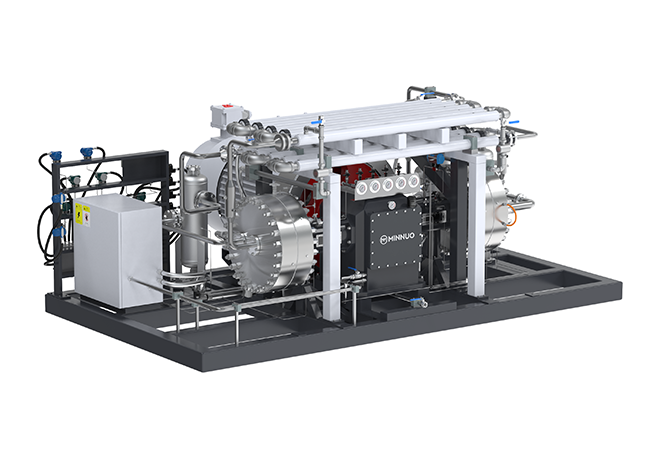
2.1 Diaphragm Hydrogen Compressor (50–500 Nm³/h) – First Choice for Medium & Small Mother Stations
- Core strengths: Complete oil-free isolation, ultra-low leakage ≤1×10⁻⁶ Pa·m³/s, stable 99.999% hydrogen purity, ATEX/GB explosion-proof certification
- Working pressure: Two-stage compression reaches 20–45MPa, perfectly fit 30MPa long-tube trailer filling
- Structural advantages: Full 316L anti-hydrogen embrittlement gas circuit, self-developed PLC intelligent control system
- Applicable scenes: Small & medium hydrogen mother stations with strict fuel cell purity requirements
Hydraulically Driven Piston Hydrogen Compressor (500–5000 Nm³/h) – Core for Large-Scale Hydrogen Bases
- Core strengths: Extra large flow, single-stage 45MPa output, 20–30% lower power consumption than traditional reciprocating models
- Stable pressure holding: Pressure drop less than 0.5% per hour after shutdown, high filling precision
- Material configuration: High-strength anti-hydrogen embrittlement alloy pressure-bearing parts
- Applicable scenes: GW-level electrolytic hydrogen production bases, large centralized mother stations with mass tube trailer filling
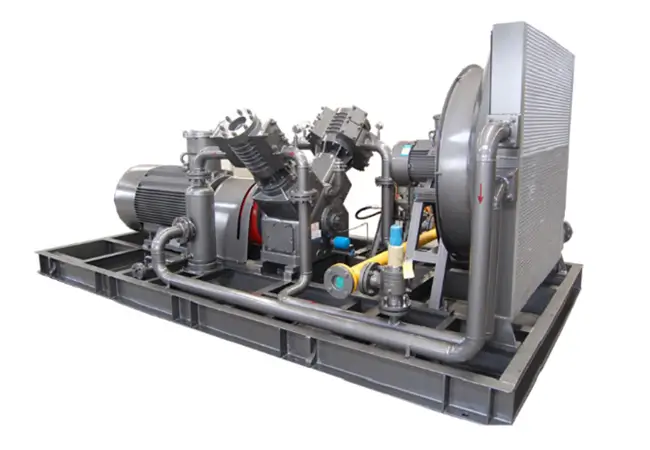
2.2 Reciprocating Piston Hydrogen Compressor – Economical Auxiliary Model for Small Test Stations
- Advantages: Low procurement cost, simple daily maintenance, pressure range 20–35MPa
- Limitations: Risk of oil contamination, higher leakage rate, needs matched multi-stage precision filters
- Applicable scenes: Laboratory test stations, industrial gas sites with loose hydrogen purity standards
III. Five Mandatory Technical Standards for Mother Station Hydrogen Compressors
3.1 Zero-Oil High Purity Design
Comply with ISO8573-1 Class 0 oil-free standard, hydrogen oil content below 0.0005mg/m³. Adopt 316L stainless steel pipelines, self-lubricating components and multi-stage filters to eliminate catalyst poisoning risks.
3.2 Ultra-Stable High Pressure Output
Pressure fluctuation controlled within ±0.1MPa under variable load, excellent pressure retention performance to avoid insufficient filling pressure for long-tube trailers.
3.3 Full Explosion-Proof Safety Configuration
Pass ATEX, IECEx and GB3836 explosion-proof certifications; equipped explosion-proof electrical cabinets, real-time hydrogen leakage sensors, dual safety valves and emergency interlock shutdown for overpressure/overtemperature/leakage faults.
3.4 Anti-Hydrogen Embrittlement Structure
All high-pressure parts use duplex stainless steel or nickel-based alloy with special anti-cracking treatment to prevent hydrogen embrittlement fatigue failure under long-term high-pressure operation.
3.5 IoT Intelligent Unattended O&M
Industrial PLC + touchscreen full parameter display; support 4G remote monitoring, real-time fault alarm and predictive maintenance, cutting unplanned downtime over 80%.
IV. Minnuo Hydrogen Compressor Technical Advantages & Future R&D Layout
4.1 Core Competitive Strengths of Minnuo
- Full product spectrum covering 50–5000 Nm³/h flow and 20–45MPa pressure, matching all mother station sizes
- Mature anti-hydrogen embrittlement and oil-free compression core technologies, performance comparable to international top brands
- Complete full lifecycle service including scheme design, skid-mounted integration, installation and after-sales maintenance
- Mass overseas delivery to over 100 countries with complete international explosion-proof certification documents
Five Future Development Directions
- Core technology breakthrough: Develop 70MPa ultra-high-pressure hydrogen compressors and extra-large flow hydraulic units to break foreign monopolies
- Intelligent digital manufacturing: Automated precision production lines to improve component consistency and shorten delivery cycles
- Scene customized skid solutions: Compact integrated units for small stations, large linked filling systems for hydrogen production bases
- Intelligent O&M platform upgrade: AI fault prediction, plant-wide DCS data interconnection for unmanned station management
- Global market expansion: Overseas service warehouses, participate in international hydrogen equipment standard formulation
V. Conclusion
Hydrogen compressors are irreplaceable core power equipment guaranteeing safe, low-cost and high-efficiency operation of hydrogen mother stations. With 30 years of compression equipment R&D accumulation, Jiangsu Minnuo supplies full-series oil-free explosion-proof hydrogen compression products covering all station working conditions.
Facing booming hydrogen energy industry demand, Minnuo will keep innovating in core sealing, anti-hydrogen embrittlement and intelligent control technologies, delivering reliable domestic hydrogen compressor equipment for global hydrogen storage & transportation projects.
VI. FAQ
Q1: What are the differences between diaphragm and hydraulic piston hydrogen compressors?
A1: Diaphragm models (50–500Nm³/h) realize complete oil-free isolation for medium-small mother stations with strict purity demands; hydraulic piston compressors support large flow 500–5000Nm³/h for large hydrogen production bases with higher energy efficiency.
Q2: What pressure grade hydrogen compressor do 30MPa long-tube trailers need?
A2: Diaphragm two-stage compression or single-stage hydraulic compressor with 45MPa rated pressure can stably finish 20–30MPa trailer filling.
Q3: How to avoid hydrogen embrittlement failure of high-pressure compressors?
A3: Minnuo adopts 316L stainless steel and nickel-based alloy for all high-pressure gas circuits with professional anti-hydrogen embrittlement heat treatment to prevent cracking under long-term high pressure.
Q4: Are Minnuo hydrogen compressors certified for hazardous hydrogen sites?
A4: Yes, all full-series units pass GB3836, ATEX and IECEx explosion-proof certification with full leakage monitoring and emergency interlock protection.
 Email
Email sales:+86 15312799623