Introduction: Reliable Solutions for Special Working Conditions
In work environments with insufficient or completely absent power supply, traditional electric air compressors are often ineffective. Diesel air compressors, with their independent power supply, high mobility, and strong adaptability, have become essential equipment in fields such as mining, construction in remote areas, and emergency rescue. With technological advancements and increasing environmental requirements, modern diesel air compressors are evolving toward greater efficiency, environmental friendliness, and intelligence while maintaining their traditional advantages.
I. Technical Characteristics of Diesel Air Compressors
1.1 Power System Integration
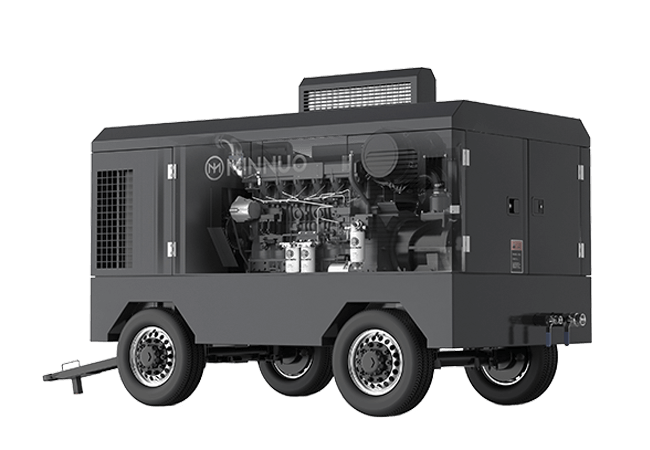
Modern diesel air compressors adopt a highly integrated design concept, directly connecting diesel engines with air compressor units via couplings or gearboxes to form complete power packages. This design not only reduces energy transmission losses but also significantly improves equipment reliability and compactness. Advanced power matching technology ensures perfect alignment between engine output power and compressor requirements, avoiding situations of “overpowering” or insufficient power.
1.2 Fuel System Optimization
Utilizing high-pressure common rail fuel injection systems enables precise fuel control and complete combustion, reducing both fuel consumption and pollutant emissions. Intelligent fuel management systems automatically adjust fuel supply based on load changes, entering economy mode under low loads to save up to 15% in fuel consumption. Large-capacity fuel tank designs support long-term continuous operation, reducing refueling frequency.
1.3 Cooling System Design
Addressing the high heat generation characteristics of diesel engines, efficient composite cooling systems are configured. Air-cooled intercoolers reduce intake air temperature and increase intake density, while water-cooled systems ensure engines operate at optimal temperatures. Intelligent temperature control systems automatically adjust cooling intensity based on ambient temperature and load conditions, preventing overheating or overcooling.
II. Core Technological Advantages
2.1 Excellent Mobility
Integrated Unit Design: Power systems, compression systems, and control systems integrated on robust chassis.
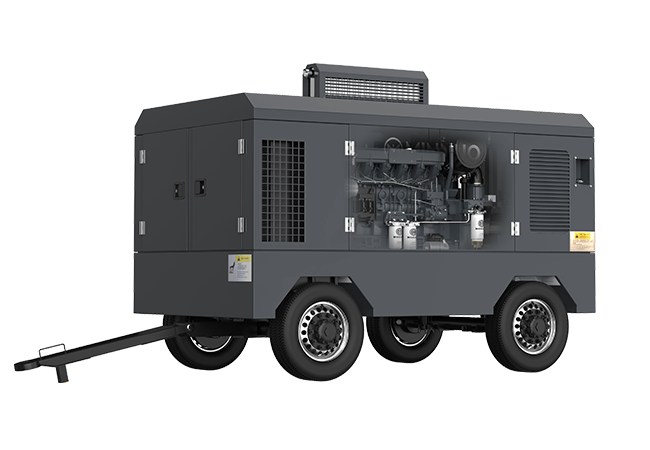
Trailer-Mounted Design: Equipped with standard towing devices for transportation by various vehicles.
Mobility Optimization: High ground clearance and reinforced suspension systems adapt to complex terrains.
Rapid Deployment Capability: Ready for operation within 15 minutes of arrival on-site.
2.2 Strong Environmental Adaptability
Wide Temperature Range Operation: Functions normally in ambient temperatures from -20°C to 50°C.
High-Altitude Performance: Special designs maintain over 90% power output at altitudes above 3,000 meters.
Dust and Water Resistance: Critical components with IP55 protection ratings adapt to dusty and humid environments.
Vibration Resistance: Reinforced structural designs and vibration reduction measures adapt to bumpy road transport.
2.3 High Reliability Assurance
Critical Component Redundancy: Dual fuel filtration, dual air filtration systems.
Fail-Safe Design: Multiple protection systems ensure safe shutdown under abnormal conditions.
Durable Material Applications: Critical components made from wear-resistant and corrosion-resistant materials.
Long-Life Design: Overhaul intervals up to 10,000 operating hours.
III. Application Scenario Analysis
3.1 Mining Operations
In open-pit and underground mining operations, diesel air compressors provide power for rock drills, down-the-hole hammers, and other equipment. Special explosion-proof designs and reinforced structures ensure safe operation in harsh working conditions. High-capacity models can supply air to multiple devices simultaneously, supporting continuous mining operations.
3.2 Infrastructure Construction
Infrastructure projects such as roads, railways, and bridges are often located in remote areas. Diesel air compressors provide reliable power for equipment like hydraulic breakers and compactors. Mobility convenience supports rapid transfer between different work sites, improving equipment utilization.
3.3 Emergency Rescue
In disaster relief operations such as earthquakes and floods, diesel air compressors provide power for life detectors and rescue tools. Quick start-up and stable operation are particularly critical in emergencies. Some models also feature power generation capabilities, enabling multi-purpose use.
3.4 Agricultural Irrigation
In farmland areas without power grid coverage, diesel air compressors drive sprinkler irrigation systems, supporting large-scale agricultural irrigation. Fuel-efficient designs reduce operating costs, making them suitable for long-term continuous operation.
IV. Environmental and Energy Efficiency Innovations
4.1 Emission Control Technology
Modern diesel air compressors commonly employ the following technologies to reduce emissions:
Exhaust Gas Recirculation Systems: Reduce nitrogen oxide emissions.
Diesel Particulate Filters: Capture particulate matter emissions.
Selective Catalytic Reduction: Further reduce nitrogen oxides.
Ultra-Low Sulfur Diesel Adaptation: Use ultra-low sulfur diesel to reduce sulfide emissions.
4.2 Noise Control
Through multi-stage noise reduction technology and soundproof enclosures, operating noise is controlled below 85 decibels, meeting noise requirements for most work environments. Vibration isolation technology reduces noise transmission.
4.3 Energy Efficiency Improvements
Variable Displacement Technology: Automatically adjusts output based on air demand.
Waste Heat Recovery: Recovers engine waste heat for equipment preheating or space heating.
Intelligent Start-Stop: Automatically enters low-power mode during standby.
V. Intelligent Control Systems
5.1 Operation Monitoring
Equipped with color touchscreen controllers that display real-time operating parameters and fault information. Key parameters include:
Engine speed, water temperature, oil pressure.
Compressor discharge pressure, temperature.
Fuel consumption, operating hours.
Maintenance reminders, fault codes.
5.2 Remote Management
Supports GPRS/4G remote monitoring, enabling:
Remote start-stop control.
Real-time transmission of operational data.
Remote fault diagnostics.
Electronic fencing and anti-theft alarms.
5.3 Intelligent Protection
Multi-layered protection systems ensure equipment safety:
Engine Protection: Overspeed, high temperature, low oil pressure protection.
Compressor Protection: Overpressure, high temperature, overload protection.
System Protection: Low oil, low water, abnormal voltage protection.
VI. Maintenance System
6.1 Daily Maintenance
Establish standardized daily inspection procedures, including:
Checking oil and water levels before daily start-up.
Inspecting belt tension and wear.
Cleaning air filters.
Draining condensate from air receivers.
6.2 Regular Maintenance
Develop maintenance plans based on operating hours:
Change oil and filters every 250 hours.
Inspect valves and seals every 500 hours.
Conduct comprehensive inspection and adjustment every 1,000 hours.
Perform deep maintenance every 2,000 hours.
6.3 Professional Services
Manufacturers provide professional service support:
Operator training.
Regular inspection services.
Rapid repair response.
Genuine spare parts supply.
VII. Purchasing Guide
7.1 Selection Considerations
Choose appropriate models based on actual needs:
Air Delivery Requirements: Consider total air consumption of simultaneously operating equipment.
Working Pressure: Match the working pressure requirements of tools and equipment.
Mobility Frequency: Choose trailer-mounted models for high mobility; stationary use may opt for cabinet-style units.
Environmental Conditions: Select models with appropriate protection ratings for special environments.
7.2 Configuration Choices
Engine Brand: Choose brands with good reliability and service networks.
Control System: Select intelligent control levels based on management needs.
Accessory Configuration: Optional dryers, filters, and other accessories as needed.
Safety Devices: Ensure comprehensive safety protection systems are included.
7.3 Economic Evaluation
Comprehensively consider the following factors:
Initial purchase cost.
Fuel consumption costs.
Maintenance expenses.
Equipment service life.
Residual value estimation.
VIII. Future Development Trends
8.1 Hybrid Technology
Diesel-electric hybrid systems combine the power of diesel engines with the economy of electric motors. Electric motors are used under low loads, while diesel engines are activated under high loads, significantly reducing fuel consumption and emissions.
8.2 Intelligent Upgrades
Utilize IoT and big data technologies to achieve:
Cloud storage and analysis of operational data.
Predictive maintenance forecasting.
Energy efficiency optimization recommendations.
Remote software upgrades.
8.3 Clean Energy Applications
Bio-diesel compatibility design.
Hydrogen fuel engine research and development.
Energy recovery system optimization.
Conclusion: An Indispensable Mobile Power Source
The irreplaceability of diesel air compressors in special working conditions ensures they will remain important for the foreseeable future. With technological progress, diesel air compressors are becoming cleaner, smarter, and more efficient. Choosing the right diesel air compressor can not only meet current operational needs but also provide reliable support for future development.
Manufacturers should continue to innovate, actively adopting new technologies while maintaining traditional advantages to enhance product competitiveness. Users should select models scientifically based on actual needs, standardize usage, and fully utilize equipment efficiency. In non-electric or power-deficient work environments, diesel air compressors will continue to play an indispensable and vital role.
FAQ
Q1: What scenarios are diesel air compressors mainly suitable for?
A1: They are ideal for sites without grid power, including open-pit & underground mining, remote road/bridge construction, earthquake/flood emergency rescue and off-grid agricultural irrigation projects.
Q2: Can diesel air compressors work normally at high altitudes and low temperatures?
A2: Yes. Special high-altitude design keeps over 90% power above 3000m, and stable operation is supported under -20℃ ~ 50℃ ambient temperature.
Q3: What emission treatment configurations do modern diesel compressors have?
A3: Equipped with EGR, DPF and SCR systems, they cut NOx and particulate emissions, complying with mainstream global environmental standards.
Q4: Does the diesel air compressor support remote monitoring and anti-theft functions?
A4: Yes. Built-in 4G/GPRS module realizes real-time data transmission, remote start/stop, fault diagnosis and electronic fence anti-theft alarm.
 Email
Email sales:+86 15952631531