Mining operations consume enormous volumes of compressed air. Underground, pneumatic drills and loaders depend on it. In processing plants, instrument air keeps valves operating and controls responding. At exploration camps, compressors power drills and sampling equipment. Yet the conditions at these sites punish equipment relentlessly. Abrasive dust penetrates every opening. Elevations above 10,000 feet rob compressors of mass flow capacity. And when a compressor fails hundreds of kilometers from the nearest service center, production stops until a technician arrives. Selecting a screw compressor that survives these conditions requires understanding the specific challenges and engineering solutions that separate mining-duty machines from standard industrial units.
I. The Three Environmental Challenges
Mining environments attack compressors through three primary mechanisms, each requiring specific design responses.
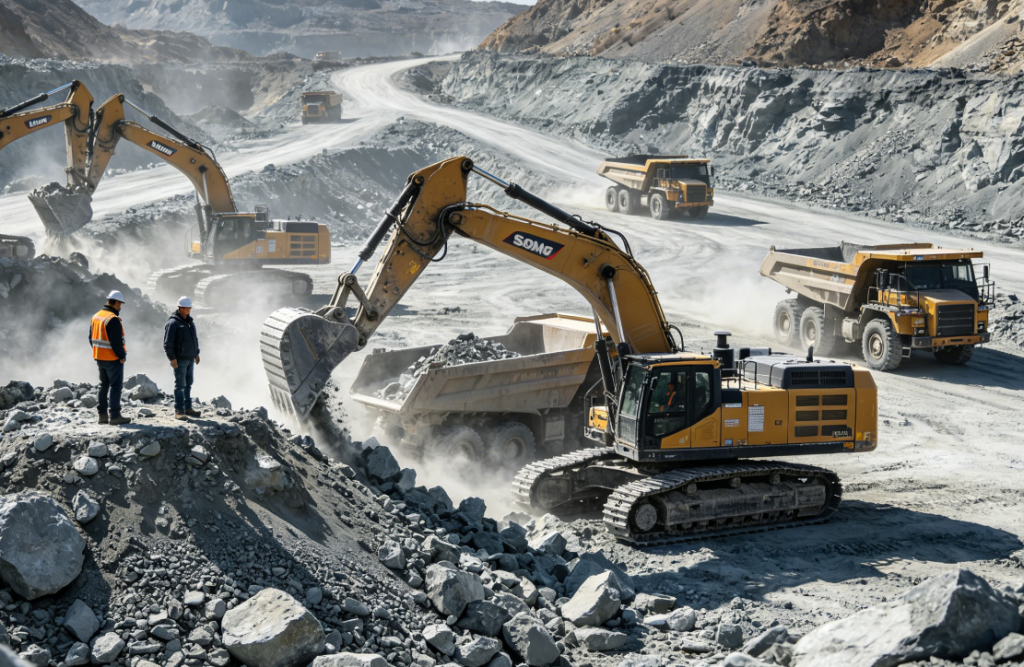
Dust is the most visible and destructive challenge. Mine dust is not ordinary industrial dirt. It consists of hard, sharp-edged mineral particles ranging from sub-micron to coarse grit. Underground, coal dust adds combustibility concerns. In mineral processing, silica dust poses both equipment and health hazards. Surface mines generate clouds of overburden dust during excavation and hauling. This dust enters compressor intakes, coats cooler fins, clogs filters, and abrades internal components.
The damage extends beyond the compressor itself. Dust-laden air passing through the intake filter deposits particles throughout the compression system. Contaminants accumulate in oil, accelerating wear on bearings and rotors. They embed in cooler fins, reducing heat transfer and raising operating temperatures. They foul sensors and block condensate drains. A compressor operating in a clean factory environment may run for years without these issues. The same machine in a mining environment without adequate protection can fail within months.
Altitude imposes a different set of challenges. Every 1,000 meters of elevation above sea level reduces air density by approximately 10%. A compressor sized for sea-level operation delivers proportionally less mass flow at altitude. A 500 CFM machine at sea level produces roughly 375 CFM equivalent at 3,000 meters. This capacity loss must be accounted for in equipment sizing—underground operations at high elevations require larger machines to deliver the same effective air volume.
Altitude also affects cooling. Air-cooled compressors rely on ambient air density for heat rejection. Thinner air at elevation removes less heat, raising operating temperatures and potentially triggering thermal shutdowns. Engine-driven compressors lose power at altitude as well—a diesel engine loses approximately 3% of rated output per 300 meters above its rated altitude. Electric motors are less affected but still experience reduced cooling at elevation.
Remoteness compounds both dust and altitude challenges. A mine located hours or days from the nearest service center cannot rely on rapid technician dispatch when equipment fails. Maintenance must be performed by on-site personnel with limited specialized training. Spare parts inventory must be maintained at the mine because ordering parts after a failure means unacceptable downtime. Compressors for remote mining applications must be designed for extended service intervals, simplified maintenance procedures, and maximum reliability.
II. Intake Filtration: The First and Best Defense
In mining service, intake filtration is the single most critical compressor protection system. The investment in proper filtration pays back many times over in extended equipment life and reduced downtime.
A multi-stage filtration approach provides layered protection. The first stage addresses the heaviest dust loading immediately at the intake point. A cyclone pre-cleaner or inertial separator removes the bulk of large particles—typically 85% to 95% of particles above 10 microns—before they reach the primary filter element. This dramatically extends primary filter life by reducing the dust load it must handle. For surface mining applications where visible dust is always present, pre-cleaning is not optional; it is essential to achieving acceptable filter change intervals.
The primary filter element should be specified for the actual dust concentration and particle characteristics at the site. Heavy-duty elements with extended surface area provide longer service life between changes. For underground coal mining, the element must also meet any applicable fire resistance requirements. High-efficiency elements with particulate removal ratings of 99.9% at 3 microns protect the compressor from the fine dust that causes the most internal damage.
A secondary safety filter element, installed downstream of the primary element, provides backup protection during primary filter changes and catches any dust that bypasses a damaged primary element. In mining service, where filter changes occur in dirty conditions, this safety element prevents contamination during the brief period when the primary filter is removed.
Filter condition monitoring is essential in mining applications where dust loading varies widely. A filter service indicator that shows restriction through the element tells operators when to change filters based on actual condition rather than calendar schedule. Changing filters too early wastes filter life and increases maintenance cost. Changing too late increases pressure drop, reducing compressor capacity and efficiency. A remote monitoring option allows filter condition to be tracked from the mine control room, eliminating the need for personnel to physically check gauges in remote locations.
The intake location itself affects filtration burden. Locating the compressor intake on the clean side of the mine site—upwind of dust sources, away from haul roads, elevated above ground level—reduces the dust concentration reaching the filters. This free protection is often overlooked in the rush to install equipment and begin production. Even a few meters of elevation or a simple windbreak can substantially reduce filter loading.
III. Altitude Compensation in Compressor Sizing
Altitude derating affects every aspect of compressor selection for mining applications. Ignoring it results in undersized equipment that cannot meet air demand.
The fundamental issue is mass flow versus volumetric flow. A compressor’s nameplate rating is expressed in volumetric flow at a reference condition—typically inlet cubic feet per minute at standard sea-level conditions. However, the pneumatic equipment consuming compressed air requires a specific mass flow of air to operate. At altitude, the compressor must process a larger volume of thin air to deliver the same mass of compressed air.
The derating factor is approximately 3.5% per 1,000 feet above sea level for typical industrial screw compressors. A 500 CFM machine at sea level delivers roughly 465 CFM equivalent at 5,000 feet, and approximately 430 CFM at 10,000 feet. These are approximate values; specific derating curves from the manufacturer should be consulted for exact sizing.
Compensating for altitude requires specifying a larger compressor than the sea-level air demand would suggest. For a mine at 12,000 feet with a true air demand of 400 CFM, the compressor must be sized for approximately 460 to 480 CFM at sea-level rating to deliver adequate mass flow. This upsizing affects not just the compressor purchase but the entire system—larger piping, larger dryers, larger filters, and higher electrical service capacity.
Engine-driven compressors face a double derating at altitude: the compressor loses capacity due to reduced air density, and the engine loses power output for the same reason. An engine rated for 100 HP at sea level produces roughly 75 HP at 8,000 feet without turbocharging. Turbocharged engines partially compensate for altitude effects and are strongly preferred for high-altitude mining applications.
IV. Cooling System Design for Mining Conditions
Mining compressors must reject heat to an environment that is often hot, dusty, and at reduced air density. Cooling system design must accommodate all three factors simultaneously.
Air-cooled systems are the standard choice for most mining applications due to water scarcity and freezing concerns. However, the cooler core must be specified with significant margin for both dust fouling and altitude derating. An oversized cooler with widely spaced fins resists clogging longer than a compact high-density core, and the extra surface area compensates for reduced heat transfer at elevation. Some mining-duty compressors specify oversized coolers with 20% to 30% additional surface area compared to standard industrial units of the same capacity.
Cooler accessibility for cleaning is a design feature that directly affects field performance. Cooler cores that can be cleaned without disassembling surrounding structure encourage more frequent cleaning. Hinged cooler access panels, quick-release fasteners, and provisions for compressed air or water cleaning lances all reduce the time and effort required to maintain cooling performance.
For underground applications, water-cooled compressors offer advantages where cooling water is available. Heat rejection to water rather than to the mine atmosphere prevents the compressor from raising ambient temperature in confined underground spaces. Water-cooled machines also operate more quietly and eliminate the need for cooling airflow through the compressor enclosure—useful where ventilation capacity is limited. The cooling water system itself requires protection: water quality must be maintained to prevent scaling, and freeze protection must be provided in cold climates.
V. Simplifying Maintenance for Remote Sites
Remote mining operations cannot depend on manufacturer service technicians for routine maintenance. The compressor must be designed so that on-site personnel with basic mechanical skills can perform all routine service tasks.
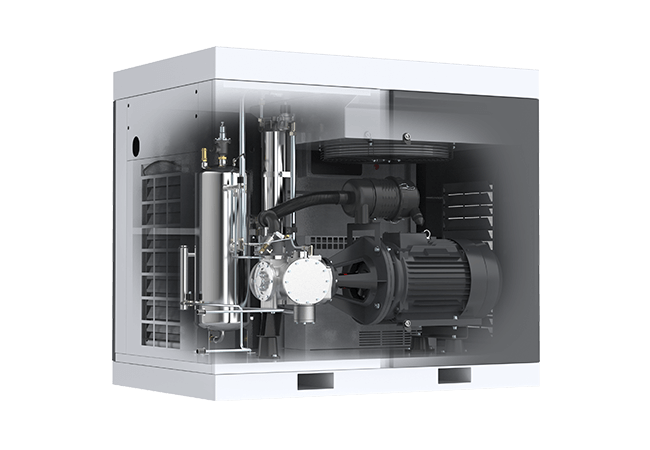
Maintenance access drives design decisions. Spin-on oil filters and separator elements that can be changed with basic hand tools eliminate the need for specialized service equipment. Clear, unambiguous labeling on all service points reduces the risk of error. Color-coded fill caps and drain points, large-print torque specifications on fasteners, and pictorial maintenance instructions mounted on the machine all help less-experienced personnel perform service correctly.
Oil analysis is particularly valuable for remote compressors because it provides early warning of developing problems without requiring disassembly. A quarterly oil sampling program can detect bearing wear, dust ingress, and oil degradation before symptoms appear externally. The sampling kit should include everything needed—sample bottles, tubing, mailing containers, and instructions—so that site personnel need only follow a simple procedure.
Critical spare parts must be maintained in on-site inventory because waiting for parts shipment after a failure causes unacceptable downtime. The recommended spare parts list for remote mining compressors includes oil filters, air filter elements, separator elements, oil sufficient for one complete change, drive belts if belt-driven, common sensors and switches, drain valve rebuild kits, and gaskets and O-rings for routine service points. The initial spares order should be placed with the compressor purchase to ensure parts are on-site before commissioning.
VI. Portable vs. Stationary Configuration
Mining operations use both portable and stationary screw compressors. The choice depends on application, mine layout, and mobility requirements.
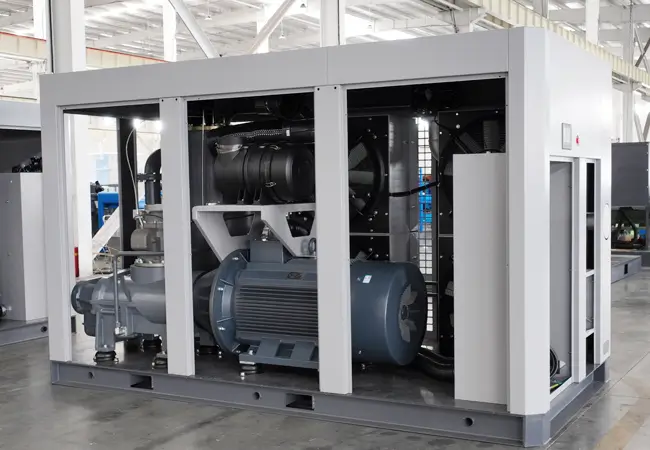
Portable compressors serve exploration drilling, temporary construction, and operations where the compressor moves frequently to follow the work. Modern portable screw compressors are self-contained packages with engine, compressor, cooling, and controls mounted on a trailer or skid. For mining service, the portable package must be ruggedized for rough haul roads, frequent relocation, and outdoor exposure. Heavy-duty running gear, lifting points for crane handling, and weatherproof enclosures are standard features for mining-duty portable units.
Stationary compressors serve permanent installations—processing plants, shaft stations, and fixed utility air systems. These machines are typically electric-motor-driven and installed in a dedicated compressor house or surface building. The stationary configuration allows more extensive environmental protection, including intake air sourced from outside the dust zone, room ventilation for cooling, and permanent piping connections. Electric drive eliminates the fuel logistics and engine maintenance burden of portable units while providing higher reliability for continuous-duty applications.
A middle-ground option increasingly common in mining is the packaged stationary compressor in a weatherproof, transportable enclosure. These units combine the self-contained packaging of a portable compressor with the electric drive and continuous-duty rating of a stationary installation. They can be set on a simple concrete pad, connected to power and air piping, and commissioned in a fraction of the time required for a conventional stationary installation. When mine operations relocate, the packaged unit can be moved with minimal decommissioning and recommissioning effort.
FAQ
Q1: How much does altitude reduce compressor output?
As a general rule, a screw compressor loses approximately 3.5% of its sea-level capacity for every 1,000 feet of elevation gain. This is an approximate figure—manufacturer derating curves for the specific compressor model should be used for accurate sizing. The loss occurs because thinner air contains less oxygen and nitrogen per unit volume, so the compressor processes less mass for the same volumetric throughput.
Q2: Can I use a standard industrial compressor at a mine if I upgrade the filtration?
Upgraded filtration is essential but not sufficient by itself. Standard industrial compressors lack the heavy-duty coolers, reinforced enclosures, and remote-maintenance features required for reliable mining service. While improved filtration will reduce internal contamination, the compressor’s cooling system, structural durability, and maintenance accessibility must also be suitable for continuous duty in a harsh environment.
Q3: What spare parts should a remote mine keep for its compressors?
At minimum: one complete set of air filter elements (primary and safety), two sets of oil filters, one oil separator element, enough oil for one complete change, one set of drive belts if applicable, common sensors and pressure switches, drain valve rebuild kits, and gasket and O-ring sets for routine service. The specific list should be developed with the compressor manufacturer based on the machine model and site conditions.
Q4: Is a diesel or electric compressor better for mining?
For stationary, continuous-duty applications with available grid power, electric drive offers lower operating cost, reduced maintenance, and higher reliability. For portable applications or sites without reliable grid power, diesel drive provides energy independence at the cost of fuel logistics and more intensive maintenance. Dual-drive compressors capable of switching between electric and diesel power are available for applications requiring both stationary efficiency and backup capability.
Q5: How often should I change air filters in a dusty mine environment?
Base filter changes on the restriction indicator, not calendar time. A filter that loads to its maximum allowable restriction in two weeks should be changed every two weeks. An identical filter in a less dusty area may last three months. Changing based on indication rather than schedule ensures filters are replaced when needed—not prematurely, and not after they have begun restricting flow.
Q6: Do mining compressors require special electrical certification for underground use?
Yes. Underground coal mines require electrical equipment certified to MSHA or equivalent standards for permissibility in potentially gassy atmospheres. This certification applies to motors, controls, and all electrical components. Non-coal underground mines may have less stringent requirements but still typically require equipment rated for wet, dusty, and potentially corrosive conditions. Verify applicable certification requirements before specifying equipment for underground installation.
Conclusion
Mining-duty screw compressors must contend with challenges that factory-floor machines never face: abrasive dust, thinning air at elevation, and maintenance support located hours or days away. Success begins with properly specified intake filtration—multi-stage, generously sized, and condition-monitored. It continues with altitude-compensated sizing that ensures the compressor delivers required mass flow at site elevation. And it depends on cooling systems, maintenance accessibility, and spare parts planning that recognize the realities of remote operation.
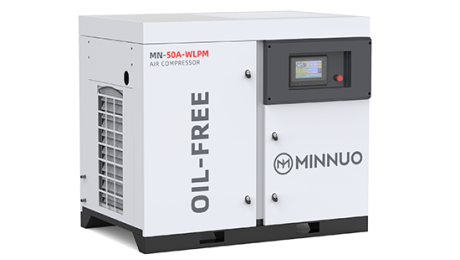
At MINNUO, our screw compressors for mining applications are engineered from the ground up for the conditions in which they operate. Heavy-duty intake filtration with cyclone pre-cleaning, altitude-rated airend sizing, oversized coolers with easy-clean access, and maintenance procedures designed for on-site personnel are standard features of our mining-duty packages. Whether you need a stationary electric compressor for an underground station, a portable diesel unit for exploration drilling, or a packaged machine for a remote processing plant, our engineering team configures solutions matched to your site elevation, dust conditions, and support infrastructure. Every MINNUO mining compressor includes commissioning support, operator training, and a recommended spare parts list tailored to your site’s specific requirements.
 Email
Email sales:+86 15312799623