A CNG filling station takes natural gas from a pipeline, removes the water, compresses it to 25 MPa (250 bar), stores it in high-pressure vessels, and dispenses it into a vehicle cylinder at 200 bar. A fast fill takes three to five minutes. Five stages sit between the pipeline and the vehicle: filtration and metering, dehydration, compression, storage and sequencing, and dispensing. This article walks through each stage and the equipment that performs it.
What is a CNG filling station?
A CNG filling station compresses natural gas and dispenses it as vehicle fuel. CNG stands for compressed natural gas, which is methane held at high pressure rather than cooled into a liquid. LNG takes the other route and liquefies at around −162 °C. CNG stays a gas throughout and is simply squeezed.
Two pressures define the station. Storage and dispensing run at 25 MPa, or 250 bar. Vehicle cylinders are rated to 20 MPa, or 200 bar, working pressure under ISO 11439. That pressure difference is what pushes gas into the vehicle. A station cannot fill a cylinder above its rating, and the dispenser enforces the limit.
CNG carries an octane rating above 120, so a dedicated CNG engine can run a higher compression ratio than the same engine on gasoline. It also emits less CO2 per unit of energy than gasoline or diesel.
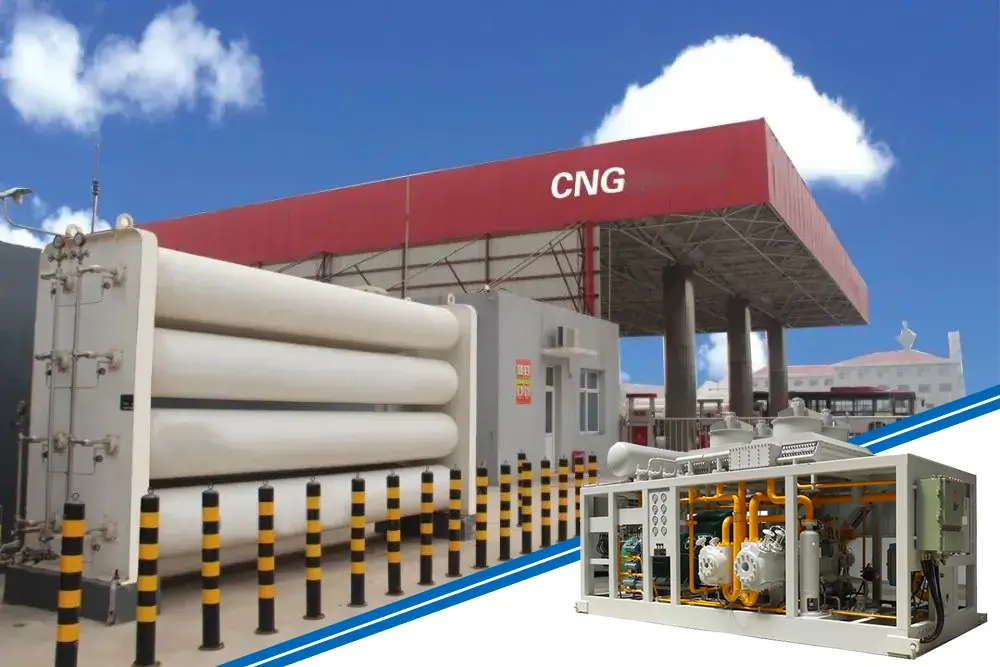
The five stages from pipeline to vehicle
Natural gas reaches the station either from a distribution pipeline or, at a daughter station, from a tube trailer that was filled at a mother station. From that point the route is the same.
- Filtration and metering
- Dehydration
- Compression
- Storage and sequencing
- Dispensing
Filtration and metering: pipeline inlet at 0.4 to 4 MPa
Gas enters through an inlet filter that traps pipe scale, dust and compressor oil carryover. A flow meter measures the volume so the operator can reconcile purchases against sales, and a pressure regulator holds the inlet at a steady value for the stages that follow.
Dehydration: water dew point below −40 °C
Water is the main enemy of a high-pressure gas system. Drop the temperature at 25 MPa with moisture still in the gas and you get ice and gas hydrates inside the storage vessels and the vehicle cylinder. An adsorption dryer passes the gas through a desiccant bed that strips the water vapour out, usually to a dew point below −40 °C. Once the bed saturates it is regenerated with hot gas that carries the moisture away.
Compression: 25 MPa at the discharge
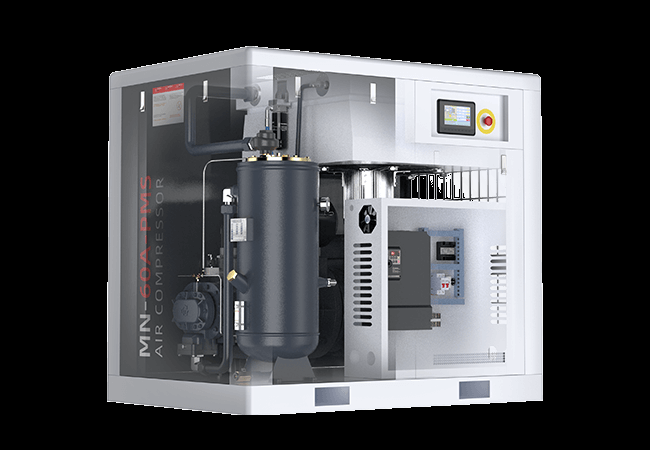
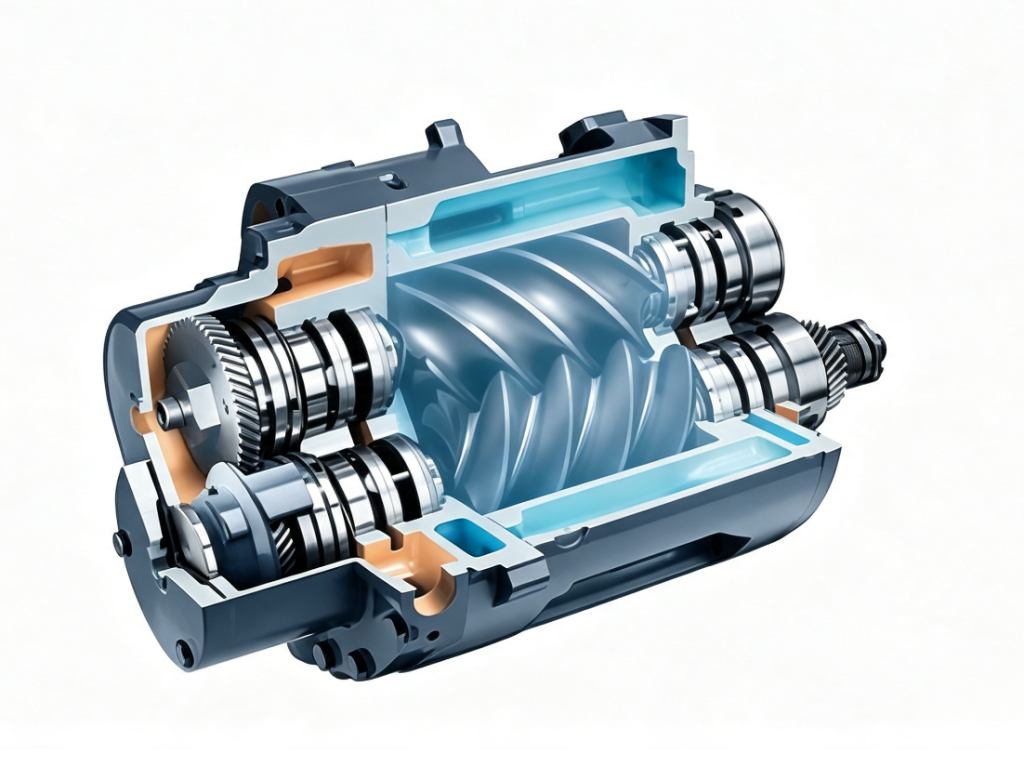
A reciprocating compressor does the actual work. It pulls the dried gas in at pipeline pressure and raises it to 25 MPa. On a station of any size this is a multi-stage machine, because compressing from a few bar to 250 bar in one step would drive the discharge temperature far too high. Intercoolers between stages bring the gas back down, and the discharge is cooled again before it reaches storage.
This compressor is the heart of the station. Its reliability sets the station’s uptime and its efficiency sets the operating cost, which is why the selection method matters more here than anywhere else on site. Minnuo builds CNG compressors for this duty.
Storage and sequencing: high, medium and low pressure banks
A buffer tank first absorbs the pressure pulsation coming off the compressor. The gas then goes into storage, which is either a set of above-ground cylinder banks or, at some sites, a storage well in the ground.
Storage is split into high, medium and low pressure banks, and a priority panel decides where the gas goes. The order matters. Gas flows from the lowest bank that is still above the vehicle pressure, because gas moving from high to low wastes less compression energy than gas moving straight from the compressor. The panel fills low first, then medium, then high, and reverses that order when dispensing.
Dispensing: 200 bar into the vehicle in three to five minutes
The dispenser, also called a filling machine, is what the driver actually touches. It meters the gas, controls the flow rate, compensates for the temperature rise that happens during a fast fill, and shuts off automatically when the vehicle cylinder reaches its rated pressure. A fast fill takes three to five minutes. A slow fill, used at depots overnight, runs at lower flow and needs no storage banks at all.
What equipment does a CNG filling station use?
| Equipment | Function | Typical figure |
|---|---|---|
| Inlet filter, meter and regulator | Removes particulates, measures volume, stabilises inlet pressure | 0.4 to 4 MPa inlet |
| Adsorption dryer | Removes water vapour before compression | Dew point below −40 °C |
| Reciprocating compressor | Raises gas from pipeline pressure to storage pressure | 25 MPa discharge, multi-stage |
| Buffer tank | Damps compressor pulsation | 25 MPa |
| Priority (sequence) panel | Routes gas to the lowest bank that is still above vehicle pressure | High, medium, low |
| Storage banks | Holds compressed gas to cover peak dispensing | 25 MPa, cylinder set or well |
| Dispenser | Meters gas into the vehicle and enforces the pressure limit | 200 bar vehicle fill |
Which station type do you need?
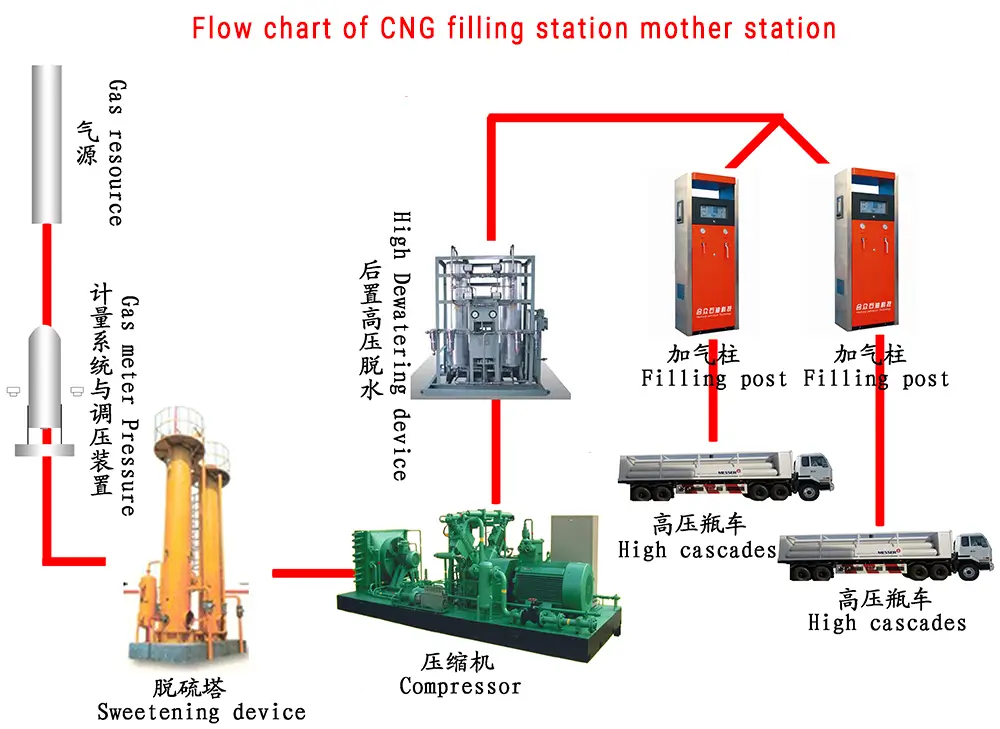
There are three, and they are distinguished by where the gas comes from rather than by size. A conventional station sits on a pipeline and takes gas directly. A mother station also sits on a pipeline, but it additionally fills tube trailers that carry gas out to daughter stations. A daughter station has no pipeline at all and runs entirely on what the trailers deliver, so it needs storage and a small compressor but no gas treatment train.
The three types differ enough in equipment and cost that they are covered separately. Compare the three types of CNG refueling stations.
Filling speed cuts across all three. Fast fill uses large storage banks so the vehicle can be filled in minutes. Slow or time fill skips storage and compresses directly into the vehicle over hours, which suits bus and truck depots where vehicles park overnight anyway.
How does a CNG station stay safe?
Natural gas ignites at a higher temperature and over a narrower range of concentrations than gasoline vapour, which makes it forgiving in some ways and dangerous in others. Methane is lighter than air, so a leak disperses upward instead of pooling. The problem is pressure. Everything downstream of the compressor holds 250 bar, and stored energy at that pressure is the real hazard.
The rules that follow are the ones every station enforces, and they come from the same logic.
- No smoking and no open flame anywhere on site.
- Vehicles entering the station are limited to 5 km/h.
- Passengers leave the vehicle outside the refuelling area.
- The engine and all electrical equipment are switched off before refuelling begins.
- Mobile phones are not used in the production or refuelling area.
- Only trained staff fill cylinders, and no cylinder with a known defect is filled.
- Staff in the hazardous area avoid synthetic clothing and footwear with metal nails, both of which can generate a spark.
- Operators hold a CNG filling qualification from the company and the local authority before working unsupervised.
Station design follows ISO 16923, and the dispensing equipment follows NFPA 52. The cylinders on the vehicles are covered by ISO 11439, and the compressors themselves are usually specified to API 618.
What does a CNG filling station cost?
Cost depends far more on the station type and the storage volume than on the compressor alone. A daughter station avoids the gas treatment train entirely and costs a fraction of a conventional station, while adding storage banks to serve more vehicles a day moves the number again. Compressor capacity, storage volume, the electrical supply, permits and land all land in the same budget.
See the full breakdown of CNG filling station costs.
Which compressor does the station run on?
Nearly every CNG station uses a reciprocating compressor. The alternative, a centrifugal machine, suits very large flows and is rare at vehicle fuelling scale. Within reciprocating machines the decisions that matter are the number of stages, the intercooling arrangement, the sealing method and the duty cycle, because a station compressor cycles far more often than a process compressor of the same size.
How to choose a natural gas compressor covers that comparison, and the CNG compressor range lists the configurations built for station duty.
FAQ
How much pressure does a CNG filling station use?
Storage and dispensing run at 25 MPa (250 bar). Vehicles fill to 20 MPa (200 bar) working pressure.
How long does it take to fill a CNG vehicle?
Three to five minutes on a fast fill. A slow or time fill takes several hours and is used at depots where vehicles park overnight.
Does a CNG station need a natural gas pipeline?
Not always. A daughter station has no pipeline and runs on tube trailers filled at a mother station.
What is the difference between CNG and LNG?
CNG stays a gas and is compressed to 25 MPa. LNG is cooled to about −162 °C until it becomes a liquid, which stores more energy per unit volume but needs cryogenic tanks.