Introduction: Where Compression Meets Thermodynamics
In foundries battling intense heat, precision electronics facilities, and bustling food processing plants, a special category of air compressors performs a remarkable dual function—they serve as both power sources for compressed air and as the “beating heart” of industrial refrigeration. This is the refrigeration air compressor: a technological marvel that seamlessly integrates gas compression with advanced thermodynamics.
I. Working Principle: The Art of Compression and Expansion
The core technology of refrigeration compressors is founded on the second law of thermodynamics. When air is compressed, according to the ideal gas law (PV=nRT), its temperature and pressure increase proportionally. When this compressed air expands rapidly through specialized devices, its temperature plummets dramatically.
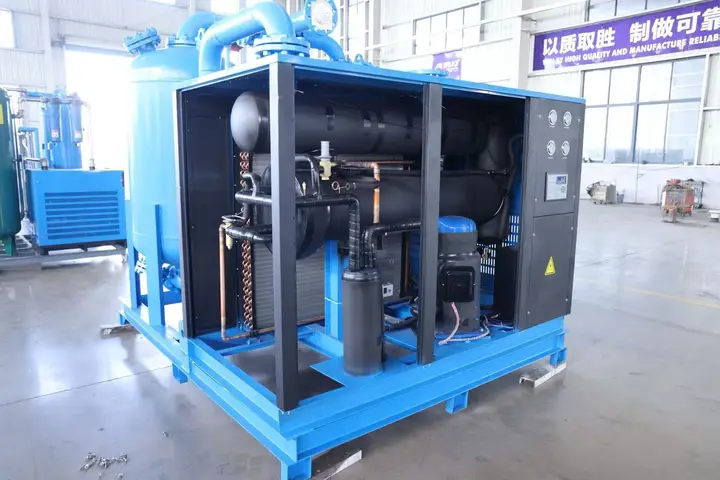
A typical refrigeration system comprises four essential components:
Compressor: Mechanically compresses refrigerant from low-temperature, low-pressure gas to high-temperature, high-pressure gas
Condenser: Cools high-pressure refrigerant into medium-temperature, high-pressure liquid
Expansion Valve: Controls refrigerant flow, causing sudden pressure drop
Evaporator: Liquid refrigerant absorbs heat and evaporates, completing the cooling cycle
This continuous “compression-condensation-expansion-evaporation” cycle enables air compressors to not only generate compressed air but also provide precisely controlled cooling environments.
II. The Energy Efficiency Revolution: From Single-Purpose to Comprehensive Energy Utilization
Traditional industrial cooling systems often operate separately from compressed air systems, resulting in significant energy waste. Modern refrigeration air compressors achieve three major energy efficiency breakthroughs through innovative design:
Heat Recovery and Utilization: Over 90% of waste heat generated during compression can be effectively recovered. One automotive manufacturer’s case study demonstrates how implementing heat recovery technology satisfied 80% of their annual process hot water requirements while reducing overall energy consumption by 15%.
Variable Frequency Smart Control: Utilizing VFD technology, refrigeration compressors can automatically adjust their speed based on actual load demands. In electronics manufacturing applications, VFD systems have demonstrated 30-40% energy savings compared to traditional fixed-speed systems.
Integrated System Optimization: Combining compression, drying, and cooling functions into a unified design reduces piping losses and equipment footprint. One food processing plant reported 40% reduction in equipment space requirements and 25% improvement in energy efficiency after adopting integrated refrigeration compressors.

III. Key Technological Breakthroughs and Applications
1. Precision Temperature Control Technology
In semiconductor manufacturing, refrigeration compressors deliver temperature control accuracy of ±0.1℃. Through multi-stage compression and precise expansion control, they ensure temperature stability during chip production. One wafer fabrication facility achieved temperature fluctuations below 0.3℃ using specialized refrigeration systems, significantly improving product yield rates.
2. Eco-Friendly Refrigerant Applications
Responding to global environmental regulations, new-generation refrigeration compressors increasingly use low-GWP refrigerants such as R32 and R454B. Testing by one refrigeration equipment manufacturer shows that while maintaining cooling efficiency, these new refrigerants reduce global warming potential by 75%.
3. Smart IoT Integration
By incorporating sensors and IoT technology, modern refrigeration compressors enable:
Real-time energy efficiency monitoring and optimization recommendations
Predictive maintenance alerts
Remote fault diagnosis and control
A data center application case study shows that smart control systems reduced average response time for cooling system failures from 4 hours to just 30 minutes.
IV. In-Depth Industry Application Analysis
Food and Pharmaceutical Industries
Maintaining -18℃ in frozen warehouses, refrigeration compressors ensure consistent low temperatures. One major food processor implemented two-stage compression systems, achieving 20% higher freezing efficiency while reducing energy consumption by 18%. Pharmaceutical sterile production lines rely on refrigeration compressors to maintain constant temperature and humidity, ensuring drug quality stability.
Electronics Manufacturing Industry
Chip testing environments require precise temperature control. One semiconductor packaging and testing company implemented compressor group control systems achieving:
Rapid switching between different temperature zones (-40℃ to +85℃)
25% reduction in testing energy consumption
30% improvement in equipment utilization
Automotive Manufacturing Industry
During painting shop drying processes, refrigeration compressors provide temperature-stable air. One automaker’s technology upgrade case shows annual savings of approximately 150,000 cubic meters of natural gas and 350 tons of carbon emissions through efficient heat recovery systems.
V. Selection and Operation Guidelines
Key considerations when selecting refrigeration compressors:
Cooling Capacity Matching: Choose appropriate cooling capacity based on actual needs, typically allowing 10-15% reserve capacity
Energy Efficiency Rating: Prioritize models with COP ≥ 3.5
Environmental Adaptability: Consider installation environment temperature, humidity, and heat dissipation conditions
Maintenance Accessibility: Select modular designs for easier maintenance and upgrades
Operation and maintenance essentials:
Establish regular maintenance schedules including condenser cleaning and refrigerant level checks
Implement energy consumption monitoring to promptly identify anomalies
Develop contingency plans to ensure continuous operation of critical production processes
VI. Future Development Trends
1. Magnetic Bearing Technology Applications
Refrigeration compressors using magnetic levitation bearings eliminate mechanical friction losses, potentially improving efficiency by 10-15%. Testing by one HVAC manufacturer shows magnetic bearing units achieving over 30% energy savings compared to conventional models.
2. AI-Optimized Control Systems
Machine learning-based intelligent control systems can:
Predict load changes and adjust operational parameters proactively
Automatically optimize multi-unit operation strategies
Implement minimum energy consumption operating modes
3. Green Refrigeration Technologies
Combinations of natural refrigerants (CO₂, ammonia) with waste heat power generation are driving refrigeration compressors toward zero-carbon emissions. One demonstration project shows refrigeration systems using CO₂ transcritical cycles achieving COP above 4.0 under specific conditions.
Conclusion: The Innovative Value of Technological Integration
Refrigeration air compressors represent the evolution of industrial equipment from single-function to integrated, intelligent systems. They not only address efficiency bottlenecks in traditional cooling and compression systems but also provide innovative pathways for industrial enterprises to achieve energy conservation and emission reduction. As technology continues to advance, refrigeration compressors will demonstrate their unique value across more industries, promoting the green transformation of industrial production.
For enterprises, investing in efficient refrigeration compressors represents not only equipment upgrades but also innovation in production models and management philosophies. When selecting refrigeration compressors, companies should comprehensively consider current needs and future development, choosing technologically advanced suppliers with complete service systems to ensure optimal return on investment.
FAQ
Q1: What dual functions can refrigeration air compressors realize?
A1: It can generate compressed air for factory power supply and provide stable industrial refrigeration cooling simultaneously.
Q2: How much energy can be saved by VFD refrigeration compressors compared with fixed-speed ones?
A2: VFD models save 30%–40% energy under electronic manufacturing working conditions.
Q3: Which industries are refrigeration air compressors most suitable for?
A3: Widely applied in food pharmacy, semiconductor electronics and automotive manufacturing workshops.
Q4: What advantages do magnetic bearing refrigeration compressors have?
A4: No mechanical friction loss, boosting overall energy efficiency by 10%–15%.
Technical Terminology Reference:
COP (Coefficient of Performance): Measure of refrigeration efficiency
GWP (Global Warming Potential): Measure of greenhouse gas impact
VFD (Variable Frequency Drive): Technology for controlling motor speed
IoT (Internet of Things): Network of connected devices
HVAC (Heating, Ventilation, and Air Conditioning): Climate control systems
Transcritical Cycle: Refrigeration cycle operating above critical point
Industry Standards Compliance:
ISO 5149: Refrigeration and heat pump safety requirements
ASHRAE Standards: Heating, refrigeration, and air-conditioning guidelines
EU F-Gas Regulations: Fluorinated greenhouse gases controls
Energy Star Certification: Energy efficiency recognition program
 Email
Email sales:+86 15366749631