Compressed air is expensive. Producing one horsepower-hour of compressed air consumes seven to eight horsepower-hours of electricity. A single PSI of unnecessary pressure costs approximately 0.5% of the compressor’s total energy consumption. In a typical industrial compressed air system with pressure drops accumulating across dryers, filters, piping, and fittings, ten or more PSI of avoidable loss is common. That represents 5% or more of the compressor’s electricity bill vanishing into friction and restriction—not from a leak to atmosphere, but from resistance to flow within the system itself. Unlike leaks, pressure drop does not announce itself with a hiss. It is silent, systemic, and expensive.
I. Why Pressure Drop Costs So Much
The relationship between pressure and energy consumption is direct and uncompensated. Every unit of pressure lost to friction or restriction is paid for at the compressor motor and never recovered.
The physics is straightforward. A rotary screw compressor consumes more power as discharge pressure increases. The specific power—kilowatts per 100 CFM of output—rises approximately 0.5% for every PSI of additional discharge pressure. A compressor delivering 500 CFM at 100 PSI with a specific power of 22 kW per 100 CFM consumes 110 kW. If the same compressor must deliver air at 110 PSI to overcome 10 PSI of downstream pressure drop, the specific power rises to approximately 23.1 kW per 100 CFM, and the same 500 CFM now costs 115.5 kW—an increase of 5.5 kW for no additional useful output. Over 6,000 operating hours per year at $0.10 per kilowatt-hour, that is an extra $3,300 annually for a single compressor installation.
The downstream equipment does not benefit from the extra pressure. The elevated pressure at the compressor discharge merely compensates for losses in the piping and components between the compressor and the point of use. The pneumatic tool, the air cylinder, the blow-off nozzle receives the same 100 PSI in both scenarios. The additional 5.5 kW produces nothing. It is pure waste.
This dynamic explains why pressure drop reduction is among the most cost-effective energy conservation measures available to compressed air system operators. The savings come from reducing the compressor’s discharge pressure, which requires eliminating the downstream losses that forced the pressure to be elevated in the first place.
II. Where Pressure Drop Hides
Pressure drop accumulates at every point where compressed air flows through a restriction. Identifying the major contributors requires walking the system from compressor to point of use.
Piping is the largest single source of pressure drop in many systems. Undersized pipe forces high air velocities, and pressure drop increases with the square of velocity. A pipe carrying air at 30 meters per second loses four times as much pressure over a given length as the same pipe carrying air at 15 meters per second. Systems that were sized for an original installation and subsequently expanded often have piping that was adequate for the initial flow but is undersized for current demand.
Fittings, valves, and connectors introduce localized pressure drops that add to the piping losses. An elbow, a tee, a reducer, a partially closed isolation valve—each creates turbulence and flow separation that dissipates energy. A single threaded elbow can impose as much flow resistance as several feet of straight pipe. A system with many bends, expansions, and contractions accumulates significant loss across these features.
Filtration elements are deliberate restrictions in the air flow path. A clean filter element has a specified pressure drop at rated flow, typically 0.5 to 2 PSI. As the element loads with contaminants, the pressure drop rises. An element left in service beyond its recommended differential pressure limit can impose 5 to 10 PSI of additional loss before the restriction becomes visible to the operator.
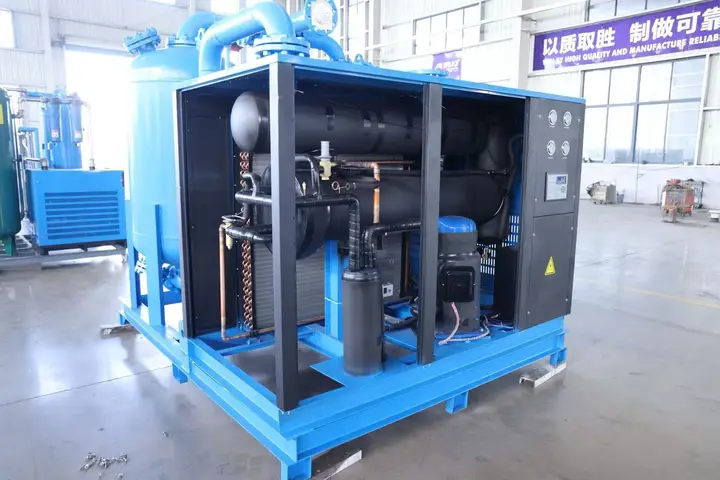
Air dryers impose a pressure drop that varies by type and condition. A refrigerated dryer typically adds 1 to 3 PSI of pressure loss. A desiccant dryer adds 2 to 5 PSI. As desiccant ages and dust accumulates, the pressure drop can increase. The dryer’s internal passages, heat exchangers, and desiccant beds all contribute.
Compressed air receivers and moisture separators impose relatively small pressure losses when properly sized, but undersized vessels with high internal velocities can introduce measurable restriction.
III. Quantifying Pressure Drop Across the System
Measuring pressure drop requires pressure readings at multiple points in the system under normal operating conditions. The pattern of pressure differences reveals where losses are concentrated.
The compressor discharge pressure is the reference point. This pressure is set to maintain the minimum required at the furthest or most demanding user. A pressure gauge or transmitter at the compressor package discharge, another at the dryer inlet, another at the dryer outlet, and additional readings at the main header, at major branch takeoffs, and at representative points of use provide the data for a pressure profile.
The difference between the compressor discharge pressure and the pressure at the furthest point of use is the total system pressure drop. Individual component drops are calculated by subtracting downstream pressures from upstream pressures. The dryer pressure drop is the difference between the dryer inlet and outlet readings. The filtration pressure drop is the difference across the filter housing. The piping pressure drop is the difference between the main header pressure near the compressor and the pressure at the end of the longest branch.
A well-designed system operating at design flow should have a total pressure drop from compressor discharge to point of use of no more than 5% to 10% of the operating pressure. A 100 PSI system should see 5 to 10 PSI of total drop. Systems with 15 or 20 PSI of pressure drop have identifiable losses that can be reduced with targeted modifications.
IV. Reducing Piping Losses
Piping pressure drop reduction offers the largest and most permanent savings, but it is also the most capital-intensive improvement. The decision to replace piping should be informed by a clear calculation of the energy savings.
Increasing pipe diameter reduces air velocity and therefore reduces pressure drop. The relationship is dramatic: doubling the pipe diameter reduces the pressure drop per unit length by a factor of approximately 32 at the same flow rate. A 2-inch line operating at high velocity and losing 5 PSI over its length would lose less than 0.2 PSI if replaced with a 3-inch line.
A loop distribution system provides two paths for air to reach any user, reducing the effective flow through each pipe section and lowering pressure drop. The loop also provides redundancy: if a section must be isolated for maintenance, users continue to receive air from the other direction.
Minimizing fittings by designing pipe runs with gentle bends rather than sharp elbows, using full-port valves instead of reduced-port, and avoiding unnecessary adapters and reducers reduces the cumulative fitting losses that can equal or exceed the straight-pipe loss in systems with complex piping geometries.
V. Managing Filtration and Dryer Losses
Filtration and dryer pressure losses are controllable through proper specification and maintenance.
Specifying filters with low initial pressure drop—high-quality elements with generous surface area—reduces the baseline restriction. The initial cost premium for low-pressure-drop elements is typically recovered within months through energy savings.
Replacing filter elements based on differential pressure indication rather than calendar schedule prevents operation with loaded elements that impose excessive restriction. A differential pressure gauge or transmitter across each filter stage provides the indication needed to make condition-based replacement decisions. When the pressure drop reaches the manufacturer’s recommended maximum, the element is replaced regardless of how many hours it has been in service.
Dryer selection reflects a trade-off between air quality and pressure drop. A desiccant dryer imposes more restriction than a refrigerated dryer but delivers lower dew point. For applications requiring minus 40 degree Fahrenheit dew point, a heated purge or blower purge desiccant dryer with low pressure drop design reduces the energy penalty compared to a heatless dryer. For applications where refrigerated drying is adequate, the lower pressure drop of a refrigerated unit makes it the more energy-efficient choice.
VI. System Pressure Optimization
Reducing pressure drop enables a lower compressor discharge pressure setpoint, which captures the energy savings. The sequence is important: first reduce the losses, then reduce the pressure. Reducing pressure without first addressing losses risks starving the furthest users of adequate pressure.
After pressure drop reductions are implemented, the compressor discharge pressure can be lowered to maintain the same minimum pressure at the point of use as before the improvements. A system that previously required 110 PSI at the compressor to deliver 95 PSI to the furthest user, after piping and filtration upgrades that eliminated 8 PSI of loss, can now operate at 102 PSI at the compressor for the same 95 PSI at the user. The 8 PSI reduction in compressor discharge pressure saves approximately 4% of compressor energy consumption.
FAQ
Q1: How can I measure pressure drop without installing permanent gauges?
A single calibrated pressure gauge with a needle valve and a length of flexible tubing can be moved from point to point to measure static pressure throughout the system. The measurement must be made under stable operating conditions with representative air demand. Record the pressure at each location and calculate the differences between upstream and downstream points. This survey provides a snapshot of system pressure losses that can be repeated periodically to track improvements.
Q2: What is a reasonable target for total system pressure drop?
A well-designed compressed air system operating at design flow should have total pressure drop from compressor discharge to point of use of 5% to 10% of the operating pressure, or roughly 5 to 10 PSI for a 100 PSI system. Systems achieving less than 5% pressure drop are excellent. Systems exceeding 10% have identifiable and economically correctable losses.
Q3: At what point does piping replacement make economic sense?
Piping replacement economics depend on the energy cost, the operating hours, and the pressure drop reduction achievable. For a system with 8 PSI of piping pressure loss that can be reduced to 2 PSI through larger pipe, the 6 PSI reduction saves approximately 3% of compressor energy. For a 75 kW compressor operating 6,000 hours per year, the annual savings of $1,350 at $0.10 per kilowatt-hour provide a basis for evaluating piping replacement cost. When piping replacement aligns with other needs—system expansion, corroded pipe replacement, or facility renovation—the incremental cost of right-sizing the new pipe is modest.
Q4: Do variable speed drive compressors help with pressure drop?
A VSD compressor can reduce energy consumption by matching output to demand, but it cannot eliminate the energy penalty of system pressure drop. If the system requires 10 PSI of additional compressor discharge pressure to overcome downstream losses, the VSD compressor must generate that pressure just as a fixed-speed machine would. The VSD reduces energy when flow demand is below maximum, but it does not escape the physics of pressure drop.
Q5: How often should I replace compressed air filters to minimize pressure drop?
Replace filters based on differential pressure indication, not calendar time. A filter element in a clean environment may last two years before reaching its maximum recommended pressure drop. The same element in a dusty environment may reach the limit in three months. Condition-based replacement ensures filters are changed when needed, not prematurely and not after they have begun imposing excessive restriction on the system.
Q6: Can pressure drop cause operating problems beyond energy waste?
Yes. Excessive pressure drop reduces the pressure available at points of use, which can cause pneumatic equipment to operate slowly or erratically. It can also mask leaks because a system operating at artificially high pressure has a larger pressure differential driving leakage flow. Reducing system pressure after eliminating pressure drops reduces both energy consumption and leakage rates.
Conclusion
Pressure drop is the silent thief in compressed air systems. It steals energy continuously, invisibly, and without the audible warning of a leak. The remedy begins with measurement: knowing where the pressure drops are and quantifying what they cost. It proceeds through targeted action: replacing undersized piping, maintaining filters based on condition rather than calendar, and selecting low-resistance components. The savings are real, predictable, and permanent. For a typical industrial compressed air system, a pressure drop reduction program that eliminates 5 to 10 PSI of unnecessary loss reduces the compressor energy bill by 3% to 5% annually—year after year, for as long as the improvements are maintained.
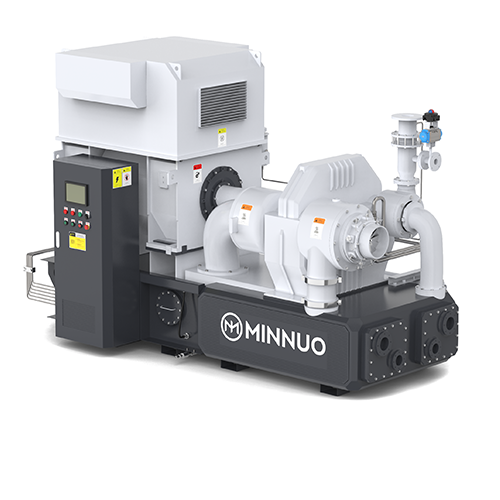
At MINNUO, our compressed air systems are engineered for low pressure drop from the start, with generously sized components, loop-capable distribution designs, and condition-monitored filtration. For existing installations, our service team can perform pressure drop audits that identify where your system’s losses are concentrated and recommend the most cost-effective improvements. Whether you need new low-pressure-drop equipment, piping upgrades, or a complete system optimization, MINNUO provides the technical expertise to reduce your compressed air energy costs through systematic pressure drop management.
 Email
Email sales:+86 15366749631