I. Introduction
Walk into any industrial facility, and you’ll hear the hum of compressed air. But in some plants, that hum is a roar—especially where oil-free screw compressors are running.
Oil-free screw compressors are inherently louder than their oil-flooded counterparts. Without oil to dampen mechanical noise and absorb sound, the rotors, timing gears, and air movement all contribute to higher noise levels. A typical oil-free compressor can produce 80-95 dB(A)—loud enough to require hearing protection for anyone nearby.
But noise doesn’t have to be an inevitable part of oil-free compression. Through careful design—of the compressor itself, its enclosure, and the installation environment—noise levels can be dramatically reduced.
This guide explores the strategies manufacturers and engineers use to quiet oil-free screw compressors, from rotor design to acoustic enclosures to installation best practices.
II. Sources of Noise in Oil-Free Screw Compressors
To reduce noise, you first need to understand where it comes from.
Mechanical noise
The rotors themselves generate noise as air is compressed between them. Without oil to dampen the mechanical action, this noise is more pronounced than in oil-flooded designs. Timing gears, which synchronize the rotors in oil-free compressors, add their own gear meshing noise. Bearings, particularly at high speeds, contribute as well.
Aerodynamic noise
Air moving through the compressor creates sound. Intake air rushing into the inlet can produce significant noise, especially at higher flow rates. The compression process itself generates pressure pulsations that radiate as sound. Discharge air exiting the compressor adds another source.
Cooling system noise
Cooling fans—whether for air-cooled units or cooling towers—are major noise contributors. Air moving across coolers creates turbulence. Fan blades themselves generate noise, particularly at higher speeds. In water-cooled units, pumps and cooling towers add their own sound profile.
Auxiliary components
Motors, especially larger ones, produce electromagnetic and mechanical noise. Belt drives (in some designs) add whine. Valves and controls can click, hiss, or chatter during operation.
Understanding these sources is the first step toward addressing them.
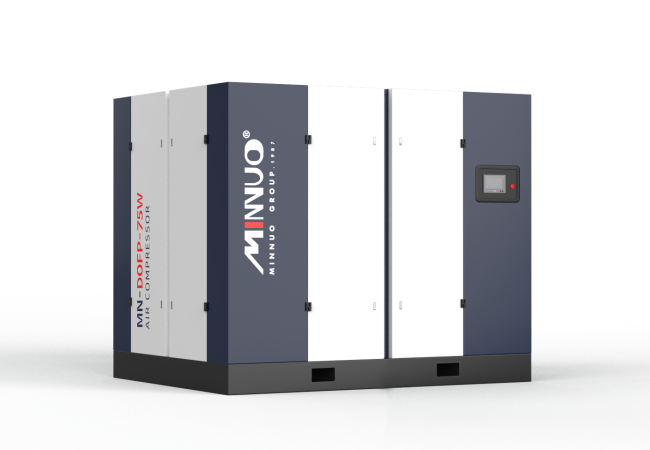
III. Rotor and Component Design for Quiet Operation
The quietest oil-free compressors start with a quiet core.
Rotor profile optimization
Rotor geometry affects both efficiency and noise. Modern rotor profiles are designed using computational fluid dynamics to minimize pressure pulsations—a major source of noise. Tighter tolerances reduce the gap between rotors and housing, which not only improves efficiency but also reduces the “slapping” sound of air passing through larger gaps.
Timing gear refinement
Unlike oil-flooded compressors where rotors contact, oil-free designs rely on timing gears to maintain clearance. Helical gears are quieter than straight-cut gears because they engage more gradually. Precision ground gears with optimized tooth profiles reduce meshing noise. Gear materials and surface treatments also affect noise levels.
Bearing selection
High-quality bearings with tight tolerances reduce vibration and noise. Some manufacturers use specialized bearing materials or designs that dampen vibration rather than transmitting it to the housing.
Multi-stage design
Multi-stage compressors often run quieter than single-stage units of equivalent capacity. Each stage handles a smaller pressure rise, reducing the overall noise generated per stage. The intercoolers between stages also act as sound barriers.
IV. Acoustic Enclosure Design
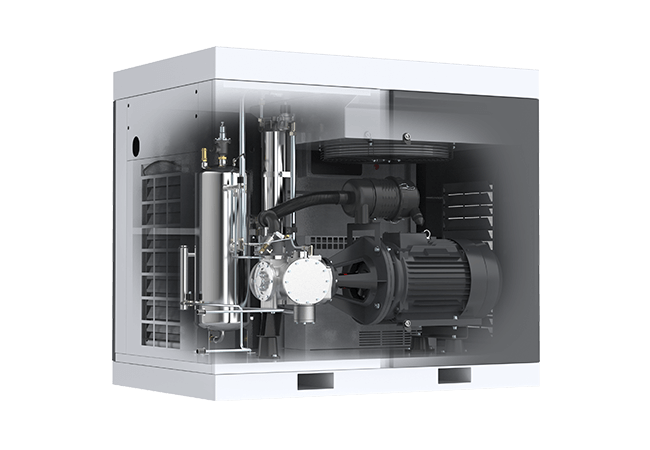
For most oil-free screw compressors, the enclosure is the primary noise control measure.
Enclosure construction
A well-designed enclosure starts with mass. Heavier materials block sound better than lightweight panels. Typical enclosures use steel panels with thickness optimized for sound attenuation. Double-wall construction with an air gap between layers provides additional sound isolation.
Sound-absorbing materials
The interior of the enclosure is lined with acoustic foam or mineral wool. These materials absorb sound energy rather than reflecting it. The thickness, density, and placement of absorbent materials all affect performance. High-quality enclosures use materials rated for both sound absorption and fire resistance.
Seals and gaskets
Even the best enclosure is useless if sound can leak out. Gaskets around doors, seals around pipes and electrical conduits, and tight-fitting panels all prevent sound from escaping. Access doors need robust latches that pull panels tight against seals.
Cooling airflow management
Enclosures must allow cooling air to flow while containing sound. This is one of the most challenging aspects of enclosure design. Inlet and outlet ducts are lined with sound-absorbing materials. Baffles force air to change direction, allowing sound to be absorbed while air passes through. Fans are selected for low noise output.
Service access
A quiet enclosure is useless if it prevents maintenance. Well-designed enclosures provide easy access to service points—filters, drains, oil fill—without removing panels. Hinged doors with quick-release latches allow full access when needed.
V. Intake and Discharge Silencing
Air moving in and out of the compressor is a major noise source that requires specific attention.
Intake silencers
The air intake is often the loudest point on a compressor. Intake silencers work like mufflers on an engine, using expansion chambers and absorbent materials to quiet the incoming air. They must be sized to handle the full flow without creating excessive pressure drop. In very quiet installations, intake silencers may be remotely located or ducted to the outside.
Discharge pulsation dampeners
Compressed air exiting the compressor contains pressure pulsations that generate noise. Pulsation dampeners—essentially small receiver tanks with internal baffles—smooth these pulsations. They’re particularly important in oil-free compressors where oil doesn’t provide damping.
Pipe and hose isolation
Rigid piping connected directly to the compressor transmits vibration and noise throughout the facility. Flexible connections (braided stainless steel hoses) isolate the compressor from the piping system, preventing sound from traveling downstream. These should be used on both intake and discharge connections.
VI. Installation Strategies for Noise Control
How a compressor is installed affects noise as much as the equipment itself.
Location selection
Place compressors away from occupied spaces where possible. If they must be in occupied areas, consider the room acoustics—hard surfaces reflect sound; soft surfaces absorb it. Corner locations can amplify noise; central locations with space around the unit often work better.
Vibration isolation
Compressors generate vibration that can transmit through floors and walls, creating structure-borne noise. Vibration isolators (spring mounts, rubber pads, or inertia bases) decouple the compressor from the building structure. For very quiet installations, an inertia base—a concrete slab poured on isolators—provides the most effective isolation.
Room acoustics
The room itself affects perceived noise. Hard walls, floors, and ceilings reflect sound, making the space seem louder. Acoustic treatments—absorbent panels on walls, dropped ceilings with acoustic tiles, or even strategic placement of equipment—can reduce reflected noise.
Remote mounting of components
For critical noise applications, some components can be located remotely. Intake filters can be placed outside the compressor room. Cooling fans can be mounted on the roof. The compressor itself can be isolated in a dedicated room while controls and service areas are outside.
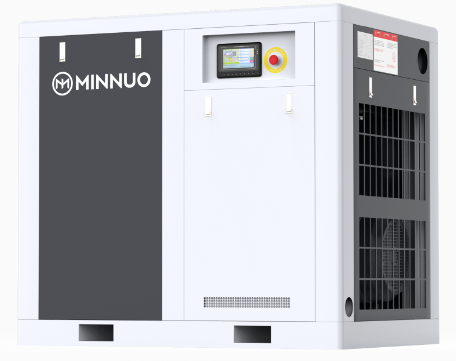
VII. Measuring and Verifying Noise Reduction
You can’t manage what you don’t measure.
Noise measurement standards
Compressor noise is typically measured according to ISO 2151 or similar standards, which specify measurement distances, microphone placement, and operating conditions. Understanding these standards helps when comparing noise specifications from different manufacturers.
Sound pressure vs. sound power
Sound pressure (dB) depends on distance from the source. Sound power is an intrinsic property of the source. When comparing compressors, sound power is the more reliable metric.
Octave band analysis
Total dB tells only part of the story. Octave band analysis breaks noise into frequency ranges, revealing which frequencies dominate. This is valuable for designing targeted noise control measures—low frequencies need mass, high frequencies need absorption.
Commissioning verification
After installation, verify that noise levels meet expectations. Measure at operator positions, adjacent work areas, and outside the compressor room. If levels are higher than expected, identify the specific sources and address them.
FAQ
Q1: How much quieter can a well-designed oil-free compressor be?
A1: A well-designed oil-free compressor with proper enclosure and installation can achieve 70-75 dB(A)—about 15-25 dB lower than an unenclosed unit. Every 3 dB reduction halves the perceived loudness, so this is a substantial improvement.
Q2: What’s the difference between oil-free and oil-flooded noise levels?
A2: Oil-flooded compressors typically run 70-80 dB(A) in enclosures. Oil-free units are inherently louder because oil provides damping. A well-enclosed oil-free compressor can approach the noise level of an oil-flooded unit, but at the same capacity, it will typically be 5-10 dB louder.
Q3: Can I retrofit an existing compressor for quieter operation?
A3: Yes, but with limitations. Adding external sound blankets, improving room acoustics, and adding vibration isolation can help. However, the most effective measures—integrated enclosure, intake silencing, and pulsation dampening—are built into the original design. Retrofitting is usually less effective than specifying a quiet unit from the start.
Q4: Do water-cooled oil-free compressors run quieter than air-cooled?
A4: Generally yes. Water-cooled units eliminate cooling fans, a major noise source. However, they add cooling tower or pump noise elsewhere. In many facilities, central cooling water is already available, making water-cooled the quieter overall choice.
Q5: What’s the quietest location for a compressor?
A5: In a dedicated compressor room with acoustic treatment, away from occupied areas. If the compressor must be in an occupied space, locate it centrally with space around it, not in a corner where sound reflects. Provide vibration isolation from the floor.
Q6: How much does acoustic enclosure add to compressor cost?
A6: A high-quality acoustic enclosure can add 20-40% to the cost of a basic compressor. This includes heavier panels, sound-absorbing materials, specialized cooling ducts, and robust sealing. For noise-sensitive installations, this premium is usually justified.
Q7: Can I use standard air filters for intake silencing?
A7: No. Standard filters are designed for particle removal, not noise reduction. Intake silencers are specifically designed to quiet incoming air. Using a standard filter may even increase noise. Always use proper intake silencers for noise-sensitive installations.
Conclusion
Oil-free screw compressors don’t have to be noisy. Through careful design—of the compressor itself, its enclosure, and its installation—noise levels can be reduced to levels that are comfortable for operators and acceptable for adjacent spaces.
The quietest units start with optimized rotors, precision timing gears, and multi-stage design. Acoustic enclosures with mass, absorbent materials, and effective seals contain the sound. Intake and discharge silencers address the remaining noise sources. And thoughtful installation—vibration isolation, room acoustics, and careful location selection—completes the picture.
For facilities where noise is a concern, the investment in a quiet oil-free compressor pays back in operator comfort, regulatory compliance, and the ability to locate equipment where it’s most convenient.
At MINNUO, we help customers select and install oil-free screw compressors that meet both air quality and noise requirements. From specifying quiet designs to optimizing installation, we focus on solutions that work for your facility—and your people.

 Email
Email sales:+86 15366749631