I. Introduction
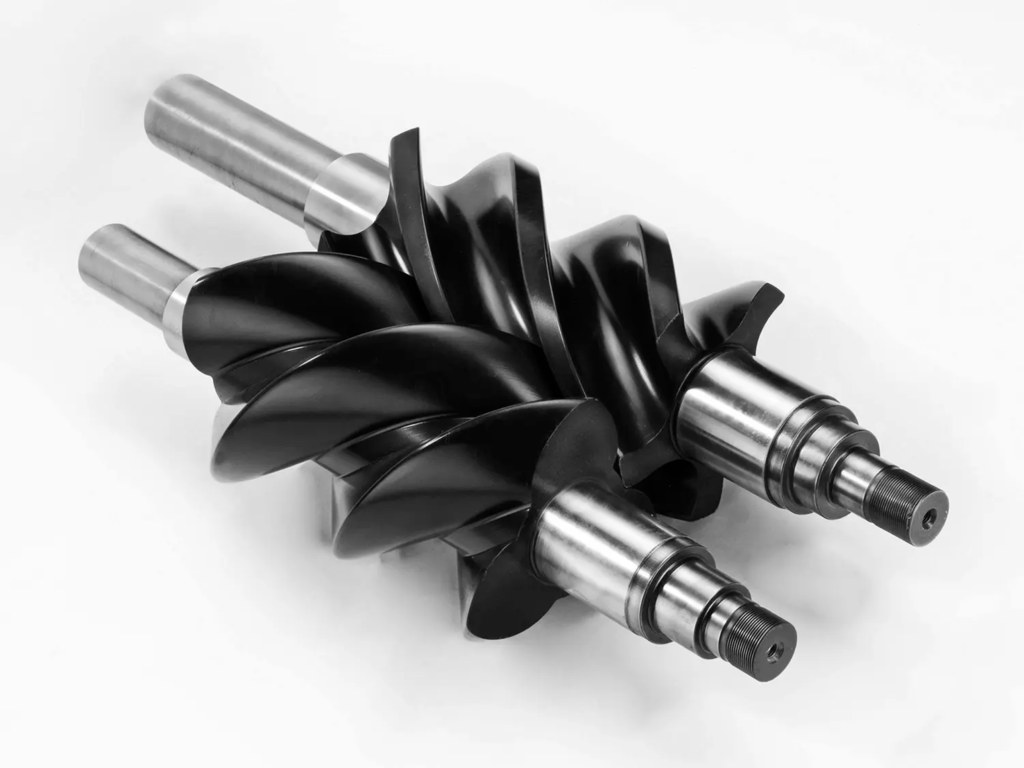
At the heart of every oil-free screw compressor lies a precision-engineered pair of rotors. These intermeshing components spin at high speeds, with microscopic clearances, to compress air without any lubricant in the compression chamber.
They are among the most expensive components in the compressor—often accounting for 30-50% of the machine’s value. And when they wear or fail, the repair cost can approach the cost of a new compressor.
But with proper care, oil-free screw compressor rotors can last 15-20 years or more. The difference between early failure and long service life comes down to how the compressor is operated, maintained, and monitored.
This guide explains the factors that affect rotor life and the practical steps you can take to maximize it.
II. How Oil-Free Screw Compressor Rotors Are Different
To understand how to extend rotor life, you first need to understand what makes oil-free rotors unique.
The design:
In an oil-free screw compressor, the rotors do not touch each other or the housing. Instead, they maintain a precise gap—typically 0.05-0.2 mm—that is sealed by:
- Special coatings on rotor surfaces
- Timing gears that synchronize rotation
- Water injection (in some designs) for sealing and cooling
What makes them vulnerable:
| Component | Vulnerability |
| Rotor coatings | Can wear, chip, or delaminate |
| Timing gears | Must maintain precise alignment |
| Bearings | Subject to wear, affect rotor position |
| Clearances | Extremely tight, sensitive to debris |
Unlike oil-flooded compressors:
Oil-flooded compressors have oil between the rotors and housing, which acts as a seal and cushion. Oil-free compressors lack this protection, making them more sensitive to operating conditions.
III. The #1 Killer: Contaminated Inlet Air
If you remember only one thing from this guide, make it this: protect your inlet air.
What contaminants do to rotors:
| Contaminant | Effect |
| Dust | Abrades rotor coatings, erodes surfaces |
| Moisture | Causes corrosion, can freeze in cold conditions |
| Oil vapor | Coats rotors, attracts particles, degrades coatings |
| Chemical vapors | Attack coatings and rotor materials |
| Salt (marine) | Corrosive, accelerates wear |
The result:
Contaminants wear away the thin coatings that provide sealing. Once the coating is compromised, clearances open up, efficiency drops, and eventually the rotors may seize or fail.
Protection strategies:
| Measure | Purpose |
| High-quality intake filters | Remove particles down to 1 micron or less |
| Filter maintenance | Replace before pressure drop increases |
| Intake location | Away from dust, exhaust, chemical vapors |
| Pre-filtration | In harsh environments, consider additional filters |
| Inlet air temperature | Avoid excessive heat (degrades coatings) |
IV. Temperature Management
Oil-free compressors run hotter than oil-flooded units. Managing temperature is critical for rotor life.
Why temperature matters:
- Excessive heat accelerates coating degradation
- High temperatures cause thermal expansion, affecting clearances
- Temperature cycles cause stress on coatings
Optimal operating range:
| Parameter | Range |
| Discharge temperature | 150-200°C (typical) |
| Maximum sustained | Follow manufacturer spec |
| Cooling water temperature | 20-35°C (water-cooled) |
| Ambient temperature | 5-40°C (air-cooled) |
Cooling system care:
- Air-cooled: Keep cooling fins clean; ensure adequate ventilation
- Water-cooled: Maintain water quality; prevent scaling
- Intercoolers: Clean periodically to maintain efficiency
What to watch:
- Sudden temperature increases indicate problems
- Gradual increases suggest fouling or wear
- Temperature differential across stages indicates intercooler issues
V. Precision: Timing Gears and Bearings
Oil-free rotors rely on timing gears to maintain precise synchronization. Any deviation affects rotor clearance and life.
Timing gear considerations:
| Factor | Impact |
| Lubrication | Gears require proper oil; use specified lubricant |
| Backlash | Excessive clearance affects rotor timing |
| Wear | Worn gears cause rotor contact |
Bearing life:
Bearings position the rotors. Worn bearings allow rotors to move, reducing clearance and potentially causing contact.
Signs of bearing or gear issues:
- Unusual noise (rumbling, whining)
- Increased vibration
- Temperature rise
- Performance loss
Prevention:
- Follow lubrication schedules precisely
- Use oil analysis to monitor bearing wear
- Address unusual noise immediately—don’t wait
VI. Operating Practices That Protect Rotors
How you run the compressor affects rotor life.
Avoid frequent starts and stops:
Every start-up causes thermal expansion cycles. Frequent cycling accelerates wear.
- For variable loads, consider VSD (variable speed drive) rather than start/stop
- If cycling is unavoidable, ensure proper cool-down periods
Run within design limits:
| Practice | Reason |
| Don’t exceed rated pressure | Higher pressure increases load |
| Don’t exceed rated temperature | Heat accelerates wear |
| Respect duty cycle | Allow cool-down if not rated for continuous |
Warm-up and cool-down:
- Allow warm-up before loading
- Allow cool-down before shutdown
- Avoid rapid pressure changes
Unloaded operation:
Extended unloaded operation can cause overheating in some designs. Follow manufacturer recommendations.
VII. Monitoring and Predictive Maintenance
The best way to extend rotor life is to catch problems before they cause damage.
What to monitor:
| Parameter | What It Tells You |
| Vibration | Bearing wear, imbalance, rotor contact |
| Temperature | Cooling issues, internal wear |
| Pressure | Performance degradation |
| Current draw | Efficiency loss, increased load |
| Oil analysis (timing gears) | Wear metals, contamination |
Vibration monitoring:
- Install permanent sensors or use portable analyzers
- Track overall vibration levels and specific frequencies
- Sudden changes indicate problems
Oil analysis:
For compressors with oil-lubricated timing gears:
- Sample regularly
- Watch for wear metals (iron, copper, lead)
- Detect contamination before damage
Performance trending:
- Track specific power (kW per 100 CFM)
- Efficiency loss often precedes catastrophic failure
Establish baselines:
Record vibration, temperature, and performance when the compressor is new. Compare over time to detect deterioration.
FAQ
Q1: How long should oil-free screw compressor rotors last?
A1: With proper operation and maintenance, 15-20 years is typical. Some last 25+ years. Factors affecting life: inlet air quality, operating temperature, duty cycle, and maintenance quality.
Q2: What are the first signs of rotor wear?
A2: Gradual efficiency loss (higher power consumption for same output), increased vibration, unusual noise (whining or rumbling), and slightly higher discharge temperatures. Monitor trends—sudden changes are more concerning than gradual.
Q3: Can rotor coatings be reapplied?
A3: Yes, but it’s a specialized process. Rotors must be stripped, inspected, re-coated, and precision-ground. This is typically done by the manufacturer or authorized rebuild center. The cost is much less than new rotors but still significant.
Q4: How often should intake filters be changed?
A4: Depends on environment. In clean conditions, 2,000-4,000 hours. In dusty environments, more often. Monitor filter pressure drop—change when it exceeds manufacturer spec (typically 5-10 inches water column). Don’t rely on time alone.
Q5: What happens if rotors lose their coating?
A5: Clearances increase, causing efficiency loss (higher power consumption). Internal leakage increases, reducing output. Eventually, the compressor may not meet capacity. In severe cases, rotors may contact, causing catastrophic failure.
Q6: Can I run an oil-free compressor with bypassed filters?
A6: Never. Unfiltered air will quickly damage rotors. Even a few hours of operation with a missing or damaged filter can cause irreversible coating wear. Always replace filters before they fail.
Q7: When should I replace rotors instead of repairing?
A7: Replace if: rotors are cracked, severely worn beyond tolerance, or if repair cost exceeds 50-60% of new rotors. Consider also if the compressor is near end of life or if newer technology offers significant efficiency gains.
Conclusion
Oil-free screw compressor rotors are precision components that deserve careful attention. They’re the heart of the machine—and the most expensive part to replace.
The good news is that rotor life is largely within your control. Clean inlet air, proper temperature management, gentle operating practices, and vigilant monitoring all contribute to long service life.
The bad news is that neglect has consequences. Contaminated air, overheating, and poor maintenance all shorten rotor life—sometimes dramatically.
Treat your oil-free compressor with the care it deserves. Protect the inlet air. Keep it cool. Monitor vibration and performance. Address problems early. Do these things, and your rotors will serve you well for decades.
At MINNUO, we help customers protect their oil-free compressor investments. From inlet filtration to cooling system design to vibration monitoring, we focus on the details that extend equipment life. Because we know that reliable rotors mean reliable compressed air—and reliable production.

 Email
Email sales:+86 15366749631