I. Introduction
In most facilities, compressed air is the fourth utility—as essential as electricity, water, and gas. When the compressed air system goes down, production stops.
For some plants, a few hours of downtime is an inconvenience. For others—continuous process industries, medical device manufacturers, food processors—even minutes of lost air can mean ruined product, broken equipment, and massive financial losses.
That’s where redundancy comes in. Backup compressors, interconnected systems, and smart controls can keep air flowing when a primary unit fails or needs maintenance.
But redundancy isn’t free. It costs money—more compressors, more space, more complexity. So how do you decide how much is enough? When do you need a full backup, and when is a partial system sufficient?
This guide helps you think through the trade-offs and choose the right level of redundancy for your operation.
II. Why Compressed Air System Redundancy Matters
First, let’s understand what’s at stake.
The cost of downtime:
- Lost production
- Idle labor
- Missed shipping deadlines
- Perishable product spoilage
- Overtime to catch up
- Customer dissatisfaction
For some industries, the numbers are staggering. A pharmaceutical plant might lose $100,000 per hour when production stops. An automotive assembly plant can lose $1 million per day.
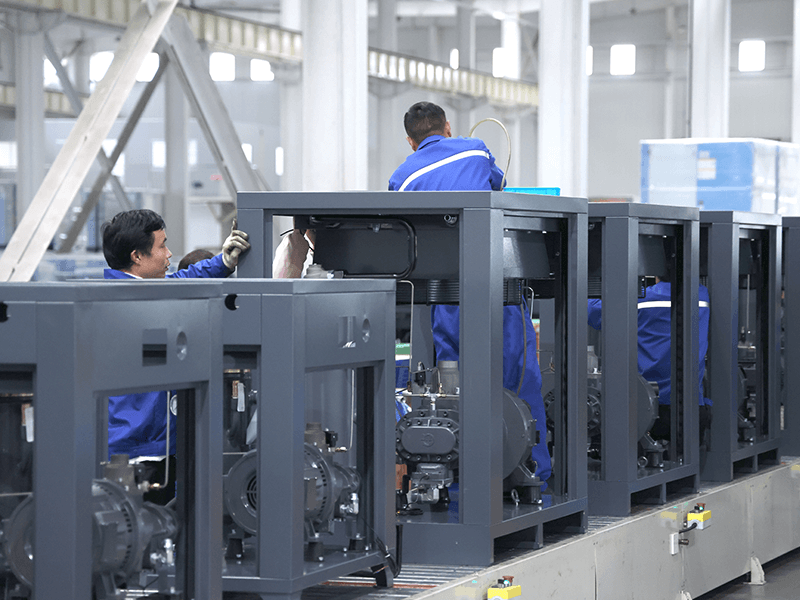
Unplanned failures happen:
Even the best-maintained compressors eventually fail. Bearings wear out. Motors burn up. Controls malfunction. Without redundancy, a simple mechanical failure becomes a production crisis.
Maintenance requires downtime:
Compressors need regular maintenance—oil changes, filter replacements, belt adjustments. With a single compressor, you must schedule maintenance during off-hours or accept production interruptions. With redundancy, you can maintain one unit while the other runs.
The goal:
Redundancy isn’t about preventing failures—that’s impossible. It’s about ensuring that no single failure stops your production.
III. Common Redundancy Configurations
There are several ways to build redundancy into a compressed air system.
N+1 Redundancy:
The most common approach. “N” is the number of compressors needed to meet your peak demand. “N+1” means you have one extra compressor as backup.
Example:
- You need 500 CFM at peak
- You install three 250 CFM compressors (two run, one backup)
- If any compressor fails, the other two can still meet demand
2N Redundancy (Full Redundancy):
Two completely independent systems, each capable of handling full demand. One runs, one sits idle as a hot backup. This is expensive but provides maximum reliability.
Spinning Reserve:
A backup compressor that runs unloaded, ready to take load instantly if the primary fails. Common in critical applications where even seconds of pressure drop matter.
Standby with Auto-Start:
A backup compressor that starts automatically when system pressure drops below a setpoint. Most common configuration for industrial plants.
Portable Backup:
Some facilities rely on portable compressors that can be brought in and connected quickly. Less expensive than installed redundancy, but requires manual intervention and connection time.
IV. When Do You Need Redundancy?
Not every facility needs the same level of redundancy. Here’s how to assess your requirements.
Criticality assessment:
| Factor | Low Criticality | High Criticality |
| Production impact | Can schedule downtime | 24/7 operation, can’t stop |
| Product perishability | Stable products | Spoils without air |
| Safety systems | No safety impact | Air required for safe operation |
| Customer commitments | Flexible delivery | Just-in-time, penalties for delay |
| Cost of downtime | <$1,000/hour | >$10,000/hour |
Questions to ask:
- What happens if the compressor fails at 2 AM on a Sunday?
- Can we afford to be down for 8 hours while waiting for a repair?
- Do we have critical processes that require uninterrupted air?
- Are there safety systems that depend on compressed air?
Minimum recommendation:
- Single-shift operations with low impact: Probably no redundancy needed
- Multi-shift or 5-day operations: N+1 recommended
- 24/7 operations or critical processes: N+1 minimum, consider full redundancy
- Life-safety applications: 2N full redundancy required
V. How Much Redundancy Is Enough?
Once you’ve decided you need redundancy, the next question is how much.
N+1: The sweet spot
For most industrial facilities, N+1 provides the best balance of cost and reliability. You have backup without doubling your investment.
Sizing considerations for N+1:
- If your peak demand is 800 CFM, don’t install one 800 CFM compressor with one 800 CFM backup. That’s expensive and inefficient at part load.
- Better: Install three 400 CFM compressors. Any two can handle peak. This gives you 50% extra capacity for growth and better efficiency at varying loads.
Multiple smaller vs. one large:
Advantages of multiple smaller compressors:
- Better part-load efficiency (can run only what you need)
- More graceful degradation (losing one loses only part of capacity)
- Easier maintenance (can take one offline while others run)
- Lower replacement cost when a unit reaches end of life
Disadvantages:
- Higher initial cost
- More complex controls
- More floor space
The 2N exception:
Full redundancy (2N) is rarely justified for compressed air alone. Exceptions:
- Life safety systems (emergency breathing air)
- Critical processes where any interruption is catastrophic
- Facilities with no ability to store product or buffer downtime
- Regulatory requirements
VI. Storage as Redundancy
Sometimes you don’t need another compressor—you need more storage.
How storage helps:
A properly sized air receiver tank can:
- Bridge short interruptions (5-15 minutes) while a backup starts
- Handle peak demands without starting another compressor
- Maintain pressure during maintenance of a single component
Sizing for emergency reserve:
Calculate how long you need to run on stored air:
Tank volume (gallons) = (Required CFM × Time in minutes × 14.7) / (Pressure drop in PSI)
Example:
- Need 200 CFM for 10 minutes
- Pressure drop allowed: 30 PSI (from 100 to 70 PSI)
- Tank size = (200 × 10 × 14.7) / 30 = 980 gallons
Storage as first line of defense:
For short-duration events, storage is cheaper and simpler than a full backup compressor. Many facilities combine:
- Moderate storage (5-10 minutes)
- One backup compressor with auto-start
- If the event lasts longer than storage can handle, the backup starts
VII. Control Strategies for Redundant Systems
Having redundant compressors isn’t enough—you need controls to make them work together.
Sequencing controls:
Automatically start and stop compressors based on demand. Lead/lag configurations ensure runtime is balanced across units.
Automatic changeover:
When a compressor faults, the control system should automatically start the next available unit. No human intervention required.
Pressure-based staging:
Setpoints determine when additional compressors start:
- 100 PSI: All compressors off or one running unloaded
- 95 PSI: Lead compressor starts
- 90 PSI: Second compressor starts
- 85 PSI: Third compressor starts (and alarm for potential problem)
Rotating lead:
Controls that rotate which compressor runs first each day or week. This ensures even wear and verifies that all units are operational.
Remote monitoring:
For critical systems, remote monitoring with alerts allows response before production is affected. Many modern controllers send text or email alarms.
FAQ
Q1: What does N+1 mean in compressed air?
A1: “N” is the number of compressors needed to meet your peak demand. N+1 means you have one additional compressor as backup. For example, if you need 500 CFM and use 250 CFM compressors, N=2 and N+1 means you install three compressors.
Q2: How do I calculate my peak demand for redundancy planning?
A2: Measure actual air consumption during your busiest production period. Add 10-15% margin for future growth. This is your “N” requirement. Then design your compressor configuration to meet this with one unit out of service.
Q3: Can I use portable compressors as backup instead of installed redundancy?
A3: Yes, but consider the time to deploy. If you can tolerate 2-4 hours of downtime while a rental is delivered and connected, portable backup may work. For critical applications where minutes matter, installed redundancy is better.
Q4: How much storage should I have for emergency backup?
A4: Calculate how long you need to run on stored air. For most industrial plants, 5-10 minutes of storage provides enough time for a backup compressor to start or for operators to shut down safely. Use the formula in Section VI to size.
Q5: Is it better to have one large backup or multiple smaller ones?
A5: Multiple smaller compressors usually win. They provide better efficiency at part load, more graceful degradation, and easier maintenance. The exception is very small facilities where space or budget limits options.
Q6: Do I need redundancy for my dryers and filters too?
A6: Yes—the compressor is only one part of the system. If your dryer fails, wet air reaches your production even if compressors are running. Consider redundancy for critical treatment components, or design bypasses for maintenance.
Q7: How often should I test my backup system?
A7: Monthly, at minimum. Test that backup compressors start automatically when pressure drops. Test that alarms work. Test that valves sequence correctly. A backup that hasn’t been tested isn’t really backup.
Conclusion
Compressed air redundancy isn’t about paranoia—it’s about risk management. The right level of backup protects your production, your customers, and your bottom line.
For most industrial facilities, N+1 configuration with multiple smaller compressors provides the best balance. Add enough storage to bridge short events and allow smooth startup of backups. Install controls that automate changeover and notify you of problems. And test regularly—because untested backup isn’t backup at all.
The cost of redundancy is real. But for many plants, the cost of downtime is far higher. Do the math for your operation. If an hour of lost production costs more than a backup compressor, you already have your answer.
At MINNUO, we help industrial facilities design compressed air systems that balance reliability with cost. Whether you need a simple N+1 configuration or a fully redundant critical air system, we can help you find the right solution for your risk profile. Because we know that when production can’t stop, your air system shouldn’t either.
 Email
Email sales:+86 15312799623