Scroll compressors occupy a specific niche in the compressed air world. They are quieter than piston machines, simpler than screw compressors, and inherently oil-free in their most common configuration. These characteristics make them the default choice for dental clinics, laboratories, and small medical air systems. But scroll compressors also have hard limits—capacity ceilings, pressure constraints, and duty cycle boundaries that cannot be crossed without inviting rapid wear or outright failure. Understanding where scroll technology excels and where it falls short prevents both under-specification that leaves a process starved for air and over-application that puts a scroll compressor into service it cannot survive.
I. How Scroll Compression Works—and What That Means for Applications
The scroll compression mechanism explains both its strengths and its limitations.
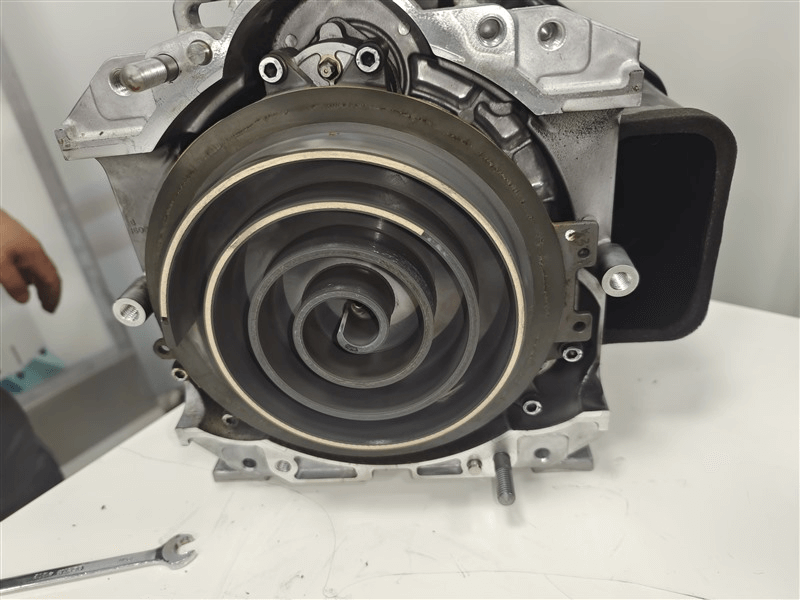
Two identical spiral elements—one fixed, one orbiting in a circular path—interleave to form crescent-shaped gas pockets. Gas enters at the outer edge of the scroll set. Each orbit of the moving scroll pushes these pockets progressively toward the center, reducing their volume and increasing their pressure. Discharge occurs at the center port.
This geometry yields several inherent advantages. The compression process is continuous rather than pulsating, producing smooth flow and low vibration. There are no valves to fail, no timing gears to wear, and—in oil-free designs—no lubricant in the compression chamber. The orbiting scroll moves at a fraction of the speed of a screw compressor rotor, reducing bearing loads and mechanical noise.
The geometry also imposes limitations. The scroll elements are precision components with tight tolerances. Increasing capacity requires physically larger scrolls, which become increasingly difficult to manufacture and support. The pressure ratio achievable in a single scroll stage is limited by the built-in volume ratio—the ratio between the initial gas pocket volume and the discharge pocket volume. Achieving higher pressures requires multiple stages or external boosters.
These physical realities define the scroll compressor’s place in the broader compressed air landscape. It is fundamentally a small to medium capacity, low to moderate pressure machine. Within that envelope, it excels. Outside it, other technologies take over.
II. Where Scroll Compressors Excel
The scroll compressor’s strengths align with specific application requirements that other compressor technologies struggle to meet.
Oil-free air delivery is perhaps the strongest selling point. The compression chamber in an oil-free scroll compressor contains no lubricant. The tip seals that maintain the seal between scroll elements are self-lubricating polymers. What enters the compression chamber is only air; what leaves is only compressed air. For applications where even trace oil contamination is unacceptable—medical breathing air, laboratory analysis instruments, food contact packaging—this inherent oil-free design provides a level of assurance that oil-lubricated compressors with downstream filtration cannot match.
Quiet operation distinguishes scroll compressors from their piston and screw counterparts within their size range. A typical scroll compressor produces 55 to 65 dBA at one meter, roughly the sound level of normal conversation. In a dental operatory, a medical clinic, or a laboratory, this low noise level allows the compressor to be installed in or near occupied spaces without acoustic enclosures. Compare this to a piston compressor of similar capacity, which may produce 75 to 85 dBA, and the scroll’s acoustic advantage becomes a decisive selection factor.
High reliability with minimal maintenance follows from the mechanical simplicity. A scroll compressor has no inlet or discharge valves to service, no piston rings to replace, no connecting rods or crankshaft bearings requiring periodic overhaul. The primary wear items are the tip seals, which are designed for replacement at intervals measured in years rather than months. Between seal replacements, routine maintenance consists largely of inlet filter changes and cooler cleaning. For installations where maintenance access is difficult or where service interruptions are costly, this simplicity translates directly to lower ownership cost.
Smooth, pulsation-free air delivery benefits applications with sensitive instrumentation. Piston compressors produce pressure pulsations at the crankshaft frequency that require receiver tanks and sometimes additional dampening to isolate from downstream equipment. Screw compressors produce smoother flow but still generate some pulsation at the pocket passing frequency. Scroll compressors, with their continuous compression process, deliver the smoothest flow of any positive-displacement compressor type.
III. Where Scroll Compressors Fall Short
The same design features that give scroll compressors their strengths also impose hard limits.
Limited capacity per unit is the primary constraint. The largest commercially available oil-free scroll compressors deliver approximately 30 to 40 horsepower with a maximum output of roughly 100 to 150 CFM. In duplex or quadruplex configurations with multiple scroll modules on a common frame, output can reach several hundred CFM. But the scroll’s fundamental capacity ceiling is much lower than screw compressors, which can deliver thousands of CFM from a single machine. For applications requiring more than a few hundred CFM, scroll technology simply does not scale.
Moderate maximum pressure is the second constraint. Standard single-stage oil-free scroll compressors achieve 100 to 130 PSIG maximum. Some two-stage designs reach 145 to 175 PSIG, but at the cost of complexity that erodes the scroll’s simplicity advantage. For applications requiring 175 PSIG and above—common in industrial manufacturing, PET bottle blowing, and process gas compression—scroll compressors are not competitive.
Limited duty cycle on many scroll compressor designs restricts their use in continuous-duty applications. Some scroll compressors are rated for intermittent duty, typically 50% to 70% duty cycle, meaning they must rest for a portion of each hour of operation. Continuous-duty-rated scroll compressors are available but at higher cost. The duty cycle limitation stems from cooling design: scroll compressors rely primarily on air cooling of the scroll housing, and the heat generated during continuous compression must be rejected to maintain acceptable operating temperatures. In contrast, oil-flooded screw compressors use their circulating oil as an effective heat transfer medium, allowing true continuous duty.
Economic competitiveness declines at higher capacities. In the 5 to 15 horsepower range, scroll compressors compete effectively on both first cost and lifecycle cost with equivalent oil-free piston and small screw machines. At 20 to 30 horsepower, scroll compressors remain competitive but the cost gap narrows. Above 30 horsepower, oil-free screw compressors generally offer lower cost per CFM of capacity and greater energy efficiency at full load.
IV. The Application Sweet Spot
Matching scroll compressor capability to application requirements yields the best results. The sweet spot spans several distinct application domains.
Dental clinics represent perhaps the most natural scroll compressor application. A typical dental clinic requires 5 to 15 CFM of oil-free compressed air at 80 to 100 PSIG. The compressor operates in or adjacent to treatment rooms where noise must be minimal. Reliability is paramount—a compressor failure means cancelled appointments. Scroll compressors meet all these requirements without compromise, which explains their near-universal adoption in modern dental facilities.
Medical air systems in small to medium facilities benefit from the scroll’s inherent oil-free design. NFPA 99 medical air requirements demand oil-free air for breathing. Scroll compressors provide this assurance without the complexity of oil-lubricated compressors with downstream purification. The scroll’s low noise allows compressor installation within the facility rather than in a remote mechanical room.
Laboratories and research facilities use compressed air for analytical instruments, sample preparation, and automation. These applications demand oil-free air to prevent sample contamination and to protect sensitive instruments. The scroll’s smooth, pulsation-free output benefits precision instrumentation. The moderate capacity of scroll compressors matches the distributed air demand common in laboratory buildings, where multiple small compressors serving individual departments or floors often provide a better solution than a single large central compressor.
Small industrial applications that require oil-free air at moderate pressures and flows complete the sweet spot. Food packaging lines, electronics assembly, pharmaceutical manufacturing, and small paint and coating operations all benefit from scroll compressor characteristics. The key is staying within the capacity, pressure, and duty cycle boundaries.
V. When to Choose Something Else
Knowing when not to specify a scroll compressor is as important as knowing when to specify one.
Applications requiring more than approximately 150 CFM should consider oil-free screw compressors or, at very large capacities, centrifugal machines. The scroll’s capacity ceiling is a physical limitation, not a marketing decision. Exceeding it by ganging together many scroll modules may be technically possible but typically ceases to be economically rational beyond four to six modules.
Applications requiring sustained pressures above 130 PSIG should evaluate two-stage scroll designs or, more commonly, oil-free screw compressors. The pressure limitation of single-stage scrolls is fundamental to the geometry. Boosting scroll discharge pressure with an external booster adds complexity that undermines the scroll’s simplicity advantage.
Continuous-duty applications operating 24 hours per day, seven days per week should verify that the specific scroll compressor model is rated for continuous duty. Not all scroll machines are. For true continuous-duty requirements, oil-flooded screw compressors or continuous-duty-rated oil-free screw machines provide proven solutions with decades of field experience.
Applications with high ambient temperatures or poor cooling conditions challenge scroll compressors more than oil-flooded screw machines. The scroll’s reliance on air cooling of the housing, without the thermal buffering of circulating oil, means that high ambient temperature directly raises operating temperature and reduces allowable duty cycle.
FAQ
Q1: Can a scroll compressor replace a reciprocating compressor of the same horsepower?
Not always. Piston compressors often deliver higher CFM per horsepower than scroll compressors of the same rating, particularly at higher pressures. Check the actual CFM output at the required pressure before replacing a piston compressor with a scroll machine. The scroll may need to be one size larger to deliver equivalent flow.
Q2: How long do scroll compressors last compared to screw compressors?
Scroll compressors in their proper application envelope—clean, moderate-duty, well-maintained—typically operate 40,000 to 60,000 hours before major overhaul. This is comparable to oil-free screw compressors. In heavy-duty or continuous applications where scroll compressors are pushed beyond their comfort zone, life is substantially shorter.
Q3: Are all scroll compressors oil-free?
No. Scroll compressors are used extensively in refrigeration and air conditioning, where they are typically hermetic designs with oil in the compression chamber for lubrication and sealing. In the compressed air market, most scroll compressors are oil-free designs, but oil-lubricated scroll air compressors do exist. Verify the specification if oil-free operation is required.
Q4: Can a scroll compressor operate in a dusty environment?
Only with appropriate inlet filtration. The scroll’s tip seals are sensitive to abrasive dust. Standard inlet filtration adequate for a piston compressor may be insufficient for a scroll. Heavy-duty inlet filtration, possibly with a pre-cleaner, is recommended for scroll compressors in dusty or dirty environments.
Q5: Why are scroll compressors more expensive per CFM than piston compressors?
Scroll elements are precision-machined components with tight tolerances that require specialized manufacturing equipment. The manufacturing cost per unit of capacity is higher than for piston compressors, particularly in smaller sizes. The price differential reflects the inherent cost of the technology. The total cost of ownership may favor scroll compressors when oil-free air quality, low noise, and reduced maintenance are valued.
Q6: Can a scroll compressor be rebuilt?
Yes. Scroll compressors can be rebuilt, typically by replacing tip seals, bearings, and gaskets. The scroll elements themselves are not generally resurfaced or remachined. If the scroll surfaces are damaged—by debris ingestion, bearing failure allowing contact, or severe corrosion—the scroll set must be replaced. Rebuild is economical relative to replacement for larger scroll modules, but for the smallest machines, replacement may be more cost-effective.
Conclusion
Scroll compressors dominate the small oil-free compressed air segment because their inherent characteristics—quiet, smooth, oil-free, and mechanically simple—align precisely with the requirements of dental, medical, laboratory, and small industrial applications. Within their capacity, pressure, and duty cycle limits, they deliver exceptional value. Beyond those limits, other technologies take over. Recognizing where the boundaries lie, and specifying accordingly, prevents both the costly mistake of over-applying scroll technology into service it cannot survive and the missed opportunity of under-specifying a scroll compressor where it would have been the ideal solution.
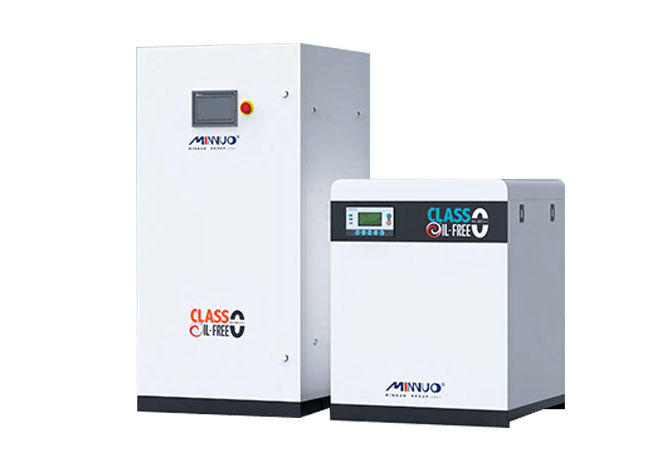
At MINNUO, we offer oil-free scroll compressors designed for the applications where this technology excels. Our engineering team evaluates your specific capacity, pressure, duty cycle, and air quality requirements to recommend the compressor technology that best matches your operating conditions—whether that is a scroll compressor within its optimal range, or an oil-free screw or piston machine when the application demands capabilities beyond the scroll’s envelope. Every MINNUO compressor installation includes application verification to ensure the selected technology will perform reliably throughout its service life.
 Email
Email sales:+86 15312799623