I. Introduction
Natural gas is one of the world’s most important energy sources. It heats homes, powers industrial processes, and increasingly, fuels vehicles. But before natural gas can be used in these applications, it often needs to be compressed.
That’s where CNG compressors come in.
CNG stands for Compressed Natural Gas. A CNG compressor takes natural gas at low pressure—from pipelines, wells, or storage—and compresses it to much higher pressures, typically 3,000 to 3,600 PSI (200 to 250 bar) for vehicle fuel.
This process isn’t simple. Natural gas has different properties than air. It’s flammable. It behaves differently under pressure. And the pressures involved are far higher than typical industrial compressed air systems.
This guide explains what CNG compressors are, how they work, and what makes them unique.
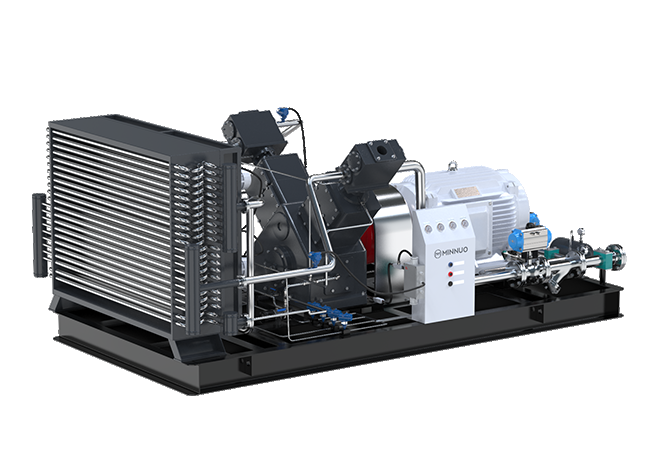
II. What Is a CNG Compressor?
A CNG compressor is a specialized machine designed to increase the pressure of natural gas for storage, transport, or use.
Basic definition:
It takes natural gas at inlet pressure (which can vary from a few PSI to several hundred) and compresses it to a much higher outlet pressure—typically 3,000-3,600 PSI for vehicle fueling, or even higher for some industrial applications.
Common applications:
| Application | Typical Pressure | Purpose |
| Vehicle refueling | 3,000-3,600 PSI | Fuel for natural gas vehicles |
| Pipeline injection | Varies | Boost pressure to match pipeline |
| Gas storage | 1,000-5,000 PSI | Store gas for later use |
| Industrial processes | Varies | Feed gas for manufacturing |
Key difference from air compressors:
- Gas properties: Natural gas is flammable, lighter than air, and behaves differently under compression
- Pressure: Much higher than typical industrial air compressors (100-150 PSI vs. 3,000+ PSI)
- Materials: Must be compatible with natural gas and resistant to hydrogen embrittlement
- Safety: Far more stringent requirements due to flammability
III. How Does a CNG Compressor Work?
The basic principle is the same as any compressor: reduce volume, increase pressure. But the execution is specialized.
The compression process:
- Intake: Low-pressure natural gas enters the compressor from a source—a pipeline, a wellhead, or a storage vessel.
- Compression stage 1: The gas enters the first cylinder, where a piston reduces its volume, raising pressure to an intermediate level (typically 300-500 PSI).
- Intercooling: Compressing gas heats it. Hot gas is less dense and harder to compress further. An intercooler (usually water-cooled or air-cooled) removes heat before the next stage.
- Compression stage 2: The cooled gas enters the second cylinder, where pressure increases further (to 1,000-1,500 PSI).
- Additional stages: Most CNG compressors have 3-4 stages to reach final pressure. Each stage includes cooling between stages.
- Final cooling: After the last stage, gas passes through an aftercooler before going to storage or dispensing.
- Storage or dispensing: High-pressure gas flows into cascade storage cylinders or directly to a dispenser for vehicle fueling.
Why multiple stages?
Compressing from 50 PSI to 3,600 PSI in one stage would generate enormous heat and stress. Multiple stages with intercooling keep temperatures manageable and improve efficiency.
IV. Key Components of a CNG Compressor
CNG compressors are complex machines with several critical subsystems.
Compressor frame and drive:
The structural backbone. Houses the crankshaft, connecting rods, and lubrication system. Driven by an electric motor, natural gas engine, or diesel engine.
Compressor cylinders:
Where the actual compression happens. Each stage has its own cylinder, sized for the volume and pressure at that stage.
Pistons and piston rings:
Pistons move back and forth in cylinders, compressing gas. Specialized rings seal the compression chamber—material selection is critical for natural gas service.
Valves:
Check valves that allow gas to enter and exit cylinders at the right times. Must seal perfectly at high pressure and withstand millions of cycles.
Cooling system:
Intercoolers between stages, aftercooler after final stage. Usually water-cooled or air-cooled. Essential for efficiency and component life.
Lubrication system:
Provides oil to bearings, crossheads, and cylinder walls. For natural gas compression, special lubricants resist dilution by gas.
Pulsation dampeners:
Reciprocating compressors create pressure pulses. Dampeners smooth these out, protecting downstream equipment.
Controls and safety systems:
PLC-based controls manage operation, monitor parameters, and shut down the compressor if conditions exceed limits.
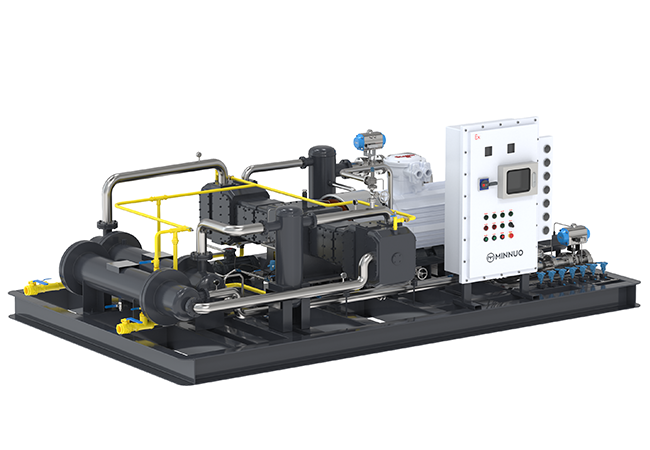
V. Types of CNG Compressors
Several compressor types are used for natural gas, each with strengths and weaknesses.
Reciprocating (Piston) Compressors:
The most common type for CNG service, especially at high pressures.
- How they work: Pistons move back and forth in cylinders, compressing gas
- Advantages: Can achieve very high pressures, efficient, mature technology
- Disadvantages: More moving parts, require maintenance, produce pulsations
- Typical use: Vehicle fueling stations, pipeline boosting, most industrial applications
Rotary Screw Compressors:
Used for lower-pressure applications or as boosters.
- How they work: Two interlocking rotors trap and compress gas
- Advantages: Continuous flow, fewer pulsations, compact
- Disadvantages: Limited pressure capability (typically under 500 PSI)
- Typical use: Booster service, low-pressure applications
Centrifugal Compressors:
Used for very high flow, lower pressure applications.
- How they work: High-speed impellers accelerate gas, converting velocity to pressure
- Advantages: Very high flow, oil-free, continuous operation
- Disadvantages: Limited pressure per stage, complex, expensive at small sizes
- Typical use: Pipeline transmission, large-scale gas processing
For vehicle fueling (3,600 PSI): Reciprocating compressors dominate.
VI. CNG Compression for Vehicle Refueling
Vehicle fueling is the most common application people think of with CNG compressors.
Refueling station types:
| Type | Description | Best For |
| Time-fill | Slow compression overnight | Fleets that return to base |
| Fast-fill | Quick compression (3-5 minutes) | Public stations, retail |
| Combination | Both capabilities | Mixed-use facilities |
Cascade storage:
Most stations don’t dispense directly from the compressor. Instead, gas is stored in cascade cylinders at three pressure levels (low, medium, high). When a vehicle fills, gas flows from the appropriate bank, and the compressor replenishes storage.
Dispenser:
The fueling point where vehicles connect. Includes hose, nozzle, meter, and safety features.
Typical station components:
- Inlet gas supply (pipeline or transported)
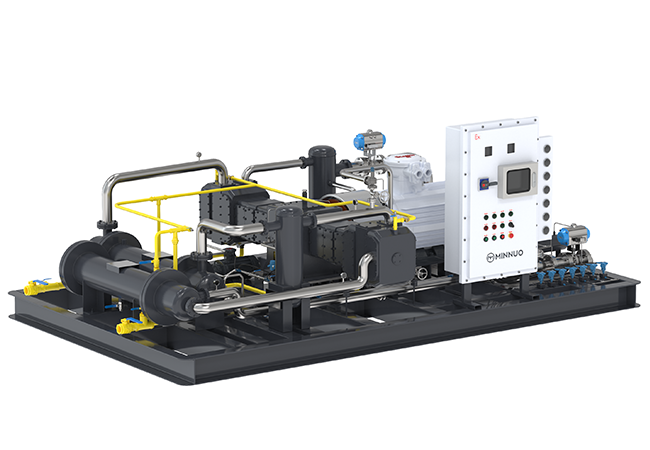
- Compressor package
- Cascade storage cylinders
- Dispenser(s)
- Controls and safety systems
VII. Safety Considerations for CNG Compressors
Natural gas is flammable. CNG compressors operate at very high pressures. Safety is paramount.
Key safety features:
| Feature | Purpose |
| Pressure relief valves | Protect against overpressure |
| Gas detection | Alert to leaks before they become dangerous |
| Ventilation | Prevent gas accumulation in enclosed spaces |
| Emergency shutdown | Stop compressor and isolate gas on fault |
| Flame arrestors | Prevent flame propagation |
| Explosion-proof electrical | Eliminate ignition sources |
Critical safety practices:
- Regular leak detection surveys: Find and fix leaks promptly
- Operator training: Everyone who interacts with the system must understand the hazards
- Maintenance procedures: Lockout/tagout, gas isolation, purging before maintenance
- Emergency response plan: Know what to do if a leak or fire occurs
Site considerations:
- Adequate spacing from buildings and ignition sources
- Proper ventilation (natural or mechanical)
- Clear access for emergency responders
- Signage and barriers
FAQ
Q1: What pressure do CNG compressors typically achieve?
A1: For vehicle fueling, the standard is 3,000-3,600 PSI (200-250 bar). Some industrial applications require higher pressures—up to 5,000 PSI or more. Pipeline injection may need only 500-1,000 PSI depending on the pipeline.
Q2: How much does a CNG compressor cost?
A2: Costs vary widely based on size and configuration. A small time-fill compressor for a few vehicles might cost $30,000-$60,000. A public fast-fill station with multiple dispensers can cost $500,000-$1,000,000+. Get quotes based on your specific requirements.
Q3: How long does a CNG compressor last?
A3: With proper maintenance, 20-30 years is typical. Major components like pistons, rings, and valves will need periodic replacement. The compressor frame and vessels can last much longer with proper care.
Q4: How much maintenance does a CNG compressor need?
A4: Regular maintenance includes: oil changes (500-1,000 hours), valve inspections (2,000 hours), packing replacement (4,000-8,000 hours), and annual professional service. Follow manufacturer recommendations.
Q5: Can I use a standard air compressor for natural gas?
A5: Absolutely not. Air compressors aren’t designed for natural gas. Materials may not be compatible. Seals will leak. Lubricants can react. Electrical components may not be rated for hazardous areas. Never use an air compressor for natural gas.
Q6: What’s the difference between CNG and LNG?
A6: CNG (Compressed Natural Gas) is natural gas stored at high pressure (3,000-3,600 PSI) in gaseous form. LNG (Liquefied Natural Gas) is natural gas cooled to -162°C (-260°F) until it becomes liquid. LNG is denser but requires cryogenic storage. Different applications suit different forms.
Q7: Do I need a CNG compressor for my fleet?
A7: If you’re considering natural gas vehicles, you need a way to fuel them. Options include: time-fill compressor (overnight fueling), fast-fill station (quick fueling like a gas station), or using public stations. The right choice depends on fleet size, duty cycle, and budget.
Conclusion
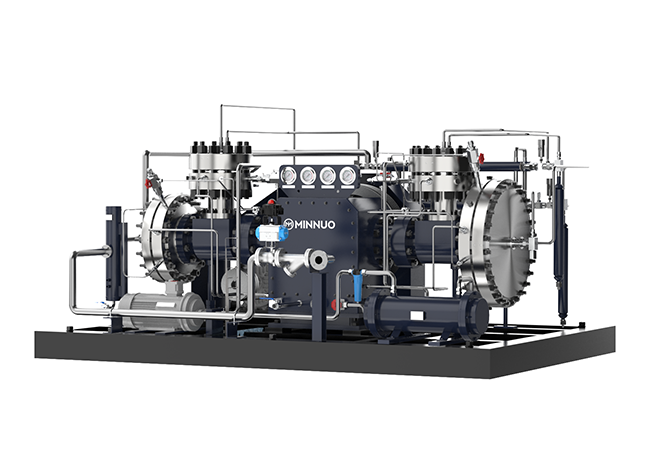
CNG compressors are specialized machines that play a critical role in the natural gas value chain. They take low-pressure gas and boost it to the high pressures needed for vehicle fuel, pipeline transport, and industrial processes.
Unlike air compressors, CNG compressors must handle flammable gas at extreme pressures—3,000 PSI and higher. They require robust construction, multiple compression stages, sophisticated cooling, and comprehensive safety systems.
Reciprocating compressors dominate the CNG space, especially for high-pressure applications like vehicle fueling. Rotary and centrifugal designs have their places, particularly for lower pressures or very high flows.
For fleet operators considering natural gas vehicles, the compressor is the heart of the fueling infrastructure. Getting the size and type right—time-fill vs. fast-fill, single vs. multiple units—determines whether your vehicles get the fuel they need when they need it.
At MINNUO, we help customers navigate CNG compressor selection. From small fleet installations to public fueling stations, we focus on reliable, safe, cost-effective solutions. Because we know that when your vehicles depend on natural gas, your compressor needs to deliver—every time.
 Email
Email sales:+86 15312799623