A screw compressor designed for sweet natural gas will fail rapidly in sour service. Hydrogen sulfide attacks the iron in steel, penetrates the metal lattice, and embrittles components that were designed to flex millions of times without fatigue. The compressor that runs reliably on pipeline-quality gas for fifteen years may crack a rotor, snap a valve spring, or leak catastrophically within months when H₂S concentrations exceed a few percent. The difference between survival and failure lies in material choices made before the compressor is ever built. Specifying the correct metallurgy and rotor coatings for sour gas service is not an optimization exercise. It is what separates a working compressor from a safety incident.
I. What Makes Sour Gas Different
Sour gas is natural gas containing hydrogen sulfide. The threshold for “sour” classification varies by standard, but NACE MR0175 defines sour service as any environment where the partial pressure of H₂S exceeds 0.05 psia, or roughly 3.5 millibar. For a gas stream at 70 bar, this threshold equates to an H₂S concentration of only about 50 parts per million. A concentration of 10% H₂S at the same pressure is not merely sour—it is aggressively sour, and the material demands are correspondingly severe.
Hydrogen sulfide attacks compressor components through three distinct mechanisms, all of which must be addressed simultaneously. Sulfide stress cracking is the most dangerous. It occurs when H₂S reacts with steel under tensile stress, promoting hydrogen absorption into the metal. The absorbed hydrogen diffuses to regions of high stress—grain boundaries, inclusions, and crack tips—where it reduces the metal’s ductility to the point where it fractures at loads far below its rated yield strength. Components under sustained tensile stress in sour service fail by cracking, not by yielding.

Hydrogen-induced cracking is related but distinct. Atomic hydrogen that diffuses into the steel recombines at internal voids and inclusions to form molecular hydrogen gas. The gas pressure inside these microscopic cavities can reach extraordinary levels, delaminating the steel from within. Unlike sulfide stress cracking, hydrogen-induced cracking does not require applied tensile stress. The hydrogen alone is sufficient to cause damage.
General and localized corrosion proceeds alongside these cracking mechanisms. H₂S dissolves in water to form a weak acid that attacks carbon steel. The corrosion rate depends on H₂S concentration, temperature, water content, and the presence of other acid gases, particularly carbon dioxide. The iron sulfide scale that forms as a corrosion product can be protective or can spall and accelerate erosion downstream.
The common thread uniting all three mechanisms is that they require water. Dry H₂S is far less aggressive than wet H₂S. Sour gas at the wellhead is almost always saturated with water vapor. Compression increases the dew point and can cause condensation where liquid water did not previously exist. A compressor that handles sweet gas without water issues may suddenly face aqueous corrosion and cracking when H₂S is present in the gas stream.
II. NACE MR0175 and Material Hardness Limits
NACE MR0175, also designated ISO 15156, is the governing standard for materials in sour oil and gas service. It establishes the metallurgical requirements that prevent sulfide stress cracking. Compliance is not optional for equipment installed in most oil and gas jurisdictions. It is referenced by regulatory codes, enforced by insurers, and demanded by project specifications.
The core principle of NACE MR0175 is that susceptibility to sulfide stress cracking increases with material strength. Higher-strength steels—those with higher yield strength and hardness—are more susceptible than lower-strength equivalents. The standard therefore imposes hardness limits on carbon and low-alloy steels in sour service. The maximum allowable hardness for most carbon steel components is 22 on the Rockwell C scale. This is a relatively soft condition, and many standard compressor components—fasteners, shafting, valve springs, and gears—are manufactured from steels that exceed this hardness.
For austenitic stainless steels, the limits are different. Solution-annealed 304 and 316 stainless steels are acceptable for sour service at hardness levels up to 22 HRC. Cold-worked austenitic stainless steels may be susceptible to cracking and require additional qualification.
Nickel alloys—Inconel 718, Inconel 625, Hastelloy C-276—are generally resistant to sulfide stress cracking and are not subject to the same hardness restrictions as carbon steel. They are the materials of choice for the most demanding sour service applications, but their cost restricts their use to components where alternative materials cannot meet requirements.
The standard also addresses heat treatment, welding procedures, and qualification testing. Welds in sour service components require post-weld heat treatment to reduce hardness and residual stress. Welding procedure qualifications must demonstrate that the resulting weld and heat-affected zone meet the sour service hardness requirements.
III. Compressor Component Material Selection
Every pressure-containing and stressed component in a sour gas screw compressor requires material specification matched to the service environment.
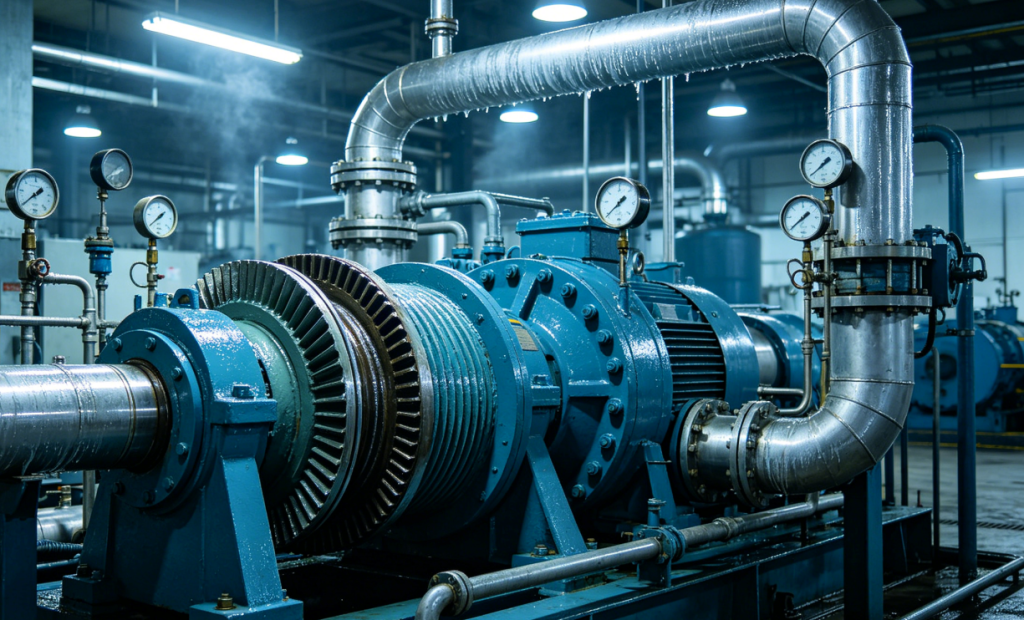
The compressor housing—the pressure boundary surrounding the rotors—is typically carbon steel in sweet service and must be upgraded for sour gas. For moderate sour service with low H₂S partial pressure and controlled operating conditions, carbon steel with hardness verified below 22 HRC may be acceptable per NACE guidelines. However, for gas containing 10% H₂S, the conservative and industry-standard approach is to specify a corrosion-resistant alloy cladding on carbon steel, or solid 316L stainless steel for the entire housing. The cost of the material upgrade is significant but far less than the cost of a housing failure.
Rotors present a unique challenge. Screw compressor rotors are precision components with complex geometry. The base material is typically a low-alloy steel selected for machinability, strength, and dimensional stability. In sour service, the rotors must be protected from both corrosion and hydrogen embrittlement. Carbon steel rotors are acceptable only if they meet NACE hardness limits and the operating conditions—temperature, H₂S partial pressure, and water content—are within the material’s qualified envelope. In many cases, rotors for high-H₂S service are specified in 17-4 PH stainless steel in the H1150 double-aged condition, which provides good corrosion resistance, adequate strength, and NACE compliance. For the most severe service, Inconel 718 rotors offer the highest assurance of sour service performance.
Bearings support the rotor shafts and maintain the precise clearances required for efficient compression. Standard bearing materials—through-hardened 52100 steel—are not suitable for sour service due to high hardness and susceptibility to cracking. Bearings in sour gas compressors are typically specified with stainless steel races or are protected from gas contact by buffer gas seals that isolate the bearing housing from the process gas.
Shaft seals prevent gas leakage along the rotating shafts where they penetrate the housing. In sour service, seal failure is both a performance problem and a safety hazard. Double mechanical seals with a barrier fluid system are standard. The seal faces are typically silicon carbide or tungsten carbide, both compatible with sour gas. The elastomeric secondary seals must be specified for H₂S service—standard Buna-N and many common elastomers degrade rapidly in H₂S.
Fasteners—bolts, studs, and screws—in pressure boundaries are subject to high tensile stress and are particularly vulnerable to sulfide stress cracking. Standard Grade 8 or Class 12.9 fasteners with hardness well above 22 HRC are unacceptable. NACE-compliant fasteners, typically ASTM A193 Grade B7M or B8M Class 2, are required for all pressure-retaining connections in sour service.
IV. Rotor Coating Selection for Sour Gas
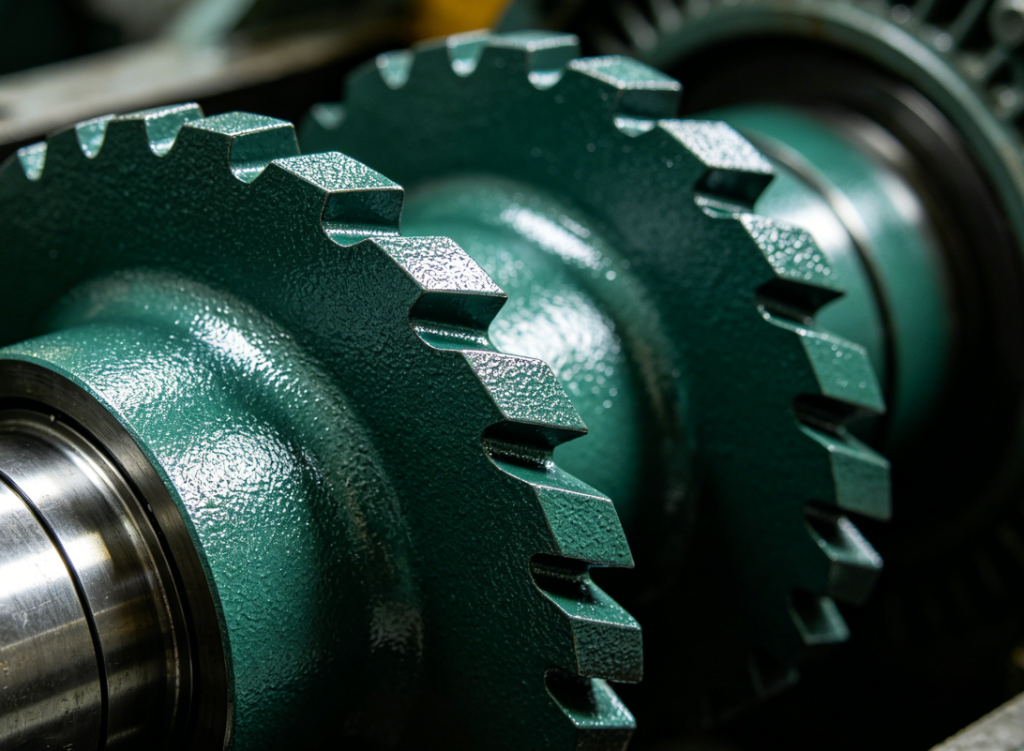
Rotor coatings serve multiple functions in a screw compressor. They reduce friction during transient rotor contact, protect against corrosion, and maintain the precise clearances that determine volumetric efficiency. In sour gas service, the coating must perform all of these functions while resisting chemical attack from H₂S and the acidic condensate it produces.
Polytetrafluoroethylene, commonly known as PTFE, is the most widely used rotor coating in general industrial screw compressors. It offers excellent chemical resistance to H₂S and acidic compounds. It provides low friction and has a long service history. However, PTFE is relatively soft and susceptible to erosion if the gas stream carries particulate matter. For sour gas with entrained sand or scale from upstream piping, PTFE may wear prematurely and require recoating sooner than expected.
Polyether ether ketone, known as PEEK, offers significantly higher hardness and better erosion resistance than PTFE while maintaining excellent chemical resistance. It is increasingly specified for sour gas service where particle erosion is a concern. Its higher cost relative to PTFE is offset by longer service life in erosive conditions. PEEK coatings are available from several compressor manufacturers and recoating service providers.
Tungsten carbide coatings applied by high-velocity oxy-fuel spraying provide the ultimate in erosion resistance. They are hard, chemically inert in H₂S environments, and can operate at higher temperatures than polymer coatings. The disadvantages are higher cost, more complex application processes, and the risk of coating spallation if the bond between coating and substrate is compromised. Tungsten carbide is specified for the most severe sour gas applications—high H₂S concentrations, high pressure, and particulate-laden gas.
Ceramic coatings occupy a middle ground between polymer and carbide options. They offer good chemical resistance, moderate erosion resistance, and can be formulated for specific application requirements. Their use in sour gas compressors is less common than PTFE or PEEK but is growing as coating technology advances.
Coating adhesion is as important as coating chemistry. A coating that delaminates exposes the underlying metal to direct H₂S attack and creates debris that can damage downstream components. The substrate preparation, bonding layer, and application process must be qualified for sour service. Coating thickness must be controlled precisely because it affects rotor clearances and therefore compressor efficiency.
V. Operating Conditions That Accelerate Failure
Even properly specified materials can fail if operating conditions stray outside the design envelope. Several conditions common in sour gas service accelerate degradation.
Water is the critical variable. Sour gas at the compressor suction is typically water-saturated. If the gas cools between stages or during shutdown, liquid water condenses. This condensate is acidic from dissolved H₂S and carbon dioxide. It attacks carbon steel aggressively and concentrates the hydrogen that causes cracking. Interstage cooling must be designed to avoid condensation, and the compressor must be kept warm during shutdowns to prevent liquid water formation. In some installations, the gas is dehydrated upstream of the compressor specifically to prevent this condensation.
Temperature extremes exacerbate both corrosion and cracking. At elevated temperatures, corrosion rates accelerate and coating materials may degrade. At low temperatures, particularly during startup and shutdown, the compressor may operate below the dew point of water and possibly of hydrocarbon liquids. Thermal cycling also stresses the bond between coatings and substrate, potentially initiating delamination.
Chlorides in the gas stream, often from formation water carryover, combine with H₂S to create particularly aggressive conditions. Chloride stress corrosion cracking attacks austenitic stainless steels, including 304 and 316, at elevated temperatures. If chlorides are present in sour gas, the material selection must account for both H₂S cracking and chloride cracking, which may require upgrading to duplex stainless steels or nickel alloys.
Liquid carryover, whether water or hydrocarbon condensate, introduces additional hazards beyond corrosion. Liquid slugs entering the compressor cause momentary rotor contact and high impact loads. In a sour gas compressor, this contact can damage the coating and expose the underlying metal to the sour environment. Upstream separation and knockout equipment must be designed and maintained to prevent liquid carryover.
VI. The Cost Case for Doing It Right
Sour gas compressor material selection is expensive. NACE-compliant materials, corrosion-resistant alloys, and premium coatings add thirty to eighty percent to the cost of a compressor compared to its sweet gas equivalent. Operators who have not previously purchased sour service equipment may question whether the premium is necessary. The answer lies in the failure history of machines where corners were cut.
A single unscheduled compressor outage on a gas production platform or processing plant costs far more than the incremental material cost. Lost production, emergency repair logistics, and the safety implications of a sour gas release combine to make the initial material premium look modest by comparison. Several well-documented failures of sweet gas compressors pressed into sour service have resulted in housing cracks, catastrophic rotor failures, and gas releases that triggered evacuations and regulatory enforcement actions.
The economic analysis should compare the incremental capital cost of proper sour service materials against the expected cost of failure, not against the cost of sweet gas equipment. The proper comparison recognizes that sweet gas equipment in sour service is not a lower-cost option. It is a time-limited trial that will eventually end in failure, with the only uncertainty being when.
FAQ
Q1: Can I use my existing sweet gas compressor for a sour gas well if I monitor it closely?
No. Sweet gas compressors lack the NACE-compliant materials, coatings, and seals required for sour service. Monitoring cannot prevent sulfide stress cracking or hydrogen-induced cracking, which occur at the microstructural level and produce no external warning before failure. The compressor may appear to operate normally until a catastrophic crack propagates through a pressure-containing component.
Q2: What is the difference between NACE MR0175 and NACE MR0103?
NACE MR0175 applies to upstream oil and gas production equipment, including wellhead compressors and gathering systems. NACE MR0103 applies to petroleum refining and petrochemical processing environments. The material requirements are similar but not identical. For gas field compression, MR0175 is the applicable standard.
Q3: Is Inconel always required for high-H₂S screw compressor rotors?
No. 17-4 PH stainless steel in the H1150 condition meets NACE requirements for many sour service applications and is significantly less expensive than Inconel. Inconel 718 is specified for the most severe conditions—very high H₂S concentrations, elevated temperatures, and high chloride levels—where 17-4 PH may be inadequate. The selection should be based on a qualified materials engineer’s assessment of the specific gas composition and operating conditions.
Q4: How often should rotor coatings be inspected in sour gas service?
Coating condition should be assessed at every major service interval, typically annually for critical machines. Borescope inspection through access ports allows visual assessment of coating integrity without disassembling the compressor. Any evidence of blistering, delamination, or substrate exposure requires either recoating or rotor replacement, depending on the extent of damage and the remaining rotor life.
Q5: Can polymer coatings provide adequate protection against wet H₂S?
Yes, provided the coating is intact and well-adhered. PTFE and PEEK are both resistant to H₂S and acidic condensate. The vulnerability is not the coating material but the bond between coating and substrate. If H₂S and water reach the metal through a coating defect, they can cause underfilm corrosion and progressive delamination. This is why recoating must be performed to qualified procedures and inspected rigorously.
Q6: What documentation should I maintain for a sour gas compressor?
Maintain material certifications for all pressure-containing and stressed components demonstrating NACE compliance, coating application records including substrate preparation and bond testing, welding procedure qualifications with hardness test results for the weld and heat-affected zone, and pressure test records for the assembled machine. This documentation supports regulatory inspections, insurer reviews, and future maintenance planning.
Conclusion
Sour gas compression demands a disciplined approach to materials and coatings that goes well beyond standard industrial compressor practice. The combination of sulfide stress cracking, hydrogen-induced cracking, and acidic corrosion attacks standard compressor materials through multiple mechanisms simultaneously. NACE MR0175 provides the regulatory and engineering framework for material selection, mandating hardness limits and qualification procedures that prevent the most dangerous failure modes. Rotor coatings provide an essential barrier between the process gas and the rotor substrate, with the choice of coating material—PTFE, PEEK, or tungsten carbide—driven by the specific gas composition and operating conditions. The cost premium for proper sour service materials is real, but it must be measured against the cost of failure, which in sour gas service includes safety consequences that sweet gas failures do not carry.
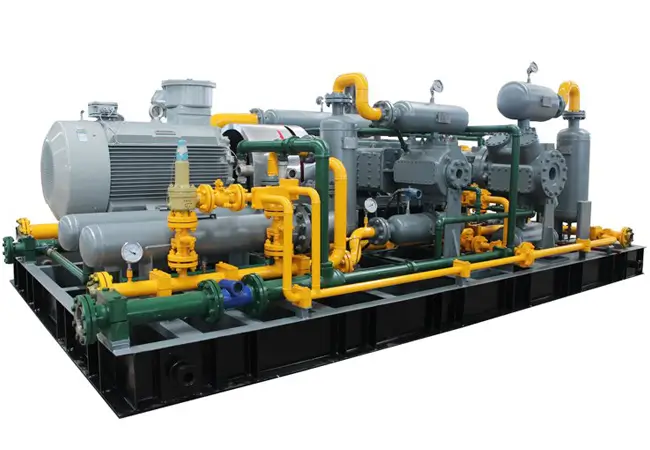
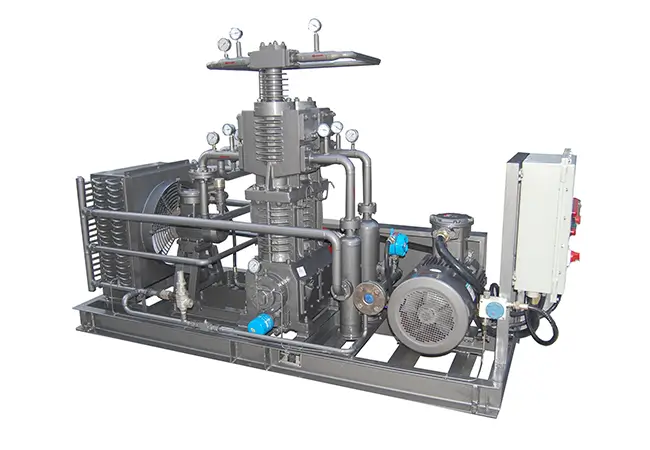
At MINNUO, our sour gas screw compressors are engineered with NACE-compliant materials throughout, from the housing and rotors to the fasteners and seals. We offer the full range of rotor coating options—PTFE, PEEK, and tungsten carbide—selected for your specific gas composition and operating conditions. Every MINNUO sour gas compressor includes complete material certification, coating application documentation, and NACE compliance verification. Whether you are compressing wellhead gas with moderate H₂S or a high-H₂S stream destined for sulfur recovery, MINNUO delivers equipment engineered for safe, reliable sour gas service.
 Email
Email sales:+86 15312799623