I. Introduction
Green hydrogen is one of the most promising pathways to decarbonize industry. Produced by electrolysis using renewable electricity, it offers a clean fuel for transportation, feedstock for chemical processes, and a means of long-duration energy storage.
But producing green hydrogen isn’t just about electrolyzers. Behind every electrolysis system is a critical piece of equipment that often goes unnoticed: the compressed air system.
Electrolyzers need clean, dry, oil-free air for purging, cooling, and control systems. And in the hydrogen environment—where purity is paramount and any contamination can damage sensitive components—oil-free screw compressors have become the standard.
This guide explains why oil-free screw compressors are essential for green hydrogen production, how they’re used, and what to consider when selecting one.
II. Why Green Hydrogen Production Needs Oil-Free Compressed Air
To understand why oil-free matters, you first need to understand the electrolysis process.
How electrolysis works:
Water (H₂O) is split into hydrogen and oxygen using electricity. The two main technologies:
| Technology | Description | Air Requirements |
| Alkaline | Mature, uses liquid electrolyte | Control air, purge systems |
| PEM (Proton Exchange Membrane) | Compact, high current density | Higher purity requirements |
| SOEC (Solid Oxide) | High-temperature | Process air preheating |
Where compressed air is used:
| Application | Purpose | Oil-Free Required? |
| Control systems | Pneumatic valves, actuators | Yes (contamination risk) |
| Purging | Flushing lines before maintenance | Yes (safety) |
| Cooling | Cooling electrolyzer stacks | Depends (but preferred) |
| Instrument air | Sensors, analyzers | Yes (accuracy) |
| Balance of plant | Various auxiliary systems | Often yes |
Why oil is unacceptable:
- Oil can poison electrolyzer membranes (PEM especially)
- Oil contamination affects hydrogen purity
- Oil in control systems causes valve sticking
- Hydrogen quality standards require clean systems
For these reasons, oil-free compressed air is the standard for green hydrogen facilities.
III. How Oil-Free Screw Compressors Are Used in Hydrogen Production
Oil-free screw compressors serve multiple roles in hydrogen production facilities.
Instrument and control air:
Electrolysis plants have hundreds of pneumatic valves and actuators. These require clean, dry compressed air to operate reliably. Oil contamination can cause valves to stick, leading to process upsets or safety incidents.
Purging and inerting:
Before maintenance, hydrogen lines must be purged to remove flammable gas. Compressed air—or nitrogen derived from it—is used for this purpose. Any oil in the purge air would contaminate the system.
Cooling:
Some electrolyzer designs use compressed air for cooling. Oil-free air ensures no contamination reaches the sensitive stack.
Balance of plant:
Air-operated pumps, conveyors, and other equipment throughout the facility require reliable compressed air.
Feed air for nitrogen generation:
Many hydrogen facilities use nitrogen for inerting. On-site nitrogen generators require clean, oil-free compressed air as feed.
IV. Purity Requirements for Hydrogen Production Applications
Different applications within a hydrogen facility have different purity requirements.
ISO 8573-1 classes for hydrogen production:
| Application | Particles | Water | Oil | Rationale |
| Instrument air | Class 2 | Class 3 | Class 1 | Sensitive controls |
| Purging air | Class 3 | Class 4 | Class 1 | Hydrogen safety |
| Cooling air | Class 3 | Class 3 | Class 2 | Stack protection |
| Feed for N₂ generator | Class 2 | Class 3 | Class 1 | Membrane protection |
The critical standard: Class 1 oil
Most hydrogen applications require Class 1 oil content: ≤0.01 mg/m³. This is the threshold for “technically oil-free” and is essential for protecting electrolyzer membranes and control systems.
Class 0 considerations:
Some ultra-pure applications (PEM electrolysis, fuel cell testing) may require Class 0—even lower than Class 1. Verify with your electrolyzer manufacturer.
V. Selecting an Oil-Free Screw Compressor for Hydrogen Facilities
Choosing the right compressor requires understanding the facility’s needs.
Sizing considerations:
- Determine air demand: List all pneumatic equipment, purge requirements, and instrument air needs. Account for simultaneous usage.
- Specify pressure: Most controls need 80-100 PSI. Cooling applications may need different pressures.
- Consider duty cycle: Hydrogen plants often run 24/7. Choose compressors rated for continuous duty.
- Plan for redundancy: For critical applications, N+1 configuration ensures no single failure stops production.
- Account for future expansion: Hydrogen facilities often scale up. Size with capacity for additional electrolyzers.
Technology choices:
| Factor | Dry Oil-Free | Water-Injected |
| Oil-free guarantee | Yes | Yes |
| Efficiency | Very good | Excellent (near-isothermal) |
| Maintenance | Moderate (timing gears) | Higher (water treatment) |
| Complexity | Moderate | Higher |
| Best for | General purpose | High efficiency, continuous run |
Dry oil-free is often preferred for simplicity and reliability. Water-injected offers higher efficiency but requires water quality management.
VI. Reliability and Redundancy for Continuous Operation
Hydrogen production is often continuous. Compressed air failure can mean production loss.
Redundancy configurations:
| Configuration | Description | Best For |
| Single compressor | Lowest cost | Small, non-critical |
| N+1 | One extra unit | Most industrial plants |
| Dual 100% | Full redundancy | Critical operations |
N+1 example:
- Peak demand: 500 scfm
- Use three 250 scfm compressors (two run, one standby)
- If any unit fails, remaining two handle peak
Additional reliability measures:
- Automatic changeover: Controls switch to backup without operator intervention
- Remote monitoring: Alerts to problems before they cause failure
- Spare parts: Critical spares kept on-site
- Backup power: Connection to emergency power if available
VII. Installation Considerations for Hydrogen Facilities
Hydrogen production has unique safety and environmental considerations.
Location:
- Compressors should be in non-hazardous areas where possible
- If in hazardous area, use appropriately rated equipment
- Ensure adequate ventilation
Air intake:
- Locate intake away from hydrogen vents or potential leaks
- Consider hydrogen detection at intake if near hazardous areas
- Filter intake to protect compressor
Material compatibility:
- Standard oil-free compressors are compatible with hydrogen environments
- For hydrogen service in the compressed air, special considerations apply
- Consult with manufacturer for hydrogen-specific applications
Safety systems:
- Hydrogen detection in compressor room
- Emergency shutdown integration
- Ventilation interlocked with gas detection
FAQ
Q1: Why can’t I use an oil-lubricated compressor for hydrogen production?
A1: Oil-lubricated compressors have inherent oil carryover (typically 2-5 mg/m³ even with filtration). This oil can poison PEM electrolyzer membranes, contaminate hydrogen product, and cause control valves to stick. For hydrogen production, oil-free is the industry standard.
Q2: What’s the difference between dry oil-free and water-injected compressors for hydrogen?
A2: Dry oil-free uses timing gears and coatings to eliminate oil. Water-injected uses water for sealing and cooling. Both are oil-free. Dry is simpler and more common; water-injected offers higher efficiency but requires water treatment.
Q3: How much compressed air does a hydrogen plant need?
A3: It varies widely by scale. A small 1 MW PEM electrolyzer might need 50-100 scfm. A large 100 MW facility could need 500-2,000 scfm. Instrument air, purge requirements, and cooling needs all factor in.
Q4: Do I need Class 0 or Class 1 oil-free air?
A4: Most hydrogen applications require Class 1 (≤0.01 mg/m³) oil content. Some sensitive PEM systems may require Class 0. Verify with your electrolyzer manufacturer. Oil-free screw compressors can meet either with proper filtration.
Q5: How often do oil-free screw compressors need maintenance in hydrogen service?
A5: Typical service intervals: filter changes every 2,000-4,000 hours, belt or coupling inspection annually, and major overhaul every 10,000-15,000 hours. Water-injected units require additional water treatment maintenance.
Q6: Can the compressor be located in a hazardous area?
A6: Yes, but requires explosion-proof or purged enclosures. To minimize cost, locate compressors in non-hazardous areas if possible. If the facility layout requires placement in hazardous zones, work with a manufacturer experienced in ATEX/IECEx equipment.
Q7: What redundancy level is recommended for hydrogen production?
A7: For continuous operation, N+1 (one extra compressor) is typical. For critical applications where downtime is unacceptable, dual 100% systems or multiple smaller units with full backup may be justified. Consider the cost of downtime vs. additional equipment.
Conclusion
Green hydrogen production is one of the most exciting developments in the energy transition. But the success of these facilities depends on more than just electrolyzers—it depends on the systems that support them.
Oil-free screw compressors provide the clean, reliable compressed air that hydrogen plants need. They protect sensitive membranes, ensure control systems function properly, and maintain the purity of the hydrogen product.
From small pilot plants to massive gigawatt-scale facilities, oil-free compression is the standard. The investment in quality compressors pays back in reliability, product quality, and peace of mind.
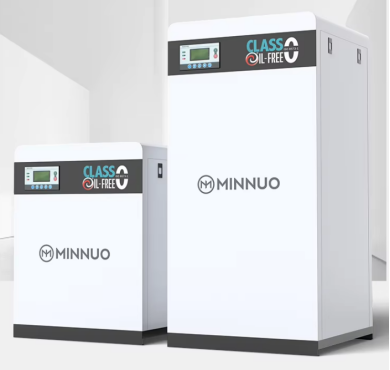
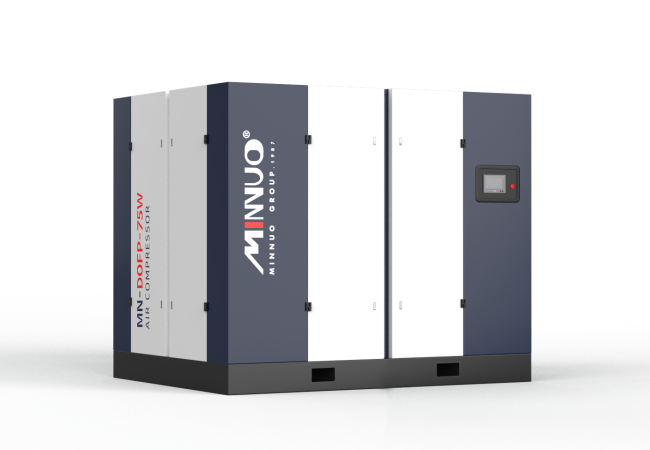
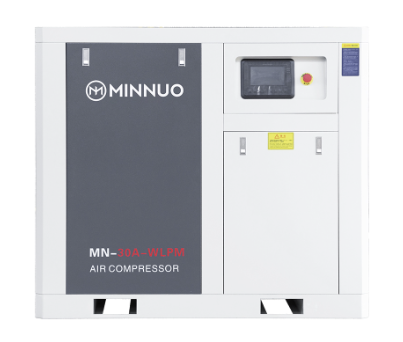
At MINNUO, we help hydrogen producers select and integrate oil-free screw compressors for their facilities. From sizing to redundancy planning to installation, we focus on systems that deliver clean air reliably—because in hydrogen production, contamination is not an option.
 Email
Email sales:+86 15366749631