Introduction: A Milestone Breakthrough in Oil-Free Technology
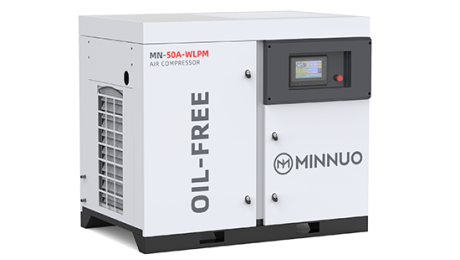
In modern high-end manufacturing, the quality of compressed air directly determines product quality. Oil-free dry screw air compressors, with their unique compression principles and precision manufacturing processes, achieve absolute cleanliness and high-efficiency stability in compressed air. They have become the ideal choice for industries with stringent air quality requirements, such as pharmaceuticals, food, electronics, and textiles. This technology not only eliminates the contamination risks associated with oil-lubricated compressors but also sets new industry benchmarks in energy efficiency, reliability, and intelligence.
I. Technical Principles and Structural Characteristics
1.1 Dry Screw Compression Principle
The core of an oil-free dry screw air compressor lies in its unique compression chamber design. A pair of precision-machined male and female rotors rotate synchronously in opposite directions within the compression chamber, maintaining micron-level clearances between the rotors and between rotors and the housing without direct contact. As the rotors rotate, the volume of the tooth spaces continuously changes, achieving the entire process of gas intake, compression, and discharge.
This non-contact compression method fundamentally eliminates dependence on lubricating oil, ensuring that compressed air never comes into contact with any oil during the entire process. The rotor surfaces undergo special coating treatments, which not only reduce the friction coefficient but also enhance wear resistance and corrosion resistance.
1.2 Key Component Design
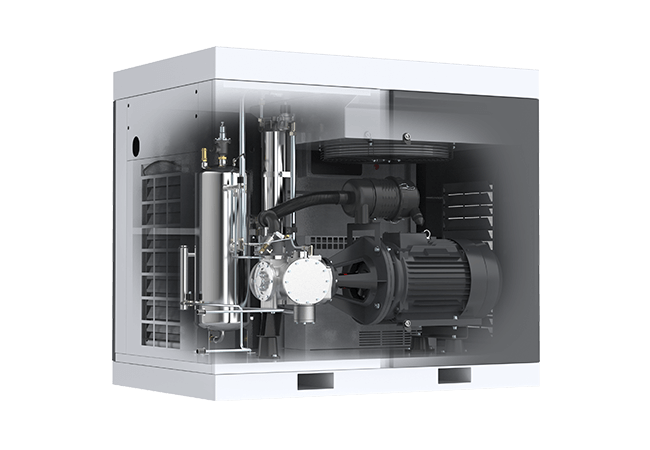
Synchronous Gear System: Precision synchronous gears ensure that male and female rotors maintain accurate relative positions, avoiding metal contact.
Shaft Seal System: Multiple shaft seal designs, including carbon ring seals and labyrinth seals, effectively prevent lubricating oil from entering the compression chamber.
Cooling System: Independent water-cooled or air-cooled systems control compression chamber temperature, ensuring stable rotor clearances.
Special Coatings: Rotor surfaces utilize PTFE, ceramic, or composite coatings to reduce friction and improve sealing performance.
1.3 Multi-Stage Compression Configuration
To meet different pressure requirements, oil-free dry screw compressors typically employ multi-stage compression designs:
Two-Stage Compression: The most common configuration, where gas is compressed in the first stage, passes through intercooling, and then enters the second stage for final compression.
Interstage Cooling: Efficient coolers reduce the discharge temperature from the first stage, improving second-stage compression efficiency.
Isothermal Compression Optimization: Enhanced cooling brings the compression process closer to isothermal compression, reducing energy consumption.
II. Core Technical Advantages
2.1 Absolute Oil-Free Quality
ISO 8573-1 Class 0 Certification: Output compressed air is completely free of oil, meeting the highest international cleanliness standards.
Zero Contamination Risk: Avoids impacts of oil emulsification and carbonization on production processes and product quality.
No Oil Management: Eliminates regular replacement of lubricating oil and oil filters, simplifying maintenance work.
Environmental Safety: No oil mist emissions, complying with the strictest environmental requirements.
2.2 High Efficiency and Energy Savings
Advanced Profile Design: Optimized rotor profiles improve volumetric efficiency and reduce internal leakage.
Intelligent Control Systems: Automatically adjust operational status based on actual air demand to avoid energy waste.
High-Efficiency Motor Configuration: Utilizes IE4 and higher efficiency class permanent magnet synchronous motors.
Energy Recovery Potential: Compression heat can be recovered for process heating or space heating, improving overall energy efficiency.
2.3 Excellent Operational Characteristics
Continuous Operation Capability: Designed for 24/7 continuous operation, with annual operating hours exceeding 8,000 hours.
Wide Regulation Range: Continuously adjustable within 30-100% load range, adapting to various air demand changes.
Low Vibration Design: Well-balanced rotor system with vibration values below 2.5 mm/s.
Noise Control: Soundproof enclosures and multi-stage noise reduction designs keep operating noise below 75 dB(A).
2.4 Maintenance Convenience
Few Wear Parts: Oil-free lubrication system reduces the number of wear components.
Modular Design: Components are modularized for easy inspection and replacement.
Long Maintenance Intervals: Overhaul intervals can reach 40,000-60,000 hours.
Intelligent Alerts: Real-time monitoring of key parameters provides early warnings for potential faults.
III. Key Application Fields
3.1 Pharmaceutical Industry
Sterile Production Environments: Provides 100% oil-free compressed air for cleanrooms.
GMP Compliance: Fully meets Good Manufacturing Practice requirements.
Process Air Supply: Used in key processes such as fermentation, mixing, and drying.
Packaging Processes: Ensures no contamination risks during pharmaceutical packaging.
3.2 Food and Beverage
Direct Contact Applications: Used in direct-contact processes such as food mixing, filling, and conveying.
Food Safety Assurance: Complies with food safety standards such as FDA and HACCP.
Packaging Lines: Ensures cleanliness and contamination-free packaging materials.
Ingredient Conveying: Provides clean power for pneumatic conveying systems.
3.3 Electronics and Semiconductors
Cleanroom Applications: Meets Class 1000 and higher cleanliness requirements.
Precision Equipment Air Supply: Provides stable, clean air for lithography machines, pick-and-place equipment, etc.
Process Air: Ensures no particulate or oil contamination during production processes.
Nitrogen Substitution: Certain processes can use clean air instead of nitrogen, reducing costs.
3.4 Textile Industry
Air Jet Looms: Provides stable, clean compressed air for air jet looms.
Airjet Spinning: Ensures no oil contamination of yarn during spinning processes.
Textile Finishing: Used in fabric setting, blowing, and other processes.
Energy Savings: Efficient operation reduces energy costs for textile enterprises.
3.5 Chemical and Petrochemical
Instrument Air: Provides reliable air sources for precision instruments and control systems.
Process Air: Certain chemical processes require oil-free compressed air.
Explosion-Proof Areas: Optional explosion-proof designs suitable for hazardous areas.
Corrosion Resistance Options: Special coatings adapt to corrosive environments.
IV. Technological Innovation Trends
4.1 Rotor Profile Optimization
Asymmetric Profiles: Improves sealing performance, reduces internal leakage.
Variable Pitch Design: Optimizes pressure distribution, reduces power consumption.
5-Axis Machining: Enables more complex profile designs, improving precision.
4.2 Coating Technology Innovations
DLC Coatings: Diamond-like carbon coatings with extremely high hardness and wear resistance.
Ceramic Composite Coatings: Excellent high-temperature and corrosion resistance.
Self-Lubricating Coatings: Reduces friction coefficient, improves efficiency.
Nano-Coatings: Smoother surfaces, reduced resistance.
4.3 Intelligent Control Systems
IoT Integration: Enables remote monitoring and intelligent diagnostics.
Artificial Intelligence Optimization: AI algorithms optimize operating parameters, improving energy efficiency.
Digital Twins: Virtual models synchronized with actual operation for performance prediction.
Edge Computing: Real-time data processing for rapid load response.
4.4 Efficient Cooling Technology
Water Cooling Optimization: Enhanced heat transfer designs improve cooling efficiency.
Air Cooling Innovations: Efficient fan and radiator designs.
Temperature Adaptation: Automatically adjusts cooling intensity based on ambient temperature.
Heat Recovery: Integrated heat recovery systems improve overall energy efficiency.
V. Selection and Application Essentials
5.1 Key Selection Parameters
Air Delivery Requirements: Accurately assess actual air consumption, considering peak and average flow.
Working Pressure: Determine pressure levels based on equipment requirements.
Environmental Conditions: Consider installation environment temperature, humidity, dust, etc.
Load Characteristics: Analyze load variation patterns to select appropriate regulation methods.
5.2 System Configuration Recommendations
Dryer Configuration: Choose refrigerated or adsorption dryers based on dew point requirements.
Filter Configuration: Multi-stage filtration ensures air quality.
Air Receiver Capacity: Sufficiently sized buffer tanks stabilize system pressure.
Backup Units: N+1 redundancy for critical applications.
5.3 Installation Environment Requirements
Ventilation Conditions: Ensure good heat dissipation and ventilation.
Air Intake Quality: Air intakes positioned away from contamination sources.
Foundation Requirements: Flat, sturdy foundations reduce vibration transmission.
Maintenance Space: Reserve sufficient space for operation and maintenance.
VI. Economic Analysis
6.1 Initial Investment
Equipment Cost: Higher initial investment compared to oil-lubricated models.
Installation Costs: Simple installation requirements reduce installation costs.
Auxiliary Equipment: No need for oil separation systems, saving auxiliary investments.
Comprehensive Comparison: Full lifecycle costs are more advantageous.
6.2 Operating Costs
Energy Consumption: High-efficiency design reduces electricity expenses.
Maintenance Costs: Minimal maintenance requirements lower maintenance costs.
Consumables Costs: No need for oil and related consumables.
Downtime Losses: High reliability reduces production interruption losses.
6.3 Long-Term Benefits
Product Quality: Clean air ensures improved product quality.
Equipment Lifespan: Design life can exceed 20 years.
Environmental Benefits: Reduces waste disposal and environmental risks.
Brand Value: Enhances corporate image and market competitiveness.
VII. MINNUO Oil-Free Dry Screw Air Compressor Solutions
7.1 Product Series Features
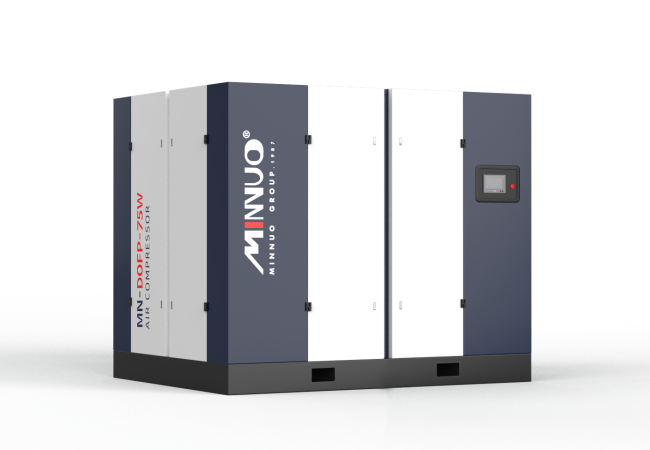
MINNUO’s oil-free dry screw air compressor series boasts the following outstanding features:
Full Series Certification: ISO 8573-1 Class 0 certified, ensuring absolute oil-free operation.
High Efficiency and Energy Savings: Meets national first-grade energy efficiency standards.
Intelligent Control: Advanced intelligent control systems enable unattended operation.
Modular Design: Facilitates installation, maintenance, and future expansion.
Multiple Pressure Options: Available in 7 bar, 8.5 bar, 10 bar, and other pressure options.
7.2 Technological Innovations
Patented Rotor Profiles: Independently developed high-efficiency rotor profiles improve volumetric efficiency.
Intelligent Temperature Control System: Precisely controls operating temperatures to extend equipment life.
Online Monitoring: Real-time monitoring of vibration, temperature, pressure, and other parameters.
Remote Service: Cloud-based platform enables remote diagnostics and maintenance.
7.3 Industry Customization
Pharmaceutical Edition: GMP compliant with optional sterile-grade configurations.
Food Edition: Meets food safety standards with optional washdown-resistant designs.
Electronics Edition: Ultra-clean design meets microelectronics industry requirements.
Textile Edition: Optimized for textile environments, improved reliability.
7.4 Service System
Professional Consultation: Comprehensive technical consultation and selection services.
Installation Support: Professional installation guidance and commissioning services.
Training Services: Complete operation and maintenance training.
After-Sales Service: Rapid-response after-sales support network.
VIII. Future Outlook
8.1 Technological Development Directions
Higher Efficiency: Continuous efficiency improvements through profile optimization and coating innovations.
More Compact Design: High-speed motor direct-drive technology reduces size.
More Intelligent Control: AI algorithms enable fully adaptive operation.
More Environmentally Friendly: Full lifecycle environmentally friendly design.
8.2 Market Prospects
With the development of high-end manufacturing and increasing environmental requirements, the oil-free dry screw air compressor market will continue to grow. Particularly in industries with strict air quality requirements such as pharmaceuticals, food, and electronics, their applications will become more widespread.
8.3 Industry Upgrading
The popularization of oil-free technology will drive quality upgrades in related industries. By providing clean, reliable compressed air, oil-free dry screw air compressors provide fundamental support for high-end manufacturing, helping industries move toward higher quality.
Conclusion: The Reliable Guardian of Pure Air
With their unique non-contact compression technology and outstanding performance, oil-free dry screw air compressors are becoming the benchmark for high-quality compressed air solutions. They represent not only technological progress but also a commitment to product quality, production safety, and environmental protection.
As a leader in oil-free compression technology, MINNUO will continue to innovate, providing customers with more efficient, reliable, and intelligent oil-free dry screw air compressor products. We believe that choosing oil-free dry screw air compressors is not only an investment in equipment performance but also a strategic choice for long-term enterprise development and quality assurance.
Today, as manufacturing moves toward higher-end, more intelligent, and greener development, oil-free dry screw air compressors will continue to play an important role, providing pure and reliable power support for various industries. Let us work together to promote industrial upgrading through technological innovation, creating a higher quality and more sustainable future.

 Email
Email sales:+86 15366749631