PET bottle production demands compressed air at two critical stages: low-pressure air for preform inflation and high-pressure air for final bottle formation. Any oil contamination in this air stream transfers directly to the interior surface of the bottle—the surface that will contact beverages, edible oils, or pharmaceutical products. The consequences range from off-taste complaints to complete batch rejection and regulatory non-compliance. Oil-free compressed air is not optional in PET blowing; it is a fundamental requirement. This article explains the purity standards, system design considerations, and compliance requirements for oil-free air in PET bottle manufacturing.
I. Why PET Bottle Blowing Demands Oil-Free Air
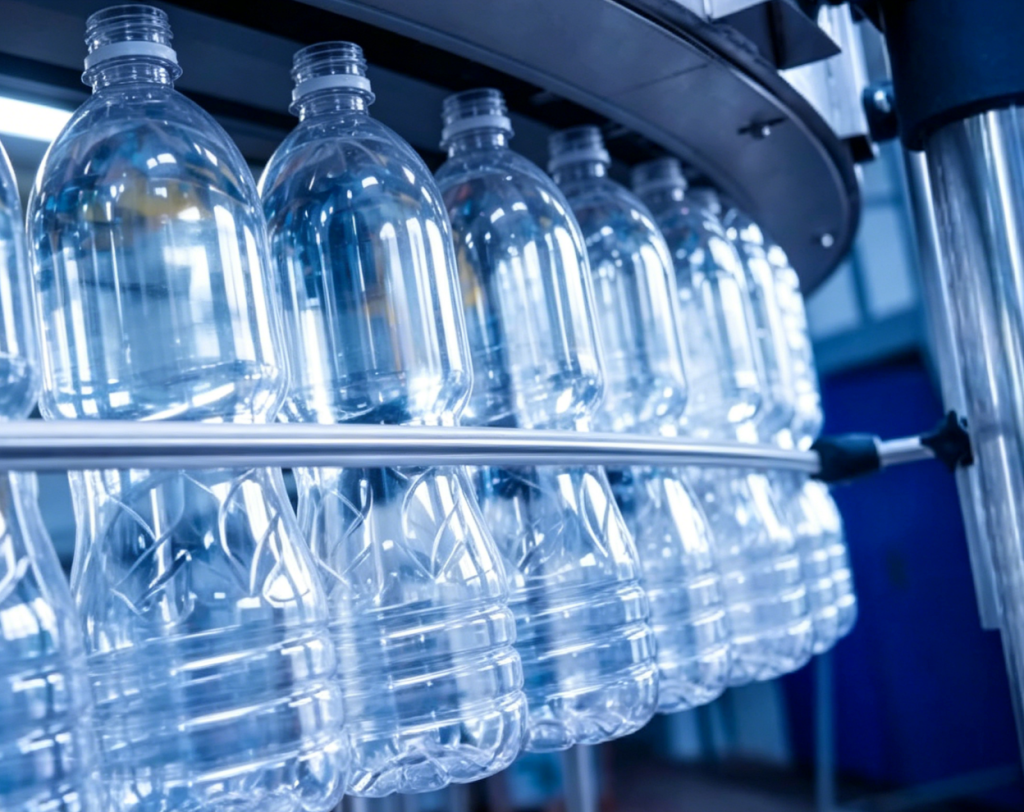
The PET blowing process creates direct and prolonged contact between compressed air and the food-contact surface of the package.
1. The Two-Stage Blowing Process
PET bottle production involves two distinct compressed air applications:
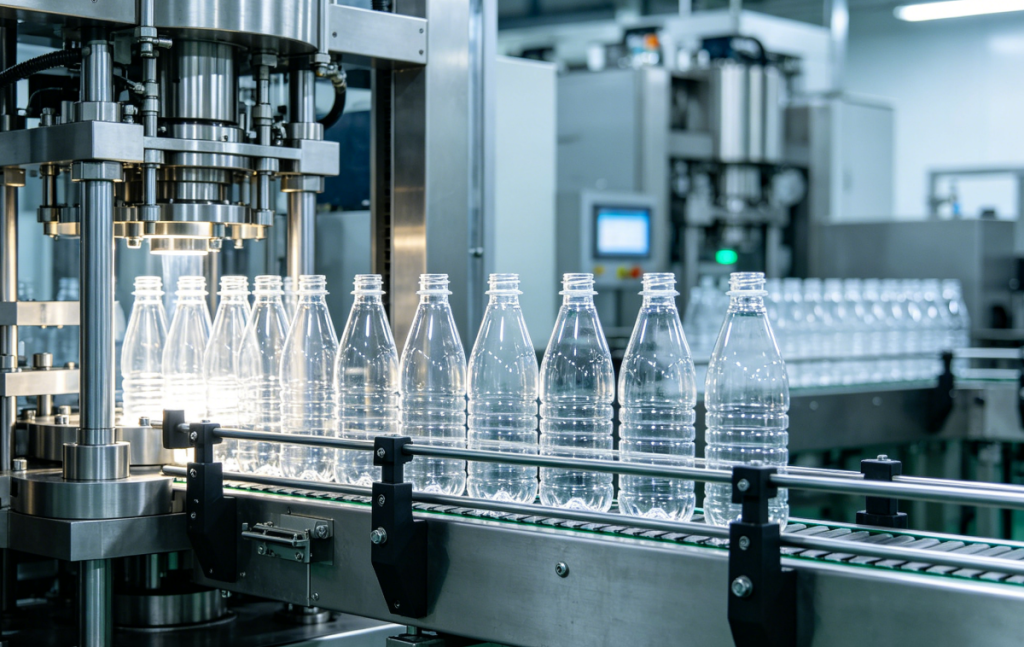
Preform heating and pre-blow (low pressure): Air at 10-15 bar inflates the heated preform to create the initial bottle shape. This air fills the entire internal volume of the preform and remains in contact with the inner surface throughout the blowing cycle.
Final blowing (high pressure): Air at 30-40 bar expands the pre-blow shape into the final mold, creating the finished bottle geometry. This high-pressure air contacts every square millimeter of the bottle interior.
Both stages introduce compressed air directly into what will become the primary food-contact surface.
2. Oil Contamination Transfer Mechanisms
Oil aerosol and vapor in compressed air deposit on the bottle interior through several mechanisms:
- Direct impingement: Air jets direct oil droplets onto the preform surface
- Condensation: Oil vapor condenses on the cooler preform surface during expansion
- Adsorption: PET material absorbs oil compounds, which later migrate into packaged products
3. Consequences of Oil Contamination
| Consequence | Impact |
| Off-taste and odor | Consumer complaints, brand damage |
| Product rejection | Entire batches discarded |
| Regulatory violation | FDA warning letters, recall orders |
| Audit failure | Loss of certifications (SQF, BRCGS, FSSC 22000) |
| Customer loss | Major beverage companies audit air quality |
4. Industry Standards and Customer Requirements
Major beverage brands enforce compressed air quality specifications exceeding regulatory minimums:
| Standard/Specification | Oil Content Requirement |
| ISO 8573-1 Class 0 | As specified by equipment manufacturer, tested per ISO 8573-2/5 |
| Coca-Cola KORE Requirements | Oil-free air mandatory for product contact |
| PepsiCo Global Quality Standards | Oil-free compressed air required |
| Nestlé Engineering Standards | Class 0 oil-free certification |
| SQF / BRCGS Food Safety Codes | Documented air quality risk assessment and controls |
II. Defining Oil-Free: ISO 8573-1 Class 0 Certification
Understanding what “oil-free” means in a certified context prevents specification errors.
1. Class 0 Is Not Zero Oil
ISO 8573-1 Class 0 does not mean absolute zero oil content. It means the oil content is below the detection limit of standardized test methods and meets limits specified by the equipment manufacturer. For practical purposes, Class 0 compressed air contains oil aerosol and vapor at levels that pose no measurable risk to product quality.
2. Class 1 vs. Class 0
| Parameter | Class 1 | Class 0 |
| Total oil content | ≤0.01 mg/m³ | As specified, typically lower |
| Measurement method | ISO 8573-2 or 8573-5 | Same |
| Typical application | General industrial, some food contact | Direct product contact, critical food/beverage |
| Audit acceptance | May require additional justification | Accepted as best practice |
For PET bottle blowing with direct product contact, Class 0 is the industry standard.
3. Certification Requirements
Valid Class 0 certification requires:
- Testing by ISO 17025 accredited laboratory
- Measurement of oil aerosol, oil vapor, and total oil
- Certification documentation maintained for audit inspection
- Recertification at specified intervals or after major service
4. Oil-Free Compressor vs. Oil-Free System
A Class 0 certified oil-free compressor delivers oil-free air at the compressor discharge. However, the complete system—piping, storage, filtration, and point of use—must maintain this purity. Contamination can enter downstream of an oil-free compressor through:
- Ambient air intake (atmospheric hydrocarbons)
- Piping corrosion or residual contamination
- Leaking valves or fittings admitting ambient air
- Contaminated storage receivers
III. Compressor Technology Selection for PET Blowing
PET blowing requires specific pressure capabilities that influence compressor selection.
1. Pressure Requirements
| Blowing Stage | Typical Pressure | Compressor Type |
| Pre-blow | 10-15 bar | Single-stage oil-free screw or two-stage reciprocating |
| Final blow | 30-40 bar | Two-stage oil-free screw, booster, or reciprocating |
| Stretch rod actuation | 7-10 bar | Same as plant air |
Single-stage oil-free screw compressors deliver up to 10-15 bar —sufficient for pre-blow but not final blow. High-pressure applications require two-stage compression or dedicated boosters.
2. Dry Oil-Free Screw Compressors for PET
Advantages:
- Inherently oil-free compression chamber
- Continuous flow without pulsation
- Suitable for 10-15 bar pre-blow air
- Lower maintenance than reciprocating boosters
Considerations:
- Single-stage limited to ~13 bar maximum
- Two-stage required for 30-40 bar final blow
- Rotor coating life affected by inlet air quality
3. Water-Injected Oil-Free Screw Compressors
Advantages:
- Near-isothermal compression improves efficiency
- Indefinite rotor life with proper water quality
- Available in two-stage configurations for high pressure
Considerations:
- Water treatment system adds complexity
- Discharged air saturated with water—increased dryer load
- Freeze protection required in cold climates
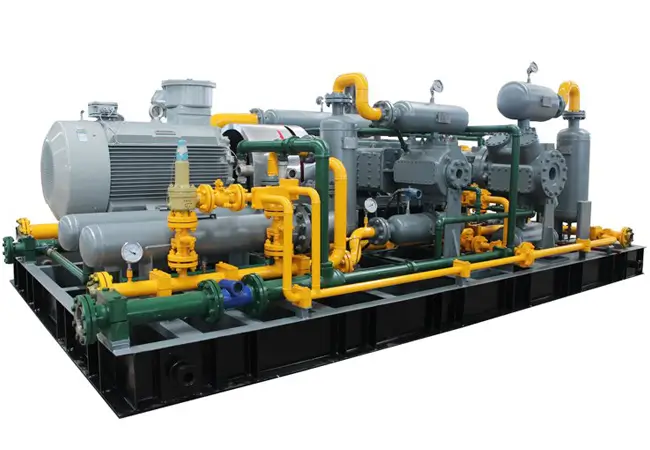
4. Oil-Free Reciprocating Boosters
Many PET lines use oil-free screw compressors for pre-blow air and oil-free reciprocating boosters for high-pressure final blow air.
Advantages:
- High pressure capability (40 bar and above)
- Simple mechanical design
- Teflon or carbon piston rings provide oil-free operation
Considerations:
- Higher maintenance than screw machines
- Pulsation requires dampening
- Wear particles from rings require filtration
5. System Configuration Options
| Configuration | Pre-Blow Air | Final Blow Air | Best Application |
| Single two-stage screw | 10-15 bar tap | 30-40 bar output | Small to medium lines |
| Screw + booster | Dedicated screw | Reciprocating booster | Medium to large lines |
| Central high-pressure | Common header | Common header | Multiple blow molders |
| Machine-mounted | Integral to blow molder | Integral to blow molder | Individual machines |
IV. Air Treatment for PET Blowing Systems
Even with oil-free compressors, comprehensive air treatment is essential.
1. Required Air Purity per ISO 8573-1
| Contaminant | Recommended Class | Specification |
| Oil | Class 0 | As certified |
| Particles | Class 1 | ≤0.1 mg/m³, 0.1-0.5 micron |
| Water (pressure dew point) | Class 1 or 2 | ≤-40°F or ≤-94°F |
| Microbiological | Sterile filtration | 0.01 micron at point of use |
2. Filtration Train Design
A complete PET blowing air treatment system includes:
Intake filtration:
- High-efficiency particulate filter (F9 or HEPA depending on environment)
- Activated carbon filter for atmospheric hydrocarbons
Compressor discharge:
- Water separator (for water-injected machines)
- Coalescing filter (0.01 micron) for any trace oil from ambient intake
- Particulate filter (1 micron) for desiccant dust or pipe scale
Point of use (at blow molder):
- High-pressure sterile filter (0.01 micron)
- Optional activated carbon for taste/odor-critical products
3. Drying Requirements
Moisture in blowing air causes multiple problems:
- Condensation on preform surface creates visual defects
- Water droplets cause uneven heating in preform ovens
- Microbial growth risk in piping and storage
Dew point specification: -40°F pressure dew point minimum for PET blowing. Desiccant dryers are standard; membrane dryers may serve small systems.
4. Material Selection for Air Contact Surfaces
Piping and components downstream of final filtration must be:
- Stainless steel (304 or 316L) for all product-contact air piping
- FDA-compliant seals and gaskets
- Orbital welded connections to eliminate crevices
- Sloped for drainage with low-point drip legs
V. System Design Considerations for PET Lines
1. High-Pressure Storage and Distribution
PET blowing systems consume air in rapid cycles as each bottle is formed. A 2-liter bottle may consume 2-3 cubic feet of high-pressure air in less than one second. Proper storage smooths demand.
High-pressure receiver sizing:
- Minimum 1 gallon per CFM of peak flow
- Multiple receivers near blow molders reduce pressure drop
- Stainless steel or internally coated carbon steel construction
2. Pressure Drop Management
Every PSI of pressure drop increases compressor energy consumption and risks insufficient blowing pressure. Design for minimal pressure loss:
- Oversized piping for high-pressure distribution
- Minimal fittings and directional changes
- Full-port valves
- Regular filter element replacement
3. Redundancy for Critical Production
PET lines running 24/7 cannot tolerate compressed air interruptions. Consider:
- N+1 compressor configuration
- Automatic transfer to backup compressor
- High-pressure storage sufficient for controlled shutdown
- Emergency connection for rental compressor
4. Integration with Blow Molder Controls
Modern blow molders communicate with the air system for:
- Pressure confirmation before cycle start
- Air consumption monitoring
- Predictive maintenance alerts
- Automatic shutdown on air quality deviation
VI. Compliance Documentation and Audit Readiness
Food safety audits require documented evidence of compressed air quality management.
1. Required Documentation
| Document | Purpose | Retention |
| Compressor Class 0 certification | Proof of oil-free capability | Life of equipment |
| Air purity test reports (semi-annual) | Ongoing compliance verification | Minimum 3 years |
| Filter change logs | Preventive maintenance evidence | Minimum 3 years |
| Dew point trend data | Drying system performance | Minimum 1 year |
| Maintenance records | System upkeep documentation | Minimum 3 years |
| Hazard analysis | HACCP / Preventive Controls | Current version |
2. Air Purity Testing Protocol
- Frequency: Semi-annual minimum; quarterly for high-risk products
- Sampling points: After final filtration, at blow molder connection
- Test parameters: Oil aerosol, oil vapor, particles, water, microbiological
- Laboratory: ISO 17025 accredited
3. Responding to Deviations
Documented corrective action procedure for out-of-specification results:
- Immediate production hold assessment
- Root cause investigation
- Corrective action implementation
- Verification testing before production resumption
- Product disposition evaluation
VII. Energy Efficiency in PET Blowing Air Systems
Compressed air for PET blowing consumes significant energy. Efficiency measures reduce operating cost.
1. Pressure Optimization
Blowing at higher than necessary pressure wastes energy. Each 14.5 PSI (1 bar) of excess pressure increases energy consumption by approximately 7-8% . Optimize:
- Pre-blow pressure for material distribution without over-pressurization
- Final blow pressure for complete mold filling
- Stretch rod timing to minimize air requirement
2. Leak Management
High-pressure leaks are disproportionately costly. A 1/8-inch leak at 40 bar wastes approximately 25 kW of compressor power continuously. Implement:
- Ultrasonic leak detection quarterly
- Leak tagging and repair tracking
- Pressure decay testing during line downtime
3. Air Recovery Systems
Some PET systems recover high-pressure blow air for use in pre-blow or plant air:
- Exhaust air from blow molds collected in recovery receiver
- Filtered and dried for lower-pressure applications
- Can reduce total air consumption by 20-30%
4. Variable Speed Drive Application
VSD compressors match output to demand, reducing energy at partial load. PET lines with varying bottle sizes or production rates benefit from VSD control.
FAQ
Q1: Can I use a standard oil-lubricated compressor with coalescing filters for PET blowing?
A1: Not recommended for direct food contact applications. Coalescing filters can achieve low oil carryover, but filter rupture or saturation events risk product contamination. Major beverage companies require oil-free compressors for PET blowing air. The audit and compliance burden of justifying oil-lubricated compressors typically exceeds the cost premium for oil-free equipment.
Q2: What is the typical service life of an oil-free compressor in PET applications?
A2: Dry oil-free screw compressors: 40,000-60,000 hours before major overhaul (rotor recoating). Water-injected oil-free screw compressors: 60,000-80,000 hours with proper water quality management. Operating conditions, inlet air quality, and maintenance practices significantly influence actual life.
Q3: Do I need a separate air dryer for pre-blow and final blow air?
A3: A central desiccant dryer sized for combined flow is standard. However, high-pressure final blow air may require additional drying if the pressure reduction across regulators causes condensation. Verify dew point at each point of use during system commissioning.
Q4: What is the payback period for air recovery on a PET line?
A4: Typical payback is 12-24 months for dedicated high-pressure air recovery systems on lines operating 6,000+ hours annually. Actual payback depends on local electricity rates, system complexity, and production volume.
Q5: How often should sterile filters be replaced on PET blowing machines?
A5: Per manufacturer recommendation, typically 6-12 months. Replace immediately if:
- Differential pressure exceeds limit
- Visible contamination or discoloration
- After any system breach or contamination event
- Per validated preventive maintenance schedule
Q6: Can one oil-free compressor supply multiple PET blow molders?
A6: Yes, this is standard practice. Size the central system for simultaneous peak demand plus 15-20% margin. Install individual pressure regulators and sterile filters at each blow molder. Consider high-pressure storage at each machine to handle instantaneous demand spikes.
Conclusion
Oil-free compressed air is non-negotiable for PET bottle blowing applications where air contacts food-contact surfaces. ISO 8573-1 Class 0 certification provides the documented assurance that beverage manufacturers and food safety auditors require. A complete system design—integrating oil-free compression, appropriate drying, multi-stage filtration, and stainless steel distribution—delivers the air purity essential for product quality and regulatory compliance. Proper documentation, routine purity testing, and disciplined maintenance ensure ongoing audit readiness and production reliability.
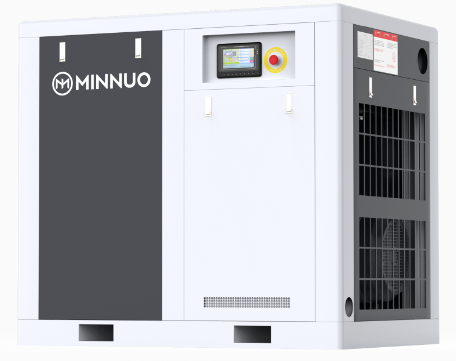
At MINNUO, we supply complete oil-free compressed air systems configured specifically for PET bottle blowing applications. Our systems include Class 0 certified oil-free screw compressors, desiccant air dryers, high-pressure filtration, and stainless steel distribution components—all designed to meet the stringent requirements of major beverage brands and food safety standards. Whether you are equipping a new PET line, expanding existing capacity, or upgrading to oil-free technology, our engineering team delivers solutions that ensure product safety, audit compliance, and reliable production. Every MINNUO system includes certification documentation, commissioning support, and ongoing technical assistance.
 Email
Email sales:+86 15312799623