In the food and pharmaceutical industry, production safety and product purity are insurmountable red lines. As a key air supply equipment, industrial piston compressors directly determine the compliance of production processes and the safety of end products. From pharmaceutical fermentation and aseptic filling to food packaging and raw material transportation, every link imposes strict requirements on the cleanliness, oil-free and water-free performance of compressed air. This article will deeply analyze the hygiene standards and compliance requirements that industrial piston compressors in the food and pharmaceutical industry must follow, helping enterprises make accurate selections, avoid risks, and build a solid defense line for production safety.
I. Core Hygiene Standards: Three Strict Requirements of Oil-Free, Water-Free and Sterile
In food and pharmaceutical production, compressed air often comes into direct or indirect contact with products and production environments. Therefore, “oil-free, water-free and sterile” have become the core dimensions of hygiene standards, and relevant indicators must strictly comply with both international and domestic norms.
1. Oil-Free Standard: Class 0 as the Core Bottom Line
Oil contamination is a fatal hazard in food and pharmaceutical production, which may lead to product deterioration, flavor changes, and even pose risks to consumers’ health. According to the international standard ISO 8573-1, the food and pharmaceutical industry prioritizes the use of Class 0 (highest level) oil-free compressed air, requiring an oil content of < 0.01 mg/m³. The Chinese Pharmacopoeia and European Pharmacopoeia further clarify that the oil content of compressed air directly in contact with drugs or food should be ≤ 0.1 mg/m³, and the oil content of air supply supporting breathing equipment should be ≤ 0.5 mg/m³ (complying with EN12021 standard).
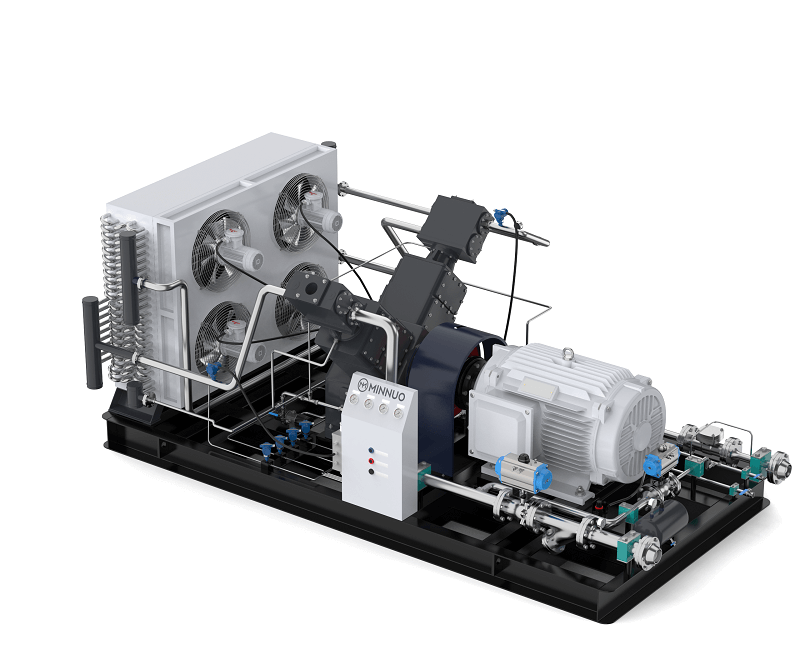
Industrial piston compressors need to eliminate oil contamination from the source through original oil-free design (rather than relying solely on downstream filtration). For example, food-grade coatings are used on metal surfaces in contact with air to avoid contact between lubricating oil and compressed air, and to prevent secondary pollution caused by the shedding of metal debris.
2. Water-Free Standard: Precise Control of Dew Point Temperature
Moisture in compressed air can breed microorganisms, cause equipment corrosion, and damage the cleanliness of the production environment. According to GB/T 13277.1 standard, the core production links of the food and pharmaceutical industry need to meet the Class 1 dew point standard, i.e., dew point ≤ -70℃ and water vapor content ≤ 2.6 ppmv; general production links can adopt the industrial general standard, with dew point ≤ -40℃ (water vapor content ≤ 127 ppmv).
Suitable industrial piston compressors need to be equipped with high-efficiency drying systems (such as adsorption and membrane dryers). Especially in processes sensitive to moisture such as food bottle blowing and pharmaceutical freeze-drying, it is necessary to ensure that the dew point meets the standard stably, so as to avoid product scrapping or unqualified compliance inspections due to excessive moisture.
3. Sterility Standard: Strict Limits on Microorganisms and Pathogens
Microbial contamination directly threatens the safety of food and pharmaceutical products, and there are clear microbial control indicators for different production scenarios. For the production of sterile drugs in the pharmaceutical industry (such as aseptic filling and freeze-drying), according to Appendix 1 of China’s GMP (2010 edition), the total aerobic microbial count (TAMC) of compressed air directly in contact with products is usually ≤ 100 CFU/m³, the Class A clean area needs to be nearly sterile, and pathogenic bacteria such as Escherichia coli and Staphylococcus aureus must not be detected.
The food industry follows GB 14881-2013 “National Food Safety Standard General Hygienic Specifications for Food Production”. The total number of colonies in compressed air in contact with food surfaces is recommended to be ≤ 500 CFU/m³, and pathogenic bacteria are also prohibited from being detected. Industrial piston compressor systems need to be equipped with HEPA/ULPA high-efficiency filters, regularly sterilized with ozone or steam, and dynamic monitoring to ensure that microbial indicators meet the standards continuously.
II. Key Compliance Certifications: Essential Qualifications for Connecting Production and Market
The food and pharmaceutical industry is strictly regulated. Industrial piston compressors need to pass authoritative compliance certifications to ensure the legality and compliance of production processes and the smooth entry of products into the market.
1. Core Domestic Certifications: GMP and Hygiene Standard Adaptation
The core requirement of the pharmaceutical industry is to pass GMP certification, which puts forward requirements for the entire process of piston compressors, including design specifications, material selection, production process control, and quality inspection. For example, equipment must use pharmaceutical-grade stainless steel materials, the structural design should be easy to clean and maintain, and it should have good sealing performance to prevent dust and microorganisms from invading; at the same time, a complete quality control system must be established to monitor the whole process from raw material inspection to finished product testing.
The food industry needs to comply with the GB 14881-2013 specification. The compressor system needs to pass third-party testing and verification to ensure that the quality of compressed air meets the requirements of food production. It is recommended to conduct full-item testing every quarter and complete ISO system review every year.
2. Core International Certifications: ISO Series and Industry-Specific Certifications
International market access requires meeting ISO 8573-1 Class 0 oil-free certification (such as TÜV Rheinland certification), which is the highest air purity standard recognized by the global food and pharmaceutical industry. In addition, the food industry needs to adapt to ISO 22000 food safety management system certification, and the pharmaceutical industry needs to comply with international norms such as EU GMP, FDA, and PIC/S to ensure the compliant circulation of products worldwide.
For specific application scenarios, it is also necessary to meet special certifications. For example, compressor components in contact with food need to pass food contact material safety certification, and air supply supporting medical devices need to comply with the ISO 13485 standard.
III. Selection and Operation and Maintenance: Key Measures to Ensure Long-Term Compliance
In addition to the equipment itself meeting standards and certifications, scientific selection and standardized operation and maintenance are also the core of ensuring the long-term compliance of industrial piston compressors.
1. Selection Points: Scene Adaptation and Technical Guarantee
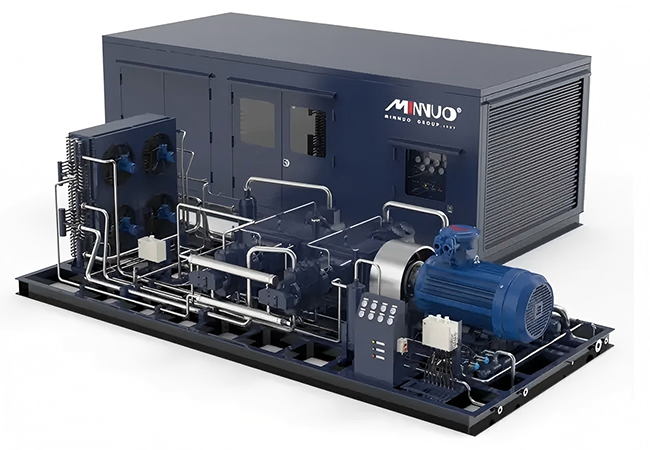
For core production links (such as pharmaceutical preparation and food filling), priority should be given to original oil-free industrial piston compressors, and the scheme of oil-injected machines + filtration should be avoided to eliminate oil contamination risks from the source; for auxiliary production links, oil-injected schemes can be considered in combination with costs, but oil residue needs to be verified regularly to ensure compliance with standards. At the same time, variable frequency models should be selected according to production load fluctuations to reduce energy consumption through dynamic energy supply adjustment, adapting to the 24-hour continuous operation needs of the food and pharmaceutical industry.
Equipment materials should preferably be food-grade and pharmaceutical-grade stainless steel, and parts in contact with air should adopt special coatings (such as E-coating) to ensure no harmful substances are precipitated; the structural design should be easy to disassemble and clean, reducing hygiene dead corners.
2. Operation and Maintenance Requirements: Regular Monitoring and System Maintenance
Establish a complete monitoring system. For high-risk scenarios (such as sterile production), it is necessary to monitor the oil content, dew point, and microbial indicators of compressed air weekly or in real time; for low-risk scenarios, monitoring can be conducted monthly or quarterly, and monitoring data should be completely retained for regulatory inspection. Regularly replace filter elements and dryer adsorbents, and disinfect and clean the compressor cavity to avoid compliance risks caused by equipment aging or improper maintenance.
Choose a brand with a complete after-sales service system to ensure timely response and maintenance when equipment fails, reduce production interruptions, and obtain professional compliance consulting and testing support to help enterprises cope with regulatory inspections.
Conclusion
The hygiene standards and compliance requirements for industrial piston compressors in the food and pharmaceutical industry core around building a full-process quality control system based on “oil-free, water-free and sterile”. Every link from equipment design, selection and certification to operation and maintenance monitoring cannot be relaxed. Choosing industrial piston compressors that meet both international and domestic standards and have authoritative certifications is not only the basis for ensuring product safety, but also the key for enterprises to avoid regulatory risks and enhance market competitiveness. MINNUO focus on the R&D and production of industrial piston compressors dedicated to the food and pharmaceutical industry. Our products have fully passed Class 0 oil-free certification and GMP adaptation certification, and can provide customized solutions according to different production scenarios, helping enterprises build a solid compliance defense line and achieve high-quality development.

 Email
Email sales:+86 15366749631