Selecting an oil-free air compressor for food packaging requires seven checks: air quality, contamination risks, airflow and receiver capacity, operating pressure, compressor technology, five-year costs, and acceptance testing. The right system should deliver clean, stable compressed air at the required pressure without unnecessary energy consumption or maintenance expenses.
Compressed air powers bottle cleaning, filling equipment, sealing machines, labeling systems, and pneumatic conveyors. However, each application places different demands on the compressed-air supply.
A beverage bottling line may require carefully controlled air purity at container-cleaning points, while a carton-sealing machine mainly needs consistent pressure and sufficient airflow. A packaging system with short, high-flow cycles may also need a different compressor and receiver configuration from one with continuous demand.
Selecting equipment based only on motor power, purchase price, or an oil-free label can lead to oversized systems, pressure fluctuations, unexpected operating costs, or contamination risks.
The following seven checks help industrial buyers develop an accurate technical specification and compare compressor quotations before placing an order.
1. What ISO 8573-1 Air Quality Is Required for Food Packaging?
Compressed air for food packaging should meet the particle, water, and oil purity requirements appropriate to each application. ISO 8573-1 provides the classification system, while food-safety risk assessments determine the required quality at individual points of use.
An oil-free air compressor operates without deliberately injecting lubricating oil into its compression chamber. However, incoming air may still contain dust, water vapor, hydrocarbons, and microorganisms.
The compressor design is therefore only one part of the contamination-control strategy.
ISO 8573-1 Air Quality Classes Explained
ISO 8573-1:2010 expresses compressed-air quality in the following sequence:
Particles : Water : Oil
For example, ISO 8573-1 [1:2:1] indicates particle Class 1, water Class 2, and total-oil Class 1.
| Parameter | Class 1 | Class 2 | Class 4 |
|---|---|---|---|
| Particles, 0.1–0.5 μm | ≤20,000/m³ | ≤400,000/m³ | No numerical limit for this size range |
| Particles, 0.5–1.0 μm | ≤400/m³ | ≤6,000/m³ | No numerical limit for this size range |
| Particles, 1.0–5.0 μm | ≤10/m³ | ≤100/m³ | ≤10,000/m³ |
| Pressure dew point | ≤−70°C | ≤−40°C | ≤+3°C |
| Total oil concentration | ≤0.01 mg/m³ | ≤0.1 mg/m³ | ≤5 mg/m³ |
The values apply separately to the relevant contaminant categories. Total oil includes liquid oil, oil aerosols, and oil vapor.
For example, compressed air specified as [1:2:1] must meet the Class 1 particle limits, achieve a pressure dew point no higher than −40°C, and contain no more than 0.01 mg/m³ of total oil.
BCAS 2022 Air Purity Recommendations for Food Contact
The British Compressed Air Society’s BPG102-1 guideline, revised in June 2022, provides recommended purity levels for different compressed-air uses in food and beverage facilities.
| Compressed-air application | Recommended ISO 8573-1 class | Key requirements |
|---|---|---|
| Direct food contact | [1:2:1] | Particle Class 1, water Class 2, oil Class 1 |
| Indirect food contact | [1:2:1] | Particle Class 1, water Class 2, oil Class 1 |
| Non-food contact | [2:4:2] | Particle Class 2, water Class 4, oil Class 2 |
Direct-contact applications include compressed air intentionally contacting food, food-contact surfaces, or packaging materials.
Indirect-contact applications include pneumatic equipment whose exhaust air could unintentionally reach these areas.
Non-food-contact applications are those without a credible direct or indirect contamination pathway.
These are industry best-practice recommendations rather than universal legal requirements. The final air-quality specification should reflect the facility’s HACCP assessment and any applicable customer or regulatory requirements.
Is ISO Class 0 Necessary for Food Packaging?
Not every food packaging application requires ISO Class 0 oil performance.
Class 0 represents a defined contamination limit more stringent than Class 1 for the specified contaminant. It does not mean the complete air system is free of every possible contaminant.
Buyers should distinguish between oil-free compression, verified oil purity, and the quality of air delivered to packaging equipment.
A compressor may achieve a stringent oil specification while still requiring downstream drying, particle filtration, and microbiological controls.
The first selection check is to specify the complete air-quality requirement at each critical outlet, rather than relying only on the compressor’s oil-free designation.
2. Where Does Compressed Air Create Contamination Risks in Food Packaging?
Contamination risk depends on where compressed air is released and whether particles, moisture, hydrocarbons, or microorganisms can reach food or packaging surfaces.
Food packaging plants often use one compressed-air network for several different functions. However, pneumatic equipment used for general automation may have different hygiene requirements from equipment operating near exposed products.
Compressed Air Risks in Beverage Bottling, Snack Packaging, and Dairy Filling
| Packaging application | Typical compressed-air function | Main concern |
|---|---|---|
| Beverage bottling | Container handling and certain bottle-cleaning systems | Contamination of bottle interiors |
| Snack packaging | Pneumatic actuators and sealing mechanisms | Exhaust entering product or packaging areas |
| Dairy filling | Filling equipment and pneumatic controls | Hygiene in sensitive production zones |
| Carton sealing | Pneumatic cylinders | Pressure stability and exhaust pathways |
| Packaging material cleaning | Air blow-off | Transfer of contaminants to food-contact surfaces |
Beverage bottling lines
Compressed air is commonly used for operating valves, handling containers, and supporting automation.
Where compressed air is used for bottle interior cleaning, its purity must be appropriate for contact with surfaces that will subsequently touch the beverage.
Moisture, particles, oil residues, and microorganisms are important considerations.
Snack and flexible packaging lines
Vertical form-fill-seal (VFFS) machines use compressed air for actuators, sealing assemblies, and product gates.
The risk depends on whether air remains within mechanical circuits or can reach exposed products.
Compressed air used for pneumatic operations should also be distinguished from nitrogen or other gases used for modified-atmosphere packaging.
Dairy and hygienic filling lines
Dairy filling operations often have strict contamination-control requirements.
Compressed air released near sensitive production areas may require suitable final filtration, hygienic distribution, and microbiological monitoring.
The exact treatment level depends on the filling process and its food-safety controls.
How to Identify Critical Compressed-Air Contact Points
Before selecting a compressor, inspect each air outlet and determine:
- Whether compressed air intentionally contacts food or packaging.
- Whether exhaust air can enter an exposed product area.
- Whether the application requires microbiological control.
- Whether separate air-treatment zones would improve efficiency.
- Where air-quality sampling should take place.
The BCAS Food & Beverage Compressed Air Best Practice Guideline provides additional guidance on compressed-air contamination risks, HACCP, system installation, and maintenance.
For facilities using both hygienic process air and general utility air, separate treatment zones may help avoid applying the highest air-quality specification to every outlet.
The objective is to deliver the required air quality where it is needed while maintaining an economical system design.
3. How to Size Compressor Airflow and Air Receivers for Packaging Lines
Compressor capacity should match the packaging line’s actual air demand, including simultaneous peak loads, leakage, and planned expansion. Air receivers can help maintain stable pressure during short periods of high consumption.
Packaging machines rarely consume compressed air at a constant rate. Filling equipment, pneumatic cylinders, sealing systems, and air-blowing stations operate in different cycles.
Determine Required Airflow
Consider a packaging line with the following estimated air requirements:
| Equipment | Average Airflow | Peak Airflow |
|---|---|---|
| Filling equipment | 1.20 m³/min | 1.80 m³/min |
| Sealing equipment | 0.90 m³/min | 1.40 m³/min |
| Labeling and conveying | 0.60 m³/min | 0.90 m³/min |
| Packaging actuators | 0.80 m³/min | 1.30 m³/min |
| Total | 3.50 m³/min | 5.40 m³/min |
Illustrative engineering values.
If all peak loads occur simultaneously, the total reaches 5.40 m³/min. Including a provisional 10% allowance for leakage and expansion gives a preliminary requirement of approximately 5.94 m³/min.
However, the actual compressor capacity depends on machine operating cycles and whether peak loads occur simultaneously.
When Does a Packaging Line Need an Air Receiver?
Air receivers store compressed air and help stabilize pressure when demand changes rapidly.
For example, bottle-cleaning and pneumatic packaging equipment may consume large quantities of air for only a few seconds.
Instead of automatically installing a larger compressor, buyers can evaluate whether receiver storage can cover these short peaks.
Receiver selection depends on peak airflow, peak duration, allowable pressure drop, and compressor response.
FAD vs. Nm³/h: Why Reference Conditions Matter
Free Air Delivery (FAD) describes compressor output under defined reference conditions. Normalized flow and actual line-volume flow use different pressure and temperature bases.
When comparing supplier quotations, confirm that airflow values use consistent reference conditions.
For equipment selection, focus on required FAD, operating pressure, peak duration, and receiver capacity rather than compressor motor power alone.
4. How to Determine the Right Compressor Pressure for Packaging Equipment
The compressor must maintain sufficient pressure at the packaging machine after accounting for losses across piping, dryers, filters, and other system components.
Operating at unnecessarily high pressure increases electricity consumption and can increase air leakage.
Consider Pressure Losses Throughout the System
Suppose a packaging machine requires a minimum inlet pressure of 0.60 MPa(g).
| Pressure requirement | Value |
|---|---|
| Minimum machine inlet pressure | 0.60 MPa(g) |
| Piping pressure loss | 0.03 MPa |
| Dryer and filter pressure loss | 0.02 MPa |
| Preliminary minimum compressor outlet pressure | 0.65 MPa(g) |
The compressor must supply at least 0.65 MPa(g) at its outlet under these assumed conditions. The final control setting also needs to accommodate pressure fluctuations and filter loading.
Why FAD at Working Pressure Matters
Compressor airflow changes with operating pressure.
For example, MINNUO’s published dry oil-free screw compressor specifications list the MN-DOFP-45A with different airflow ratings:
| Working pressure | Published airflow |
|---|---|
| 0.7 MPa | 7.70 m³/min |
| 0.8 MPa | 6.73 m³/min |
| 1.0 MPa | 5.10 m³/min |
This illustrates why buyers should compare airflow at the required pressure rather than relying on the maximum capacity shown in a product catalog.
A suitable compressor should deliver sufficient FAD while maintaining stable operating pressure throughout the packaging line.
5. Water-Injected vs. Dry Screw vs. Scroll: Which Oil-Free Compressor Should You Choose?
Water-injected screw, dry oil-free screw, and oil-free scroll compressors are suitable for different packaging requirements. The decision should depend on airflow, duty cycle, energy efficiency, maintenance, and total ownership cost.
Compare Oil-Free Compressor Technologies for Packaging Lines
| Selection factor | Water-injected screw | Dry oil-free screw | Oil-free scroll |
|---|---|---|---|
| Typical application | Medium-to-large air systems | Continuous industrial operations | Smaller or modular systems |
| Compression method | Water-assisted screw compression | Dry screw compression | Orbiting scroll elements |
| Cooling characteristics | Water-assisted heat removal | Air or water cooling | Commonly air-cooled |
| Maintenance focus | Water circuit, seals, treatment system | Bearings, seals, cooling and mechanical service | Scroll elements and bearings |
| Main purchasing consideration | Water quality and operating costs | Energy performance and overhaul costs | Capacity and duty-cycle suitability |
Water-injected compressors use water to help control compression temperature.
Dry oil-free screw compressors compress air without oil or water injection into the compression chamber, although lubricated components may exist elsewhere within the machine.
Scroll compressors are commonly used for smaller or modular compressed-air installations.
For continuous industrial packaging, screw compressors are often practical candidates, but the most economical technology depends on actual operating conditions.
How to Compare Compressor Specific Power
Specific power expresses electrical input per unit of delivered airflow.
Specific Power = Package Electrical Input ÷ Free Air Delivery
Its common unit is kW/(m³/min).
Consider two hypothetical compressor packages operating at the same discharge pressure.
| Parameter | Compressor A | Compressor B |
|---|---|---|
| FAD | 6.0 m³/min | 6.0 m³/min |
| Discharge pressure | 0.7 MPa(g) | 0.7 MPa(g) |
| Package electrical input | 45 kW | 42 kW |
| Specific power | 7.50 kW/(m³/min) | 7.00 kW/(m³/min) |
Compressor B consumes approximately 6.7% less electricity at this operating point.
The comparison illustrates why package input power is more useful than motor rating alone.
The CAGI Performance Verification Program provides independently verified performance information for participating compressor models. Standardized performance data helps buyers compare equipment under consistent operating conditions.
MINNUO Water-Injected and Dry Screw Compressor Specifications
MINNUO offers both water-injected and dry oil-free screw compressor configurations.
| Published specification | Water-injected screw | Dry oil-free screw |
|---|---|---|
| Motor power range | 5.5–250 kW | 45–400 kW |
| Published airflow range | Approximately 0.7–45 m³/min | Approximately 3.78–67.36 m³/min |
| Compression method | Water-assisted screw | Dry screw |
| Pressure selection | Depends on model | Published range: 0.7–1.0 MPa |
The published model tables provide a starting point for selecting compressor capacity.
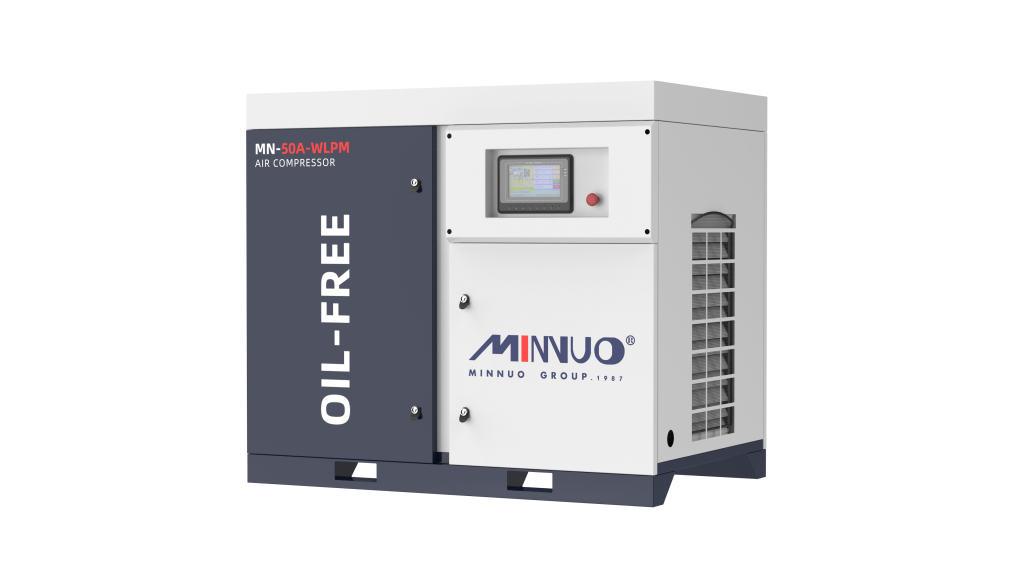
For example, the water-injected MN-50A-WLPM is listed with a maximum airflow of 6.50 m³/min at 0.8 MPa.
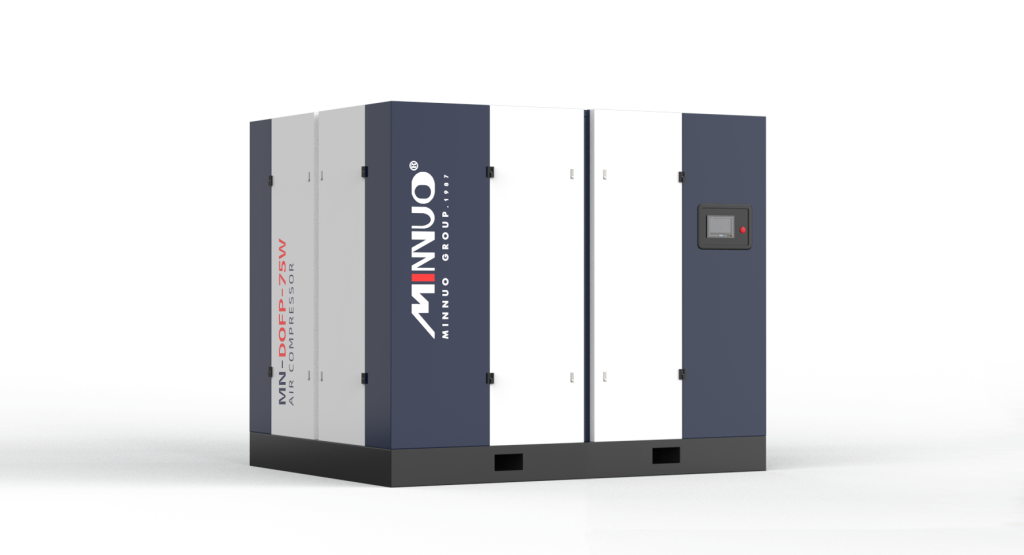
The dry oil-free MN-DOFP-45A is listed at 6.73 m³/min at 0.8 MPa.
These model values identify potential candidates; they do not establish a performance winner. Actual package power, operating range, and treatment requirements must also be considered.
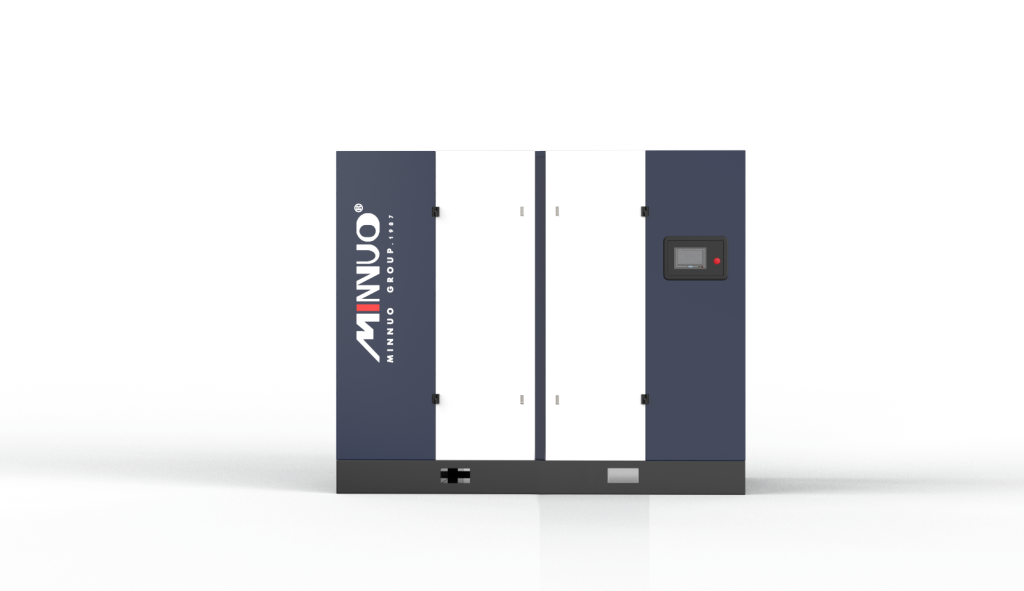
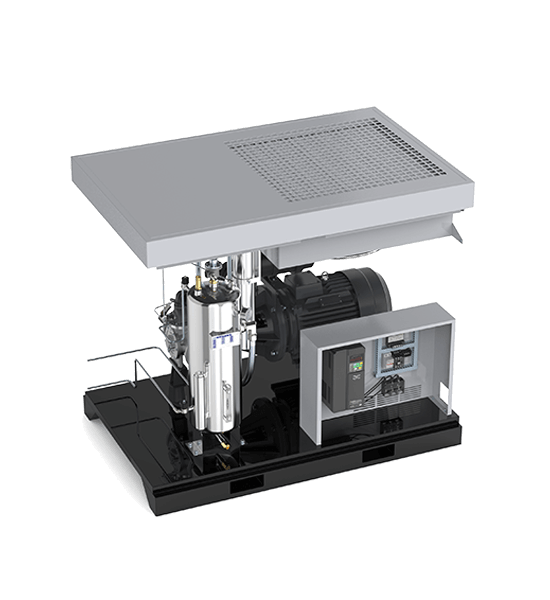
Detailed specifications are available in MINNUO’s Oil-Free Water-Injected Rotary Screw Compressor and Dry Oil-Free Air Compressor product pages.
6. How Much Does an Oil-Free Compressor System Cost Over Five Years?
The total ownership cost of an oil-free air compressor includes equipment purchase, electricity, maintenance, and air treatment. For packaging plants operating multiple shifts, energy consumption can represent a substantial long-term expense.
Compare Electricity Consumption
Consider two hypothetical compressor packages operating 6,000 hours annually at an electricity tariff of $0.12/kWh.
| Parameter | Compressor A | Compressor B |
|---|---|---|
| Average electrical input | 55 kW | 48 kW |
| Annual electricity cost | $39,600 | $34,560 |
| Five-year electricity cost | $198,000 | $172,800 |
Under these assumptions, Compressor B saves approximately $25,200 in electricity over five years.
This difference demonstrates why buyers should compare operating efficiency instead of focusing only on initial equipment prices.
How Air Treatment Affects Operating Costs
Dryers, filters, and other treatment equipment also influence total ownership costs.
| Air-quality requirement | Typical equipment | Main cost consideration |
|---|---|---|
| Pressure dew point around +3°C | Refrigerated dryer | Electricity and maintenance |
| Pressure dew point around −40°C | Desiccant dryer | Regeneration energy and servicing |
| Oil-vapor control | Appropriate adsorption treatment | Media replacement and pressure drop |
| Sensitive food-contact applications | Validated point-of-use filtration | Filter maintenance and air-quality testing |
A packaging plant with different air-quality requirements may benefit from separate treatment zones rather than applying the strictest specification to every outlet.
Evaluate Total Ownership Cost
Before placing an order, compare the complete system costs, including compressor purchase, air-treatment equipment, electricity, maintenance, cooling utilities, and service support.
Variable-speed compressors may provide savings when air demand fluctuates, while fixed-speed models can remain economical under stable continuous demand.
The lowest-priced compressor is not always the lowest-cost solution over five years.
7. What Compressor Tests and Documents Should Buyers Request Before Ordering?
Before purchasing an oil-free air compressor, buyers should verify the compressor’s technical performance, air-quality specifications, system design, maintenance requirements, and acceptance procedures.
A complete quotation should demonstrate how the equipment will meet the packaging line’s operating and hygiene requirements.
Required Compressor Specifications and Test Reports
| Document | Main information |
|---|---|
| Technical datasheet | FAD, pressure, power, voltage and dimensions |
| Air-quality specification | Required ISO 8573-1 particle, water and oil classes |
| Performance test information | Rated airflow, electrical input and test conditions |
| System design drawing | Compressor, receiver, dryer, filters, drains and piping |
| Maintenance schedule | Service intervals, consumables and overhaul requirements |
| Factory acceptance test plan | Equipment performance and control functions |
| After-sales agreement | Warranty, spare parts and technical support |
In addition to technical documentation, buyers should review the supplier’s expected spare-parts availability and service responsibilities.
ISO 1217 and ISO 8573 Testing Methods
Different compressor and air-quality measurements use different standards.
| Test parameter | Relevant standard | Purpose |
|---|---|---|
| Compressor performance | ISO 1217 | Acceptance testing for displacement compressors |
| Oil aerosols and liquid oil | ISO 8573-2:2018 | Oil aerosol measurement |
| Humidity and pressure dew point | ISO 8573-3:1999 | Moisture measurement |
| Solid particles | ISO 8573-4:2019 | Particle-content measurement |
| Oil vapor | ISO 8573-5:2025 | Oil-vapor measurement |
| Viable microbiological contaminants | ISO 8573-7:2003 | Microbiological sampling |
Total-oil verification may require both aerosol and vapor measurements.
The relevant testing methods should be selected according to the air-quality requirements and agreed acceptance criteria.
FAT vs. SAT: What to Verify Before Production
Factory Acceptance Testing (FAT) verifies agreed compressor characteristics before shipment.
Site Acceptance Testing (SAT) evaluates the installed compressed-air system under defined operating conditions.
For food packaging, site testing may be particularly important because contamination or pressure loss can occur downstream of the compressor.
| Parameter | Unit | Verification objective |
|---|---|---|
| Airflow | m³/min | Confirm required capacity |
| Discharge pressure | MPa(g) | Verify operating range |
| Electrical input | kW | Check energy performance |
| Point-of-use pressure | MPa(g) | Verify packaging equipment requirements |
| Pressure dew point | °C | Confirm moisture class |
| Total oil concentration | mg/m³ | Confirm oil purity |
| Particle concentration | Particles/m³ | Confirm particle classification |
| Microbiological quality | Validated test result | Verify site-specific hygiene criteria |
Final Oil-Free Compressor Purchasing Checklist
The following checklist can be used when preparing a supplier request for quotation.
| Procurement item | Information to specify |
|---|---|
| Production application | Bottling, filling, sealing, labeling or other packaging process |
| Air-contact category | Direct, indirect or non-food contact |
| Required air quality | ISO 8573-1 particle, water and oil classes |
| Required airflow | m³/min at agreed reference conditions |
| Maximum continuous demand | m³/min |
| Short-duration peak demand | m³/min and seconds |
| Minimum machine inlet pressure | MPa(g) |
| Compressor discharge pressure | MPa(g) |
| Receiver requirement | Volume, pressure range and peak duration |
| Operating schedule | Hours/day and days/year |
| Electrical supply | Voltage, frequency and phase |
| Required treatment | Dryer, filters, drains and point-of-use controls |
| Supplier documentation | Performance data, maintenance schedule and warranty |
| Acceptance requirements | FAT, SAT and air-quality tests |
A well-prepared specification enables suppliers to propose equipment based on actual engineering requirements and makes competing quotations easier to evaluate.
Frequently Asked Questions About Oil-Free Air Compressors for Food Packaging
Q1. What ISO 8573-1 Class Is Recommended for Food Packaging?
A: The BCAS BPG102-1 food and beverage guideline recommends ISO 8573-1 [1:2:1] for direct and indirect food-contact air and [2:4:2] for non-food-contact applications. The final specification should reflect the facility’s food-safety hazard assessment.
Q2. Is ISO Class 0 Mandatory for Food Packaging Compressors?
A: No. Class 0 oil performance is not universally mandatory. The required oil purity depends on contamination risks and applicable production requirements. A complete compressed-air system may also need drying, filtration and microbiological controls.
Q3. How Do You Calculate Air Receiver Capacity for Packaging Equipment?
A: Determine the airflow deficit during peak demand, peak duration and allowable receiver pressure drop. Calculate the approximate stored-air requirement, then size the receiver according to operating conditions and compressor controls.
Q4. Which Is Better for Packaging: Water-Injected or Dry Oil-Free Screw Compressors?
A: Both technologies can be suitable. Compare rated airflow, working pressure, specific power, maintenance requirements, water management and lifecycle costs at equivalent operating conditions.
Q5. What Tests Should Buyers Request Before Compressor Delivery?
A: Request agreed compressor performance data, air-quality documentation and a factory acceptance test plan. After installation, verify operating pressure, airflow and the required compressed-air purity at critical points of use.
Final Buying Checklist for Food Packaging Air Compressor Systems
An oil-free air compressor should be selected according to the complete packaging process, not simply by comparing compressor prices.
Start with the required air purity and contamination risks. Then determine simultaneous airflow demand, evaluate receiver storage, calculate operating pressure and compare compressor technologies using equivalent performance data.
Finally, review energy consumption, air-treatment costs, maintenance requirements and acceptance-test documentation.
For industrial buyers evaluating oil-free compressed-air equipment, MINNUO provides water-injected and dry oil-free screw compressor configurations. Equipment selection can be based on the required airflow, pressure, operating hours and air-quality specifications.
For a general explanation of oil-free compression technology, read What Is an Oil-Free Air Compressor?.
The right compressor investment is a complete air system that delivers reliable pressure, sufficient airflow and the required air quality while keeping lifecycle costs under control.

 Email
 sales:+86 15312799623