Introduction
Compressed air is known as the fourth industrial energy source across machinery, chemical, electronics and auto manufacturing plants. Its stable pressure directly determines production continuity, while power bills make up a large share of factory operating expenses.
Most factories run screw compressors, air receivers and dryers as isolated standalone devices with mismatched parameters and disconnected control logic. This leads to air pressure swings over ±0.3MPa and chronically high specific power consumption.
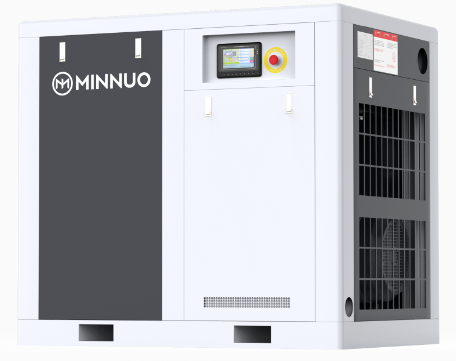
As a professional manufacturer of screw air compressors, Minnuo has accumulated data from thousands of factory retrofits. When compressors, air tanks and dryers operate under scientifically coordinated linkage:
- Air pressure fluctuation controlled within ±0.05MPa (40%+ stability improvement)
- System power consumption reduced by 18%
- Factories save tens of thousands USD in annual electricity costs
This article breaks down linkage principles, influencing factors, step-by-step optimization schemes and real test data to guide enterprises to build efficient compressed air systems.
1 Core Equipment Functions & Basic Linkage Logic
1.1 Unique Role of Each Single Device
Screw Air Compressor (Air Generation Source)
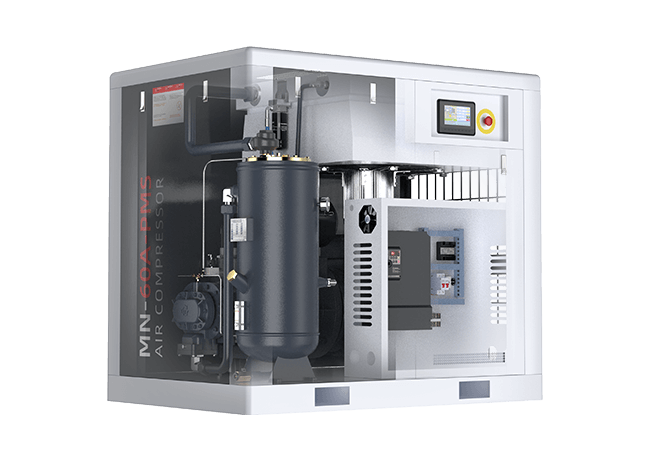
Minnuo MN series screw machines adopt 3rd generation airends with volumetric efficiency above 88%, paired with IE3 premium motors, delivering 5%–8% lower base power consumption than traditional models.
Core function: Compress atmospheric air to process pressure (0.7–1.0MPa) and output stable continuous airflow.
Air Receiver (Pressure Buffer & Energy Storage)
Three key functions:
- Pressure buffering: Absorb pulse exhaust from compressors to eliminate sharp pressure jumps
- Peak energy reserve: Release stored air during sudden demand spikes to cover temporary output shortages
- Primary moisture separation: Remove 60%–80% free water via gravity sedimentation
Minnuo air receivers are made of Q345R steel, hydrostatic tested at 1.5× working pressure, available from 0.3m³ to 50m³.
Compressed Air Dryer (Moisture Removal Unit)
Compressed air after compression carries high dew point (10–20℃). Excess moisture causes pipeline rust, pneumatic tool failure and defective finished goods.
Refrigerated dryers lower dew point to 210℃; adsorption dryers reach -20-70℃. Minnuo twin-tower adsorption dryers maintain dew deviation ≤±3℃ with 8000-hour adsorbent service life.
1.2 Closed-Loop Linkage Core Logic
Linkage means building a coordinated “air production-pressure stabilization-dehumidification” system to offset individual equipment weaknesses:
- Flow balance: Compressor rated output ≥ tank buffer flow + dryer processing volume + terminal total air demand
- pressure matching: Tank upper pressure = compressor unloading pressure minus pipeline & dryer pressure drop
- Time staggering: Shift dryer regeneration cycles away from factory peak air usage to avoid simultaneous high air consumption
1.3 Common Failures Caused by Poor Matching
| Failure Type | Manifestation | Root Cause |
| Severe pressure fluctuation | Terminal swing over ±0.2MPa, frequent pneumatic equipment alarms | Undersized air tank, frequent compressor start-stop |
| Excessive power waste | Specific power >0.12kWh/m³, far above industry average | Oversized compressor, over 30% unloading runtime |
| Insufficient drying performance | Dew point higher than -10℃, water condensate inside pipes | Dryer capacity smaller than compressor exhaust |
| Accelerated equipment aging | Airend & adsorbent wear out rapidly | Neglected daily tank drainage, liquid water entering dryer |
2 Four Key Factors That Determine Linkage Effect
2.1 Proper Equipment Sizing (Fundamental Premise)
Three matching calculation standards:
- Flow: Compressor rated flow = Max terminal air consumption × 1.1 margin; Dryer capacity ≥ Compressor flow × 1.2 (reserved for regeneration air)
- Pressure: Compressor rated pressure = Required end pressure + pipeline loss (≤0.05MPa) + dryer pressure drop (adsorption ≤0.08MPa, refrigeration ≤0.03MPa)
- Tank volume empirical rule: Tank capacity (m³) = Compressor flow (m³/min) × 10
Example: 6m/min screw compressor needs at minimum 6m³ air receiver.
Bad Case Reference: A furniture factory matched a 2.5m³/min 15kW compressor with 0.3m³ tank and 1.5m³/min dryer. The unit cycled start-stop every 3 minutes, pressure fluctuated ±0.25MPa, specific power hit 0.13kWh/m³ with constant dryer overload alarms.
2.2 Pipeline Layout & Pressure Loss Control
Pipeline resistance is a hidden energy drain:
- Main pipe diameter ≥ 1.2× compressor outlet pipe size (DN50 outlet needs DN65 main line)
- Limit elbow count to ≤2 per 10 meters; replace sharp 90° bends with curved elbows, use flanges instead threaded joints
- Install air tank between compressor and dryer, pipeline distance between them controlled under 5 meters
2.3 Intelligent Coordinated Control Logic
Independent single-machine auto control cannot realize system optimization:
1 Pressure linkage: Tank pressure difference between load & unload set to 0.1~0.15MPa
2 VSD coordination: Variable frequency compressor adjusts rotation speed automatically once tank pressure swings ±0.02MPa to avoid frequent startup
3 Time staggering: Arrange dryer regeneration period outside production peak hours
2.4 Standardized Daily Maintenance (Long-Term Stability Guarantee)
- Air receiver: Drain water 1–2 times daily, clean internal impurities monthly, hydrostatic test yearly
- Adsorption dryer: Replace molecular sieve every 6 months; refrigerated dryer clean condenser every 3 months
- Screw compressor: Lubricant change every 500 running hours, air filter replacement every 2000 hours, regular pressure sensor calibration
3 Step-by-Step System Linkage Optimization Plan
Step 1 Recalculate Air Demand & Reselect Matching Equipment
1 Calculate total air consumption: Q = Sum of single device air flow × simultaneous utilization factor
2 Confirm required working pressure + allowable pipeline loss
3 Clarify dew point standard by industry (electronics ≤-40℃, general machinery ≥-20℃)
Real Sizing Example – Auto Parts Factory
| Air Demand Index | Selected Equipment | Parameter Matching Logic |
| Total consumption 8m³/min | Minnuo MN-55 VSD screw compressor | Rated output 10m³/min, 0.8MPa |
| Allowable swing ≤±0.05MPa | 10m³ air receiver | Follow 10× flow empirical formula |
| Dew point ≤-40℃ | Twin-tower adsorption dryer | Capacity 12m³/min (10×1.2) |
Step 2 Pipeline Renovation to Cut Pressure Drop
1 Upgrade pipe size: DN50 original pipe replaced with DN80, pressure loss down from 0.08MPa to 0.03MPa
2 Remove redundant elbows, install pressure stabilizing valve at tank outlet (set 0.75MPa before dryer inlet)
3 Full pipeline leak inspection with ultrasonic detector, control total leakage ratio under 3%
Step 3 Upgrade Intelligent Linked Control System
1 VSD compressor linked with tank pressure sensor for real-time speed adjustment
2 Set load pressure 0.7MPa, unload pressure 0.8MPa to maintain stable tank pressure window
3 Add IoT cloud module for real-time monitoring of flow, pressure and dew point with abnormal push alerts
Step 4 Form Fixed Maintenance Schedules
Build daily three-check routine: tank drainage, dryer adsorbent status, pipeline pressure reading; log all maintenance records and conduct quarterly system parameter calibration.
4 Optimization Test Data & Real Factory Case
4.1 One-Month Contrast Test Data
| Test Item | Before Optimization | After Optimization | Improvement |
| Terminal pressure swing | ±0.22MPa | ±0.04MPa | Stability +81.8% |
| Specific power consumption | 0.125kWh/m³ | 0.103kWh/m³ | Power -17.6% |
| Stable dew point | -15℃ | -42℃ | Drying performance greatly improved |
| Compressor start-stop frequency | 28 times/h | 3 times/h | Startup wear reduced heavily |
4.2 Electronic Factory Energy-Saving Renovation Case
Original setup: 3×22kW fixed-speed compressors + two 1m³ tanks + small refrigerated dryers
Pain points: Pressure swing ±0.2MPa lowering packaging yield; 35% unloading ratio pushing annual power cost over 600,000 RMB; insufficient drying causing monthly equipment breakdowns.
Minnuo overall optimization scheme:
1 Replace with 2×MN-45 VSD screw compressors (total 12m³/min output)
2 Add 15m³ main air receiver in parallel with original small tanks
3 Upgrade to two 15m³/min adsorption dryers
4 Deploy IoT linked pressure control platform
Post-renovation outcomes:
Pressure swing limited to ±0.03MPa, packaging yield up from 98.5% to 99.8%; annual electricity expense cut by 120,000 RMB; pipeline condensation eliminated with zero monthly failures.
5 Minnuo Full Set Matching Solution Advantages
5.1 Matched Complete Product Line
- Screw Compressor: MN series airend volumetric efficiency >88%, ABB inverters, exceeds GB19153 Class 1 energy efficiency standard
- Air Receiver: X-ray welded Q34R vessels, 0.3–50m³ options, 10+ year service life
- Dryer: Adsorption type down to -70 dew point; refrigerated type adopts Danfoss compressors for stable 2~10℃ dew
5.2 Customized Matching Service
Professional technical team provides on-site air audit, flow/pressure calculation and customized design:
- Intermittent production (injection molding): Larger air tank + fast-response VSD unit
- 24h continuous chemical lines: High-capacity adsorption dryers + stable pressure linkage
- High-altitude / high-temperature plants: Special anti-high-temp & low-density customized configuration
5.3 Full Lifecycle Support
On-site installation & parameter calibration, operator training, nationwide 48-hour on-site maintenance, two-year core component warranty.
6 Troubleshooting for Common Matching Faults
1 Large Pressure Fluctuation
Check insufficient tank volume / pipeline leakage / unreasonable pressure difference setting; expand tank capacity, repair leaks, adjust load-unload gap to 0.1~0.15MPa
2 Excessive Power Consumption
Oversized compressor or long unloading time or heavy pipeline loss; adopt VSD machine, enlarge main pipe diameter
3 Poor Dew Point Effect
Dryer capacity insufficient / aged adsorbent / high intake air temp; upgrade dryer model or replace molecular sieve, add pre-cooler
7 Future Development Trend of Compressed Air Systems
1 Intelligent prediction: AI algorithm forecasts air consumption and auto-adjust unit parameters, pressure control accuracy up to ±0.01MPa
2 Waste heat comprehensive utilization: Recover compressor heat for dryer regeneration, overall system efficiency +20%
3 Integrated skid: All-in-one compressor + tank + dryer unit cuts footprint by 30% and installation cost by 20%
Minnuo MN-IoT integrated intelligent units are under continuous iteration, ready for mass launch to realize full automatic demand prediction and remote O&M.
FAQ
Q1 What is the empirical formula for air receiver volume matching?
A1 Tank volume (m³) = compressor rated flow (m³/min) × 10 as the standard reference value.
Q2 How much power can factories save after full system linkage optimization?
A1 Normally 18% reduction in unit air power consumption, with hundreds of thousands RMB saved yearly for medium & large factories.
Q3 Where should the air tank be installed in the pipeline layout?
A3 Between compressor outlet and dryer inlet, with pipeline distance controlled within 5 meters to minimize pressure loss.
Q4 What dew point standard should electronic workshop compressed air reach?
A4 Electronics production requires stable dew point ≤ -40℃, so twin-tower adsorption dryers are recommended.
Q5 Can VSD compressors automatically coordinate with air tank pressure?
A5 Yes, linked pressure sensors trigger real-time speed adjustment once pressure fluctuates ±0.02MPa to avoid frequent startup and stop.
Conclusion
Scientific matching and linkage of screw compressors, air receivers and dryers fundamentally resolve pressure instability and high energy waste in industrial compressed air stations. Accurate sizing, optimized piping, intelligent linkage control and standardized daily maintenance jointly lift air supply stability by over 40% and cut power consumption by 18%.
Minnuo provides complete matching equipment and one-stop system renovation service for thousands of manufacturing enterprises. If your plant suffers pressure swing, high electricity bills or poor drying performance, contact our technical team for a free customized compressed air optimization plan.
 Email
Email sales:+86 15312799623