Industrial air compression creates an unavoidable byproduct: water. Atmospheric air contains moisture, and when that air is compressed and cooled, the moisture condenses. In an oil-lubricated compressor, this condensate does not emerge as pure water. It carries compressor lubricant—emulsified, mixed, and dissolved into a contaminated stream that cannot be discharged to drain without treatment. Environmental regulations in most jurisdictions classify this oily condensate as industrial wastewater. Discharging it untreated carries fines, facility shutdown orders, and reputational damage. Oil-free compression eliminates the contamination at its source. For plants pursuing zero liquid discharge goals or simply seeking to reduce their environmental compliance burden, this single change to the compressed air system simplifies the water treatment puzzle considerably.
I. Where Oily Condensate Comes From
To understand the environmental problem, it is necessary to understand the path water takes through an oil-lubricated compression system.
Atmospheric air at 25°C and 60% relative humidity carries approximately 12 grams of water per cubic meter. A 100 kW compressor drawing 10 cubic meters of ambient air per minute ingests roughly 7 kilograms of water every hour, or 170 liters per day. During compression, this air is heated to 80°C to 110°C and pressurized. When the air subsequently cools—in the aftercooler, the air receiver, the dryer, and the distribution piping—the water vapor condenses into liquid water.
In an oil-lubricated compressor, this condensate is now contaminated. It carries compressor lubricant in three forms: free oil that separates into a visible layer, mechanically emulsified oil dispersed as fine droplets, and dissolved hydrocarbons at concentrations that may exceed 100 milligrams per liter. The total oil content of compressor condensate from a well-maintained oil-lubricated machine ranges from 50 to 500 milligrams per liter, orders of magnitude above common discharge limits.
This contaminated water must be collected from multiple points—the aftercooler, the air receiver, the refrigerated or desiccant dryer, and every in-line filter. Each collection point produces condensate with different oil concentrations and characteristics. The combined volume typically runs to hundreds or thousands of liters per year for a single mid-sized compressor.
II. The Regulatory Reality: Why Untreated Discharge Is Not an Option
Environmental regulations in most industrialized and many developing countries strictly limit the hydrocarbon content of water discharged to sewer systems, surface water, or groundwater.
The European Union’s Industrial Emissions Directive requires treatment of industrial wastewater to remove oils and greases before discharge. Individual member states specify numeric limits. Germany’s Abwasserverordnung limits total hydrocarbons in discharged wastewater to 10 milligrams per liter for many industrial sectors. The United Kingdom requires oil and grease levels below 20 to 50 milligrams per liter for trade effluent consent, with actual limits set by the local water utility based on receiving water sensitivity.
In North America, the United States Clean Water Act gives the Environmental Protection Agency authority to regulate industrial wastewater discharges through the National Pollutant Discharge Elimination System. Typical permit limits for oil and grease range from 10 to 100 milligrams per liter, depending on the receiving water body and the industrial sector. Violations carry fines that range from thousands to tens of thousands of dollars per day.
The practical implication for compressed air system operators is straightforward. Compressor condensate from an oil-lubricated machine exceeds almost all regulatory discharge limits. It must be collected and treated before it can leave the facility. The cost and administrative burden of this treatment are part of the total cost of owning an oil-lubricated compressor—costs that are often overlooked in purchase price comparisons.
III. The Conventional Solution: Condensate Treatment Systems
Facilities operating oil-lubricated compressors manage oily condensate through a combination of collection, separation, and disposal or further treatment.
Oil-water separators are the standard first treatment stage. These devices use gravity separation, oleophilic media, or membrane filtration to separate free oil from the water phase. The separated oil is collected as a concentrated waste stream that must be disposed of as hazardous or regulated waste. The treated water, now with reduced but not zero oil content, may be discharged to sewer if it meets the facility’s discharge permit limits, or may require further treatment.
The typical multi-stage treatment train begins with a gravity separator that removes free oil down to roughly 50 to 100 milligrams per liter. An oleophilic coalescing stage follows, reducing oil content to 10 to 20 milligrams per liter. An activated carbon polishing stage achieves single-digit milligrams per liter oil content. At each stage, the treatment media saturate and require replacement or regeneration.
The maintenance burden of this treatment train is not trivial. Coalescing elements and carbon filters require periodic replacement. The separator requires cleaning. The waste oil and spent treatment media require disposal as regulated waste, with associated documentation and cost. A treatment system that is not properly maintained quickly exceeds discharge limits, exposing the facility to enforcement action.
In colder climates, condensate treatment faces the additional challenge of fluctuating flow rates. Compressors produce more condensate in humid summer months than dry winter months. Treatment systems sized for summer peak flow may be oversized for much of the year. Biological treatment stages, where employed, are particularly sensitive to flow variability and oil spikes.
IV. How Oil-Free Compression Eliminates the Problem at Its Source
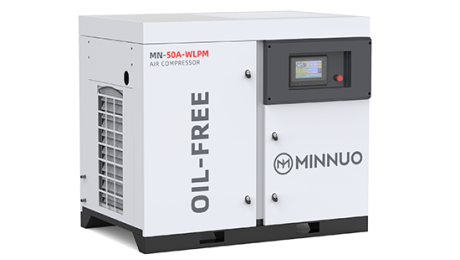
An oil-free compressor changes the condensate equation fundamentally. No oil enters the compression chamber. No oil contacts the compressed air. The condensate that forms downstream is essentially oil-free water.
In a dry oil-free screw compressor, the rotors never touch and require no lubrication in the compression chamber. The timing gears and bearings are lubricated with oil or grease, but these are isolated from the compression space by shaft seals and purge air systems. The compressed air never contacts lubricant at any point in its journey through the compressor.
In a water-injected oil-free screw compressor, the injected fluid is water, not oil. The condensate from such a compressor contains no lubricating oil. It may carry trace levels of compressor bearing grease if shaft seals are worn, but under normal operation with proper maintenance, the condensate is oil-free water.
The practical result is that condensate from an oil-free compressor requires no oil-water separation before discharge. The condensate does contain trace atmospheric hydrocarbons absorbed from the intake air, but at concentrations typically below 5 milligrams per liter—often well within regulatory discharge limits without further treatment. Where the condensate must meet the most stringent limits, a simple activated carbon stage, smaller and less frequently serviced than for oil-lubricated compressor condensate, provides adequate polishing.
The elimination of oily condensate removes an entire waste stream. No oil-water separator to purchase, install, maintain, and document. No spent treatment media to dispose of as regulated waste. No waste oil to manage. No condensate treatment system failure risking regulatory non-compliance. The environmental compliance burden of the compressed air system drops to near zero.
V. Zero Liquid Discharge Context
Zero liquid discharge is a plant-wide water management strategy that aims to eliminate all liquid waste streams leaving the facility. In a ZLD framework, all wastewater is recovered, treated, and reused within the plant boundary.
Compressor condensate fits naturally into a ZLD framework when it is oil-free. Pure or nearly pure water condensate can be reused for cooling tower makeup, boiler feedwater after minimal treatment, landscape irrigation, or general plant washdown water. The condensate represents a water source rather than a waste stream.
When compressor condensate is contaminated with oil, it becomes a problem within the ZLD framework. The oil must be removed before the water can be reused. The removed oil becomes a concentrated waste stream that must be managed. The treatment process itself consumes energy and chemicals and generates additional waste. An oil-lubricated compressor in a ZLD facility adds cost and complexity to the water treatment system.
For facilities actively pursuing ZLD certification or simply working toward water conservation goals, switching to oil-free compression directly supports those objectives. The condensate volume, while modest compared to process wastewater streams, becomes a usable resource rather than a treatment burden.
VI. Economic Comparison: Treatment Cost vs. Technology Premium
The total cost of condensate management for oil-lubricated compressors often exceeds the capital cost premium for oil-free technology over a reasonable evaluation period.
Condensate treatment cost includes the capital cost of the separator and downstream treatment equipment, the annual cost of replacement elements for coalescing and carbon stages, the cost of waste oil and spent media disposal, and the labor cost for system maintenance and compliance documentation. For a 75 kW compressor operating 6,000 hours per year, annual condensate treatment costs of $2,000 to $4,000 are typical.
The water-injected oil-free compressor has its own water management requirements, including a reverse osmosis system to maintain water quality in the compression circuit. This system has maintenance costs. However, the RO system serves the compressor’s internal function—maintaining proper water quality for injection—not treating an effluent stream. The comparison between condensate treatment cost for an oil-lubricated machine and the RO maintenance for a water-injected machine is not a direct one, and each application should be evaluated individually.
For dry oil-free screw compressors, there is no water management system beyond the condensate drains themselves. The comparison is straightforward: the annual cost of condensate treatment for an oil-lubricated compressor versus zero for the dry oil-free alternative. Over a 10-year service life, the avoided condensate treatment cost alone can offset a significant fraction of the oil-free technology premium.
FAQ
Q1: Does a water-injected oil-free compressor produce condensate that requires treatment?
The condensate from a properly maintained water-injected oil-free compressor is essentially water. It may contain trace levels of grease from shaft bearings if seals are worn, but under normal operation, oil content is negligible. The condensate from the water separator and dryer stages is typically suitable for discharge to sewer without additional treatment.
Q2: What about atmospheric hydrocarbons in compressor condensate?
Both oil-lubricated and oil-free compressors draw in ambient air that contains atmospheric hydrocarbons. In an oil-lubricated compressor, these are a minor contributor compared to the lubricant itself. In an oil-free compressor, atmospheric hydrocarbons are the only source of any oil-related compounds in the condensate. At typical atmospheric concentrations, the resulting condensate oil content is below 5 milligrams per liter.
Q3: What documentation do I need for condensate discharge compliance?
Facilities should maintain discharge permits or trade effluent consents, condensate treatment system maintenance records demonstrating proper operation, periodic condensate analysis results verifying discharge quality, and waste oil and spent media disposal manifests. An oil-free compressor eliminates much of this documentation burden by eliminating the treatment system itself.
Q4: Are there industries where oil-free compression for condensate reasons is specifically advantageous?
Food and beverage processing, pharmaceutical manufacturing, and semiconductor fabrication are industries where condensate quality is particularly important. These sectors also face stringent wastewater discharge limits and frequent environmental audits. Oil-free compression aligns with their broader commitment to clean production.
Q5: What happens to the condensate from an oil-free compressor if I want to reuse it?
Oil-free compressor condensate can typically be reused directly for non-potable applications including cooling tower makeup, landscape irrigation, and equipment washdown, provided the condensate meets the receiving system’s water quality requirements. The condensate is essentially distilled water with low mineral content and is well-suited to these applications.
Q6: Does switching to oil-free compression completely eliminate environmental compliance concerns for the compressed air system?
It eliminates the most significant concern—oily condensate. The compressed air system still requires management of energy consumption, noise emissions where applicable, and proper disposal of maintenance-related wastes including filter elements and desiccant. However, the regulatory and administrative burden drops substantially.
Conclusion
Zero liquid discharge compliance and compressed air system design are connected in ways that many facility managers overlook. Oil-lubricated compressors generate a continuous stream of oily condensate requiring treatment, documentation, and disposal. This stream represents an ongoing environmental liability and an operational cost that is invisible in compressor purchase price comparisons. Oil-free compression eliminates oily condensate at its source. The condensate that remains is essentially water, suitable for discharge or reuse without the treatment infrastructure that oil-lubricated machines demand. For plants pursuing ZLD goals or simply seeking to reduce their environmental compliance burden, oil-free technology transforms the compressed air system from a wastewater generator into a net contributor to water sustainability.
At MINNUO, our oil-free compressor systems help facilities simplify their environmental compliance while delivering the clean air their processes demand. From dry oil-free screw compressors to water-injected designs, our engineering team can assess your compressed air system’s condensate footprint and recommend the right oil-free technology to support your environmental objectives. Whether you are pursuing ZLD certification, managing regulatory compliance, or simply seeking to reduce your plant’s environmental impact, MINNUO provides the oil-free compression solutions and documentation to support your goals.
 Email
Email sales:+86 15366749631