In a semiconductor wafer production workshop, an seemingly ordinary air compressor operates steadily. The compressed air it delivers is transported through pipelines to the lithography process, directly participating in the formation of precise chip structures. If this air compressor were a traditional oil-lubricated model, even 0.1-micron oil mist particles mixed into the air could render the wafer scrapped, resulting in losses of thousands of yuan. Today, oil-free air compressors have become the “standard configuration” in such scenarios. Data shows that the market penetration rate of oil-free air compressors in China has exceeded 35% in 2025, doubling compared to five years ago. In high-end manufacturing fields such as semiconductors, medical care, and food processing, this ratio even surpasses 60%. The explosive growth of oil-free air compressors is essentially a revolution in industrial power sources driven by the rigid demand for “clean air” in high-end manufacturing.
From “Optional” to “Indispensable”: Why Has Clean Air Become the Lifeline of High-End Manufacturing?
To understand the value of oil-free air compressors, we must first clarify the role of “compressed air” in industrial production. Known as the “fourth industrial power source,” compressed air is indispensable in driving automated equipment, purging and cooling products, and participating in precision manufacturing processes. The core difference between “oil-lubricated” and “oil-free” lies in whether the compressed air contains oil. This difference may have minimal impact in mid-to-low-end manufacturing, but it is a “lifeline” in high-end fields.
In the semiconductor industry, every step of chip manufacturing has zero tolerance for impurities. When compressed air is used for wafer cleaning, oil content will form a film on the wafer surface, hindering the uniform coating of photoresist and directly causing defects in chip circuits. In the medical industry, during the production of sterile preparations, compressed air must directly contact medicinal liquids or packaging; oil-contaminated air may cause medicinal liquid pollution and violate GMP certification standards. The impact is even more intuitive in the food processing field: if the compressed air used for bread fermentation contains oil, it will alter the food’s flavor and even trigger food safety issues.
In the past, some enterprises tried to replace oil-free models with a combination of “oil-lubricated air compressors + precision filtration” to reduce costs. However, in practical applications, filtration equipment not only increases energy consumption and maintenance costs but also carries the risk of “filtration failure”—once the filter becomes saturated, oil will still mix into the air. As high-end manufacturing imposes increasingly strict requirements on product quality, oil-free air compressors, which “eliminate oil pollution from the source,” have naturally upgraded from “alternative solutions” to “mandatory equipment.”
Oil-Free Air Compressors: How Do They Achieve “Clean Output”?
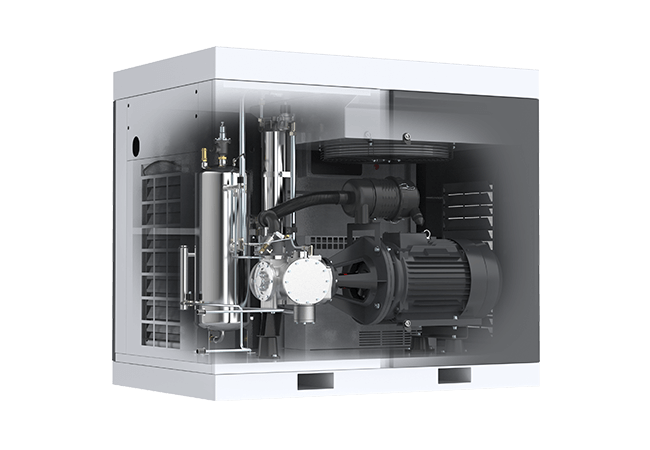
Many people wonder: air compressors compress air through the high-speed operation of pistons or screws. Without the lubrication and sealing of lubricating oil, wouldn’t wear and air leakage occur? This is precisely the core breakthrough of oil-free air compressor technology—replacing traditional “oil lubrication” with “oil-free lubrication solutions,” which ensures equipment reliability while achieving air cleanliness. Currently, mainstream oil-free technologies are mainly divided into two categories:
Category 1: “Dry Oil-Free”: Self-Lubrication Achieved Through Materials
The core components (such as screws and pistons) of this type of oil-free air compressor are made of special composite materials, such as engineering plastics filled with polytetrafluoroethylene (PTFE) and ceramic coating materials. These materials inherently possess excellent wear resistance and self-lubricating properties, reducing frictional loss during operation without the need for lubricating oil. Taking dry oil-free screw air compressors as an example, the surface of their screws is coated with a hard ceramic layer. Combined with a precision gap design, this not only avoids direct metal-to-metal wear but also ensures sealing during compression. The output air contains no oil at all, meeting the CLASS 0 oil-free standard (the highest international oil-free grade).
Category 2: “Water-Lubricated Oil-Free”: Water Replaces Oil for Dual Functions
Water-lubrication technology uses pure water or deionized water to simultaneously perform three functions: “lubrication,” “sealing,” and “cooling.” In water-lubricated air compressors, water forms a water film on the rotor surface, reducing friction while preventing air leakage. The heat generated during compression is also carried away by water. This technology offers greater environmental friendliness—water can be recycled without special treatment, resulting in low later maintenance costs. Moreover, it avoids the risk of wear particle detachment that may occur with composite materials, making it particularly suitable for the semiconductor and electronics industries, where extremely high air cleanliness is required.
Regardless of the technical path, the core logic of oil-free air compressors is to “cut off oil pollution at the source,” which is fundamentally different from the “pollute first, filter later” approach of traditional oil-lubricated air compressors. This is precisely why they are irreplaceable in high-end manufacturing.
Behind the Soaring Penetration Rate: Triple Drivers from Policy, Market, and Technology
The doubling of oil-free air compressors’ penetration rate in just a few years is not driven by a single factor but by the combined effects of policy guidance, market demand upgrading, and technological maturity.
Policy dividends serve as an important “catalyst.” Under the “dual carbon” goals, industrial energy conservation has become a mandatory requirement, and oil-free air compressors precisely have the dual advantages of “cleanliness” and “energy efficiency.” Compared with traditional oil-lubricated air compressors, high-efficiency oil-free models can reduce energy consumption by 15%-20% while avoiding the environmental pressure caused by waste oil disposal. Additionally, the newly revised General Criteria for Green Factory Evaluation explicitly lists “the use of oil-free compressed air equipment” as a bonus item for green certification of high-end manufacturing enterprises, further encouraging enterprises to proactively replace their equipment.
The explosive growth of high-end manufacturing is the core “demand-side” driver. In recent years, the production capacity of high-end industries in China, such as semiconductors, new energy vehicles, and biopharmaceuticals, has expanded rapidly—in 2024, domestic semiconductor wafer production capacity increased by 28% year-on-year, and biopharmaceutical production capacity grew by 35%. New production lines in these industries all list oil-free air compressors as “standard equipment.” Taking new energy vehicle battery production as an example, processes such as lithium battery pole piece drying and cell packaging require oil-free compressed air to prevent adverse effects on battery performance. A battery production line with an annual output of 10 GWh alone generates a procurement demand of tens of millions of yuan for oil-free air compressors.
Technological maturity and cost reduction serve as the “feasibility” guarantee. In the past, oil-free air compressors had high technical barriers, with prices 2-3 times those of oil-lubricated models, making many enterprises hesitant. However, with domestic enterprises’ breakthroughs in material technology (such as ceramic coatings and engineering plastics) and control systems, the price of domestic oil-free air compressors has dropped to 60%-70% of the original level. At the same time, their service life has increased from 8 years to more than 12 years, and maintenance costs have decreased by 30%. The improved cost-effectiveness has made them affordable for small and medium-sized high-end manufacturing enterprises, further boosting the penetration rate.
The Future: The “Next Revolution” of Oil-Free Air Compressors
As high-end manufacturing moves toward “higher precision and greater environmental friendliness,” the competitive focus of oil-free air compressors is also changing. In the future, “intelligence” and “systematization” will become new trends—for example, integrating IoT technology to realize real-time monitoring of air compressor operating status and predictive maintenance to reduce downtime; linking with enterprises’ energy management systems to automatically adjust air supply according to production needs, further reducing energy consumption.
At the same time, in response to the personalized needs of different industries, oil-free air compressors are also developing toward “customization.” For instance, “ultra-high-pressure oil-free air compressors” developed for the semiconductor industry can meet the special pressure requirements of lithography processes; “low-noise oil-free air compressors” designed for the medical industry can adapt to the low-noise environment of hospitals.
Essentially, the soaring penetration rate of oil-free air compressors is not only an equipment upgrade but also a reflection of the “quality-first” concept in high-end manufacturing. When product precision reaches the micron level, and food safety and medical safety become insurmountable red lines, “clean air” is no longer an “additional demand” but a “basic project” for industrial upgrading. Oil-free air compressors are precisely the core power source of this “clean revolution,” and their development will continue to drive China’s high-end manufacturing toward higher quality and greater greenness.
 Email
Email sales:+86 15366749631