In the food and beverage industry, “cleanliness” is a core principle that runs through the entire production process. From the preservation of milk sources in daily processing to the retention of flavor in juice filling, from the environmental control of baking fermentation to the anti-corrosion and antibacterial measures in vacuum packaging of meat, compressed air, as an indispensable “invisible raw material” in production, its purity is directly related to product safety, flavor integrity, and compliance. Issues such as oil pollution risks and pressure fluctuations in traditional oil-lubricated compressors have become pain points restricting the high-quality development of the industry. However, Class 0 oil-free scroll compressors, with their core advantages of zero oil pollution, stability, high efficiency, and hygienic compliance, have gradually become the preferred equipment for food and beverage production enterprises. This article will explain in detail why oil-free scroll compressors can be a “solid guarantee” for food safety from the perspectives of technical principles, core advantages, and application scenarios.
1. Technical Popular Science: The “Clean Compression” Principle of Oil-Free Scroll Compressors
To understand the core competitiveness of oil-free scroll compressors, it is first necessary to clarify their essential difference from traditional oil-lubricated compressors – oil-free compression technology, which is the key to achieving Class 0 clean air supply.
Traditional reciprocating or screw compressors mostly adopt an “oil-lubricated” design. Lubricating oil is used to reduce friction and wear between moving parts while achieving a sealing effect. However, this design has a fatal flaw: during the compression process, lubricating oil is prone to form oil mist, which enters the production process along with compressed air. Even after filtration, oil vapor may still remain (usually ≥ 0.1 mg/m³). In food and beverage production, even a tiny amount of oil pollution can cause product odor, deterioration, and even trigger food safety incidents.
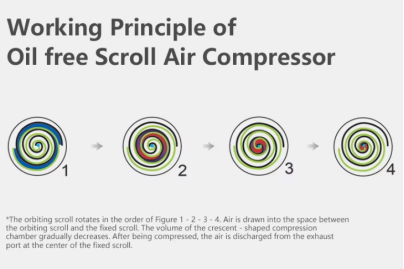
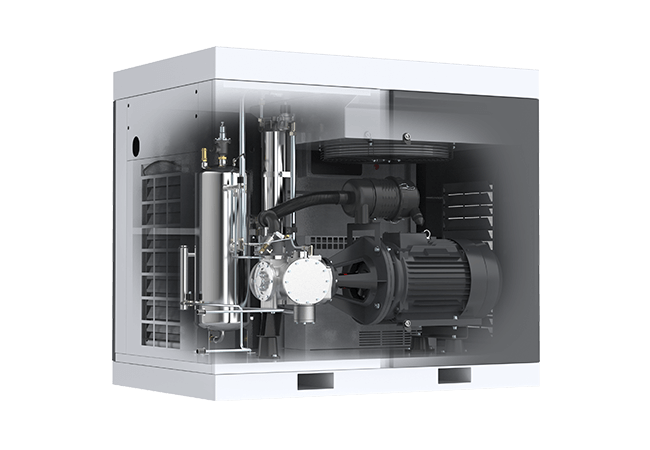
Oil-free scroll compressors, on the other hand, completely eliminate the reliance on lubricating oil through an innovative structure of meshing scroll plates and self-lubricating bearings. Their core working principle is as follows: two intermeshing scroll plates (one fixed and one rotating eccentrically) form a closed compression chamber. As the scroll plates rotate, the volume of the compression chamber gradually decreases, realizing the step-by-step compression of gas. The key point is that the scroll plates are made of a special wear-resistant and self-lubricating composite material. Combined with self-lubricating bearings, there is no need to inject lubricating oil between the moving parts, eliminating the risk of oil pollution from the source. This design not only achieves the Class 0 oil-free standard (oil content ≤ 0.01 mg/m³) but also reduces friction and wear, improving the operational stability and service life of the equipment.
In addition, the “flexible compression” characteristic of oil-free scroll compressors is also particularly important. Compared with the pulsating exhaust of traditional compressors, the meshing movement of the scroll plates is smoother, resulting in continuous and stable output air flow with minimal pressure fluctuations. This is crucial for links in food filling and packaging that have high requirements for pressure accuracy.
2. Core Advantages: Meeting the Stringent Requirements of the Food and Beverage Industry
The requirements of food and beverage production for compression equipment far exceed those of ordinary industrial scenarios. It not only needs to meet cleanliness requirements but also adapt to complex working conditions such as humidity, frequent cleaning, and continuous operation. Jiangsu Minnuo Group (Minnuo), an enterprise that has been deeply engaged in the gas equipment field for decades, has developed oil-free scroll compressors that accurately match industry needs in various core indicators, demonstrating multiple advantages.
2.1 Zero Oil Pollution: Class 0 Clean Air Supply, No Risk in Direct Food Contact
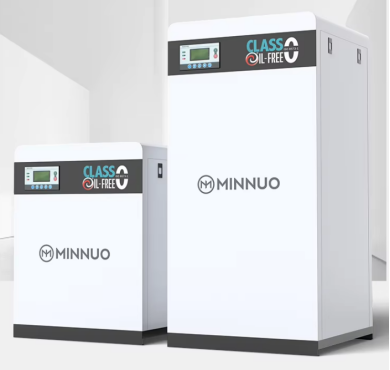
The Class 0 oil-free certification is the “gold standard” for compression equipment in food contact applications, meaning that the oil content in compressed air is ≤ 0.01 mg/m³, which fully meets the hygiene requirements for direct food contact. Jiangsu Minnuo’s oil-free scroll compressors achieve truly oil-free compression through scroll plate self-lubrication technology, avoiding product quality issues caused by oil pollution from the source. At the same time, the equipment is equipped with a VOC + HEPA H13 integrated filtration system, which can remove 99.999% of particles and 99.997% of oil mist aerosols, further purifying the air supply and ensuring that the compressed air is free of odor and impurities, thus safeguarding the pure flavor of food.
2.2 Comprehensive Compliance: Multiple Authoritative Certifications, Adapting to the Global Market
The food and beverage industry has extremely strict compliance requirements, and different countries and regions have clear hygiene standards. Jiangsu Minnuo’s oil-free scroll compressors fully meet the mainstream international compliance requirements: the contact surfaces of materials are made of food-grade 304 stainless steel, complying with the 21 CFR 177.2600 standard (U.S. Food Contact Material Safety Specification); the overall equipment has passed the HACCP certification (Hazard Analysis and Critical Control Point System), adapting to the quality control needs of food production enterprises worldwide; it also holds ISO 9001 and CE certifications, ensuring standardized and reliable production processes. In addition, the equipment has an IP67 protection level, which can withstand high-pressure cleaning environments, preventing corrosion or microbial growth caused by moisture intrusion into the equipment during cleaning, and perfectly meeting the hygiene requirements of food workshops.
2.3 Stability and High Efficiency: Ensuring Production Continuity and Energy Efficiency
Food and beverage production mostly involves 24-hour continuous operation, which places high demands on the stability and energy efficiency of equipment. The output pressure of Jiangsu Minnuo’s oil-free scroll compressors can be flexibly adjusted between 3-10 bar, with an airflow capacity of up to 0.41 m³/min, which can stably meet the air demand of different links such as filling, packaging, and cleaning. The pressure fluctuation is extremely small, which can ensure uniform juice filling volume and tight vacuum packaging seals, avoiding production losses caused by unstable pressure.
In terms of energy efficiency, the equipment meets the Level 1 energy efficiency standard, with an energy consumption of ≤ 5.5 kW/(m³/min), which is more than 30% more energy-efficient than traditional oil-lubricated compressors. Especially for low-load stages such as packaging and cleaning, the equipment adopts PMVFD frequency conversion technology, which can automatically adjust the operating power according to the air demand, further reducing energy consumption costs. At the same time, the maintenance interval of the equipment is as long as 4000 hours, and the filter supports quick replacement without professional tools, which not only reduces the downtime for maintenance but also avoids the risk of secondary pollution that may occur during maintenance.
2.4 Low Noise and Hygiene: Adapting to Clean Workshop Environments
Food clean workshops have strict restrictions on noise and hygiene conditions. The operating noise of traditional compressors is usually above 75 dB, which not only affects the physical and mental health of operators but also may interfere with the stability of the production environment. The operating noise of Jiangsu Minnuo’s oil-free scroll compressors is ≤ 65 dB, which is equivalent to the volume of daily conversation, and can be directly deployed in areas sensitive to noise such as filling workshops and bakeries. Its 304 stainless steel shell is smooth and corrosion-resistant, with no hygiene dead corners, facilitating daily cleaning and disinfection and not becoming a hotbed for microbial growth, fully meeting the hygiene requirements of food clean workshops.
3. Scene Implementation: Covering the Entire Production Process of Food and Beverage
With its multiple advantages, oil-free scroll compressors have been widely used in various core links of food and beverage production, providing customized air supply solutions for the production of different types of products.
3.1 Dairy Processing: Safeguarding the Freshness and Safety of Milk Sources
In the processing of dairy products such as milk and yogurt, compressed air is used in links such as stirring, fermentation, and filling, directly or indirectly contacting raw milk. The Class 0 clean air supply provided by Jiangsu Minnuo’s oil-free scroll compressors can avoid odor and deterioration of dairy products caused by oil pollution; its stable pressure output ensures uniform and accurate filling processes, reducing product losses; the equipped high-efficiency dryer stabilizes the dew point at ≤ -40℃, effectively preventing microbial growth caused by moisture and extending the shelf life of dairy products. After adopting this equipment, a German dairy enterprise has increased its product qualification rate by 3% and significantly reduced the complaint rate.
3.2 Baking and Fermentation: Ensuring Flavor and Taste
In the baking industry, dough fermentation requires a clean and odor-free air environment, and compressed air is also used for the pneumatic forming and packaging of bread and cakes. Jiangsu Minnuo’s oil-free scroll compressors completely remove odors and pollutants from the air through the VOC + HEPA H13 filtration system, avoiding affecting the fermentation flavor of the dough; the low operating noise does not interfere with the stability of temperature and humidity in the fermentation workshop; its food-grade 304 stainless steel shell is resistant to cleaning and can adapt to the frequent hygiene cleaning needs of the baking workshop. A Japanese baking brand reported that after using this equipment, the flavor consistency of its products has been significantly improved, and the customer repurchase rate has increased.
3.3 Juice and Beverage Filling: Retaining Natural Flavors
Juices, carbonated drinks, and other beverages have extremely high requirements for the purity of the air supply. Oil pollution or impurities may cause changes in the flavor and color of the beverages. The oil-free and odor-free air supply provided by Jiangsu Minnuo’s oil-free scroll compressors can ensure that the beverages are not polluted during filling and nitrogen injection processes, retaining their natural flavors; the stable pressure output ensures uniform filling speed, avoiding problems such as under-filling and overfilling; the IP67 protection level can withstand the flushing operations in the beverage workshop, preventing equipment corrosion. After adopting this equipment, a Mexican juice enterprise has increased the efficiency of its filling line by 15% and extended the product shelf life by 2 months.
3.4 Vacuum Packaging of Meat and Seafood: Building a Solid Anti-Corrosion Line
The vacuum packaging of meat, seafood, and other products relies on stable compressed air to drive packaging equipment. At the same time, the air supply is required to be oil-free and water-free to avoid polluting the products or causing bacterial growth inside the packaging. Jiangsu Minnuo’s oil-free scroll compressors are equipped with a high-efficiency dehumidification function, which can prevent moisture from entering the packaging and affecting the anti-corrosion effect; their IP67 waterproof design can adapt to the humid environment of seafood processing workshops, preventing equipment rust; the oil-free air supply ensures the freshness and safety of meat and seafood, extending the shelf life. After using this equipment, a Chinese meat processing enterprise has reduced the deterioration rate of vacuum-packaged products by 5% and significantly reduced storage losses.
3.5 CIP/SIP Cleaning: Ensuring the Hygiene of Production Equipment
Clean-in-Place (CIP) and Sterilization-in-Place (SIP) of food production equipment are key links to ensure production hygiene, which require a clean air supply with constant pressure to drive cleaning valves. Jiangsu Minnuo’s oil-free scroll compressors can provide stable pressure output, ensuring uniform spraying of cleaning fluid to thoroughly remove residual materials and microorganisms inside the equipment; their Class 0 clean air supply avoids possible secondary pollution during the cleaning process, complying with the hygiene requirements of the HACCP system for the cleaning link; the quick-change filter design allows maintenance to be completed without affecting production, ensuring the continuity of the cleaning process.
4. Selection Guide: How Can Food and Beverage Enterprises Select Suitable Oil-Free Scroll Compressors?
Faced with a large number of compression equipment on the market, food and beverage enterprises need to select oil-free scroll compressors that are truly suitable for their production needs from core dimensions such as compliance, cleanliness, and stability.
4.1 Prioritize the Verification of Compliance Certifications and Cleanliness Standards
Compliance is the bottom line of the food industry. When selecting equipment, it is necessary to confirm whether it has international mainstream standard certifications such as Class 0 oil-free certification (oil content ≤ 0.01 mg/m³), HACCP certification, and 21 CFR 177.2600 certification to ensure that the equipment meets the hygiene requirements of global food production. At the same time, pay attention to whether the contact surfaces of materials are made of food-grade 304 stainless steel and whether the filtration system has HEPA H13-level filtration capacity to ensure the cleanliness of the air supply from the source.
4.2 Match Pressure and Flow Parameters with Production Needs
Different production links have different requirements for pressure and flow: the filling and packaging links usually require a pressure of 3-6 bar, while CIP cleaning may require a pressure of 8-10 bar. Enterprises need to select equipment with adjustable pressure and stable flow according to their own production processes to ensure that the equipment can continuously meet the air demand of different links. It is recommended to select equipment with a pressure fluctuation of ≤ ± 0.1 bar and a flow deviation of ≤ ± 2% to avoid production losses caused by unstable parameters.
4.3 Pay Attention to Equipment Adaptability and Maintenance Costs
The environment of food workshops is complex, so it is necessary to select equipment with a protection level of ≥ IP65, which is resistant to cleaning and corrosion, to ensure that the equipment can adapt to humid and dusty production environments. At the same time, considering maintenance costs and downtime losses, priority should be given to equipment with a maintenance interval of ≥ 4000 hours and filters that support quick replacement to reduce the frequency of maintenance and downtime. In addition, the energy efficiency level of the equipment is also crucial. Level 1 energy efficiency equipment can significantly reduce long-term operating costs and meet the development needs of enterprises for energy conservation and consumption reduction.
4.4 Evaluate Brand Strength and After-Sales Service
Oil-free scroll compressors have high technical thresholds, and the R&D strength and production experience of the brand directly determine the quality of the equipment. It is recommended to select brands that have been deeply engaged in the gas equipment field for many years, have mature production systems and cases, such as Jiangsu Minnuo Group (Minnuo). Since its establishment in 1987, it has provided reliable equipment for many food and beverage enterprises around the world and accumulated rich industry experience. At the same time, pay attention to after-sales service guarantees, and select brands that can provide 24/7 technical support, emergency response within ≤ 6 hours, and global spare parts supply to ensure that problems can be solved quickly when equipment failures occur, reducing production losses.
5. Conclusion: Oil-Free Scroll Compressors – A “Booster” for the High-Quality Development of the Food and Beverage Industry
Nowadays, as food safety receives increasing attention, clean, stable, and compliant compressed air has become a core guarantee for food and beverage production. By virtue of oil-free compression technology, comprehensive compliance certifications, and designs adapted to complex working conditions, oil-free scroll compressors solve the pain points of traditional equipment such as oil pollution and pressure fluctuations from the source, providing reliable air supply solutions for dairy products, baking, beverages, meat processing, and other fields.
As a leading enterprise in the industry, Jiangsu Minnuo Group, relying on decades of technical accumulation and a deep understanding of the needs of the food industry, has developed oil-free scroll compressors that not only meet the Class 0 cleanliness standard but also demonstrate significant advantages in energy efficiency, stability, and maintenance convenience, becoming a trusted choice for many food and beverage brands around the world. In the future, as the food and beverage industry continues to raise its requirements for hygiene, safety, and production efficiency, oil-free scroll compressors will continue to develop in a more efficient, intelligent, and environmentally friendly direction, injecting strong impetus into the high-quality development of the industry and safeguarding the safety and deliciousness of every food product.
 Email
Email sales:+86 15366749631