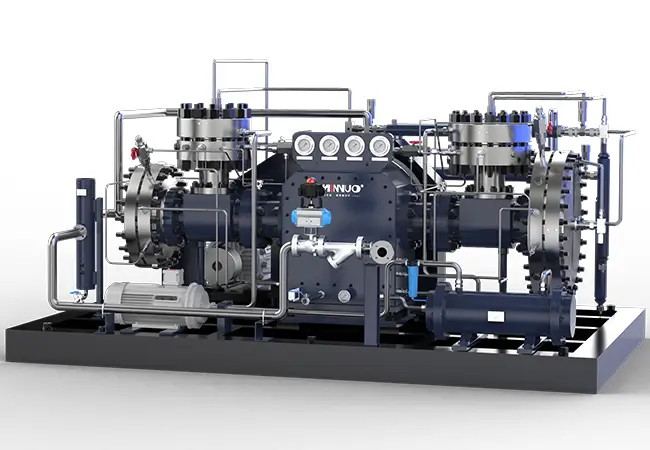
In industrial production, piston compressors, known as the “power heart”, are widely used in key fields such as petrochemicals, refrigeration, and gas transmission. Their stable operation directly determines production continuity, energy consumption costs, and safe production efficiency. According to industry data, scientific maintenance can extend the service life of industrial piston compressors by more than 30% and reduce the probability of sudden failures by 40%. Improper maintenance or neglect of upkeep will accelerate equipment wear, reduce volumetric efficiency (every 5% decrease in volumetric efficiency increases energy consumption by 8%), and even cause safety hazards such as valve deflagration. As a brand focusing on the R&D and service of industrial compressors, MINNUO summarizes the following core maintenance best practices based on years of industry experience and equipment operation and maintenance practices, helping enterprises maximize the service life of piston compressors and achieve efficient, low-cost, and safe operation.
I. Daily Basic Maintenance: Prevent Minor Issues, Lay a Solid Foundation for Longevity
Daily inspections are the key to avoiding the escalation of minor faults into major damages. It is necessary to adhere to the principle of “daily inspection, weekly summary, and monthly review”, focusing on five core systems. The operation is simple but can effectively reduce wear risks:
1. Lubrication System: The “Lifeblood” of Piston Rings and Bearings : Lubricating oil is the “protective barrier” for the moving parts of the compressor. It is necessary to strictly control the three cores of oil level, oil quality, and oil pressure. In the shutdown state, the oil dipstick should be between the upper and lower limits (difference ≤5mm), and the oil level is allowed to fluctuate ±10% during operation. If it is lower than the lower limit, add oil immediately according to the standard of “displacement × 0.05L/m³”, and never mix oils of different viscosities. Check the oil quality through the oil drop test every week, and replace it immediately when the impurity ring is >3mm or an emulsified layer appears. The replacement cycle of mineral oil is 2000 hours, and that of synthetic oil can be extended to 4000 hours. Monitor the oil pump outlet pressure in real time to maintain it at 0.2-0.4MPa. When it is lower than 0.15MPa, clean the oil filter with precision ≤50μm or replace the oil pump seal. At the same time, check the elasticity of the piston ring by turning the crankshaft daily. Replace it in time when the opening gap is >1.2mm or the radial thickness wear is >10%. The gas ring and oil ring should be placed staggeredly (the openings are 120° to each other) to avoid gas and oil leakage leading to reduced efficiency.
2. Air Circuit System: The Core of Sealing and Efficiency : Focus on checking valves and seals. Listen to the working sound of the valves every shift; a normal sound is a uniform “click”, and abnormal noise indicates valve plate deformation or spring breakage. Disassemble and clean the valves every month. When the carbon deposit thickness is >0.5mm, soak it in 10% caustic soda solution, grind the sealing surface to a roughness of Ra≤1.6μm, and check the valve plate lift with a feeler gauge at the same time, controlling the suction valve at 0.8-1.2mm and the discharge valve at 1.0-1.5mm. Deviation will lead to a 10% decrease in gas volume. The leakage of the piston rod stuffing box should be ≤5 drops per minute. When exceeding, adjust the gland tightness or replace the seal ring made of filled polytetrafluoroethylene. The compression amount of the cylinder gasket should reach 20%-30%, and the bolts should be tightened in batches diagonally, with the torque of M12 bolts reaching 40-50N・m. In addition, discharge the condensate from the air storage tank and cylinder daily to avoid internal component corrosion, and purge with dry air in humid environments.
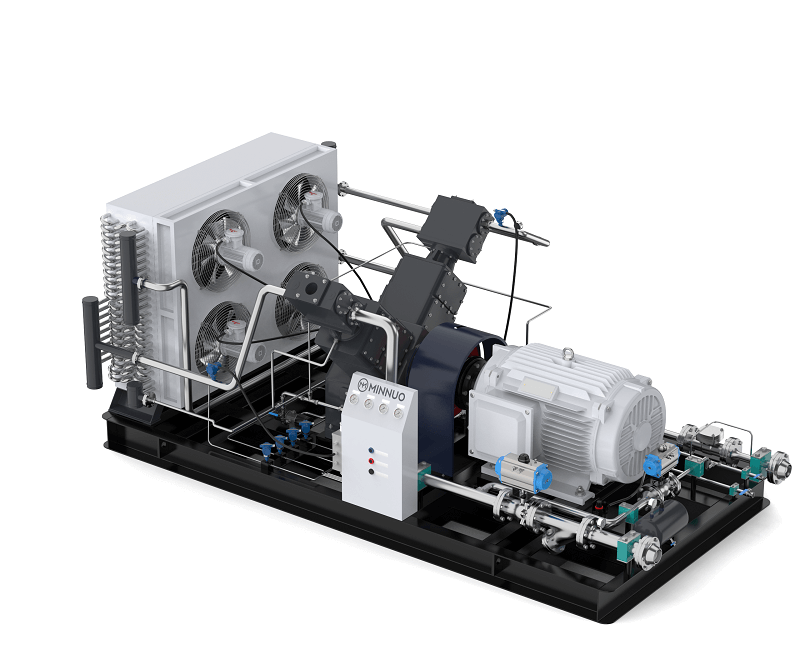
3.Cooling System: Control Temperature, Reduce Thermal Wear : Maintain according to the cooling method. For water-cooled models, check the cooling water pressure (0.2-0.4MPa) and temperature (outlet water temperature ≤40℃) daily, clean the water filter every week, replace the filter screen when the impurity particle size is >1mm, and perform chemical descaling every quarter. When the scale thickness is >1mm, circulate with 5% hydrochloric acid solution (neutralize and rinse after the pH value drops to 4-5). For air-cooled models, purge the radiating fins with 0.4-0.6MPa compressed air at a 45° angle every shift to ensure no dust blockage. Disassemble and clean when the heat dissipation efficiency decreases by >15%, and check the fan belt tension at the same time, controlling the deflection at 10-15mm/100mm span.
4.Electrical and Control System: Ensure Operational Stability : Monitor the voltage fluctuation ≤±10% (measured 342-418V for 380V system), and replace the contactor immediately when the contact ablation area is >10%. The capacity of the control circuit fuse is 1.5 times the rated current. Calibrate the pressure switch with a standard pressure gauge every six months, with the loading pressure = rated pressure – 0.05MPa and the unloading pressure = rated pressure + 0.1MPa. Adjust in time when the error is >±0.02MPa. At the same time, check the grounding resistance ≤4Ω and the emergency stop button response time <0.3 seconds to ensure electrical safety.
5.Vibration and Fastening: Prevent Loosening, Avoid Major Failures : Check the foundation bolts with a torque wrench every week. The torque of M24 bolts should reach 500-600N・m. Loosening leading to vibration value >10mm/s may cause cylinder cracks. Regularly monitor the elongation of connecting rod bolts and replace them immediately when exceeding 0.2% of the design value to avoid major accidents caused by bolt breakage.
II. Periodic Graded Maintenance: Proactive Prevention, Extend Equipment Life Cycle
In addition to daily inspections, it is necessary to implement a graded maintenance plan according to the equipment operation time to achieve “early detection, early repair, and early prevention” and avoid excessive wear of components:
Level 1 Maintenance (Every 500 Hours) : Replace the air filter element (shorten to 200 hours in dusty environments, and force replacement when the pressure difference is >1bar); clean the cylinder water jacket and purge internal scale with compressed air; check the piston stroke gap ≤0.5mm, and adjust the crankshaft bearing gasket when exceeding the limit; test the safety valve opening pressure (1.1 times the working pressure) with the reseating pressure ≥0.9 times.
Level 2 Maintenance (Every 2000 Hours) : Disassemble and grind the cylinder mirror surface, and hone and repair when the cylindricity error is >0.05mm; replace the piston ring (must be replaced when the opening gap is worn to 1.5mm); add lithium-based grease to the motor bearing (fill 1/3 of the bearing cavity, excessive grease will cause bearing overheating); calibrate the pressure sensor to ensure accuracy ±1.5%FS.
Annual Overhaul (Every Year or Every 8000 Hours) : Detect the crankshaft straightness and straighten when the bending amount is >0.1mm/m; replace the connecting rod big end bearing shell, and use thin-walled bearing shell replacement when the wear amount is >0.08mm; conduct the overall air tightness test, maintain pressure at 1.25 times the working pressure for 30 minutes, with pressure drop ≤1%. Check all sealing surfaces when exceeding; thoroughly clean the oil circuit, air circuit, and cooling system, replace aging seals, springs, and other vulnerable parts. After completion, conduct no-load test operation, and put into production only after all parameters meet the standards.
III. Key Safety Operations: Avoid Risks, Protect Equipment and Personnel Safety
Standard operating procedures are the dual premise of extending equipment life and ensuring personnel safety. The following points must be strictly followed:
“Five Checks” Before Startup : Check lubrication (normal oil level, oil quality, and oil pump pressure), check air circuit (clean air filter, no valve jamming, no pipeline leakage), check cooling (no water-cooled blockage, flexible air-cooled fan), check electrical (normal voltage, good grounding, no alarm), check protection (protective cover in place, sensitive emergency stop).
“Three Controls” During Operation : Control the discharge temperature <160℃ (prevent valve deflagration), control the oil pressure ≥0.1MPa, control the vibration value <10mm/s, and stop immediately to troubleshoot if abnormalities are found.
Shutdown Specifications : For normal shutdown, run unloaded for 5 minutes (until the oil temperature drops below 70℃), cut off the suction valve, release pressure slowly (pressure reduction ≤0.1MPa per minute), and discharge condensate. Emergency shutdown is only used for emergencies such as discharge temperature >180℃, too low oil pressure, and severe vibration. After shutdown, thoroughly troubleshoot faults, and do not reset until the fault is eliminated. For long-term shutdown (>72 hours), drain all lubricating oil and cooling water, apply anti-rust oil inside the cylinder, move the piston to the bottom dead center, and turn the crankshaft 180° every month to prevent bearing seizure.
IV. MINNUO Exclusive Support: Professional Empowerment, Make Maintenance More Efficient
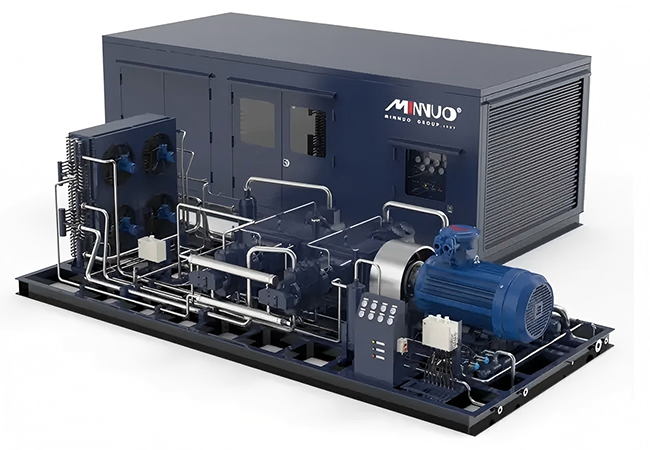
Extending the service life of industrial piston compressors requires not only scientific maintenance methods but also professional technical support and suitable parts guarantee. As a professional brand in the industrial compressor field, MINNUO has deep roots in the industry for many years. With advanced R&D technology and a complete service system, it provides comprehensive maintenance support for global customers:
- Customized Maintenance Plans: According to the customer’s equipment model and operating conditions (such as dusty, high-temperature, and high-pressure environments), tailor-made daily inspection and periodic maintenance plans to meet the enterprise’s production needs, avoiding ineffective maintenance and over-maintenance.
- Genuine Compatible Parts Supply: All maintenance parts (lubricating oil, piston rings, valves, seals, etc.) are customized by the original factory, perfectly compatible with MINNUO piston compressors, with high purity and strong wear resistance, effectively reducing component wear and eliminating equipment faults caused by incompatible parts.
- On-site Service by Professional Technical Team: We have an experienced team of operation and maintenance engineers who can provide on-site inspection, fault diagnosis, maintenance guidance, and overhaul services, quickly solve various problems in the maintenance process, and carry out maintenance training for enterprise employees to improve their independent operation and maintenance capabilities.
- Full Lifecycle Operation and Maintenance Management: From equipment installation and commissioning to later maintenance, overhaul, and upgrading, MINNUO provides full-process operation and maintenance support, regularly visits customers, tracks equipment operation status, timely reminds maintenance nodes, and helps enterprises maximize the reduction of operation and maintenance costs and extend equipment service life.
The life of an industrial piston compressor starts with high-quality equipment and is achieved through scientific maintenance. Following the above best practices, combined with MINNUO’s professional support, can keep your piston compressor running efficiently and stably for a long time, reduce the downtime of sudden failures, lower operation and maintenance costs, and escort your enterprise’s production. If you need to obtain a customized maintenance plan, quotation for genuine parts, or technical consultation, please contact MINNUO, and we will serve you wholeheartedly!
 Email
Email sales:+86 15366749631