If you’ve ever worked with helium compressors, you know they’re different. They run hotter, leak more easily, and demand far more maintenance than standard air compressors. This isn’t a design flaw—it’s a direct consequence of helium’s unique physical properties. Understanding why helium is so difficult to compress is the first step in appreciating the engineering that goes into specialized helium compressors and avoiding the costly mistakes that come from treating them like ordinary machines. This article explores the fundamental science behind the challenge and explains how modern compressor technology rises to meet it.
I. The Tiny Atom: Helium’s Greatest Asset and Biggest Problem
Helium is the second lightest and second smallest element in the universe, after hydrogen. But unlike hydrogen, which tends to form molecules (H₂), helium exists as single atoms.
1. Atomic Size and Leakage
A helium atom has an atomic radius of approximately 31 picometers (3.1 × 10⁻¹¹ meters) . To put that in perspective:
- A human hair is roughly 1,000,000 times thicker than a helium atom.
- A water molecule is about 3 times larger than a helium atom.
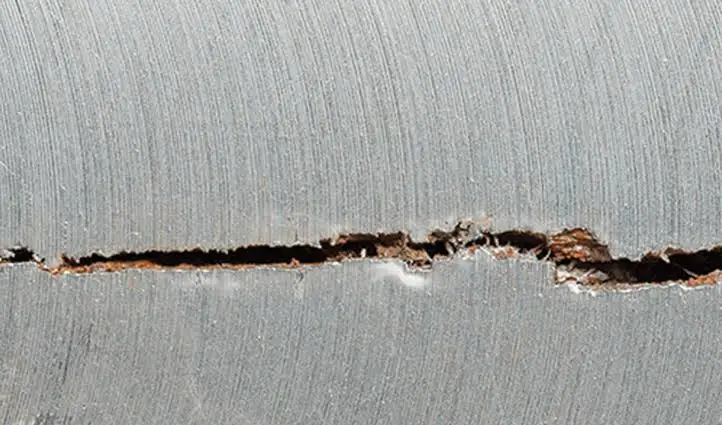
This minuscule size means helium can pass through seals and gaps that would contain any other gas. What seems like a perfectly sealed fitting for air or nitrogen becomes a leak path for helium. This property, known as high permeability, makes helium the standard gas for leak testing—because if a system can hold helium, it can hold anything.
2. The Leakage Challenge in Compressors
In a compressor, clearances between moving parts are necessary for operation. Piston rings, valve seats, and shaft seals all have microscopic gaps. For air or nitrogen, these gaps are acceptable. For helium, they become escape routes. A helium compressor must be manufactured to tolerances measured in microns, with sealing systems far more sophisticated than those in standard compressors.
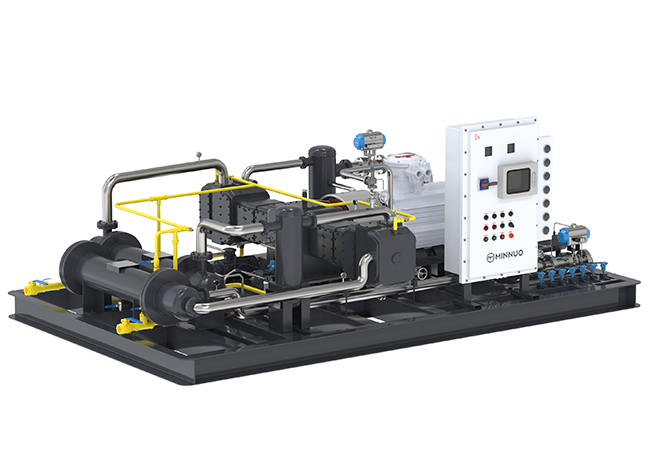
II. The Thermodynamic Challenge: Why Helium Gets So Hot
Compressing any gas generates heat—that’s basic physics. But helium takes this to another level.
1. The Adiabatic Index (γ)
The adiabatic index (ratio of specific heats, Cp/Cv) describes how a gas behaves when compressed without heat loss. For air, γ is approximately 1.4. For helium, γ is 1.66.
What this means in practice: When compressed, helium’s temperature rises much faster and higher than air under the same compression ratio. A compressor that handles air comfortably at 100°C may see discharge temperatures exceeding 200°C or even 300°C when compressing helium.
2. The “Hot Helium” Problem
This extreme temperature rise creates cascading challenges:
- Lubricant degradation: At high temperatures, conventional lubricants break down, oxidize, or evaporate.
- Thermal expansion: Components expand, changing critical clearances and potentially causing contact or seizure.
- Material stress: Seals, valves, and piston rings must withstand temperatures far beyond normal operating ranges.
- Cooling demands: Interstage cooling becomes absolutely critical, often requiring water-cooled systems rather than simple air cooling.
III. The High Thermal Conductivity: A Double-Edged Sword
Helium’s thermal conductivity is approximately 6 times higher than air.
1. Why This Matters
On one hand, this high conductivity helps cool the compressor internally—heat transfers quickly from hot components to the gas. On the other hand, it means that any heat generated in the compression process is rapidly transferred to every part of the system. Valves, cylinder walls, and seals all experience the full thermal load.
2. The Impact on Materials
Standard compressor materials may not withstand the combination of high temperature and rapid heat transfer. Helium compressors often require:
- High-temperature alloys for valves and seats.
- Specialized piston ring materials (often carbon-reinforced PTFE or advanced composites).
- Ceramic coatings on cylinder walls to manage thermal stress .
IV. The Low Molecular Weight: Inertia and Dynamics
Helium’s molecular weight is 4 g/mol, compared to air’s average of 29 g/mol .
1. Valve Dynamics
Compressor valves open and close based on pressure differentials and the inertia of the gas. With helium’s low density, the gas has less momentum to move valve plates. This means:
- Valves may open more slowly, reducing efficiency.
- Valve springs must be carefully matched to the gas properties.
- Incorrect valve selection leads to flutter, fatigue, and premature failure.
2. Pulsation and Flow Behavior
Low-density gases behave differently in piping systems. Pressure pulsations, resonance, and flow distribution all require specialized analysis for helium systems. Standard pulsation dampeners designed for air may be ineffective.
V. The Solubility and Permeation Challenge
Helium’s small size also makes it highly soluble in many materials.
1. Permeation Through Elastomers
Most elastomeric seals (O-rings, gaskets) are permeable to helium. Over time, helium diffuses through the seal material and escapes. This is why helium compressors often use:
- Metal seals (e.g., silver-plated stainless steel) for critical joints.
- Specialized elastomers with low permeability (e.g., FKM, FFKM) when elastomers are necessary.
- Multi-stage sealing systems with intermediate vent ports to capture leaked gas .
2. Absorption into Lubricants
If the compressor uses oil, helium can dissolve into the lubricant and be carried out of the system, leading to apparent “consumption” of helium. This necessitates:
- Efficient oil separation systems.
- Regular oil degassing (in some designs).
- In many high-purity applications, oil-free compressors are preferred to eliminate this issue entirely .
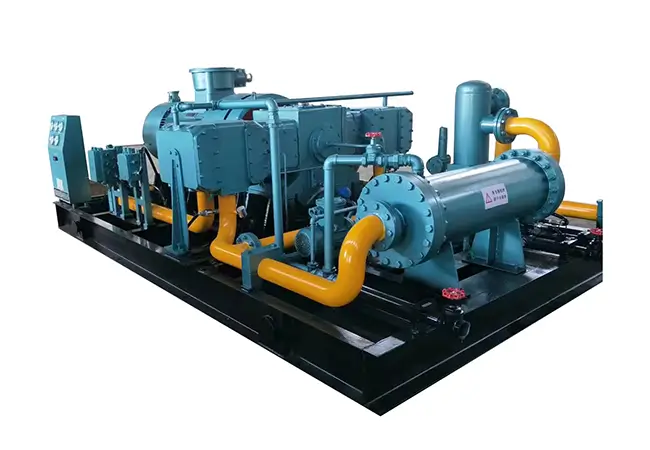
VI. How Engineers Solve These Problems
Understanding the challenges leads to the engineering solutions that make modern helium compressors possible.
1. Multi-Stage Compression with Intercooling
Rather than compressing helium in one step (which would generate impossible temperatures), helium compressors use multiple stages with efficient intercooling between each stage. A typical helium compressor might have 3-4 stages, with water-cooled heat exchangers between them.
2. Precision Manufacturing and Tight Tolerances
To minimize internal leakage, helium compressor components are machined to extremely tight tolerances. Pistons, cylinders, and seals are matched with precision that would be unnecessary—and prohibitively expensive—for air compressors.
3. Specialized Materials
- Valves: Often made from hardened stainless steel or specialty alloys with proprietary coatings.
- Seals: Metal-to-metal sealing for static joints; advanced polymers for dynamic seals.
- Piston rings: Carbon-filled PTFE or other low-friction, high-temperature materials that maintain sealing at high temperatures.
4. Oil-Free Designs for Critical Applications
For applications requiring absolute purity (MRI systems, semiconductor manufacturing, research), oil-free helium compressors use:
- Hermetically sealed designs with no dynamic shaft seals.
- Diaphragm compression for the highest purity at lower flows.
- Labyrinth piston seals that use controlled leakage paths rather than contact seals .
5. Advanced Cooling Systems
Helium compressors often require liquid cooling—either water or a specialized coolant—to manage the extreme heat of compression. Cooling systems are sized generously, often with redundancy for critical applications.
FAQ: Helium Compression
Q1: Can I use a standard air compressor for helium?
A1: Absolutely not. A standard air compressor will fail rapidly when used with helium. The combination of high temperatures, internal leakage, and material incompatibility will lead to premature wear, seal failure, and potentially dangerous overheating. Always use a compressor specifically designed for helium service.
Q2: Why does my helium compressor run so much hotter than my air compressor?
A2: This is normal and expected. Helium’s high adiabatic index (1.66 vs. 1.4 for air) means it heats up much more during compression. If your helium compressor isn’t running hot, either your cooling system is exceptionally effective, or your temperature sensors may be inaccurate.
Q3: How do I detect helium leaks in my compressor system?
A3: The most effective method is an electronic helium leak detector (mass spectrometer type). These devices can detect leaks as small as 10⁻¹² mbar·L/s. For routine checks, a soap solution can reveal larger leaks, but remember—helium will escape through gaps that won’t bubble with soap, so this method only finds significant leaks.
Q4: What maintenance is unique to helium compressors?
A4: Key differences include:
- More frequent valve inspections due to higher thermal and mechanical stress.
- Regular leak checking of all seals and fittings.
- Careful monitoring of cooling system performance.
- Oil analysis (if oil-lubricated) to detect helium absorption and contamination.
- Replacement of seals on a stricter schedule than air compressors .
Q5: Why are helium compressors so expensive?
A5: The cost reflects the engineering required to overcome helium’s challenges:
- Precision manufacturing with micron-level tolerances.
- Exotic materials (high-temperature alloys, specialized coatings).
- Multi-stage designs with intercoolers.
- Extensive testing, including helium leak detection.
- Lower production volumes compared to standard industrial compressors .
Q6: What’s the difference between a helium compressor and a hydrogen compressor?
A6: Both gases are challenging due to small molecular size, but hydrogen introduces additional concerns: it can cause hydrogen embrittlement in some metals, and it’s flammable/explosive. Hydrogen compressors require materials resistant to embrittlement and must meet hazardous area electrical classifications. Helium, being inert, avoids the flammability issue but demands equally stringent sealing.
Conclusion
Helium’s remarkable properties—its tiny atomic size, high adiabatic index, extreme thermal conductivity, and low molecular weight—make it invaluable for everything from cooling MRI magnets to enabling semiconductor manufacturing. But those same properties make it extraordinarily difficult to compress. The specialized helium compressors that overcome these challenges are masterpieces of precision engineering, combining multi-stage designs, advanced materials, micron-level tolerances, and sophisticated cooling into machines that can reliably handle this most elusive of gases.
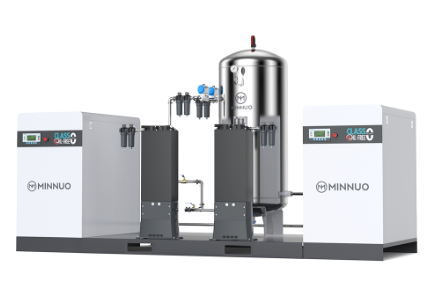
Understanding why helium is hard to compress isn’t just academic curiosity—it’s essential knowledge for anyone who operates, maintains, or specifies helium compression equipment. It explains why these machines cost more, why they need different maintenance, and why treating them like ordinary compressors is a recipe for failure. At MINNUO, our helium compressors are engineered from the ground up to respect and overcome these fundamental challenges, delivering the reliability and performance that demanding helium applications require.

 Email
Email sales:+86 15366749631