As core power equipment in manufacturing, energy, chemical and other fields, the stable operation of industrial piston compressors is directly related to production efficiency, operating costs and operational safety. Statistics show that more than 60% of equipment failures are caused by improper maintenance. Scientific fault troubleshooting and periodic maintenance can extend the compressor’s service life by more than 30% and reduce energy consumption by 5%-15%. Combining MINNUO’s years of experience in industrial equipment services, this article details the common fault troubleshooting methods and standardized maintenance cycles of piston compressors, helping enterprises achieve efficient equipment operation and maintenance.
I. Core Cognition: The Key Value of Maintenance for Industrial Piston Compressors
Industrial piston compressors operate under high load and high frequency for a long time, and problems such as wear of moving parts, aging of seals, and air circuit blockage are likely to gradually appear. Ignoring maintenance may not only lead to sudden equipment shutdowns—the loss of a single unplanned shutdown is often several times the annual maintenance cost—but also trigger chain problems such as insufficient discharge pressure, soaring energy consumption, and potential safety hazards. On the contrary, standardized maintenance can achieve three core values: first, ensure stable output of compressed air and improve the precision of downstream air-consuming equipment and product qualification rate; second, timely detect minor faults and avoid small problems from upgrading to major faults such as crankshaft breakage and valve deflagration; third, optimize equipment operating status, maximize return on investment, and meet enterprise environmental protection and safe production compliance requirements.
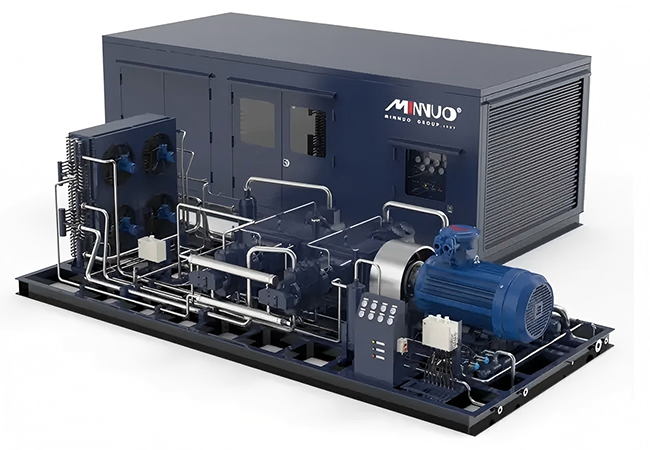
II. Accurate Troubleshooting of Common Faults: Targeted Treatment for Quick Recovery
Summarizing years of practical experience, MINNUO’s technical team classifies common faults of piston compressors into five categories, with detailed troubleshooting ideas and solutions to help maintenance personnel quickly locate problems.
1. Failure to Start or Immediate Shutdown After Startup
Fault Phenomenon: The motor has no response after pressing the start button, or trips and shuts down instantly after startup.
Core Causes: Abnormal electrical system, mechanical jamming, and pressure switch failure are the main incentives. Specifically, low power supply voltage or phase loss, poor contact of control lines, and thermal relay action; lubricating oil solidification in low-temperature environments, piston or connecting rod jamming, and overly tight belts; the pressure in the air tank has not been released below the startup pressure, and the pressure switch contacts have not reset.
Troubleshooting and Solutions: Prioritize checking the power supply voltage and line connections, and reset the thermal relay; check the lubricating oil level and quality in the shutdown state, and replace with the appropriate grade of oil; manually turn the flywheel to confirm no jamming before restarting; release excess pressure in the air tank and calibrate the pressure switch setting value.
2. Insufficient Discharge Pressure and Slow Pressure Boosting
Fault Phenomenon: The equipment operates normally, but the pressure in the air tank can never reach the rated value, or the pressure boosting time is significantly prolonged.
Core Causes: Air intake system blockage, seal leakage, incorrect pressure setting, or exhaust pipe leakage. Long-term non-replacement of the air filter leads to insufficient air intake; wear and deformation of the i ntake and exhaust valve plates, or wear of piston rings and cylinder walls cause gas leakage; the upper limit setting of the pressure switch is lower than the rated pressure; loose or damaged pipe interfaces and valve seals.
Troubleshooting and Solutions: Disassemble and clean the air filter, and replace it compulsorily when the pressure difference exceeds 1 bar; open the cylinder head to check the valve plate status, replace worn parts, measure the gap between the cylinder and the piston, and replace the piston ring when exceeding the limit; recalibrate the pressure switch to ensure the loading pressure = rated pressure – 0.05 MPa and the unloading pressure = rated pressure + 0.1 MPa; conduct a pressure test on the exhaust pipe, and use soapy water to detect and repair leakage points.
3. Abnormal Noise and Vibration During Operation
Fault Phenomenon: The equipment emits sharp metal friction sounds, low-frequency impact sounds during operation, or severe shaking of the machine body, with vibration value exceeding 10 mm/s.
Core Causes: Wear of moving parts, loose connecting parts, poor lubrication, or valve failure. Wear of piston pins, connecting rod bearings, etc., leads to excessive gaps; loose fixing bolts of flywheels, cylinder heads and other components; low oil level in the crankcase or deteriorated lubricating oil causes dry friction; valve plate breakage and spring damage lead to closing impact.
Troubleshooting and Solutions: Shut down the machine to check the tightness of each component, and retighten the anchor bolts with a torque wrench (the torque of M24 bolts needs to reach 500-600 N·m); check the lubricating oil level and quality, and supplement or replace in time; disassemble the valve assembly and replace damaged valve plates or springs; measure the gaps of bearings and piston pins, and replace corresponding parts when exceeding the limit.
4. Excessive Lubricating Oil Consumption (Oil Blowby)
Fault Phenomenon: The oil level in the crankcase drops too fast, a large amount of oil mist appears at the exhaust port, and the oil content in the accumulated water of the air tank increases significantly.
Core Causes: Excessive lubricating oil filling, piston ring failure, or cylinder wear. The oil level exceeds the upper limit of the oil gauge, and is carried into the cylinder by the piston during operation; piston ring wear, breakage, or reverse installation leads to seal failure; the cylinder wall is scratched or excessively worn, and the fitting gap increases, causing oil to blow up.
Troubleshooting and Solutions: Drain excess lubricating oil to keep the oil level between the upper and lower limits of the oil gauge; disassemble the piston assembly, check the elasticity of the piston ring, replace it when the opening gap is >1.2 mm or the radial thickness wear is >10%, and arrange the openings of the gas ring and oil ring at 120° to each other during installation; measure the inner diameter of the cylinder, and perform boring repair or replace the cylinder when exceeding the tolerance.
5. Overheating Shutdown
Fault Phenomenon: The temperature of the machine body exceeds 100℃ during operation, or the temperature relay acts to cause automatic shutdown.
Core Causes: Cooling system failure, poor lubrication, valve failure, or poor environmental ventilation. Cooling fan damage, belt slipping, or dust blockage of cooler fins; insufficient or deteriorated lubricating oil; blocked or poorly sealed exhaust valves leading to increased temperature in the cylinder; equipment installed in a closed space with high ambient temperature in summer.
Troubleshooting and Solutions: Purge the cooler fins with compressed air, check the fan and belt status, and ensure the fan belt deflection is 10-15 mm/100 mm span; supplement or replace lubricating oil to ensure the oil pump outlet pressure is maintained at 0.2-0.4 MPa; check the smoothness of the exhaust valve and repair or replace faulty valves; improve the installation environment to ensure good ventilation and avoid direct sunlight.
III. Scientific Maintenance Cycle: Hierarchical Maintenance to Prevent Problems
The maintenance of piston compressors should follow the principle of “daily monitoring + hierarchical maintenance”, and a plan should be formulated according to the equipment operation time and working conditions (such as dust, high temperature, and high humidity environments requiring shortened cycles). MINNUO recommends the following standardized maintenance cycles, which are suitable for most industrial scenarios.
1. Daily Maintenance (Daily/Per Shift)
As a basic maintenance link, it should be performed by operators daily: ① Check the oil level, oil quality, and oil pump pressure to ensure the oil level is 1/2-2/3 of the oil gauge; ② Observe the values of pressure gauges, thermometers, and other instruments to ensure the exhaust temperature is <160℃ and the oil pressure is 0.15-0.4 MPa; ③ Listen to the equipment operation sound, focusing on whether the “click” sound of the valve is uniform; ④ Check for leaks at pipe interfaces and seals, and detect bubbles with soapy water; ⑤ Clean the equipment surface and cooling port dust, and drain the accumulated water in the air tank and cylinder; ⑥ Fill in the operation record and hand over the equipment status.
2. Level 1 Maintenance (Every 500 Hours)
The core goal is to identify potential problems, including: ① Replace the air filter, shorten to 200 hours in dusty environments; ② Clean the cylinder water jacket and lubricating oil filter; ③ Check the piston stroke gap (≤0.5 mm) and adjust the crankshaft bearing gasket; ④ Test the safety valve opening pressure (1.1 times the working pressure) to ensure the reseating pressure is ≥0.9 times; ⑤ Check the tightness of the drive belt, and adjust or replace if necessary.
3. Level 2 Maintenance (Every 2000 Hours)
In-depth inspection of core components is required, including: ① Disassemble and grind the cylinder mirror surface, and perform honing repair when the cylindricity error is >0.05 mm; ② Replace the piston ring (compulsory replacement when the opening gap is worn to 1.5 mm); ③ Clean the valve assembly, soak with 10% caustic soda solution when the carbon deposit thickness is >0.5 mm, and grind the sealing surface; ④ Fill the motor bearing with lithium-based grease (the filling amount is 1/3 of the bearing cavity); ⑤ Calibrate the pressure sensor to ensure the accuracy of ±1.5% FS; ⑥ Fully check the seals, and replace the seal ring when the leakage of the piston rod stuffing box is >5 drops per minute.
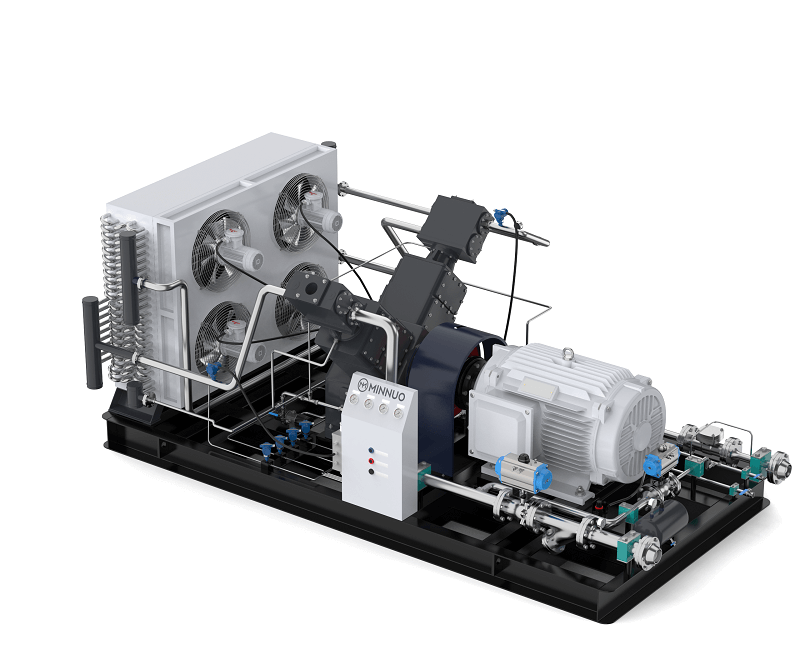
4. Annual Overhaul (Every 8000-10000 Hours)
Comprehensive maintenance of the equipment is required, including: ① Detect the straightness of the crankshaft, and straighten when the bending amount is >0.1 mm/m; ② Replace the connecting rod big end bearing shell (when the wear amount is >0.08 mm); ③ Check and replace all wearing parts (such as valve plates, springs, gaskets); ④ Conduct a comprehensive air tightness test of the whole machine, maintain pressure at 1.25 times the working pressure for 30 minutes, and the pressure drop is ≤1%; ⑤ Calibrate all instruments and replace expired or faulty parts; ⑥ Derust and paint the equipment and pipes, and improve the overhaul record.
5. Long-term Shutdown Maintenance (>72 Hours)
Protective measures should be taken when the equipment is idle: ① Drain the lubricating oil and cooling water, apply anti-rust oil in the cylinder, and move the piston to the bottom dead center; ② Disconnect the electrical connection and post a “shutdown maintenance” sign; ③ Turn the crankshaft 180° monthly to prevent bearing seizure; ④ Before re-commissioning, replace the lubricating oil, clean the seals and add new oil.
IV. MINNUO Warm Reminder: Core Operation and Maintenance Principles and Professional Support
The operation and maintenance of industrial piston compressors must adhere to the principle of “prevention first, rapid response”: first, strictly select suitable special lubricating oil and avoid mixing oils of different viscosities; second, establish a complete maintenance account to record maintenance time, component replacement, fault handling and other information; third, it is strictly prohibited to perform maintenance under pressure. After an emergency shutdown (such as exhaust temperature >180℃, severe vibration), the fault must be investigated before resetting.
If you encounter complex faults in equipment maintenance or need to customize an exclusive maintenance plan, MINNUO has a professional technical team and a complete spare parts system, which can provide one-stop services such as on-site maintenance, maintenance training, and spare parts replacement to help your equipment operate stably and efficiently.
 Email
Email sales:+86 15366749631