Abstract
Magnetic levitation and air levitation chillers are new oil-free centrifugal refrigeration core devices with zero friction, high efficiency and low maintenance, widely adopted for low-carbon transformation in data centers, chemical plants, precision manufacturing and commercial complexes. Traditional oil-type chillers suffer high energy consumption and degraded heat exchange efficiency, driving market replacement by oil-free levitation units.
Despite shared oil-free features, maglev and air levitation chillers differ greatly in levitation mechanism, efficiency, operating adaptability and full-lifecycle cost. Proper model selection requires comprehensive evaluation of load, runtime, site environment and budget.
Jiangsu Minnuo Group develops both technical lines and delivers customized solutions for harsh industrial conditions. This paper systematically analyzes the two chillers from industrial trends, core distinctions, selection criteria, corporate strengths and future upgrade directions.
I. Industrial Application Pattern: Dual Driving of Oil-Free Energy-Saving Renovation and Domestic Technology Substitution
Industrial refrigeration is a high-energy-consuming segment in factories. Chiller units operate continuously throughout the year, accounting for more than 30% of the energy consumption of factory public engineering systems, making them a key target for enterprises’ energy conservation and carbon reduction. Currently, the domestic oil-free chiller market presents two core development trends.
(1) Oil-free levitation units are fully replacing traditional oil-fueled units.
Traditional oil-fueled centrifugal and screw chillers suffer from heat exchanger contamination by lubricating oil, regular oil circuit maintenance and sharp efficiency drop under low loads, failing to meet ultra-low energy consumption and high-precision temperature control requirements. Magnetic levitation and air levitation chillers operate completely oil-free, eliminating thermal resistance caused by oil film heat exchange. Their comprehensive energy consumption is 35%–50% lower than that of traditional units, with the investment payback period of most projects ranging from 2 to 4 years and stable and considerable energy-saving benefits. With the implementation of national mandatory first-level energy efficiency standards for chillers, the market penetration rate of oil-free levitation equipment continues to rise.
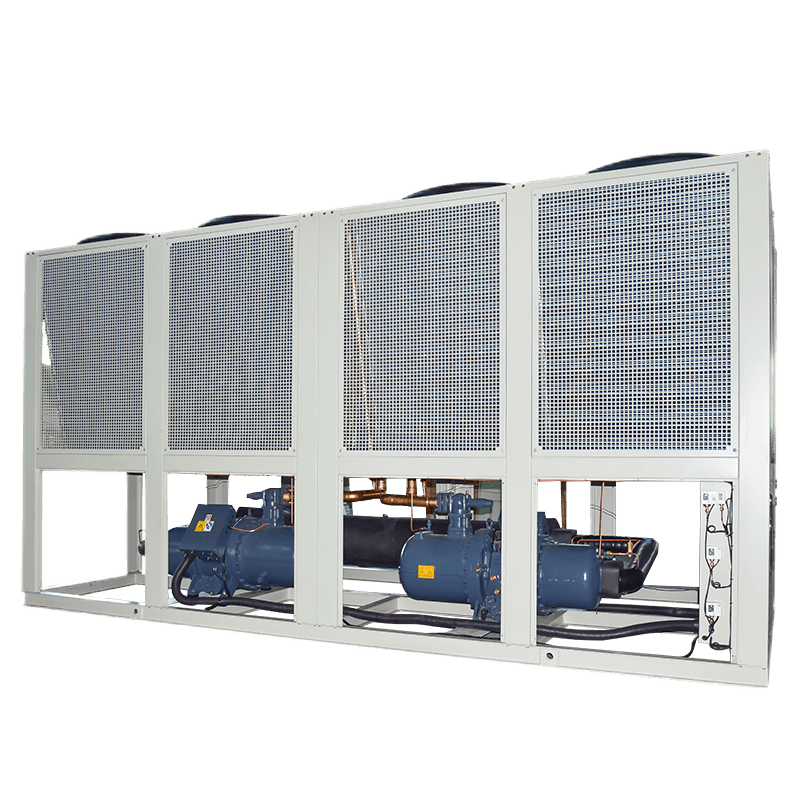
(2) Domestic substitution is accelerating in high-end industrial refrigeration scenarios.
In the early years, the high-power, long-term continuous operation and high-precision temperature control chiller market was long monopolized by overseas brands, which are featured by high procurement costs, slow after-sales response and long spare parts delivery cycles. As a representative local refrigeration enterprise, Jiangsu Minnuo Group has been deeply engaged in the chiller industry for years. It has broken through core technologies including magnetic levitation electromagnetic bearing control algorithms, air levitation dynamic pressure air film rotors, high-speed variable-frequency motors and dust-proof and anti-corrosion integrated protection. The self-developed domestic magnetic levitation and air levitation chillers deliver performance comparable to international first-class brands, with outstanding advantages of high cost performance, rapid localized maintenance and customized working condition adaptation. They have been widely applied in projects such as lithium battery, chemical, data center, cement supporting refrigeration and precision pharmaceutical workshops, and are gradually expanding into overseas markets.
Relying on years of accumulated refrigeration technology, Jiangsu Minnuo Group has built an integrated system covering independent R&D of magnetic levitation/air levitation compressors, complete machine assembly, intelligent IoT management and on-site renovation & maintenance. By continuously optimizing products for complex domestic industrial working conditions, it has become a benchmark enterprise for the domestic upgrading of industrial oil-free chillers.
II. Core Principles and Essential Differences Between Magnetic Levitation and Air Levitation Chillers
Both types of units share the core advantages of oil-free bearings, zero metal friction, low vibration and noise, and stepless variable-frequency regulation. They completely eliminate supporting components such as lubricating oil, oil separators and oil filters, greatly reducing maintenance workload. However, their underlying levitation technologies are fundamentally different, leading to hierarchical differences in energy efficiency, stability, environmental adaptability and investment cost.
2.1 Comparison of Core Levitation Principles
(1) Magnetic Levitation Chiller: Active Electromagnetic Levitation (Active Control Type)
It adopts 5-DOF (degree of freedom) electromagnetic bearings to generate real-time magnetic fields and stably suspend the compressor rotor at the bearing center. Supported by high-precision sensors and dedicated electronic control systems for millisecond-level magnetic field adjustment, it realizes zero physical contact operation. The levitation state is independent of rotational speed, maintaining stable suspension within the 10%–100% load range. Similar to high-speed maglev trains, it relies on continuous electromagnetic force for levitation and requires an independent power supply control system. A backup battery is equipped during power failure to protect the rotor and avoid bearing collision damage.
(2) Air Levitation Chiller: Dynamic Pressure Air Film Levitation (Passive Mechanical Type)
It relies on the high-speed rotation of the rotor to press air into the wedge gap of bearings to form micron-level high-pressure air films, suspending the rotor by air buoyancy. With no electromagnetic coils or magnetic field control units, it adopts a purely passive mechanical levitation structure. Similar to hovercrafts, a complete air film is formed only when the rotational speed reaches the threshold. Slight dry friction occurs during the low-speed start-stop phase with unformed air films. No additional power supply is required to maintain levitation; the rotor decelerates naturally after power failure without violent bearing collision risks.
2.2 Detailed Differences in Six Key Performance Dimensions
2.2.1 Energy Efficiency (Core Indicator of Annual Operating Cost)
- Magnetic Levitation Chiller: Full-load COP ranges from 6.5 to 7.5, and the Integrated Part Load Value (IPLV) reaches 11.5–13.0. It boasts excellent energy efficiency under low loads (10%–40%), delivering prominent power-saving effects in scenarios with large annual load fluctuations and long-term low-load operation. It supports stepless stable regulation within the 5%–100% load range.
- Air Levitation Chiller: Full-load COP ranges from 6.1 to 6.8, with lower bearing power consumption. The energy consumption gap with magnetic levitation chillers is negligible under stable full-load working conditions. However, air film stiffness decreases when the load is below 30%, resulting in attenuated regulation stability and energy efficiency. It is more suitable for projects with stable high-load operation all year round, with a general IPLV range of 10.0–11.5.
2.2.2 Initial Investment and Spare Parts Cost
For units with the same cooling capacity, magnetic levitation chillers are 5%–15% more expensive due to electromagnetic bearings and high-precision sensing control systems. Their electronic control sensors and magnetic bearing spare parts are costly and require professional factory maintenance. In contrast, air levitation chillers have no complex electromagnetic control modules, featuring lower overall cost, simple mechanical bearing structure, affordable universal spare parts and lower maintenance thresholds, delivering better long-term operation and maintenance economy.
2.2.3 Environmental Adaptability and Protection Performance
(1) Magnetic Levitation Chiller: It requires high power supply stability; voltage fluctuations exceeding ±5% will trigger protective shutdowns. Dust-proof and moisture-proof measures must be taken for electric control cabinets in dusty and humid environments. It has moderate requirements for intake air cleanliness with no risk of bearing wear caused by dust.
(2) Air Levitation Chiller: Its air film bearings operate on air media, making them highly sensitive to intake dust and moisture. Multi-stage high-precision air filters are mandatory to prevent bearing abrasion from dust accumulation. It features a wide voltage tolerance range (stable operation under ±15% voltage fluctuation), strong resistance to grid impact and vibration, and is applicable to factories with unstable power supply.
2.2.4 Noise, Vibration and Temperature Control Accuracy
The magnetic levitation rotor achieves a suspension control accuracy of ±5μm with nearly zero vibration. The overall unit noise is ≤62dB, and the chilled water temperature control accuracy reaches ±0.1℃, suitable for ultra-quiet and high-precision scenarios such as laboratories, operating rooms and semiconductor wafer workshops. Air levitation chillers generate slight airflow disturbance with slightly higher vibration and noise, and a temperature control accuracy of ±0.3–0.5℃, meeting the needs of most conventional industrial refrigeration scenarios.
2.2.5 Power Failure Resistance and Operation Fault Tolerance
Magnetic levitation chillers rely on backup batteries to maintain magnetic field support for the rotor during instantaneous power failure. Battery failure will cause rotor drop and bearing collision damage, requiring factory configuration of voltage stabilization and emergency power supplies. Air levitation chillers have no electromagnetic components; the rotational speed decreases slowly after power failure with gradual air film dissipation and smooth rotor landing, featuring strong fault tolerance and no need for backup power systems.
2.2.6 Maintenance Cycle and Workload
Both types of units eliminate oil circuits, with far lower basic maintenance workload than traditional chillers. Magnetic levitation chillers focus on maintaining electromagnetic sensors, magnetic control circuit boards and backup power supplies, requiring annual calibration of magnetic field control systems. The core maintenance of air levitation chillers is regular cleaning of intake precision filters; mechanical bearings have no electronic component loss with fewer electric control faults.
III. Core Selection Criteria for Factory Chillers (Minnuo Group Working Condition Selection Standards)
Based on years of industrial refrigeration project experience, Minnuo Group has summarized six major selection dimensions for magnetic levitation and air levitation chillers. Enterprises shall match models according to actual factory working conditions to avoid long-term energy consumption loss and shutdown faults caused by simple price-based selection.
3.1 Model Selection Based on Annual Load Fluctuation Range
(1) Preferred Scenarios for Magnetic Levitation Chillers
Scenarios with large annual load fluctuations and long-term low-load operation (10%–50% load) in transitional seasons. Typical projects include large commercial complexes, multi-shift precision electronic workshops, 24-hour uninterrupted data centers and multi-temperature-control laboratories. Its excellent low-load energy efficiency can greatly reduce annual power consumption, with the equipment price difference recovered within 3 years.
(2) Preferred Scenarios for Air Levitation Chillers
Scenarios with stable production conditions, annual load fluctuation less than 30% and long-term operation above 60% load. Typical projects include chemical continuous reaction cooling, cement supporting process refrigeration, large food processing production lines and stable-load regional energy stations. It delivers outstanding full-load energy efficiency, lower initial investment and higher comprehensive cost performance.
3.2 Protected Model Matching Based on On-Site Power Supply and Environmental Conditions
(1) Factories with large grid fluctuations, no voltage stabilization equipment and general power supply conditions: Air levitation chillers are preferred for their wide voltage tolerance and no risk of magnetic control system damage from power failure.
(2) Coastal high-humidity, mining high-dust and acid-base corrosive factories: Both types of units can be customized with anti-corrosion coatings and stainless steel heat exchangers. Air levitation chillers require upgraded multi-stage dust filtration systems, while magnetic levitation chillers focus on IP54 dust and moisture protection for electric control cabinets.
(3) Scenarios with strict requirements for noise, vibration and temperature control accuracy (medical operating rooms, semiconductor wafer workshops, metering laboratories): Magnetic levitation chillers are mandatory to meet high-precision and low-noise standards.
3.3 Payback Period Calculation Based on Annual Operating Hours
- Annual operating hours > 6000 hours with 24-hour continuous refrigeration all year round: Magnetic levitation chillers deliver significant long-term energy-saving benefits with lower overall long-term operating costs despite higher initial investment.
- Annual operating hours of 3000–6000 hours with seasonal intermittent refrigeration: Air levitation chillers feature prominent cost performance with short price difference payback period and lower maintenance costs.
- Short-term projects with annual operating hours < 3000 hours: Efficient traditional screw chillers can be comprehensively compared if no mandatory first-level energy efficiency requirements apply.
3.4 Cooling Capacity Matching and Multi-Unit Intelligent Joint Control Redundancy Design
For centralized cooling in large-capacity and multi-workshop factories, a multi-unit joint control scheme is adopted: magnetic levitation chillers serve as main units for projects with extreme load fluctuations, matched with air levitation chillers for stable base load operation; all-air levitation chiller configuration is applicable for projects with stable annual loads. In all cases, a 15%–20% cooling capacity redundancy is reserved, with one standby and multiple linked operating modes configured to avoid production line shutdowns caused by insufficient cooling capacity during peak periods.
3.5 Heat Exchanger Material and Air Cleanliness Matching
Both types of units support oil-free heat exchange with long-term stable and non-decaying heat exchange efficiency. Factories with high sediment and open cooling tower water quality shall be equipped with Minnuo customized anti-fouling high-efficiency shell-and-tube heat exchangers. Air levitation chillers must be matched with three-stage precision air filtration devices with regular intake system cleaning and maintenance; magnetic levitation chillers only require basic electric control dust prevention with no mandatory intake filtration requirements.
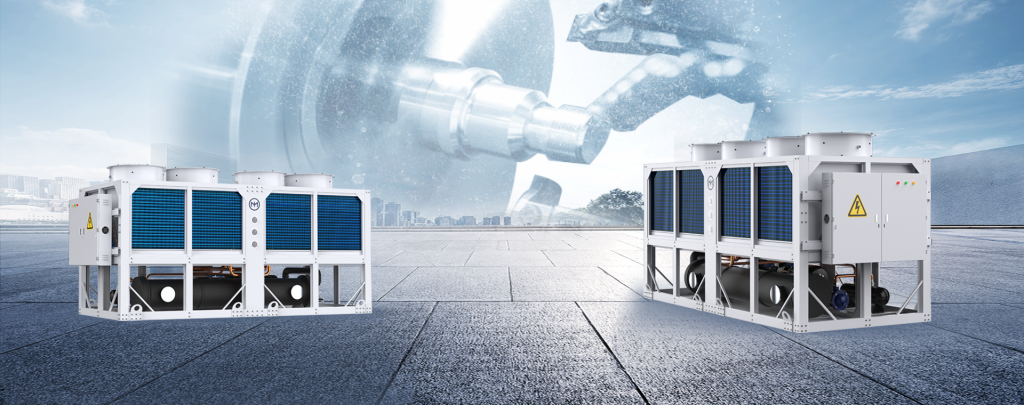
3.6 Standard Configuration of Intelligent IoT Remote Operation and Maintenance System
Multiple chillers in large factories are uniformly equipped with PLC intelligent joint control and Minnuo self-developed cloud monitoring platform, which real-timely collects unit cooling capacity, outlet water temperature, energy consumption, bearing status and fault early warning data. It supports remote diagnosis, automatic load distribution and predictive maintenance, reducing unplanned shutdown losses and adapting to the upgrading needs of factory digital and unmanned operation.
IV. Four Core Competitive Advantages of Jiangsu Minnuo Group in the Oil-Free Chiller Industry
With years of in-depth layout in the refrigeration equipment industry, Jiangsu Minnuo Group has completed the R&D of dual technical product lines for magnetic levitation and air levitation chillers. It conducts in-depth customization for complex and harsh domestic industrial working conditions, realizing domestic chiller performance benchmarking imported brands and forming differentiated core competitiveness.
4.1 Independent R&D of Core Compressors and In-Depth Optimization of Levitation Technology for Working Conditions
Minnuo independently develops magnetic levitation electromagnetic bearing control algorithms and air levitation dynamic pressure air film rotor profile designs, with self-developed and self-produced high-speed variable-frequency motors, rotors, bearings and heat exchangers. Component materials are optimized for 24-hour continuous heavy-load, high-temperature, high-humidity and dusty industrial environments. Magnetic levitation units are equipped with enhanced drop protection bearings, and air levitation units adopt upgraded wear-resistant air film surface textures, greatly extending the overhaul cycle of core components and keeping the unit failure rate far below the industry average.
4.2 Full-Coverage Energy-Saving Product Lines for Precise Scenario-Based Energy Reduction
The group’s product portfolio covers all cooling capacities of magnetic levitation and air levitation chillers. The maximum IPLV of magnetic levitation chillers reaches 12.8, and the full-load COP of air levitation chillers stably exceeds 6.6. Customized energy-saving solutions are provided based on the load characteristics of different industries: magnetic levitation units are recommended for data centers and precision electronics workshops, while air levitation units are applied to chemical, building material and stable-load industrial factories, achieving a comprehensive power-saving rate of 35%–50% and providing core support for enterprise cost reduction and efficiency improvement.
4.3 Full-Working-Condition Customized Protection for Special Production Scenarios
Customized special models are developed for industry pain points, including anti-corrosion models for coastal factories, dust-proof models for mining areas, explosion-proof models for chemical industries and enhanced heat dissipation models for high-temperature workshops. The electric control system of magnetic levitation chillers is upgraded to IP55 protection level, and air levitation chillers are equipped with self-developed multi-stage dust-proof intake modules, solving the industry problem of insufficient stability of domestic units in harsh working conditions.
4.4 National Localized Intelligent Operation and Maintenance System to Solve Foreign Brand Service Deficiencies
Equipped with the Minnuo cloud IoT remote monitoring platform, the group provides 7×24-hour online unit operation monitoring and advance maintenance early warnings. Relying on nationwide service outlets, it delivers 4-hour on-site emergency maintenance and guaranteed rapid spare parts supply through self-owned warehousing centers. It effectively solves the pain points of long after-sales cycles and high spare parts prices of foreign brands, winning wide market recognition by serving hundreds of chemical, building material, data center and pharmaceutical enterprises.
V. Industrial Upgrade Direction: Minnuo Group’s Technical Development Path and Industry Trends
With the advancement of industrial green low-carbon transformation, intelligent manufacturing popularization and ultra-low energy consumption policy implementation, the oil-free chiller industry is evolving towards ultra-high energy efficiency, refined working condition customization, cluster intelligent management and control, low-carbon refrigerant application and integrated full-system solutions. As a benchmark domestic refrigeration equipment enterprise, Jiangsu Minnuo Group promotes domestic industry upgrading through technological breakthroughs in four core dimensions.
5.1 Core Technology Iteration to Continuously Improve Levitation Unit Energy Efficiency Limits
The group intensifies R&D of new-generation ultra-efficient 5-DOF magnetic levitation bearings and high-pressure ratio two-stage compression air levitation compressors to further raise IPLV energy efficiency indicators. It synchronously develops waste heat recovery integrated units to reuse chiller waste heat for factory heating and production hot water, improving overall plant energy utilization efficiency. It completes the adaptation R&D of low-GWP environmentally friendly refrigerants to meet domestic environmental regulations and overseas export standards, and tackles special levitation refrigeration technologies for explosion-proof, high-altitude and ultra-low temperature scenarios to make up for the technical shortcomings of domestic equipment in special working conditions.
5.2 Improved Industry-Specific Product Matrix for Standardized Scenario Customization
Standardized magnetic levitation/air levitation special models are launched for five mainstream sectors: data centers, lithium battery new materials, precision pharmaceutical workshops, building materials & chemical industries, and commercial complexes. The group optimizes the overall dust-proof, anti-corrosion and shock-absorbing structure of units, simplifies installation and commissioning processes, reduces enterprise renovation costs, and builds two differentiated product systems for fluctuating and stable loads to achieve accurate model selection.
5.3 Upgrade from Single Equipment Supply to Integrated Factory Refrigeration Solutions
Breaking the single-unit supply model, the group builds a complete refrigeration system integrating magnetic levitation/air levitation host, high-efficiency cooling tower, circulating water pump, intelligent centralized control platform and waste heat recovery. The system is connected to the factory Energy Management System (EMS) to realize intelligent cooling capacity scheduling, real-time energy consumption statistics and automatic load balancing, facilitating digital and unmanned factory operation and reducing labor costs for energy management.
5.4 Deepen Domestic Substitution and Expand Global Market Layout
The group continuously enhances the independent controllability of core magnetic levitation and air levitation technologies to expand domestic market share in industrial refrigeration. Based on international energy efficiency standard-compliant oil-free chillers, it deploys refrigeration projects in overseas manufacturing parks in Southeast Asia, Central Asia and Africa, exports domestic refrigeration equipment and complete energy-saving solutions, and upgrades from a single equipment manufacturer to a global industrial refrigeration system service provider.
VI. FAQ (Frequently Asked Questions)
Q1: What is the core difference between magnetic levitation chiller and air levitation chiller?
A1: The core gap lies in levitation mode. Magnetic levitation adopts active electromagnetic suspension, stable at all load ranges with superior low-load efficiency; air levitation uses passive dynamic pressure air film suspension, only stable under high full load, with lower initial purchase cost and wider voltage adaptability.
Q2: Which chiller is more energy-saving for data center 24-hour operation with variable load?
A2: Magnetic levitation chiller is the optimal choice. Its IPLV reaches 11.5–13.0, maintaining high efficiency under 10%–50% low load, which matches the long-term fluctuating load characteristics of data centers and brings obvious annual power-saving benefits.
Q3: Can air levitation chillers work in high-dust mining factories?
A3: Yes, but multi-stage high-precision air filtration modules must be configured. Air film bearings are sensitive to dust; without complete filtration, dust will scratch bearing surfaces and shorten service life. Magnetic levitation chillers only need standard electric control cabinet dust protection.
Q4: What are the maintenance cost differences between the two oil-free chillers?
A4: Air levitation chillers have lower long-term maintenance costs. Their spare parts are universal mechanical components with low prices; daily maintenance mainly involves cleaning air filters. Magnetic levitation chillers need annual calibration of magnetic control systems, and sensors and magnetic bearings are expensive replacement parts.
VII. Conclusion: Oil-Free Levitation Chillers as Core Power Equipment for Industrial Low-Carbon Refrigeration
As new-generation high-efficiency refrigeration core equipment, magnetic levitation and air levitation chillers are decisive factors affecting factory refrigeration energy consumption, production temperature control stability, equipment maintenance costs and environmental compliance levels. Neither technology has absolute advantages; their value lies in scenario adaptation. Magnetic levitation chillers are preferred for fluctuating low-load, high-precision and low-noise scenarios, while air levitation chillers are more suitable for industrial factories with stable high loads, cost-effectiveness priority and ordinary power supply conditions. Accurate working condition matching, reliable domestic equipment selection and sound intelligent operation and maintenance systems are the keys to reducing long-term enterprise operating costs.
Jiangsu Minnuo Group has been deeply engaged in the chiller industry for years. Rooted in independent innovation of core levitation refrigeration technologies and actual complex domestic industrial working conditions, it provides customized magnetic levitation & air levitation chillers and complete refrigeration system solutions for various industries with the advantages of high energy efficiency, stable durability and rapid localized services. In the future, Minnuo will continue to deepen its layout in the oil-free refrigeration track, iterate core levitation technologies, enrich industry-specific product matrices and upgrade intelligent operation and maintenance services. It will empower the green low-carbon transformation of China’s manufacturing industry with higher-efficiency, more reliable and smarter domestic refrigeration equipment, and promote the global development of China’s levitation chiller technologies.
 Email
Email sales:+86 15366749631