Two compressors sit on a factory floor. One is oil-flooded. The other is oil-free. They deliver the same flow, at the same pressure, to the same header pipe. They both run 6,000 hours a year. They both get serviced on schedule. After ten years, one has cost its owner significantly more than the other. The difference is not in the purchase price. It is in everything that happens after the machine is commissioned.
The oil-flooded compressor costs less to buy. That is the number on the quote, and it is the number that drives most purchasing decisions. The oil-free compressor costs more upfront. The case for the oil-free machine rests on costs that are harder to see on a spreadsheet: electricity consumed over a decade, filters replaced every few months, maintenance hours logged, and — the hardest number to pin down — the cost of a product contamination event that may or may not happen. This article compares the two technologies across a ten-year ownership horizon so that the decision is based on total cost, not just purchase price.
I. The Purchase Price Gap: What You Pay on Day One
The upfront cost difference by size range
The price premium for oil-free screw compressors varies with capacity. For a small machine in the 15 to 30 kW range, an oil-free unit typically costs 25 to 40 percent more than an equivalent oil-flooded model. For a medium-sized machine in the 55 to 90 kW range, the premium narrows to 20 to 30 percent. For large machines above 150 kW, the premium is 15 to 25 percent. The premium exists because oil-free compressors require precision timing gears, rotor coatings that can withstand dry running, and more elaborate cooling systems to manage the higher discharge temperatures that result when oil is not present to absorb compression heat. These are not optional features. They are the core of the technology.
What the price difference buys in engineering terms
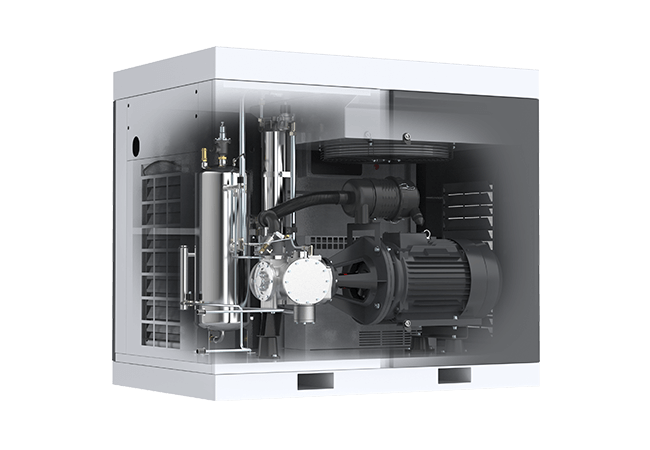
An oil-flooded compressor injects oil into the compression chamber. The oil seals the clearance between the rotors, cools the air during compression, and lubricates the bearings. The rotors can be manufactured to less demanding tolerances because the oil film fills the gaps. An oil-free compressor achieves the same compression without oil. The rotors do not touch each other or the housing. Timing gears on the shaft ends maintain clearances of a few microns. The rotors are coated with PTFE or a similar material that provides a wear surface. The cooling is done by water jackets or inter-stage coolers. The engineering is more complex, and the cost reflects that complexity. Whether the complexity pays for itself depends on the next nine years and ten months of operation.
II. Energy Costs: The Largest Piece of the Total Cost Pie
Energy consumption: the 10-year number that dwarfs the purchase price
Energy accounts for 70 to 75 percent of the total cost of ownership of any industrial compressor over a ten-year life. A 75 kW compressor running 6,000 hours per year at an electricity rate of 0.10 USD per kWh consumes 45,000 USD in electricity per year. Over ten years, that is 450,000 USD. The purchase price of the compressor — whether 40,000 or 55,000 USD — is roughly one-tenth of the energy cost. A 5 percent difference in energy efficiency between two machines therefore matters far more to the total cost than a 30 percent difference in purchase price.
Where the efficiency difference comes from
Oil-flooded compressors are inherently efficient at transferring heat away from the compression process. The oil absorbs heat as the air is compressed, keeping the air temperature lower and reducing the work required for compression. Oil-free compressors, lacking that oil cooling, compress air at higher temperatures. The higher temperature means more work is required to compress the same mass of air through the same pressure ratio. This efficiency gap at full load is typically 3 to 7 percent in favor of the oil-flooded machine. At part load, the gap narrows and can reverse depending on the specific machines being compared, the control strategy, and the operating profile.
The specific power comparison
Specific power — the electrical power input in kW divided by the delivered air flow in Nm³/min or CFM — is the metric that captures energy efficiency. A modern oil-flooded 75 kW compressor might achieve a specific power of 6.3 kW per Nm³/min at 7 bar. An equivalent oil-free machine might achieve 6.6 kW per Nm³/min. The difference of 0.3 kW per Nm³/min, multiplied by the flow rate and the annual operating hours, gives the annual energy penalty of the oil-free machine. At 12 Nm³/min and 6,000 hours, that is 21,600 kWh per year, or 2,160 USD at 0.10 USD per kWh. Over ten years, the energy penalty totals 21,600 USD. This is a real cost. It must be weighed against the costs that the oil-free machine avoids.
III. Maintenance Costs: Where the Oil-Free Machine Starts to Recover Ground
Oil-flooded compressor maintenance: the recurring cost of oil and filters
An oil-flooded compressor consumes oil, oil filters, air-oil separators, and inlet filters on a schedule determined by operating hours and conditions. A typical 75 kW oil-flooded machine running 6,000 hours per year requires an oil change and filter replacement every 2,000 hours — three times a year. Each service includes approximately 20 to 30 liters of synthetic compressor oil at 15 to 20 USD per liter, an oil filter at 50 to 80 USD, an air filter at 60 to 100 USD, and an air-oil separator element at 300 to 500 USD. The annual consumable cost is roughly 1,500 to 3,000 USD per year. Over ten years, that is 15,000 to 30,000 USD in consumables alone. Add the labor for three to four service visits per year at 4 to 6 hours each, and the maintenance labor cost over ten years adds another 15,000 to 25,000 USD.
Oil-free compressor maintenance: no oil changes, but coated rotors and timing gears
An oil-free compressor has no oil in the compression chamber. There are no oil changes, no air-oil separators to replace, and no oil filters on the airend circuit. The consumable cost is limited to inlet air filters and, if the machine has a small oil circuit for the timing gears and bearings, gearbox oil changes at extended intervals — typically every 4,000 to 8,000 hours. The annual consumable cost for an oil-free machine is roughly 500 to 1,000 USD. Over ten years, that is 5,000 to 10,000 USD — roughly one-third of the oil-flooded consumable cost. The trade-off is that the oil-free machine has a major service event at roughly 40,000 to 60,000 hours when the rotor coating must be inspected and possibly reapplied, and the timing gears may need replacement. This is a significant expense — 8,000 to 15,000 USD — that the oil-flooded machine does not have. The timing of this event within the ten-year window depends on the annual operating hours.
Filtration: the hidden cost of protecting downstream equipment from oil
An oil-flooded compressor requires downstream filtration to remove oil aerosol and oil vapor before the air reaches the point of use. A coalescing filter and an activated carbon filter are standard. The coalescing element is replaced every 4,000 to 6,000 hours at a cost of 150 to 400 USD per element. The carbon element is replaced every 2,000 to 4,000 hours at a cost of 200 to 500 USD. For a machine running 6,000 hours per year, the annual filtration consumable cost is 500 to 1,500 USD. Over ten years, that is 5,000 to 15,000 USD. An oil-free compressor does not need these filters because there is no oil to remove. A particulate filter and a dryer are still required for both machines — those costs are common to both technologies and do not affect the comparison.
The table below summarizes the key cost categories over a ten-year ownership period for a typical 75 kW compressor running 6,000 hours per year.
Table: 10-Year Total Cost of Ownership — 75 kW Oil-Flooded vs. Oil-Free
| Cost Category | Oil-Flooded (USD) | Oil-Free (USD) | Difference |
| Purchase price (installed) | 40,000 | 55,000 | +15,000 (oil-free) |
| Energy cost (10 years) | 450,000 | 472,500 | +22,500 (oil-free) |
| Consumables (oil, filters, separators) | 22,000 | 7,500 | -14,500 (oil-free) |
| Oil removal filtration elements | 10,000 | 0 | -10,000 (oil-free) |
| Routine maintenance labor | 20,000 | 12,000 | -8,000 (oil-free) |
| Major service event (rotor coating/gears) | 0 | 12,000 | +12,000 (oil-free) |
| 10-Year Total | 542,000 | 559,000 | +17,000 (oil-free) |
Note: Energy costs assume 0.10 USD/kWh, 6,000 hours/year. Actual costs depend on site electricity tariffs, operating hours, and specific equipment performance curves. This table is illustrative and should be recalculated with site-specific data.
The ten-year total in this example shows the oil-free machine costing approximately 3 percent more than the oil-flooded machine. That 17,000 USD difference is roughly the cost of a single product contamination event. For applications where oil contamination is unacceptable — food, pharmaceutical, electronics, spray painting — the premium buys the elimination of a risk that, if it materializes, costs far more than 17,000 USD. For applications where oil contamination is tolerable — general manufacturing, construction, mining — the oil-flooded machine holds the cost advantage.
IV. The Cost of Contamination: The Number That Is Hard to Quantify but Easy to Underestimate
What a contamination event actually costs
A batch of food product contaminated with compressor oil during pneumatic conveying is scrapped. The value of the product is lost. The line stops for cleaning. The cleaning is validated. The production schedule slips. The customer receives a late delivery. If the contamination is discovered after shipment, the batch is recalled. A recall in the food industry costs between 500,000 and several million USD depending on the product volume and distribution reach. For a pharmaceutical product, the cost of a batch failure investigation alone can reach 50,000 to 100,000 USD before any product is scrapped. For an electronics manufacturer, a field failure traced to oil contamination can trigger a warranty claim that costs many times the value of the individual component that failed.
The probability of a contamination event: low, but not zero
A well-maintained oil-flooded compressor with properly functioning filtration delivers air with oil content below 0.01 mg/m³ — ISO 8573-1 Class 1. This is very clean air. A contamination event occurs only when something in the chain fails. A coalescing filter element that is not changed on time saturates and releases trapped oil. A carbon filter that is not replaced exhausts its adsorption capacity and begins releasing previously captured hydrocarbons. A condensate drain that sticks closed allows oil to pool and re-entrain. These are maintenance failures, not equipment design failures. But maintenance is performed by people, and people make mistakes. The question is not whether the filtration system can achieve the required purity under ideal conditions. It is whether it will achieve it every hour of every year across a decade of operation. The oil-free compressor removes the question by removing the oil.
The cost of defending a lubricated system to an auditor or customer
For pharmaceutical and food manufacturers, the cost of using oil-flooded compressors includes the cost of proving the air is clean. This means more frequent oil content testing. More documentation. More time spent answering auditor questions about the filtration system. An oil-free compressor simplifies the audit defense. The air is oil-free because no oil was introduced. The documentation burden shifts from proving the filters work to proving the compressor is inherently oil-free — a simpler argument to make and to sustain.
V. Downtime and Reliability: The Cost of Not Having Air
Service intervals and planned downtime
Both oil-flooded and oil-free compressors require planned downtime for service. The oil-flooded machine needs more frequent but shorter service events — oil and filter changes every 2,000 hours, each taking 4 to 6 hours. The oil-free machine needs less frequent but potentially longer service events — the major rotor coating inspection at 40,000 to 60,000 hours can take several days. Over a ten-year period, the total planned downtime hours are broadly comparable. The difference is in how they are distributed.
Unplanned downtime risk
An oil-flooded compressor that loses oil pressure or suffers an oil pump failure will shut down. An oil-free compressor has no oil pump in the compression circuit, eliminating that failure mode. The oil-free machine’s timing gears and their small oil circuit are a potential failure point that the oil-flooded machine’s airend does not have. Neither technology is immune to unplanned downtime. The key to minimizing downtime for both is the same: a preventive maintenance program that follows the manufacturer’s schedule, a spare parts inventory that includes critical components, and a service provider who can respond quickly when a fault occurs.
The cost of backup capacity
Plants that cannot tolerate compressed air downtime — pharmaceutical manufacturers, continuous process industries, some food processors — install backup compressors. The backup capacity requirement is the same regardless of the compressor technology. The cost of the backup compressor and its maintenance is a system cost, not a technology cost, and does not materially affect the oil-flooded vs. oil-free comparison.
FAQ
Q1: Is an oil-free compressor more expensive to run than an oil-flooded compressor?
A1: At full load, an oil-free compressor typically consumes 3 to 7 percent more energy than an equivalent oil-flooded machine because the compression process runs hotter without oil cooling. Over a ten-year period, this energy penalty can amount to 15,000 to 30,000 USD for a 75 kW compressor. However, the oil-free machine avoids the cost of oil, oil filters, air-oil separators, and downstream oil removal filtration — savings that partially or fully offset the energy penalty depending on operating conditions and electricity tariffs.
Q2: How much does an oil-free compressor cost compared to an oil-flooded model?
A2: The purchase price premium for oil-free technology ranges from 15 to 40 percent depending on the compressor size, with smaller machines commanding a higher percentage premium. A 75 kW oil-free compressor typically costs 20 to 30 percent more than an equivalent oil-flooded machine. The premium reflects the precision timing gears, rotor coatings, and more elaborate cooling systems required for dry compression.
Q3: Can filtration make an oil-flooded compressor as clean as an oil-free one?
A3: A properly maintained coalescing and carbon filtration system can reduce oil content to below 0.01 mg/m³, meeting ISO 8573-1 Class 1. Whether this is equivalent to Class 0 oil-free air depends on the definition of Class 0 agreed between the manufacturer and the user. The practical difference is not the achievable purity under ideal conditions, but the risk of a filtration failure event that allows oil to pass downstream. An oil-free compressor eliminates that risk by eliminating the oil at the source.
Q4: What is the payback period for upgrading from oil-flooded to oil-free?
A4: There is rarely a payback period in pure financial terms for general industrial applications where the oil-flooded machine’s energy advantage and lower purchase price outweigh the oil-free machine’s maintenance and filtration savings. The financial case for oil-free rests on the avoided cost of contamination events, which are probabilistic. For applications where even one contamination event over ten years is unacceptable — food, pharmaceutical, electronics, spray painting — the oil-free machine’s value is in risk elimination, not in a calculable energy or maintenance payback.
Q5: How long does an oil-free compressor last compared to an oil-flooded model?
A5: Both technologies have similar expected service lives of 10 to 15 years for the main structural and mechanical components with proper maintenance. The oil-free compressor’s rotor coating is a wear item that typically requires inspection and possible reapplication at 40,000 to 60,000 hours. The oil-flooded compressor’s airend does not have an equivalent wear item, but it does require oil changes and separator replacements throughout its life. Both machines, properly maintained, will reach their design life.
VI. Making the Decision: When the 10-Year Cost Difference Matters and When It Does Not
Applications where oil-free is the only defensible choice
For pharmaceutical manufacturing, food and beverage processing where air contacts the product, electronics cleanroom operations, and high-end spray painting, the oil-free compressor is not an upgrade over an oil-flooded machine. It is the baseline. The cost of a contamination event in these applications is so high relative to the equipment cost difference that the decision is made on risk, not on a TCO spreadsheet. The question for these users is not “oil-free or oil-flooded?” but “which oil-free compressor and with what air treatment?”
Applications where the oil-flooded compressor holds the cost advantage
For general manufacturing, automotive assembly, metal fabrication, construction, and mining — applications where oil in the compressed air is a nuisance rather than a catastrophe — the oil-flooded compressor’s lower purchase price and better energy efficiency translate into a lower total cost of ownership over ten years. The 15,000 to 30,000 USD TCO advantage of the oil-flooded machine in the 75 kW example is real, and for a user who does not face a contamination risk that justifies paying a premium to avoid it, the oil-flooded machine is the economically rational choice.
The middle ground: applications where the answer is not obvious
Between the two extremes lie applications where the decision is genuinely difficult. A contract manufacturer that serves both food and non-food customers. A plant that currently runs oil-flooded machines but is upgrading its quality standards. A facility located in a region where electricity costs are high, tilting the balance toward the more energy-efficient oil-flooded machine, but where a single customer audit failure would cost more than the equipment price difference. In these cases, the TCO calculation must be run with site-specific energy tariffs, operating hours, and maintenance costs. The contamination risk must be assessed honestly, not optimistically. And the decision should be made with the understanding that the cost of being wrong — if the contamination risk materializes — will not appear on the TCO spreadsheet until it is too late.
Conclusion
The 10-year cost difference between an oil-free and an oil-flooded compressor is not a single number that applies to every application. It is a calculation that depends on energy tariffs, operating hours, maintenance practices, and the financial consequence of a contamination event in the specific process the compressor serves. For applications where oil contamination is tolerable, the oil-flooded machine typically holds a modest cost advantage. For applications where it is not, the oil-free machine is not the expensive option — it is the only option that makes sense.
At MINNUO, we design both oil-flooded and oil-free rotary screw compressor packages, and we advise our clients based on the specific requirements of their process, not on a preference for one technology over the other. The right compressor is the one that meets the air quality standard the application demands at the lowest total cost over its service life. We provide the engineering support to run that calculation with site-specific data so that the decision is based on numbers, not assumptions.

 Email
Email sales:+86 15366749631