As the core front-end equipment of oxygen and nitrogen generators, air compressors are responsible for providing stable, clean, and appropriately pressured compressed air with matching flow rates for the entire system. The rationality of their selection directly determines the efficiency of oxygen and nitrogen production, gas purity, equipment service life, and operational energy consumption. The core working principle of oxygen and nitrogen generators is to separate air through molecular sieve or membrane separation technology, and stable compressed air is the basic premise of this process—improper selection of air compressors can lead to issues such as substandard gas purity, frequent equipment failures, soaring energy consumption, and even failure to meet production needs. Combining practical experience in the oxygen and nitrogen production industry, relevant industry standards, and equipment characteristics, this guide details the core selection points, practical steps, and precautions to help enterprises accurately match air compressors and achieve efficient, stable, and energy-saving operation of the entire system.
I. Core Principles of Selection
The selection of air compressors supporting oxygen and nitrogen generators shall follow the core principle of “adaptability first, energy conservation as supplement, and reliability as bottom line”, focusing on three core needs: first, meeting the pressure and flow rate requirements of oxygen and nitrogen generators to ensure stable air supply; second, controlling the cleanliness of compressed air to avoid oil, water, and impurities polluting molecular sieves or membrane modules and extending the service life of core components; third, optimizing energy consumption according to production conditions to reduce long-term operational costs. At the same time, it shall comply with the relevant technical requirements for raw air in JB/T 6427—2015 “Pressure Swing Adsorption Oxygen and Nitrogen Generation Equipment” to ensure the compliance of selection.
II. Determination of Core Selection Parameters (Top Priority)
Parameter matching is the core of selection. It is necessary to first clarify the core needs of the oxygen and nitrogen generator, then determine the key parameters of the air compressor accordingly, so as to avoid the problems of “overcapacity” or “insufficient capacity”. The specific parameters are as follows:
(1) Pressure Parameters: Matching System Requirements and Avoiding Energy Waste
The discharge pressure of the air compressor shall match the rated working pressure of the oxygen and nitrogen generator, and a margin for pipeline pressure loss and system fluctuation shall be reserved, which is the basis for ensuring gas separation efficiency.
- Basic Requirements: The rated working pressure of oxygen and nitrogen generators is usually 0.7~1.3MPa (gauge pressure). The discharge pressure of the air compressor shall be 0.1~0.2MPa higher than the rated pressure of the nitrogen and oxygen generator to make up for the pressure loss of pipelines, valves, and filters, ensuring that the air pressure entering the oxygen and nitrogen generator is stable within the rated range. For example, if the required pressure of the nitrogen generator is 0.8MPa, the air compressor shall provide a discharge pressure of ≥0.95MPa.
- Misunderstanding Reminder: Higher pressure is not better. For every 1bar increase in pressure, energy consumption increases by about 7%; if only 0.7MPa is needed but a 1.0MPa air compressor is selected, it will lead to long-term energy waste and increased production costs.
- Special Scenarios: For high-pressure oxygen and nitrogen generation systems (e.g., pressure ≥1.6MPa), medium and high-pressure screw or piston air compressors shall be selected to ensure stable pressure output and avoid pressure fluctuations affecting gas purity.
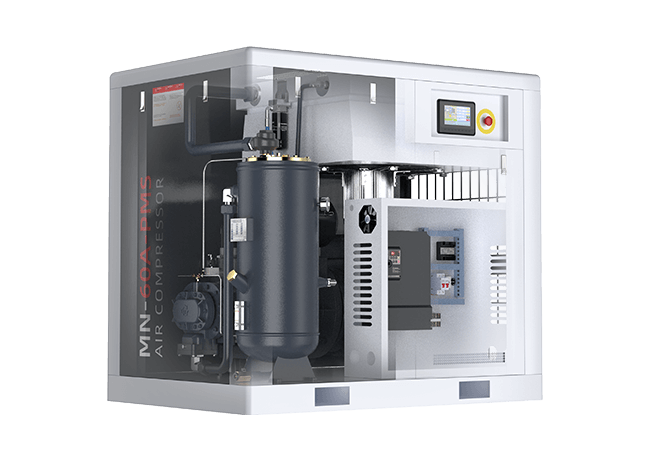
(2) Flow Rate Parameters: Ensuring Supply and Reserving Redundancy
Flow rate is the “production capacity foundation” of oxygen and nitrogen generators. The discharge flow rate of the air compressor shall cover the raw air demand of the oxygen and nitrogen generator, and a reasonable redundancy shall be reserved to cope with production load fluctuations and flow rate attenuation caused by equipment aging.
- Basic Calculation: The raw air demand of oxygen and nitrogen generators is directly related to the product gas output and separation efficiency. Taking PSA nitrogen generation equipment as an example, the nitrogen output is usually 10%~40% of the raw air volume (depending on purity requirements); for example, a PSA equipment with a nitrogen output of 50Nm³/h requires about 150~200Nm³/h of raw air, and the air compressor selection shall reach 200~250Nm³/h (reserving 20%~30% redundancy).
- Redundancy Standard: Under normal working conditions, the discharge flow rate of the air compressor shall be 15%~30% more than the maximum raw air demand of the oxygen and nitrogen generator; if the production load fluctuates greatly (e.g., intermittent air use), the redundancy shall be increased to 30%~50% to avoid shutdown or purity reduction of the oxygen and nitrogen generator due to insufficient flow rate.
- Unit Attention: The flow rate unit of air compressors is usually m³/min (cubic meters per minute) or Nm³/h (standard cubic meters per hour), which shall be consistent with the flow rate unit of the oxygen and nitrogen generator (standard state: 0°C, 0.101325MPa absolute pressure) to avoid calculation errors.
(3) Cleanliness Parameters: Eliminating Pollution and Protecting Core Components
The molecular sieves and membrane modules of oxygen and nitrogen generators have extremely high requirements for the cleanliness of compressed air. Oil, water, and solid impurities can cause molecular sieve poisoning and membrane module blockage, greatly shortening their service life and even directly affecting gas purity. Therefore, the cleanliness parameters of air compressors shall strictly follow the following requirements, complying with the allowable limit content standards for raw air in JB/T 6427—2015.
- Oil Content: A core control indicator. Oil-free air compressors (oil content ≤0.01ppm) are preferred, especially for industries with high gas purity requirements such as food, pharmaceutical, and electronics, as well as high-purity nitrogen (≥99.999%) production scenarios; if oil-lubricated air compressors are selected, efficient oil removal equipment (such as multi-stage oil removal filters) shall be matched to ensure that the oil content of the air entering the oxygen and nitrogen generator is ≤0.01ppm, otherwise, irreversible molecular sieve poisoning will occur and maintenance costs will increase.
- Water Content: Moisture in compressed air can cause molecular sieves to become damp and reduce their adsorption capacity. Drying equipment (refrigerated dryer or adsorption dryer) shall be matched to control the air dew point below -20°C (the lower the dew point, the less the water content); in high-humidity areas or high-purity oxygen and nitrogen generation scenarios, adsorption dryers shall be selected to ensure the dew point reaches below -40°C.
- Solid Impurities: Precision filters shall be matched to filter solid particles in the air to ≤0.1μm, avoiding impurities entering the oxygen and nitrogen generator, wearing internal components, and blocking pipelines.
(4) Energy Consumption Parameters: Reducing Long-term Operational Costs
In an entire oxygen and nitrogen generation system, air compressors often account for more than 70% of the energy consumption. Therefore, energy consumption parameters are an important consideration in selection, directly determining long-term operational costs.
- Priority to Inverter Air Compressors: Inverter models can automatically adjust the speed according to the actual air consumption of the oxygen and nitrogen generator, reducing no-load operation time. Their energy consumption is 15%~30% lower than that of fixed-frequency models, especially suitable for scenarios with large air consumption fluctuations (the advantage of inverters is particularly obvious when air consumption fluctuations exceed 30%).
- Focus on Specific Power: Specific power is the core indicator for measuring the energy consumption of air compressors (unit: kW/(m³/min)). The lower the specific power, the lower the energy consumption; when selecting, compare the specific power of models with the same pressure and flow rate, and prioritize products whose specific power meets the national first-level energy efficiency standard.
- Auxiliary Energy Conservation: Configure a reasonable air storage tank (volume ≥15% of the air compressor’s per-minute discharge flow rate), which can buffer air consumption fluctuations, reduce the frequency of frequent start-stop of the air compressor, and further improve system efficiency.
III. Air Compressor Model Selection and Scenario Adaptation
At present, the air compressors supporting oxygen and nitrogen generators mainly include four types: piston type, screw type (oil-lubricated/oil-free), scroll type, and centrifugal type. Different models have great differences in performance and applicable scenarios, and shall be reasonably selected according to the scale, working conditions, and purity requirements of the oxygen and nitrogen generator. The specific adaptation is as follows:
(1) Piston Air Compressors
- Core Characteristics: Simple structure, low price, wide pressure range (can reach high pressure), high single-stage compression ratio, suitable for small-flow and high-pressure working conditions; but high noise (usually ≥85dB), strong vibration, frequent maintenance (many wearing parts, such as piston rings and valves), unstable discharge flow rate, high oil content (needing matching efficient oil removal equipment), and short service life.
- Adaptable Scenarios: Small oxygen and nitrogen generators (gas production ≤10Nm³/h), intermittent air use scenarios (such as laboratories and small workshops), or low-end production scenarios sensitive to cost and with low gas purity requirements; can also be used for auxiliary air supply in high-pressure oxygen and nitrogen generation systems.
(2) Screw Air Compressors (Mainstream Selection)
Divided into oil-lubricated screw machines and oil-free screw machines, they are the mainstream models supporting oxygen and nitrogen generators currently, especially suitable for medium and large-scale production scenarios.
- Oil-lubricated Screw Machines: Core Characteristics: Stable discharge flow rate, smooth operation, low noise (75~85dB), long maintenance cycle (usually maintained once every 2000~4000 hours), high efficiency, suitable for medium and large factories; but high oil content, needing matching complete oil removal and drying equipment, and the initial investment cost is higher than that of piston type.
- Oil-free Screw Machines: Core Characteristics: Clean discharge (oil content ≤0.01ppm), no need for complex oil removal equipment, can directly meet high-purity oxygen and nitrogen generation needs, stable operation, and long service life; but high initial investment cost, requiring professional maintenance, suitable for scenarios with high gas purity requirements (such as food, pharmaceutical, electronics, and high-purity gas production).
- Adaptable Scenarios: Medium and large oxygen and nitrogen generators (gas production 10~1000Nm³/h), continuous air use scenarios (such as chemical industry, metallurgy, and new energy); oil-free screw machines are preferred for industries with high cleanliness requirements such as food, pharmaceutical, and electronics, and oil-lubricated screw machines are suitable for industrial scenarios with general purity requirements and pursuing cost performance.
(3) Scroll Air Compressors
- Core Characteristics: Compact structure, small volume, extremely low noise (≤70dB), smooth operation, oil-free design (some models), simple maintenance; but limited discharge flow rate (usually ≤5m³/min), narrow pressure range (0.7~1.0MPa), suitable for small-scale scenarios.
- Adaptable Scenarios: Small oxygen and nitrogen generators (gas production ≤5Nm³/h), laboratories, supporting precision instruments, or scenarios with high noise requirements (such as laboratories in office buildings and small medical oxygen generation equipment).
(4) Centrifugal Air Compressors
- Core Characteristics: Large discharge flow rate (usually ≥100m³/min), high operational efficiency, no mechanical friction, long service life, can achieve oil-free operation, suitable for clean gas needs; but extremely high initial investment cost, complex structure, high maintenance difficulty, prone to surge at small flow rates, requiring configuration of anti-surge system.
- Adaptable Scenarios: Large oxygen and nitrogen generators (gas production ≥1000Nm³/h), large chemical parks, steel plants and other large-scale continuous air use scenarios, complying with the specifications of large-scale equipment in JB/T 6427—2015.
IV. Practical Selection Steps (Proceed in Sequence to Avoid Omissions)
- Clarify the core parameters of the oxygen and nitrogen generator: First determine the rated gas production, rated working pressure, and gas purity requirements of the oxygen and nitrogen generator (such as nitrogen 99.9%, 99.999%, oxygen 93%, 99.5%), and confirm the production conditions (continuous air use/intermittent air use, air consumption load fluctuation range) at the same time, which is the basic basis for air compressor selection.
- Calculate the core parameters of the air compressor: According to the gas production of the oxygen and nitrogen generator, calculate the required raw air volume, then reserve 15%~30% flow redundancy to determine the discharge flow rate of the air compressor; according to the rated pressure of the oxygen and nitrogen generator, add 0.1~0.2MPa pipeline pressure loss to determine the discharge pressure of the air compressor; according to the gas purity requirements, determine the cleanliness level of the air compressor (oil content, dew point).
- Match the model: Combine the calculated parameters, production conditions, and budget to select a suitable air compressor model (such as piston/scroll type for small-scale intermittent air use, screw type for medium and large-scale continuous air use, centrifugal type for large-scale mass air use; oil-free models for high-purity requirements).
- Selection of supporting equipment: The air compressor needs to be matched with a dryer, precision filter, and air storage tank to form a complete air source treatment system—select the dryer according to the dew point requirements (refrigerated type for ordinary scenarios, adsorption type for high requirements), configure the filter in multiple stages according to “coarse filtration → fine filtration → oil removal filtration”, and the air storage tank is used to stabilize pressure and buffer flow rate.
- Compare manufacturers and after-sales service: Prioritize air compressor manufacturers with experience in supporting oxygen and nitrogen generators to ensure equipment compatibility; pay attention to the manufacturer’s after-sales guarantee (such as on-site installation, commissioning, regular maintenance, and supply of wearing parts) to avoid failure to handle equipment failures in a timely manner later, affecting production; at the same time, compare the energy efficiency level and specific power of products to balance energy conservation and reliability.
- On-site adaptation confirmation: After selection, combine the on-site installation space, power supply conditions, and ventilation environment (poor ventilation and high temperature in the machine room will cause the machine to shut down due to high temperature) to confirm the installation feasibility of the air compressor; in plateau areas, calculate the altitude correction coefficient of the air compressor to ensure that the equipment operates normally in the local environment.
V. Common Selection Misunderstandings and Avoidance Methods
- Misunderstanding 1: Only focus on price and ignore parameter matching. Some enterprises prioritize low-cost models, ignoring the adaptability of pressure, flow rate, and cleanliness, leading to problems such as insufficient air supply, substandard gas purity, and frequent equipment failures later, which instead increase maintenance costs. Avoidance Method: First clarify the parameter requirements, then compare the cost performance of models with the same parameters, and prioritize products with matching parameters, high energy efficiency, and perfect after-sales service.
- Misunderstanding 2: The air compressor is undersized and operates at full load for a long time. To save costs, some enterprises select air compressors with flow rate and pressure slightly lower than the demand, leading to long-term full-load operation of the equipment, which not only increases energy consumption but also shortens the service life of the air compressor and oxygen and nitrogen generator, and even causes shutdown failures. Avoidance Method: Strictly follow the calculated parameters, reserve sufficient redundancy, and avoid “insufficient capacity”.
- Misunderstanding 3: Ignore cleanliness and select oil-lubricated air compressors without matching oil removal equipment. If the oil from oil-lubricated air compressors enters the oxygen and nitrogen generator, it will cause molecular sieve poisoning and membrane module blockage, directly affecting equipment service life and gas purity, with extremely high later maintenance costs. Avoidance Method: Prioritize oil-free air compressors for high-purity scenarios; if oil-lubricated air compressors are selected, efficient oil removal equipment must be matched to ensure that the oil content meets the standard.
- Misunderstanding 4: Blindly select inverter models. Although inverter air compressors are energy-saving, their initial investment cost is high. If the air consumption load is stable (fluctuation ≤10%), fixed-frequency models are more cost-effective. Avoidance Method: Select according to the fluctuation of air consumption load; prioritize inverter models for large fluctuations, and fixed-frequency models for small fluctuations.
- Misunderstanding 5: Emphasize the main unit and neglect post-treatment. Ignoring the matching of dryers, filters, and air storage tanks leads to compressed air containing water, oil, and impurities, polluting the core components of the oxygen and nitrogen generator. Avoidance Method: Match complete post-treatment equipment synchronously during selection to ensure that the quality of compressed air meets the requirements.
VI. Selection Precautions and Post-maintenance Suggestions
(1) Selection Precautions
- Compatibility: The interface size and pressure adjustment range of the air compressor shall be compatible with the oxygen and nitrogen generator and supporting equipment (dryer, filter) to avoid problems such as poor connection and mismatched pressure.
- Environmental Adaptability: Select a suitable air compressor according to the on-site environment (temperature, humidity, altitude). For example, select a high-temperature resistant model for high-temperature environments, strengthen the configuration of drying equipment for high-humidity environments, and select a plateau-specific model for plateau areas.
- Compliance: The selection shall comply with JB/T 6427—2015 “Pressure Swing Adsorption Oxygen and Nitrogen Generation Equipment” and relevant industry standards to ensure that the raw air quality and equipment performance meet the standards, especially for the food and pharmaceutical industries, which shall comply with relevant certification requirements such as GMP and ISO 8573-1 CLASS 0.
- Backup Plan: For continuous production scenarios (such as chemical industry and metallurgy), it is recommended to configure 1 backup air compressor to avoid shutdown of the oxygen and nitrogen generator due to air compressor failure and reduce production losses.
(2) Post-maintenance Suggestions
- Regular Maintenance: According to the requirements of the air compressor manufacturer, regularly replace lubricating oil and filter elements (air filter element, oil filter element, oil removal filter element), check wearing parts such as belts and bearings to ensure normal operation of the equipment; for oil-free air compressors, focus on checking seals to avoid air leakage and pollution problems.
- Daily Monitoring: Regularly monitor the discharge pressure, flow rate, oil content, dew point and other parameters of the air compressor, and handle abnormalities in a timely manner to avoid affecting the operation of the oxygen and nitrogen generator; strengthen the discharge of condensed water in winter to prevent pipeline freezing.
- Maintenance of Supporting Equipment: Synchronously maintain the dryer, filter, and air storage tank, regularly clean the filter element of the filter and discharge the condensed water of the air storage tank to ensure the normal operation of the post-treatment system and the quality of compressed air.
- Professional Operation and Maintenance: It is recommended to entrust qualified professional personnel for regular maintenance, and use the historical data query function of the intelligent control system to predict equipment failure risks and reduce downtime.
VII. Summary
The core of selecting air compressors supporting oxygen and nitrogen generators is to achieve “parameter matching, scenario adaptation, energy conservation and efficiency, and stability and reliability”. It is necessary to focus on the core needs of the oxygen and nitrogen generator, first clarify key parameters such as pressure, flow rate, and cleanliness, then select suitable models and supporting equipment according to production conditions, avoid common selection misunderstandings, and attach importance to post-maintenance. Reasonable selection can not only ensure the efficiency and gas purity of oxygen and nitrogen production but also reduce long-term operational costs and extend the service life of the entire system. It is recommended that enterprises, when selecting, first consult air compressor manufacturers with experience in supporting oxygen and nitrogen generators, and formulate customized selection plans combined with on-site actual conditions to ensure the balance between equipment adaptability and economy.
 Email
Email sales:+86 15366749631