I. Introduction
Electricity is consumed the instant it’s generated. When the sun sets and solar production drops, or when demand spikes unexpectedly, grid operators must have power ready to fill the gap. Traditionally, that meant firing up natural gas peaker plants—expensive and emissions-heavy.
But what if excess electricity could be stored as compressed air, then released later to generate power?
That’s the promise of Compressed Air Energy Storage (CAES) . Large compressors pump air into underground caverns or pressure vessels when electricity is cheap or abundant. When power is needed, the compressed air is released, heated, and expanded through turbines to generate electricity.
While utility-scale CAES has been around for decades, new technologies are making smaller, more flexible systems possible—opening applications for industrial facilities, renewable energy integration, and even behind-the-meter storage.
This guide explains how CAES works, where it’s being used, and what it could mean for industrial energy management.
II. What Is Compressed Air Energy Storage?
CAES is a form of mechanical energy storage that uses compressed air as the storage medium.
The basic principle
Excess electricity drives a motor-compressor that draws in air and compresses it to high pressure. The compressed air is stored—typically in underground caverns or above-ground pressure vessels. When electricity is needed, the stored air is released, heated, and expanded through a turbine to generate power.
Why compress air?
Energy storage technologies have different strengths:
| Technology | Typical Scale | Duration | Round-trip Efficiency |
| Lithium-ion battery | 1 MW – 100 MW | 1-4 hours | 85-95% |
| Pumped hydro | 100 MW – 2,000 MW | 6-12 hours | 70-85% |
| CAES | 10 MW – 300 MW | 4-24 hours | 40-70% |
| Hydrogen storage | 1 MW – 1,000 MW | 24-100+ hours | 30-50% |
CAES falls between batteries (fast response, shorter duration) and hydrogen (long duration, lower efficiency). Its niche is medium-duration storage where batteries would be too expensive and hydrogen would be too inefficient.
The efficiency challenge
CAES is not as efficient as batteries. Energy is lost as heat during compression and as cooling during expansion. But CAES has advantages: it can be built at large scale, use existing geological formations for storage, and have very long asset life (30-50 years).
III. How CAES Works
Modern CAES systems have several configurations.
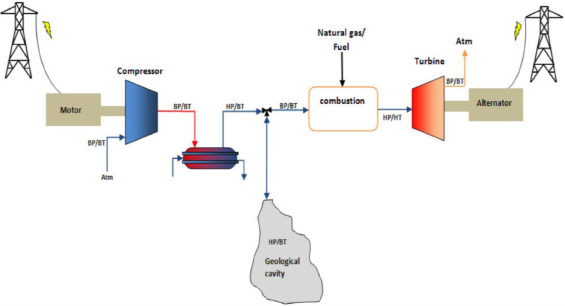
Conventional CAES (diabatic)
The original technology uses a natural gas burner to heat the compressed air before expansion.
Process:
- Compressor uses off-peak electricity to compress air into storage
- Heat from compression is dissipated to atmosphere (lost)
- During discharge, compressed air is released, mixed with natural gas, and combusted
- Hot gas expands through a turbine, generating electricity
The natural gas input improves efficiency but means the system still produces emissions. The first commercial CAES plant (Huntorf, Germany, 1978) uses this design.
Advanced CAES (adiabatic)
Adiabatic CAES captures and stores the heat of compression, then uses it to reheat the air during discharge—eliminating the need for natural gas.
Process:
- Compressor uses off-peak electricity to compress air
- Heat is extracted and stored in a thermal storage medium (ceramic, molten salt, etc.)
- Cooled compressed air enters storage
- During discharge, compressed air is reheated using stored thermal energy
- Hot gas expands through a turbine, generating electricity
No natural gas means zero emissions during operation. Efficiency is higher than conventional CAES. Several demonstration plants are operating.
Isothermal CAES
The holy grail: compress and expand air at constant temperature, eliminating thermal losses entirely. Specialized systems use liquid pistons, foam, or other mechanisms to achieve near-isothermal operation.
Several companies are developing isothermal CAES for smaller-scale applications (1-10 MW). Commercial deployment is limited but growing.
Storage types
Storage can be:
- Salt caverns: Created by solution mining, excellent sealing properties, low cost per unit of storage
- Aquifers: Porous rock formations, lower cost but harder to seal reliably
- Hard rock mines: Repurposed mines, requires lining for sealing
- Above-ground vessels: Steel pressure vessels or pipelines, higher cost but flexible location
IV. Utility-Scale CAES Applications
The largest CAES projects serve grid-scale energy storage.
Huntorf, Germany
The first commercial CAES plant (1978) uses two salt caverns with total volume of 310,000 m³. Capacity: 290 MW for up to 4 hours. Efficiency: 42%. Still operating after 45+ years.
McIntosh, Alabama
Built in 1991, this plant stores air in a salt cavern 1,500 feet underground. Capacity: 110 MW for 26 hours. Efficiency: 54% (improved by recovering heat from the turbine exhaust). Plant continues to operate for grid balancing.
Under construction / planned
Several large CAES projects are under development:
- Norton, Ohio: 2,700 MW storage in limestone mine
- Texas and California: Multiple projects in the 100-500 MW range
- Europe: Several adiabatic CAES demonstration plants
These projects are driven by renewable energy growth and the need for longer-duration storage than batteries can economically provide.
V. Industrial CAES Applications
Beyond utility-scale, CAES has potential for industrial facilities.
Behind-the-meter storage
Manufacturing facilities can install small-scale CAES to:
- Shift energy use from peak to off-peak periods (reducing demand charges)
- Provide backup power during grid outages
- Capture excess renewable generation from on-site solar or wind
A facility with large, intermittent loads (forging presses, large compressors, etc.) might benefit from CAES to flatten demand.
Compressed air system optimization
Industrial facilities already use compressed air for production. What if the existing compressed air system could serve dual purpose—providing both production air and energy storage?
A hybrid approach uses excess off-peak capacity to fill the air receiver tanks to higher pressure than needed for production. During peak periods, the system draws from storage, reducing compressor load and cutting demand charges. Some facilities report 15-25% reduction in electricity costs from this “virtual storage” approach.
Remote and island applications
In remote locations with high diesel costs, CAES can integrate with renewable energy to reduce fuel consumption. Solar or wind power runs the compressor during the day; stored air powers a generator at night.
Hybrid systems with renewables
Wind and solar are intermittent. CAES can capture excess generation when production exceeds demand, then deliver power when the wind stops blowing or the sun sets. Several wind-CAES hybrids are under development.
VI. Advantages and Limitations
CAES has clear strengths and weaknesses.
Advantages
- Long duration: Can store energy for hours or days, not just minutes
- Large scale: Single plants can provide hundreds of megawatts
- Long life: 30-50 years vs. 10-15 years for batteries
- Low operating cost: No expensive materials to replace periodically
- Geological storage: Low cost per kWh when suitable caverns exist
- Domestic technology: Components (compressors, turbines) are mature and manufactured globally
Limitations
- Lower efficiency: 40-70% vs. 85-95% for batteries
- Geology-dependent: Best sites require salt caverns or aquifers
- High capital cost: Above-ground vessels are expensive
- Long lead time: Projects can take 5-10 years to develop
- Gas use (conventional CAES): Still requires natural gas
- Limited commercial experience: Fewer than 10 plants operating worldwide
The sweet spot
CAES makes most sense when:
- Storage duration is 4+ hours (batteries become expensive)
- Scale is 50+ MW (above-ground storage less cost-effective at smaller scales)
- Suitable geology exists (salt caverns, hard rock mines)
- Natural gas is not desired (adiabatic CAES)
- Long asset life matters (30+ years)
VII. The Future of CAES
Several trends are accelerating CAES development.
Renewable integration
As wind and solar penetration grows, grids need longer-duration storage. Batteries are cost-effective for 1-4 hours. For 6-12 hours, CAES and pumped hydro are the primary options.
Retiring fossil plants
Coal and gas plants retiring can be repurposed as CAES sites. The turbines, generators, and grid connections are already there. Several projects are exploring this repurposing model.
Advanced CAES technologies
New approaches aim to overcome traditional CAES limitations:
- Small-scale CAES: Using pipelines or vessels for storage, targeting 1-20 MW applications
- Liquid air energy storage (LAES): Air is liquefied for storage, then expanded to generate power
- Supercritical CAES: Air is stored at pressures and temperatures above the critical point
Declining costs
Compressors, turbines, and thermal storage systems are becoming less expensive. CAES costs have fallen significantly over the past decade.
Policy support
Governments are recognizing the need for long-duration storage. The US Department of Energy has funded multiple CAES demonstration projects. The EU includes CAES in energy storage mandates.
FAQ
Q1: Is CAES the same as a regular compressed air system?
A1: No. Industrial compressed air systems typically operate at 100-150 PSI. CAES systems operate at 600-1,500 PSI or higher. The compressors, storage vessels, and turbines are all much larger and specialized for energy storage.
Q2: How efficient is CAES compared to batteries?
A2: Lithium-ion batteries achieve 85-95% round-trip efficiency. Conventional CAES achieves 40-55%. Adiabatic CAES (with heat storage) achieves 60-70%. The lower efficiency is the main trade-off for longer-duration, lower-cost storage.
Q3: Can I install CAES at my factory?
A3: Unlikely for now. Utility-scale CAES requires geological storage or large above-ground pressure vessels. Small-scale CAES systems are emerging but not yet commercially mature. However, optimizing your existing compressed air system for peak shaving (using storage to reduce demand charges) is a proven practice.
Q4: Does CAES emit pollution?
A4: Conventional CAES (like Huntorf and McIntosh) uses natural gas to heat the air before expansion, producing CO₂ emissions. Advanced adiabatic CAES captures and reuses compression heat, eliminating natural gas and producing zero emissions during operation.
Q5: How much does CAES cost?
A5: Capital costs for utility-scale CAES range from $500 to $1,500 per kW of power capacity, plus storage costs. For comparison, lithium-ion batteries are $300-600 per kWh (different metric). The right comparison depends on power vs. energy requirements.
Q6: How long do CAES plants last?
A6: The Huntorf plant in Germany has operated since 1978—over 45 years. McIntosh in Alabama has operated since 1991. Compressors, turbines, and caverns can last 30-50 years with proper maintenance, much longer than batteries.
Q7: Why aren’t there more CAES plants?
A7: Several reasons: natural gas peaker plants have been cheaper; batteries have improved rapidly; CAES has high upfront costs and long development timelines; and suitable geology isn’t available everywhere. However, with renewable growth and the need for long-duration storage, interest in CAES is increasing.
Conclusion
Compressed air energy storage is not new—the first plant opened in 1978. But the case for CAES is stronger than ever. As renewable energy penetration grows, grids need storage that can provide power for 6, 12, or 24 hours. Batteries are cost-effective for short durations. Pumped hydro is limited by geography. CAES sits in the middle, offering long-duration, large-scale storage at competitive cost.
For industrial facilities, the direct application of CAES is still emerging. But the principles—using compressed air to store energy and shift demand—are already relevant. Optimizing your compressed air system with storage and controls can reduce demand charges and save energy.
At MINNUO, we help industrial facilities use compressed air more efficiently. While utility-scale CAES is beyond our scope, we work with customers to optimize their existing systems—using storage, controls, and smart operation to reduce energy costs. Because we know that in the future of energy, every kilowatt-hour saved or shifted matters.
 Email
Email sales:+86 15366749631