Introduction: The Revolutionary Transformation from Waste to Clean Energy
Amid the global energy transition and sustainable development wave, biogas is increasingly recognized as a renewable clean energy source. As a key equipment for biogas collection, purification, storage, and utilization, biogas compressors undertake the important mission of transforming low-grade biogas into high-value energy. From waste treatment in agricultural farms to resource utilization of municipal solid waste, and energy recovery from industrial organic wastewater, biogas compressors are becoming a critical technological bridge connecting environmental protection and energy, economic benefits and social benefits.
I. Special Challenges and Technical Solutions for Biogas Treatment
1.1 Complexity of Gas Composition
Biogas primarily consists of methane (CH₄, 50-70%) and carbon dioxide (CO₂, 30-50%), while also containing impurities such as hydrogen sulfide (H₂S), moisture, and siloxanes. This complex composition places special demands on compressors:
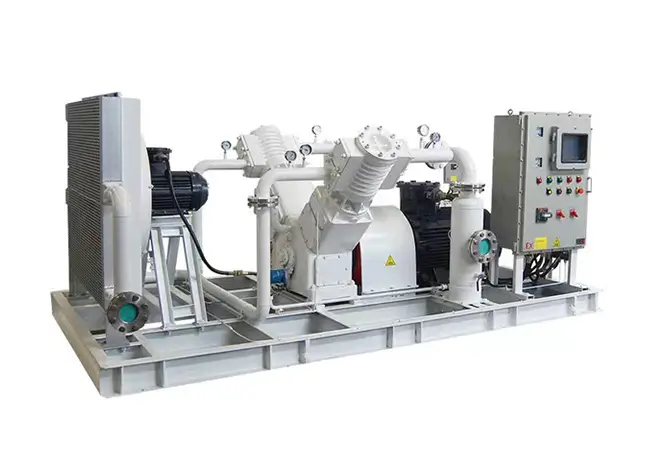
Corrosion-Resistant Design: Critical components require 316L stainless steel or special alloy materials to address the strong corrosiveness of H₂S.
Explosion-Proof Safety: Methane is a flammable and explosive gas; equipment must comply with ATEX explosion-proof standards.
Humidity Adaptation: Biogas typically has high moisture content, necessitating efficient dehumidification and drainage systems.
1.2 Pressure Fluctuation Management
Biogas production is influenced by factors such as raw material changes and temperature fluctuations, resulting in significant variations in gas output and pressure. Modern biogas compressors employ:
Variable Frequency Drive Technology: Automatically adjusts speed based on intake pressure to maintain stable output.
Buffer Systems: Configured with sufficiently sized buffer tanks to smooth pressure fluctuations.
Intelligent Control: Achieves precise pressure control through PID algorithms.
1.3 Impurity Treatment Technology
Impurities in biogas not only affect compression efficiency but may also damage equipment. Advanced biogas compressors are equipped with:
Multi-Stage Filtration Systems: Including particulate filtration, activated carbon adsorption, and siloxane removal.
Online Monitoring: Real-time monitoring of gas composition with automatic adjustment of treatment parameters.
Automatic Cleaning: Regular backwashing of filtration systems to maintain treatment efficiency.
II. Core Technical Advantages
2.1 Efficient Compression Technology
Biogas compressors feature specially optimized designs for the unique properties of biogas:
Multi-Stage Compression: Employs 3-4 compression stages, each with efficient coolers to control discharge temperature.
Isothermal Compression Optimization: Enhanced cooling approaches isothermal compression, improving efficiency.
Leakage Control: Special seal designs control methane leakage rates below 0.1%.
2.2 Energy Efficiency Enhancement
Biogas compression is energy-intensive, making energy-saving design crucial:
Heat Recovery: Recovers compression heat for heating biogas production systems, improving overall energy efficiency.
Variable Frequency Drives: Adjusts power based on actual demand to avoid energy waste.
System Optimization: Optimizes pipeline layout and valve design to reduce pressure losses.
2.3 Intelligent Management
Modern biogas compressors feature advanced intelligence:
Remote Monitoring: IoT technology enables remote operational status monitoring.
Predictive Maintenance: Analyzes operational data to predict equipment maintenance needs.
Automatic Adjustment: Automatically optimizes operational parameters based on biogas output and quality.
III. Application Scenario Analysis
3.1 Agricultural Biogas Projects
Biogas compressors play a key role in large-scale farms and biogas projects:
Centralized Collection: Compresses and stores dispersed biogas output centrally.
Purification Processing: Produces vehicle fuel (Bio-CNG) through compression and subsequent treatment.
Grid-Connected Power Generation: Provides stable pressure fuel for biogas generators.
3.2 Municipal Waste Treatment
Biogas recovery and utilization in landfills and wastewater treatment plants:
Landfill Gas Utilization: Collects and compresses biogas from landfills for power generation or heating.
Sludge Biogas: Treats biogas from sewage treatment plant sludge for energy self-sufficiency.
Distributed Energy: Provides clean energy to surrounding areas.
3.3 Industrial Organic Wastewater
Organic wastewater treatment in industries such as food processing, brewing, and papermaking:
Wastewater Energy Conversion: Transforms biogas from wastewater treatment into usable energy.
Process Integration: Integrates closely with production processes to achieve energy recycling.
Carbon Reduction: Significantly reduces carbon emissions from industrial processes.
IV. Safety and Reliability Design
4.1 Explosion-Proof Safety Systems
Biogas compressors must meet the highest safety standards:
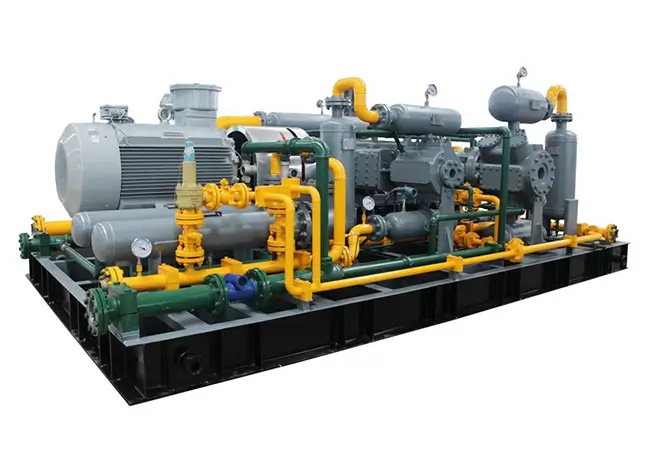
Intrinsic Safety Design: All electrical equipment complies with explosion-proof requirements.
Leakage Monitoring: Multi-point methane concentration monitoring with alarm triggers for exceedances.
Emergency Shutdown: Multiple safety interlocks ensure safe shutdown under abnormal conditions.
4.2 Corrosion Protection
Multiple protections address the corrosive components of biogas:
Material Selection: Gas-contact components use corrosion-resistant materials.
Surface Treatment: Special coatings and surface treatment technologies.
Regular Inspection: Establishes regular inspection and maintenance protocols.
4.3 Operational Monitoring
Comprehensive monitoring systems ensure safe operation:
Parameter Monitoring: Real-time monitoring of key parameters such as pressure, temperature, and vibration.
Fault Diagnostics: Intelligent fault diagnosis systems provide early warnings for potential issues.
Data Recording: Complete recording of operational data supports safety analysis.
V. Economic Benefit Analysis
5.1 Return on Investment
Biogas compressor investments can be recovered within a reasonable timeframe:
Energy Revenue: Direct economic benefits from biogas utilization.
Environmental Benefits: Environmental gains from carbon reduction and potential carbon trading income.
Policy Support: Government subsidies and preferential policies for renewable energy projects.
5.2 Operational Costs
Scientific operational management can significantly reduce costs:
Energy Optimization: Reduces compression energy consumption through technological innovation.
Maintenance Costs: Reliable design and preventive maintenance minimize repair expenses.
Labor Costs: High automation reduces manual labor requirements.
5.3 Full Lifecycle Assessment
Economic evaluation from a full lifecycle perspective:
Equipment Lifespan: High-quality equipment can achieve over 15 years of service life.
Upgrade Potential: Modular design supports future technological upgrades.
Residual Value Consideration: Equipment recovery value after decommissioning.
VI. Technological Innovation Trends
6.1 Advances in Material Science
New material applications will further enhance performance:
Composite Materials: Lighter, stronger compression machine components.
Smart Materials: Advanced materials with self-healing capabilities.
Eco-Friendly Materials: Materials that are easier to recycle and process.
6.2 Intelligent Development
Digital technologies will deeply integrate into biogas compression systems:
Digital Twins: Virtual models optimize operations.
Artificial Intelligence: Machine learning optimizes control strategies.
Blockchain: Enables traceable certification of carbon reduction credits.
6.3 System Integration
Biogas compressors will integrate more deeply into energy systems:
Multi-Energy Integration: Coordination with solar, wind, and other renewable energy sources.
Smart Grids: Participation in grid regulation as distributed energy resources.
Hydrogen Integration: Combines with hydrogen technology to develop new energy systems.
VII. Industry Standards and Certification
7.1 International Standards
Biogas compressors must comply with multiple international standards:
Safety Standards: Explosion-proof certifications such as ATEX and IECEx.
Performance Standards: Compressor performance standards like ISO 13631.
Environmental Standards: Relevant emission and energy efficiency standards.
7.2 Industry Certifications
Professional certifications enhance equipment credibility:
Quality Systems: ISO 9001 quality management system certification.
Environmental Certification: ISO 14001 environmental management system certification.
Industry Certifications: Relevant certifications for specific industries.
7.3 Testing and Verification
Rigorous testing ensures equipment performance:
Factory Testing: Comprehensive performance testing before leaving the factory.
Field Verification: Performance verification in actual operating environments.
Third-Party Certification: Testing and certification by independent third-party organizations.
VIII. Future Outlook
8.1 Technological Development Directions
Future biogas compressors will develop in the following directions:
Higher Efficiency: Continuously improves energy efficiency through technological innovation.
Stronger Adaptability: Adapts to more types of biogas feedstocks.
More Intelligent Control: Achieves fully automated intelligent operation.
8.2 Market Prospects
With increasing global emphasis on renewable energy:
Market Size: Expected to maintain steady growth.
Application Expansion: Expands from traditional fields to more industries.
International Cooperation: Technological exchange and cooperation will become closer.
8.3 Policy Support
Government policies will continue to drive industry development:
Subsidy Policies: Financial support for biogas utilization projects.
Carbon Trading: Economic incentives from carbon emission trading mechanisms.
Standard Improvement: Continuous improvement of related standard systems.
Conclusion: A Key Technology Driving Sustainable Development
As key equipment connecting waste treatment and clean energy utilization, biogas compressors play an irreplaceable role in promoting circular economy development and energy transition. With continuous technological advancement and increasingly widespread applications, biogas compressors will make greater contributions to global sustainable development.
Choosing efficient and reliable biogas compressors is not only an investment in equipment but also a commitment to environmental protection and sustainable development. Let us work together to advance biogas utilization technology and jointly build a cleaner, more sustainable energy future.
 Email
Email sales:+86 15366749631