You’ve seen the electricity bill. The line item for your plant’s power consumption is daunting, and you know your air compressor is a major contributor—often 20% to 40% of your total industrial electrical use. But when you look at the machine, it seems to be running normally. So, you’re left with the frustrating, costly question: “Why is it using so much power, and what can I actually do about it?”
High energy consumption is rarely due to a single, obvious failure. Instead, it’s usually the result of multiple, hidden inefficiencies that compound over time. These “energy thieves” silently add percentage points to your load, often going unnoticed until you conduct a focused audit.
This guide uncovers the seven most common—and frequently overlooked—causes of excessive compressor electricity use. For each, we provide a clear diagnostic method and a direct fix, empowering you to transform your compressed air system from a cost center into a model of efficiency.
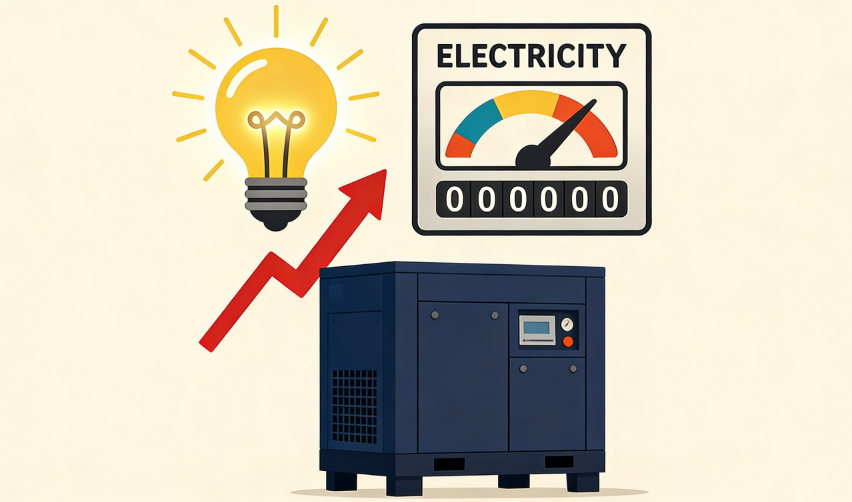
The 7 Hidden Energy Thieves (and How to Stop Them)
Energy Thief #1: Unquantified & Unaddressed Air Leaks
- The Problem: A small, constant hiss might not seem like much, but leaks are the single largest source of wasted energy in most systems. A plant-wide leak rate of 20-30% is common, meaning you’re paying to compress air that never performs any work.
- Diagnosis: Conduct a “shutdown leak test.” With all production stopped, run your compressor to fill the system to pressure, then shut it off. Time how long it takes for the pressure to drop by a set amount (e.g., 10 psi). A rapid drop indicates significant leakage.
- The Fix: Implement a formal ultrasonic leak detection and repair program. Scan your entire distribution network quarterly and prioritize fixing the largest leaks first. This alone can save 5-20% of your compressor’s energy.
Energy Thief #2: Inefficient Operating Pressure
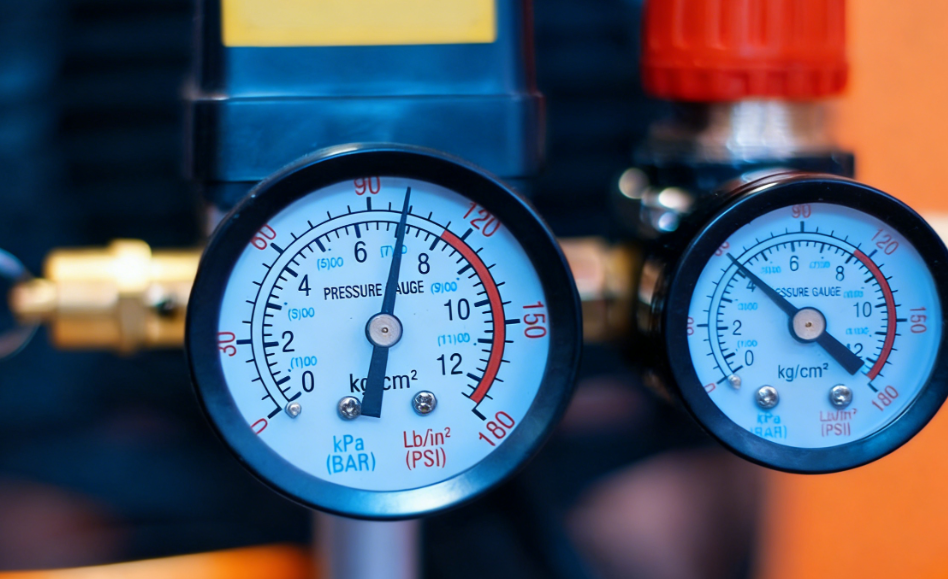
- The Problem: For every 1 bar (14.5 psi) you increase your system’s operating pressure, your compressor’s energy consumption rises by approximately 7%. Many plants run at a uniformly high pressure to satisfy one or two high-demand tools, forcing all other uses to waste energy.
- Diagnosis: Check your central system pressure setting. Then, identify the minimum required pressure for your most sensitive piece of equipment. The gap between these two numbers is pure waste.
- The Fix: Implement pressure band optimization. Lower the overall system pressure to the minimum safe level. For tools requiring higher pressure, install a small, local booster compressor. This strategy can yield dramatic savings.
Energy Thief #3: Wrong Control Strategy for the Demand
- The Problem: A fixed-speed compressor operating under partial load is inherently inefficient. In load/unload mode, it unloads but continues to spin, consuming 20-40% of full-load power while producing zero air. This “unloaded running” is a massive energy sink.
- Diagnosis: Monitor your compressor’s load profile. Does it spend long periods loaded below 70% or frequently cycling between load and unload?
- The Fix: For highly variable demand, replace or supplement with a Variable Speed Drive (VSD) compressor. A VSD unit precisely matches motor speed to air demand, eliminating unloaded running and saving 15-35% in typical applications. For multiple compressors, install a central sequencing controller.
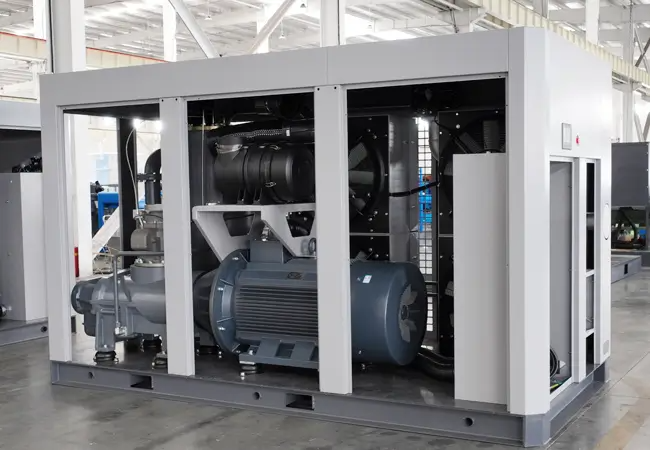
Energy Thief #4: Poor Inlet Conditions
- The Problem: Your compressor breathes air. Restricting its intake or feeding it hot air makes it work harder. A clogged inlet filter can increase energy use by 2%, and every 5°C (9°F) rise in inlet air temperature reduces efficiency by about 1%.
- Diagnosis: Inspect the inlet filter visually and check the differential pressure gauge if equipped. Measure the temperature of the air near the compressor intake.
- The Fix: Change inlet filters regularly based on pressure drop, not a calendar. Relocate the intake to a source of cooler, clean air, away from heat sources like ovens or radiators.
Energy Thief #5: Neglected Heat Exchangers
- The Problem: Air and oil coolers fouled with dust, dirt, or scale cannot reject heat effectively. This causes the compressor to run hotter, leading to higher discharge temperatures, increased oil degradation, and reduced volumetric efficiency—all of which force the motor to draw more current.
- Diagnosis: Check the temperature differential (ΔT) between the cooled medium (air or water) and the oil or air discharge. A smaller-than-design ΔT indicates poor heat transfer.
- The Fix: Establish a strict cleaning schedule for all heat exchangers. For air-cooled units, clean fins regularly. For water-cooled units, implement proper water treatment to prevent scaling.
Energy Thief #6: Inappropriate Uses of Compressed Air
- The Problem: Using expensive, refined compressed air for applications like open blowing, cooling, or agitation is like fueling your car with rocket fuel. The energy cost is 8-10 times higher than using a dedicated fan or blower.
- Diagnosis: Walk your plant floor. Look for open tubes, nozzles, or “homemade” devices used for cleaning parts, cooling operators, or moving lightweight materials.
- The Fix: Launch an “air awareness” campaign. Educate staff on the high cost of compressed air. Replace open blowing with engineered nozzles (which can cut flow by 30-50%) or, better yet, install low-pressure blowers for cleaning and cooling tasks.
Energy Thief #7: Lack of System Data and Accountability
- The Problem: “You can’t manage what you don’t measure.” Without monitoring key parameters, inefficiencies persist because they remain invisible. There is no accountability for energy waste.
- Diagnosis: Ask: Do you know your system’s specific power (kW/CFM)? Do you track pressure, flow, and energy use over time? Is anyone responsible for compressed air efficiency?
- The Fix: Install permanent monitoring. At a minimum, use a power meter on the compressor and a flow meter on your main header. Log this data to establish a baseline and track the impact of improvements. Assign energy performance as a Key Performance Indicator (KPI).
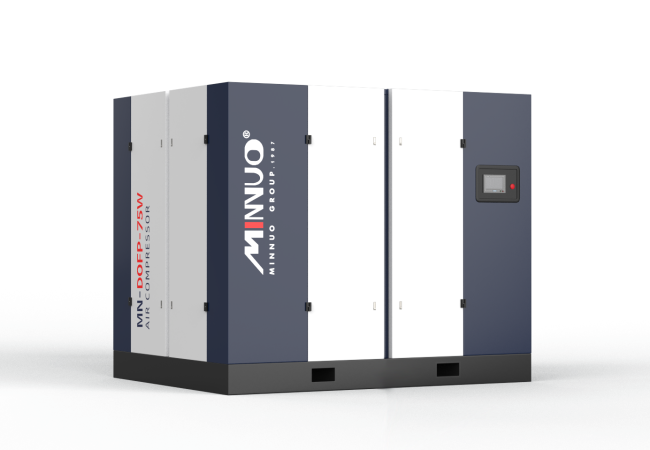
Your Action Plan: From Diagnosis to Savings
Don’t be overwhelmed. Start with the low-hanging fruit:
- This Week: Conduct the shutdown leak test and walk the floor to find inappropriate uses.
- This Month: Check and clean inlet filters and heat exchangers. Review your system pressure with production staff.
- This Quarter: Analyze your compressor’s load profile to evaluate if a control strategy change (like adding a VSD) is justified. Begin budgeting for a flow meter and power meter.
The savings from these actions are cumulative. Addressing just three or four of these thieves can easily reduce your compressed air energy costs by 20% to 30% or more.
Conclusion: High Energy Use is a Solvable Problem
Your air compressor’s electricity consumption is not a fixed, unavoidable cost. It is a direct reflection of your system’s health and design. By systematically hunting down these seven hidden energy thieves, you shift from being a passive bill-payer to an active cost-manager.
The investment in time and resources to uncover and fix these issues has one of the fastest paybacks in industrial maintenance. The money you save drops straight to your bottom line, year after year.
To accurately identify your largest opportunities and quantify the potential savings, begin with a Compressed Air System Energy Audit. At MINNUO, our audit uses data loggers to capture your system’s true flow and pressure profile, pinpoints major leaks and inefficiencies, and provides a detailed report with a prioritized, cost-justified action plan to significantly reduce your operating costs.

 Email
Email sales:+86 15366749631