You invested in a Variable Speed Drive (VSD) air compressor for one primary reason: to save energy by perfectly matching air output to demand. But instead of a smooth, efficient hum, you’re met with the constant, jarring cycle of it loading and unloading. This on-off roar isn’t just annoying—it’s a glaring sign that your energy-saving investment is being squandered. Industry data shows that frequent loading/unloading can increase energy consumption by 15-25%, erasing the VSD’s core value.
If your VSD is behaving like an old-fashioned fixed-speed machine, it means you’re not getting the savings you paid for. The good news is that this problem is almost always solvable. This guide will walk you through the five most common reasons for this wasteful behavior and provide a clear action plan to get your compressor running as smoothly and efficiently as it was designed to.
The Golden Rule: How a VSD Should Work
First, let’s clarify the ideal operation. A properly functioning VSD compressor avoids the load/unload cycle entirely. Instead, it follows a smooth process:
- Senses a drop in system pressure;
- Gradually increases its motor speed to produce more air;
- Meets the new demand and stabilizes at a higher speed;
- Senses a decrease in demand;
- Gradually slows its motor speed to a minimum (typically 25-40% of its full speed), avoiding a shutdown.
The load/unload cycle should be a rare event, reserved for when air demand drops so low that the compressor hits its minimum speed and must temporarily unload to prevent overheating. If it’s happening frequently, you have a problem.
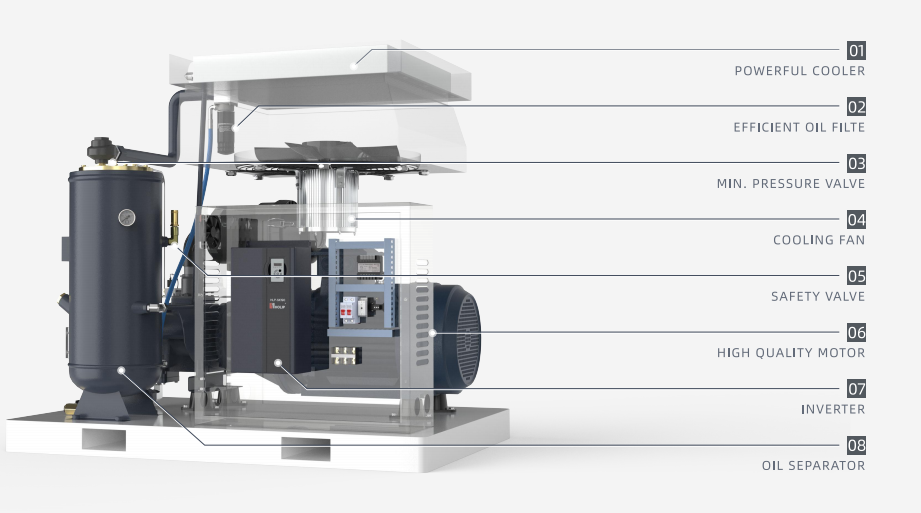
The 5 Culprits: Why Your VSD is Stuck in a Cycle
Here are the five most common causes, ranked from the simplest to the most complex.
Culprit #1: An Improperly Set (or Too Narrow) Pressure Band
- The Problem: The pressure band is the range between the minimum (cut-in) and maximum (cut-out) pressure. If this band is set too narrow (e.g., only 10 psi or less), the compressor doesn’t have enough “room” to modulate its speed. A tiny drop in pressure forces it to ramp up to full speed almost immediately, and a tiny increase causes it to unload.
- The Fix: Widen the pressure band. A band of 20-30 psi is often a good starting point, giving the VSD the flexibility it needs to do its job. Always consult your manufacturer’s guidelines.
Culprit #2: Your System Has Significant Air Leaks
- The Problem: Air leaks act as a constant, artificial demand on your system. They can be so large that even when all production equipment is off, the demand is still higher than the compressor’s minimum output. This forces the compressor to load until it hits the upper pressure limit, then unload as the pressure skyrockets, only to repeat the cycle.
- The Fix: Implement a regular, ultrasonic leak detection and repair program. A leak-free system is the foundation of efficient VSD operation. It’s estimated that a single 1/8-inch leak can cost over $2,500 annually in wasted energy.
Culprit #3: The VSD’s Minimum Speed is Set Too High
- The Problem: Every VSD has a minimum speed limit to ensure adequate lubrication and cooling. If this minimum is set higher than what’s needed to balance your system’s baseline demand (from leaks and constant users), the compressor will produce too much air and be forced to unload.
- The Fix: Consult your compressor manual or a technician to safely lower the minimum speed setting as much as the compressor’s design allows, creating a wider effective operating range. Never set it below the manufacturer’s specified absolute minimum.
Culprit #4: A Mismatch Between Compressor Size and Air Demand
- The Problem: Your VSD compressor might simply be too large for your actual air needs. If your regular demand is below the compressor’s minimum output at its lowest speed, it has no choice but to load and unload. This is a common issue in facilities that oversized their compressor “for future growth.”
- The Fix: Analyze your air demand profile. The solution may involve adding a smaller VSD or a fixed-speed compressor to handle the base load, allowing the large VSD to shut down during low-demand periods.
Culprit #5: A Faulty Sensor or Controller Issue
- The Problem: Sometimes, the issue is electronic. A faulty pressure transducer or a software glitch in the controller can send incorrect signals, making the compressor think the pressure is constantly swinging, triggering the load/unload cycle unnecessarily.
- The Fix: This requires a qualified technician to diagnose using the compressor’s data logs and to test or replace the sensors and update the controller firmware.
Your Step-by-Step Diagnostic and Action Plan
Don’t guess. Follow this systematic approach:
- Log the Data: Use the compressor’s controller to log system pressure over 24-48 hours. The graph will clearly show the violent sawtooth pattern of load/unload cycling versus a smooth curve of proper modulation.
- Conduct a Leak Audit: After hours, when production is silent, see if the compressor continues to cycle. If it does, you have a major leak. This is your first and most cost-effective area to address.
- Check the Settings: Review the pressure band and minimum speed settings in the controller. Compare them to the manufacturer’s recommendations and your process’s actual pressure requirements.
- Calculate Your Real Demand: Determine your facility’s minimum air demand (including leaks) and compare it to your compressor’s minimum output—this helps identify VSD compressor sizing mismatches.
- Call a Professional: If the above steps don’t reveal the issue, it’s time to call in an expert to check for sensor or controller faults.
Frequently Asked Questions
To address common questions about VSD cycling, we’ve compiled answers to the most frequently asked questions:
Q1: What’s the difference between a VSD compressor loading/unloading and a fixed-speed one?
A1: For a fixed-speed compressor, loading/unloading is its primary and normal control method to match demand. For a VSD compressor, it is a fail-safe or last-resort mode. A VSD should primarily use motor speed modulation, making frequent cycling a sign of inefficiency.
Q2: Is it ever normal for a VSD to load and unload?
A2: Yes, but only briefly and infrequently. It’s normal during startup, shutdown, or if air demand drops to absolute zero for a short period. However, if it occurs repeatedly throughout the day, it indicates a problem.
Q3: Can this cycling damage my compressor?
A3: Yes, over time. Frequent cycling causes more wear and tear on the motor starter, control valves, and the compressor’s mechanical components than smooth speed modulation, potentially leading to premature failure.
Q4: How wide should my pressure band be set?
A4: There’s no one-size-fits-all answer, as it depends on your most pressure-sensitive equipment. However, a band of 20-30 psi works well for most industrial applications—it strikes a balance between process stability and VSD efficiency, as recommended by most manufacturers.
Case in Point: A Packaging Plant’s $8,000 Wake-Up Call
- Challenge: A food packaging plant’s new 100 HP VSD compressor was cycling every 90 seconds, and energy bills remained high. The maintenance team was convinced the unit was defective.
- Diagnosis: A system audit revealed two issues: a pressure band set to a narrow 12 psi, and a network of air leaks accounting for 25% of the compressor’s full capacity.
- Solution: The pressure band was widened to 25 psi, and a targeted leak repair program was implemented.
- Result: The load/unload cycle ceased entirely. The compressor now modulates smoothly for 95% of the day, realizing its full energy-saving potential and saving the plant over $8,000 annually.
Conclusion: Reclaim Your VSD’s Efficiency
A VSD compressor constantly loading and unloading is a cry for help. It’s telling you that your system is out of balance. By methodically investigating the cause—whether it’s a simple setting, a pervasive leak, or a sizing issue—you can silence the noise, slash your energy bills, and finally get the return on investment you deserve.
If your VSD is exhibiting these costly symptoms, contact MINNUO’s compression experts for a comprehensive VSD Performance Audit. We will diagnose the root cause and provide a clear roadmap to optimize your system for peak efficiency and long-term savings.

 Email
Email sales:+86 15366749631