I. Introduction: The “Invisible Lifeline” of Food Filling Lines – The Core Need for Oil-Free Compressed Air
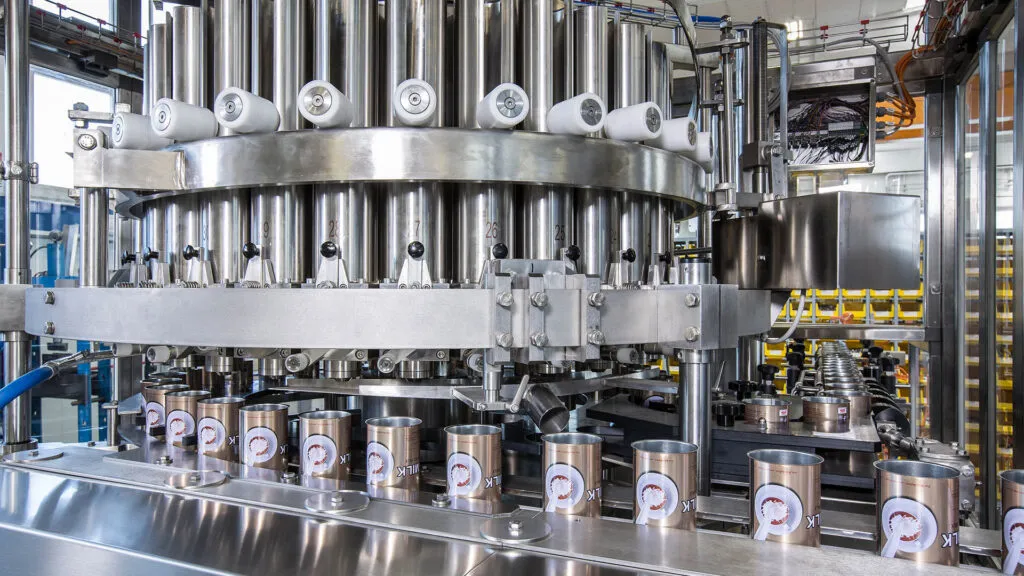
Food filling lines serve as the “final line of defense” in the food industry. From beverage filling and dairy packaging to sauce dosing, every step relies on compressed air for operation: pneumatic valves control material flow, pneumatic pistons drive filling heads for precise dosing, and pneumatic capping machines ensure a tight seal. Unlike ordinary industrial scenarios, however, compressed air in food filling lines comes into direct or indirect contact with food. If the air contains contaminants such as oil or particles, it can lead to the scrapping of entire batches of products and even trigger food safety incidents.
According to regulations from the Codex Alimentarius Commission (CAC), compressed air in contact with food must meet “food-grade cleanliness standards,” requiring oil content ≤ 0.01mg/m³ and particle size ≤ 0.1μm. The U.S. FDA CFR 21 Part 178.3570 further specifies that equipment used to generate compressed air for food processing must have materials, lubricants, and seals that comply with food contact safety standards, prohibiting any harmful substances that could migrate into food.
In the field of oil-free air compressors, oil-free scroll and oil-free screw technologies are the two mainstream options. The former, with its simple structure and low initial cost, is widely used in small food workshops. The latter, however, stands out as the first choice for medium-to-large food filling lines due to its stable air output, strong continuous operation capability, and superior compliance. This article will comprehensively compare the differences between the two from the perspectives of technical principles, core performance, compliance, and practical application scenarios, revealing why oil-free screw air compressors are more suitable for food filling lines.
II. Technical Principle Breakdown: Differences in “Air Generation Logic” Between Oil-Free Scroll and Oil-Free Screw
To understand the performance gap between the two, it is first necessary to clarify their core working principles. Although both can produce oil-free air, differences in structural design directly determine their stability and applicable scenarios.
2.1 Oil-Free Scroll Air Compressors: A Miniaturized Choice for “Static Meshing”
The core structure of an oil-free scroll air compressor consists of two intermeshing scroll plates (a fixed scroll plate and an orbiting scroll plate). Through the eccentric orbiting motion of the orbiting scroll plate, continuously shrinking sealed chambers are formed, drawing in air from the inlet, compressing it, and discharging it from the outlet. The key to its oil-free design lies in the precision-machined gap between the scroll plates, which ensures sealing without the need for lubricating oil for auxiliary sealing or cooling – thus, the generated air contains no oil.
Technical Features:
- Simple structure: Only one core moving part (the orbiting scroll plate), with few wearing parts and low maintenance difficulty;
- Air pressure range: 0.7-1.0MPa, flow range: 0.2-5m³/min, suitable for small flow requirements;
- Low operating noise: Typically 60-75dB(A), suitable for close-range operation scenarios;
- Limitations: The meshing gap of the scroll plates is highly affected by temperature. After long-term operation, the gap tends to widen, leading to reduced air compression efficiency and increased pressure fluctuations.
2.2 Oil-Free Screw Air Compressors: The Industrial Core for “Dynamic Meshing”
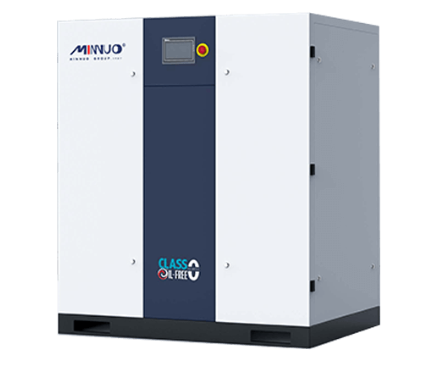
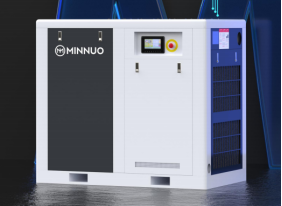
The core of an oil-free screw air compressor is a pair of intermeshing male and female rotors (usually twin screws). The rotors adopt a “dry meshing” design, meaning their surfaces are treated with special coatings (such as nitriding or PTFE coating) to achieve sealing and lubrication without lubricating oil. Air is drawn into the chambers through the rotational meshing of the rotors; as the rotors rotate, the volume of the chambers gradually shrinks, compressing the air to the rated pressure before discharge.
To address heat generation during compression, oil-free screw air compressors are usually equipped with independent cooling systems (air-cooled or water-cooled), ensuring the rotors operate at a constant temperature and preventing changes in the meshing gap due to thermal expansion.
Technical Features:
- Precision structure: Rotors adopt a 5:6 tooth ratio design, with meshing precision reaching the micron level to ensure stable compression;
- Air pressure range: 0.7-1.6MPa, flow range: 5-100m³/min, covering medium-to-large production needs;
- Strong continuous operation capability: Designed service life of 80,000-100,000 hours, enabling 24/7 uninterrupted operation;
- Core advantage: The meshing gap of the rotors is less affected by temperature, resulting in minimal fluctuations in air pressure and flow – ideal for continuous production scenarios requiring high stability.
III. Core Comparison: Why Prioritize Oil-Free Screw for Food Filling Lines? A 4-Dimension PK
The core needs of food filling lines are “continuity, stability, compliance, and safety.” The following comparison of oil-free scroll and oil-free screw compressors across 4 key dimensions clearly demonstrates their suitability:
3.1 Air Output Stability: The “Zero Fluctuation” Advantage of Oil-Free Screw
Food filling lines have extremely high requirements for the stability of compressed air pressure and flow. Take beverage filling as an example: the dosing precision of pneumatic filling heads depends on constant air pressure (typically 0.6-0.8MPa, with pressure fluctuation ≤ ±0.02MPa). A sudden drop in pressure causes underfilling, while a sudden surge leads to material spillage and packaging damage.
- Shortcomings of Oil-Free Scroll:
Oil-free scroll compressors rely on “gap sealing” between scroll plates. The oil-free design results in high friction coefficients; after long-term operation (over 8 hours), the scroll plates heat up (reaching 80-90℃), and thermal expansion widens the meshing gap, leading to increased pressure fluctuations (measured fluctuation range: ±0.05-0.08MPa). A small beverage factory once used two 1.5m³/min oil-free scroll compressors in parallel; after 12 hours of operation, the filling volume error expanded from ±1% to ±3%, exceeding the industry standard (≤ ±2%).
Additionally, oil-free scroll compressors adjust flow through an “load/unload” mode. Pressure drops sharply during unloading and rises suddenly during loading; frequent switching fatigues pneumatic components and increases failure risks.
- Advantages of Oil-Free Screw:
The twin rotors of oil-free screw compressors use “dry meshing + coated sealing”; combined with an independent cooling system, their operating temperature is stably controlled at 60-70℃, with a thermal expansion coefficient only 1/3 that of scroll plates. The meshing gap fluctuation is ≤ ±0.01mm, corresponding to an air pressure fluctuation of ≤ ±0.02MPa – fully meeting the precision requirements of food filling lines.
Meanwhile, oil-free screw compressors are equipped with Variable Frequency Drive (VFD) systems, which dynamically adjust rotor speed based on real-time air demand (e.g., flow differences between peak and off-peak periods). The flow adjustment range is 30%-100%, avoiding pressure fluctuations caused by “load/unload” cycles. Measured data from a large-scale dairy factory shows that after switching to oil-free screw compressors, the filling volume error stabilized within ±0.5%, and the defect rate dropped from 0.8% to 0.1%.
3.2 Compliance Performance: Oil-Free Screw Fully Meets FDA CFR 21 Standards
Compressed air equipment for food filling lines must be certified to FDA CFR 21 standards. These standards not only require air cleanliness but also impose strict requirements on equipment materials, lubricants, seals, and drainage systems, prohibiting any potential sources of food contamination.
- Compliance Risks of Oil-Free Scroll:
To control costs, most low-cost oil-free scroll compressors use ordinary nitrile rubber (NBR) seals, which easily age and peel off after long-term operation, causing particle contamination. Some models have poorly designed drainage systems that fail to fully discharge condensate, allowing bacteria (such as Escherichia coli and mold) to grow and enter the filling process via compressed air.
Furthermore, if the scroll plate coating uses non-food-grade materials (e.g., ordinary epoxy resin), it may release harmful substances at high temperatures – failing to meet the “food contact material” requirements of FDA CFR 21 Part 178.3570. A small sauce factory once used non-compliant oil-free scroll compressors, leading to the detection of trace rubber particles in its products. The factory was fined $50,000 by the FDA and forced to shut down production for one month for rectification.
- Compliance Assurance of Oil-Free Screw:
Regular oil-free screw air compressors are designed to fully comply with FDA CFR 21 standards for the food industry:
- Air-contacting components (rotors, cylinders, intake filters, oil separators) use food-grade materials such as 304 stainless steel and PTFE coating (compliant with FDA 21 CFR 177.1550);
- Seals are made of food-grade fluororubber (FKM) or silicone rubber (VMQ), which are odorless, non-aging, and do not release harmful substances;
- Equipped with a three-stage air purification system: primary filtration (removes ≥10μm particles) → precision filtration (removes ≥0.1μm particles) → activated carbon filtration (removes odors and trace contaminants). The final air has an oil content ≤ 0.001mg/m³ and particle content ≤ 0.01μm, far exceeding FDA standards;
- The drainage system adopts a “automatic drainage + secondary drying” design, achieving a 99.9% condensate discharge rate to prevent bacterial growth.
Test reports from a multinational beverage company (a Coca-Cola supplier) show that its oil-free screw air compressors meet all indicators of FDA CFR 21 Part 178.3570 and ISO 8573-1 Class 1, passing FDA on-site audits for three consecutive years.
3.3 Continuous Operation Capability: Oil-Free Screw Adapts to “24/7 Uninterrupted Production”
Medium-to-large food filling lines typically operate on a three-shift, 24/7 basis, with an annual operating time of over 8,000 hours. This places extremely high demands on the continuous operation capability and reliability of air compressors.
- Limitations of Oil-Free Scroll:
The meshing gap of scroll plates lacks lubrication protection; wear intensifies after long-term operation, resulting in an average service life of only 20,000-30,000 hours. After continuous operation for over 12 hours, failure risks increase significantly (e.g., scroll plate jamming, motor overload). A biscuit factory once attempted to operate four oil-free scroll compressors in shifts, but frequent switching caused air pressure fluctuations. Additionally, 2-3 sets of scroll plates needed replacement annually, leading to high maintenance costs and significant production interruption risks.
- Reliability of Oil-Free Screw:
The rotors of oil-free screw compressors are made of high-strength alloy steel (e.g., 38CrMoAlA), with a surface hardness of over HRC60 after nitriding treatment, ensuring excellent wear resistance. Core bearings use imported brands such as SKF or NSK, with a designed service life of 50,000 hours. The entire machine adopts a modular design, with a failure rate only 1/5 that of oil-free scroll compressors.
Practical application data shows that the Mean Time Between Failures (MTBF) of oil-free screw air compressors reaches 40,000 hours, stably supporting 24/7 uninterrupted operation. Annual maintenance is required only 2-3 times (filter replacement, cooling system inspection), fully adapting to the continuous production needs of food filling lines. An oil-free screw air compressor at an instant noodle factory has operated continuously for 5 years (40,000 hours) without a single major failure, requiring only 4 air filter replacements – with annual maintenance costs of less than RMB 10,000.
3.4 Cost-Effectiveness: The “Long-Term Advantages” of Oil-Free Screw Surpass Initial Investment
Many enterprises hesitate due to the higher initial procurement cost of oil-free screw compressors (usually 2-3 times that of oil-free scroll). However, from the perspective of “Total Cost of Ownership (TCO),” oil-free screw compressors offer superior long-term benefits – especially for medium-to-large food filling lines.
Taking a beverage filling line with a daily output of 100,000 bottles (requiring an air supply of 10m³/min at 0.8MPa) as an example, the 5-year total cost comparison between the two types of equipment is as follows:
| Cost Item | Oil-Free Scroll (5 units in parallel) | Oil-Free Screw (1 unit) |
| Initial Procurement Cost | 5 × RMB 80,000 = RMB 400,000 | 1 × RMB 200,000 = RMB 200,000 |
| Operating Electricity | 5 × 7.5kW × 8,000h × RMB 0.8/kWh = RMB 240,000/year × 5 = RMB 1,200,000 | 1 × 37kW × 8,000h × RMB 0.8/kWh = RMB 236,800/year × 5 = RMB 1,184,000 |
| Maintenance Cost | 2 sets of scroll plates/year (RMB 40,000/set) + filters (RMB 5,000) = RMB 85,000/year × 5 = RMB 425,000 | Filter replacement (RMB 10,000/year) + cooling system maintenance (RMB 5,000/year) = RMB 15,000/year × 5 = RMB 75,000 |
| Downtime Losses | 4 failures/year × RMB 50,000/failure = RMB 200,000/year × 5 = RMB 1,000,000 | 2 maintenance stops/year × RMB 10,000/stop = RMB 20,000/year × 5 = RMB 100,000 |
| 5-Year Total Cost | RMB 400,000 + RMB 1,200,000 + RMB 425,000 + RMB 1,000,000 = RMB 3,025,000 | RMB 200,000 + RMB 1,184,000 + RMB 75,000 + RMB 100,000 = RMB 1,559,000 |
As shown in the data, although the initial procurement cost of oil-free screw compressors is higher, their 5-year total cost is only 51.5% that of oil-free scroll compressors. The core reasons are: lower maintenance costs, fewer downtime losses, and better energy efficiency (power consumption per unit flow is only 95% that of oil-free scroll compressors). For medium-to-large food filling lines, the cost advantage of oil-free screw compressors becomes more significant as production scale expands.
IV. Practical Application Cases: “Selection Upgrade” Experiences of 3 Food Enterprises
4.1 Case 1: A Dairy Factory – From Oil-Free Scroll to Oil-Free Screw, Filling Qualification Rate Increased by 3%
A large-scale dairy factory (daily output: 500 tons of milk) originally used 6 oil-free scroll compressors in parallel for air supply. Due to large pressure fluctuations, it experienced “overfilling” and “underfilling” issues during milk filling, with a qualification rate of only 96.5%. In 2022, it replaced the system with 2 oil-free screw compressors (20m³/min). After the upgrade, the air pressure fluctuation was controlled within ±0.01MPa, significantly improving filling precision – the qualification rate rose to 99.8%, reducing annual scrapping losses by approximately RMB 1.2 million. Meanwhile, the equipment operated continuously without failures, and maintenance costs dropped from RMB 150,000/year to RMB 30,000/year, allowing the factory to recover the equipment upgrade cost in just 2 years.
4.2 Case 2: A Beverage Factory – FDA Audit Drove Upgrade, Oil-Free Screw Became a “Compliance Tool”
A fruit juice beverage factory planned to enter the U.S. market and needed to pass FDA CFR 21 certification. Its original oil-free scroll compressors failed two audits due to non-compliant seal materials and inadequate air purification systems. In 2023, it replaced the system with a 15m³/min oil-free screw compressor (FDA-certified), equipped with a three-stage purification system and food-grade seals. The third audit was passed on the first attempt. Currently, the factory’s products have successfully entered the U.S. market, with an annual export volume of $8 million – the oil-free screw air compressor has become its “compliance passport.”

4.3 Case 3: A Sauce Factory – Meeting 24/7 Production Needs, Oil-Free Screw Achieves “Zero Interruption”
A broad bean paste factory operated on a 24/7 continuous production model. It originally used 4 oil-free scroll compressors in shifts, but frequent failures caused downtime, resulting in monthly losses of approximately RMB 50,000. In 2021, it replaced the system with a 12m³/min oil-free screw compressor. The equipment has operated continuously for 3 years without major failures, with monthly maintenance time of only 2 hours – reducing downtime losses to RMB 5,000/month and saving approximately RMB 540,000 annually. Additionally, the higher air cleanliness of the oil-free screw compressor extended the sauce’s shelf life from 6 months to 12 months, significantly enhancing product competitiveness.
V. Selection Guide for Oil-Free Screw Air Compressors in Food Filling Lines: 4 “Must-Check” Parameters
When selecting an oil-free screw air compressor, focus on the following 4 parameters to align with the actual needs of food filling lines and avoid selection errors:
5.1 Air Cleanliness Level: Must Meet ISO 8573-1 Class 1
Compressed air for food filling lines must comply with ISO 8573-1 Class 1 (oil content ≤ 0.001mg/m³, particle size ≤ 0.01μm, dew point ≤ -70℃) and be certified to FDA CFR 21 Part 178.3570. During selection, request third-party test reports from suppliers to verify air cleanliness and compliance.
5.2 Pressure and Flow Stability: Pressure Fluctuation ≤ ±0.02MPa
Based on the requirements of the filling line’s pneumatic equipment, select the appropriate rated pressure (typically 0.6-0.8MPa) and flow rate (reserve a 20% margin to avoid insufficient supply during peak periods). Prioritize models equipped with Variable Frequency Drives (VFD) to ensure dynamic stability of flow and pressure.
5.3 Continuous Operation Capability: MTBF ≥ 40,000 Hours
Pay attention to the equipment’s Mean Time Between Failures (MTBF) and designed service life. Prioritize models with nitrided rotors and imported bearings to ensure 24/7 uninterrupted operation. Additionally, confirm the supplier’s after-sales response time (preferably ≤ 24 hours) to avoid prolonged downtime due to failures.
5.4 Materials and Seals: Food-Grade Certification Is Key
Verify that air-contacting components (rotors, cylinders, filters) are made of 304 stainless steel or PTFE coating, and that seals are food-grade fluororubber (FKM) or silicone rubber (VMQ). Request material compliance certificates (e.g., FDA 21 CFR 177.1550 certification) from suppliers.
VI. Common Misconceptions Addressed: Dispelling 3 “Cognitive Biases” in Oil-Free Air Compressor Selection
6.1 Misconception 1: “Oil-Free Scroll Has Low Initial Cost, Making It Suitable for SMEs”
Fact: For small workshops with a daily output ≤ 10,000 bottles, the initial cost advantage of oil-free scroll is obvious. However, for medium-sized filling lines with a daily output ≥ 50,000 bottles, oil-free screw compressors offer lower long-term costs (maintenance + downtime losses) and avoid penalty risks due to non-compliance. It is recommended that SMEs directly select oil-free screw compressors when planning capacity expansion to avoid secondary upgrade costs.
6.2 Misconception 2: “All Oil-Free Air Compressors Meet FDA Standards”
Fact: “Oil-free” only means the air contains no oil, but FDA CFR 21 standards impose strict requirements on equipment materials, seals, and purification systems. Many low-cost oil-free scroll compressors can produce oil-free air but fail to meet FDA audit requirements due to non-compliant materials and designs. During selection, clearly request FDA certification documents and third-party test reports from suppliers to avoid falling into the “fake oil-free” trap.
6.3 Misconception 3: “Oil-Free Screw Compressors Are Complex to Maintain, Less Convenient Than Oil-Free Scroll”
Fact: Although oil-free screw compressors have a precision structure, they have few wearing parts (only filters and bearings require regular replacement) and simple maintenance procedures (ordinary workers can operate them after training). In contrast, worn scroll plates of oil-free scroll compressors need to be replaced entirely, resulting in higher maintenance costs and greater difficulty. In practical applications, oil-free screw compressors require only 1/3 the annual maintenance frequency of oil-free scroll models, making them more suitable for “hassle-free operation” needs.
VII. Conclusion: Oil-Free Screw Air Compressors – The Optimal Choice for “Stable and Compliant” Food Filling Lines
The core competitiveness of food filling lines lies in “safety, stability, and efficiency.” Oil-free screw air compressors perfectly meet these needs through three core advantages: “zero-fluctuation air output, FDA compliance assurance, and 24/7 continuous operation.” Compared with oil-free scroll compressors, oil-free screw models have a higher initial investment, but their irreplaceable advantages in compliance, stability, and cost-effectiveness make them “essential equipment” for medium-to-large food filling lines.
For food enterprises planning to expand into overseas markets (especially regions with strict food safety requirements such as the U.S. and Europe), oil-free screw air compressors are not just production equipment but also “passports” for international certification. For enterprises pursuing efficient continuous production, oil-free screw compressors minimize downtime losses, improve product qualification rates, and enhance market competitiveness.
Choosing a high-quality oil-free screw air compressor is equivalent to equipping a food filling line with an “invisible lifeline” – it not only ensures food safety but also creates sustained economic benefits for the enterprise. In an era of increasingly strict food safety regulations, choosing an oil-free screw air compressor means choosing a future of “assured production and steady development.”
 Email
Email sales:+86 15366749631