In industries with strict requirements for gas purity such as food and pharmaceuticals, electronics and semiconductors, and precision manufacturing, the cleanliness of compressed air directly determines product quality and production compliance. Traditional oil-lubricated air compressors are prone to gas contamination due to lubricating oil leakage, making them increasingly incompatible with high-purity scenario needs. Oil-free air compressors, with their core advantage of “zero oil contamination”, have become the preferred power equipment for high-cleanliness industrial scenarios. This article analyzes the adaptation logic of oil-free air compressors from technical principles, core advantages, industrial applications, and key selection dimensions, providing professional references for enterprises to make accurate selections.
I. Technical Analysis of Oil-Free Air Compressors: Differences and Adaptation of Two Core Pathways
The “oil-free” feature of oil-free air compressors is mainly achieved through two technical pathways, each with distinct structural designs and performance characteristics to meet different scenario requirements:
- Total oil-free lubrication technology: Key moving parts such as piston rings and valve plates are made of self-lubricating materials (e.g., graphite, ceramics), eliminating the need for lubricating oil injection and fundamentally preventing oil contamination. These models have a relatively simple structure and low maintenance costs, with exhaust purity reaching ISO 8573-1 Class 0 (oil-free). They are suitable for scenarios with zero tolerance for oil contamination, such as food processing and pharmaceutical preparation production.
- Oil-free lubrication + precision filtration technology: Some models reduce contact between lubricating oil and compressed gas through optimized sealing structures, combined with a multi-stage high-efficiency filtration system (pre-filtration + activated carbon adsorption + precision filter element), controlling the oil content in compressed air below 0.01mg/m³ to meet general high-purity needs. Typical applications include electronic component assembly and precision coating. Their advantage lies in strong operational stability, making them suitable for long-term high-load working conditions.
It is worth noting that ISO 8573-1 Class 0 is the core certification standard for oil-free air compressors, indicating that compressed air contains no visible oil droplets and extremely low oil vapor content. Enterprises should prioritize verifying this certification during selection.
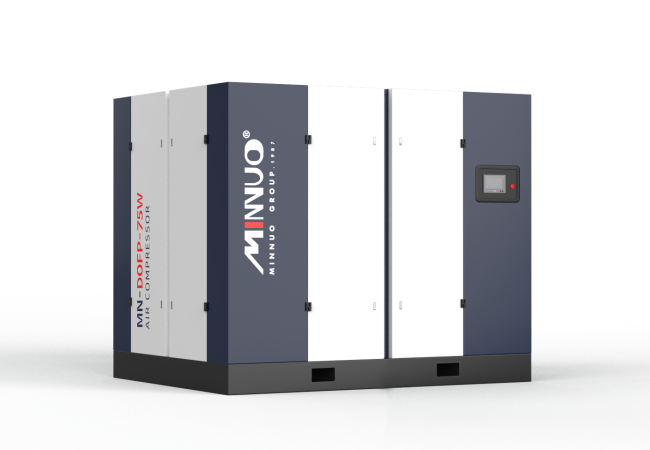
II. Four Core Advantages of Oil-Free Air Compressors: Meeting the Rigid Needs of High-Purity Scenarios
- Clean and pollution-free, ensuring compliant production: The output gas is free of oil mist and oil vapor contamination, avoiding product scrapping and production rework caused by gas pollution. They are particularly suitable for GMP certification in the food and pharmaceutical industries and cleanroom requirements in the electronics industry. After adopting total oil-free air compressors, a pharmaceutical enterprise reduced its batch non-conformity rate due to oil contamination from 3% to 0, cutting compliance costs by 40%.
- Lower maintenance costs and longer equipment lifespan: Total oil-free models eliminate the need for lubricating oil and oil filter replacement, reducing consumable purchases and maintenance man-hours. The oil-free environment prevents corrosion of cylinders, bearings, and pipelines by lubricating oil, extending the average service life of equipment by 20%-30% compared to oil-lubricated models and lowering long-term replacement costs.
- Superior energy efficiency, aligning with low-carbon needs: Self-lubricating components have a lower friction coefficient. Combined with IE5 ultra-high-efficiency motors and optimized air channel design, oil-free air compressors save 5%-10% more energy than oil-lubricated models of the same power. Variable frequency oil-free models can adjust rotational speed in real-time according to air demand, achieving energy savings of up to 15%-25% in scenarios with fluctuating loads.
- Wide scenario coverage and strong adaptive flexibility: Pressure ranges from 0.7-40MPa, and flow rates can be flexibly selected from 0.5-50m³/min, meeting both low-pressure and high-flow needs (e.g., food packaging) and high-pressure scenarios (e.g., specialty gas filling). Mobile total oil-free models can flexibly adapt to outdoor precision operations such as on-site equipment maintenance and temporary gas supply.
III. Typical Application Scenarios: Precise Adaptation to High-Purity Needs
- Food and pharmaceutical industries: Vacuum packaging in food processing, beverage carbonation, and pneumatic transportation of pharmaceutical preparations all require oil-free compressed air. Total oil-free air compressors prevent oil contamination of food or pharmaceuticals, complying with national food safety standards and pharmaceutical GMP regulations. After application by a beverage enterprise, product shelf life was extended by 3 months, and consumer complaint rates dropped by 60%.
- Electronics and semiconductor industries: In chip manufacturing and electronic component welding, compressed air is used for pneumatic control and dust blowing. Oil vapor can cause chip short circuits and component corrosion. High-purity gas output by oil-free air compressors ensures the qualification rate of precision electronic devices. A semiconductor factory reduced its chip packaging defect rate from 1.9% to 0.4% after adoption.
- Precision manufacturing and coating industries: In high-end automotive coating and precision machining, compressed air is used for paint atomization and high-precision tool driving. Oil-free compressed air avoids paint contamination, ensuring uniform and smooth coating surfaces, and reduces oil accumulation inside tools to improve machining accuracy. A car modification plant reduced its coating rework rate from 8% to 1.2% after application.
- Medical and specialty gas fields: Gas supply for medical equipment (e.g., ventilators, anesthesia machines) and medical oxygen filling have extremely high requirements for gas purity. Oil-free air compressors combined with multi-stage filtration systems can achieve medical-grade gas cleanliness, ensuring medical safety. In the auxiliary compression of specialty gases (e.g., high-purity nitrogen, argon), the oil-free design prevents cross-gas contamination.
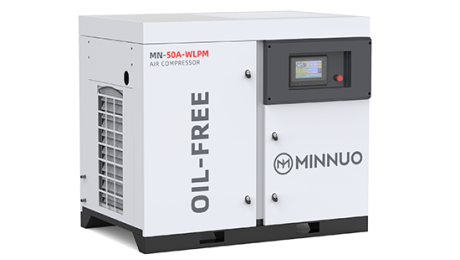
IV. Four Key Selection Dimensions for Oil-Free Air Compressors: Accurate Adaptation Without Pitfalls
- Clarify purity grade requirements: Select the appropriate grade based on industry standards. Prioritize ISO 8573-1 Class 0 total oil-free models for food, pharmaceutical, and medical fields; for electronics and coating industries, choose oil-filtered oil-free models with oil content ≤0.01mg/m³ to avoid over-investment or insufficient purity.
- Precisely match pressure and flow parameters: Combine the rated pressure of production equipment (e.g., 0.6-0.8MPa for pneumatic tools, 15-35MPa for gas cylinder filling) and peak air demand, selecting models with parameter redundancy ≤10% to avoid energy waste caused by “overcapacity operation”. Reserve 15% flow margin for continuous production scenarios to ensure stable air supply.
- Consider operational stability and maintenance convenience: For long-term high-load operations, prioritize models with good cylinder cooling and long bearing life. Focus on product structural design—modular models with easily replaceable wear parts can reduce downtime for maintenance. For total oil-free models, verify the service life and replacement costs of self-lubricating components.
- Verify certifications and after-sales service: Confirm that products have passed international certifications such as ISO 8573-1 Class 0, CE, and PED to ensure quality compliance. Choose brands with comprehensive after-sales service, focusing on timely spare parts supply within 72 hours, on-site commissioning, and remote fault diagnosis to avoid production disruptions due to equipment failures.
V. Industry Trends: Oil-Free + Intelligent + High-Purity Upgrades
With the continuous improvement of industrial clean production requirements and the deepening of the dual carbon policy, oil-free air compressors are evolving in three key directions: first, purity precision upgrades—total oil-free technology will achieve ppb-level (10⁻⁹ grams per cubic meter) oil content control, adapting to higher-standard precision manufacturing scenarios; second, intelligent integration—integrating IoT monitoring and AI predictive maintenance to real-time monitor gas purity and equipment status, reducing maintenance costs; third, energy-saving optimization—the combination of photovoltaic energy storage and oil-free air compressors will become a new trend, further reducing carbon footprints.
For enterprises, selecting oil-free air compressors is not only a rigid demand to meet high-purity production but also a long-term investment to reduce costs, improve efficiency, and achieve compliant development. In the wave of industrial manufacturing transformation towards “precision and greenization”, oil-free air compressors that are accurately selected and scenario-adapted will become the core power support for high-cleanliness industrial scenarios, helping enterprises gain an advantage in quality competition and environmental compliance.

 Email
Email sales:+86 15366749631