Introduction: The High-Pressure Challenge in Modern Industry
Imagine this: Your manufacturing line grinds to a halt because your air compressor can’t maintain the 200 PSI needed for your hydraulic presses. Or your oil and gas well stimulation operation faces costly delays due to inconsistent air supply at 300 PSI. For industries that rely on high-pressure compressed air—from aerospace and automotive to petrochemicals and power generation—this isn’t just an inconvenience; it’s a threat to productivity and profitability.
Traditional high-pressure air solutions—like reciprocating compressors or multi-stage piston units—often fall short: they’re noisy, prone to breakdowns, and guzzle energy when running at full capacity. But there’s a better way. High-pressure screw air compressors have emerged as the gold standard, combining the reliability of screw technology with the power to deliver 100-400 PSI (and beyond) for even the most demanding industrial tasks.
This guide breaks down what makes high-pressure screw compressors a game-changer, how they work, their key advantages, and how to choose the right unit for your specific needs—so you can stop fighting air supply issues and start focusing on what matters: growing your operation.
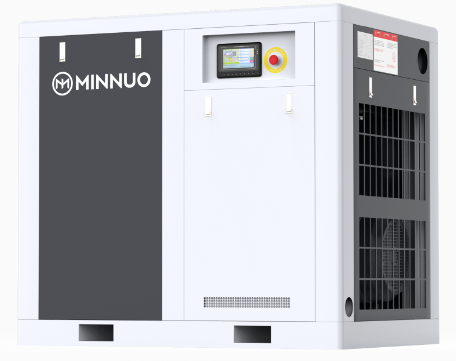
What Is a High-Pressure Screw Air Compressor?
A high-pressure screw air compressor is a specialized type of rotary screw compressor designed to generate compressed air at pressures significantly higher than standard industrial compressors (which typically max out at 150 PSI). These units leverage the proven efficiency of twin interlocking helical screws to compress air in one or two stages, delivering consistent pressure ranging from 100 PSI to 400 PSI—with custom configurations available for ultra-high-pressure applications (up to 1000 PSI).
How It Works: The Science Behind the Power
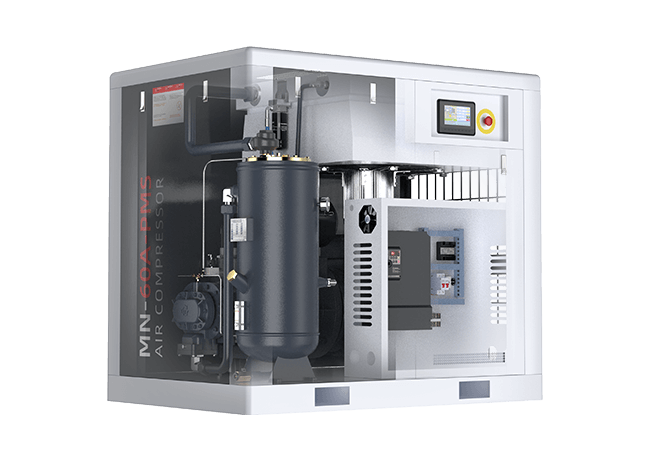
The core of a high-pressure screw compressor lies in its air-end design, featuring asymmetrical rotor profiles that are precision-machined to micron-level tolerances. This design minimizes internal leakage and maximizes volumetric efficiency, which is especially critical for maintaining performance at high pressures. It operates in two key phases for maximum efficiency:
- Air Intake & Initial Compression: Ambient air is drawn into the compressor’s air-end, where two interlocking screws (rotors) trap and compress the air as they rotate. In single-stage models, this process directly boosts pressure to 100-150 PSI; in two-stage models, the air is first compressed to 100 PSI, cooled, then compressed again to reach 200-400 PSI.
- Cooling & Drying: High-pressure compression generates heat, so integrated coolers (air-cooled or water-cooled) remove excess temperature to prevent component wear. Many units also include built-in dryers to remove moisture, ensuring the high-pressure air meets quality standards (critical for applications like painting or precision machining).
- Storage & Delivery: The compressed air is stored in a high-pressure tank (rated for 100-400 PSI) and delivered to your tools or processes via specialized hoses, with pressure regulators to maintain exact requirements.
Why High-Pressure Screw Compressors Outperform Traditional Solutions
When compared to legacy high-pressure systems (like reciprocating compressors) or multi-unit setups, high-pressure screw compressors offer a clear set of advantages that directly impact your bottom line:
1. Unmatched Energy Efficiency
Reciprocating compressors waste energy through constant starts and stops, while multi-stage piston units lose efficiency due to friction. High-pressure screw compressors, by contrast, operate with continuous rotary motion—reducing energy loss by up to 30% compared to reciprocating models. When paired with Variable Speed Drive (VSD) technology, they adjust motor speed to match air demand, cutting energy costs by an additional 20-40% for operations with fluctuating needs.
Example: A 50 HP high-pressure screw compressor with VSD uses 25% less energy than a comparable fixed-speed unit. For a compressor running at 70% load, 8,760 hours/year, and $0.15/kWh, this translates to annual savings of approximately $8,100 (calculated on a base energy draw of ~37.5 kW).

2. 24/7 Reliability for Continuous Operations
Screw technology has fewer moving parts than reciprocating compressors (no pistons, valves, or connecting rods), which means less wear and tear. High-pressure screw units are engineered for industrial-grade continuous operation—many can run 24/7 for months without downtime, making them ideal for critical applications like power plant maintenance or oilfield operations. The average mean time between failures (MTBF) for high-pressure screw compressors is 30,000+ hours, compared to 10,000-15,000 hours for reciprocating models.
3. Lower Maintenance & Operating Costs
Fewer moving parts translate to simpler maintenance. Routine upkeep for a high-pressure screw compressor typically involves only oil changes (every 2,000-4,000 hours), filter replacements, and basic inspections—no costly valve overhauls or piston repairs. This reduces maintenance labor costs by 40-50% and extends the unit’s lifespan to 10-15 years (vs. 5-8 years for reciprocating compressors).
4. Quieter, Cleaner Operation
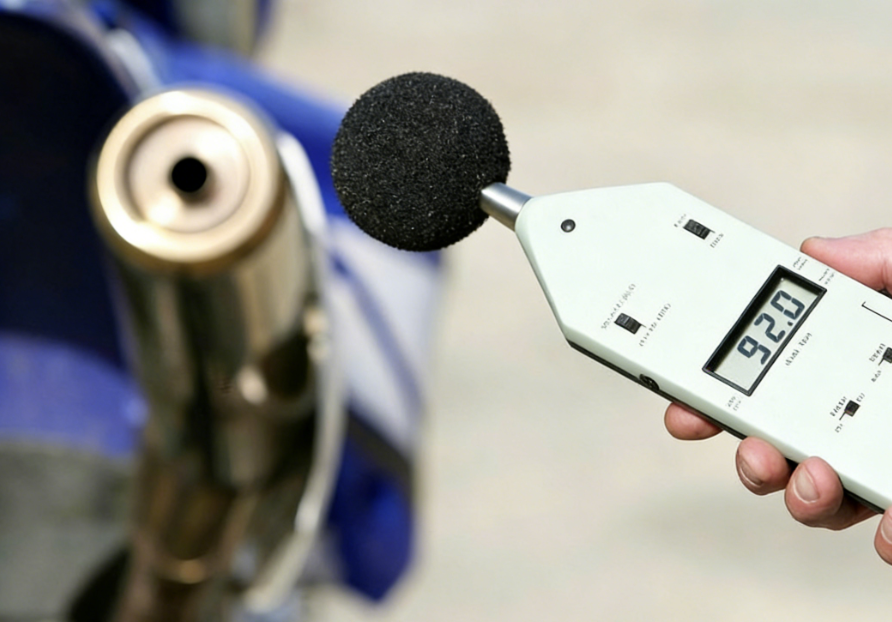
Reciprocating compressors can reach 85-95 dB (loud enough to require hearing protection), while high-pressure screw compressors operate at 65-75 dB—quiet enough to run near workstations without disrupting operations. Additionally, their sealed air-end design minimizes oil carryover (as low as 3 ppm), delivering cleaner air that meets ISO 8573-1 Class 2 standards—critical for food processing, pharmaceutical, or electronics manufacturing.
High-Pressure Screw Compressor vs. Traditional High-Pressure Solutions: A Data-Driven Comparison
| Performance Metric | High-Pressure Screw Compressor | Reciprocating Compressor | Multi-Stage Piston Compressor |
| Pressure Range | 100-400 PSI (up to 1000 PSI custom) | 100-300 PSI | 200-500 PSI |
| Energy Efficiency (kW/100 CFM) | 7.5-9.0 | 11.0-13.5 | 9.5-12.0 |
| MTBF (Hours) | 30,000+ | 10,000-15,000 | 15,000-20,000 |
| Noise Level (dB) | 65-75 | 85-95 | 80-90 |
| Lifespan (Years) | 10-15 | 5-8 | 7-10 |
Key Applications: Where High-Pressure Screw Compressors Shine
High-pressure screw compressors are versatile enough to handle a wide range of industrial tasks, but they excel in applications that demand consistent pressure, reliability, and efficiency. Here are the top industries and use cases:
1. Manufacturing & Metalworking
Tasks like hydraulic press operation, metal forming, and laser cutting require 150-250 PSI of consistent air. High-pressure screw compressors deliver the power needed to keep these processes running smoothly, with VSD technology adapting to the variable demand of batch production.
2. Oil & Gas
Well stimulation, pipeline testing, and gas lift operations rely on 250-400 PSI air. High-pressure screw compressors are built to withstand harsh offshore or remote environments, with weatherproof enclosures and redundant systems to prevent costly downtime.
3. Aerospace & Automotive
Aerospace component testing (e.g., pressure testing fuel lines) and automotive paint booths require 100-200 PSI of clean, dry air. High-pressure screw compressors with integrated dryers and oil-free configurations can meet the strict ISO 8573-1 Class 1 standards for oil-free air, ensuring no contamination of sensitive parts. For critical aerospace testing of composite materials or fuel systems, where both ultra-high pressure (300+ PSI) and 100% oil-free air (ISO 8573-1 Class 0) are mandatory, specially engineered oil-free high-pressure screw compressors are the definitive solution.
4. Petrochemical & Chemical Processing
Inert gas blanketing, catalyst regeneration, and chemical transfer demand 200-300 PSI. High-pressure screw compressors can be configured to handle nitrogen or other inert gases, with explosion-proof designs for hazardous environments.
5. Power Generation
Turbine maintenance, boiler cleaning, and control system operation require 150-200 PSI of reliable air. High-pressure screw compressors with N+1 redundancy ensure uninterrupted supply—critical for preventing power outages.
How to Choose the Right High-Pressure Screw Compressor
Selecting the perfect high-pressure screw compressor isn’t just about picking the highest PSI rating. It requires matching the unit’s capabilities to your specific application, demand, and environment. Follow these steps to make an informed decision:
Step 1: Define Your Pressure & Flow Requirements
Start by calculating two key metrics:
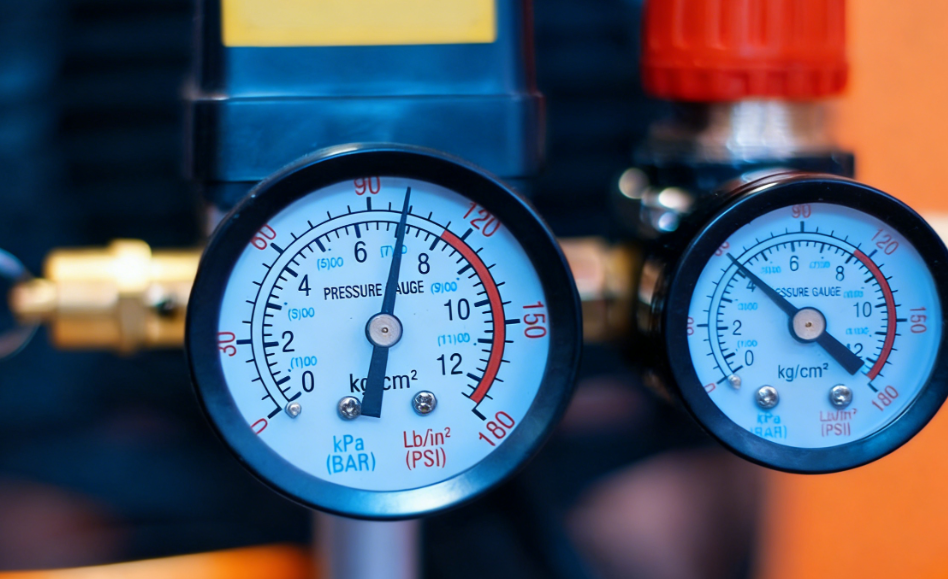
- Required Pressure (PSI): Check your tools or processes—e.g., a hydraulic press may need 200 PSI, while pipeline testing needs 300 PSI. Choose a compressor that can maintain this pressure even at peak demand (add 10-15% as a buffer).
- Flow Rate (CFM): Calculate the total CFM needed by adding the requirements of all tools/processes that run simultaneously. For example, if you have two hydraulic presses (each 15 CFM) and a laser cutter (20 CFM), you need a minimum of 50 CFM.
Step 2: Choose Single-Stage vs. Two-Stage
- Single-Stage: Ideal for 100-150 PSI applications (e.g., automotive paint booths). More compact and cost-effective for lower pressure needs.
- Two-Stage: Better for 150-400 PSI (e.g., oilfield operations). Cools air between compression stages, reducing energy use and extending component life.
Step 3: Opt for VSD (If Demand Fluctuates)
If your air demand varies (e.g., batch manufacturing), a VSD high-pressure screw compressor will save you money by adjusting motor speed to avoid wasting energy during low-demand periods. Fixed-speed models are better for constant, 24/7 operations.
Step 4: Consider Environmental Factors
- Location: Offshore or coastal operations need corrosion-resistant materials; cold climates require heated enclosures.
- Space: Compact models are available for tight facilities; skid-mounted units are easy to move for remote sites.
- Regulations: Hazardous environments (e.g., petrochemical plants) need explosion-proof certifications (ATEX, UL Class I Div 2).
Step 5: Evaluate Total Cost of Ownership (TCO)
Don’t just focus on upfront cost—calculate long-term expenses: energy use, maintenance, and lifespan. A high-efficiency VSD model may cost 10-20% more upfront but often saves 30-40% in annual energy costs, with many units paying for themselves in 18-24 months (varies by usage hours and energy rates).
Case in Point: A Petrochemical Plant’s 40% Energy Savings
Challenge
A mid-sized petrochemical plant in Texas relied on three 75 HP reciprocating compressors to generate 250 PSI for inert gas blanketing. The units were noisy (92 dB), required monthly valve repairs, and consumed 12,000 kWh/month—costing $1,800 in electricity bills alone. Frequent downtime due to breakdowns caused $5,000+ in lost production each quarter.
Solution
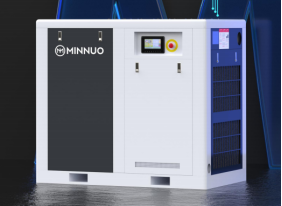
The plant replaced the reciprocating units with one 100 HP two-stage high-pressure screw compressor from MINNUO, equipped with VSD and an integrated dryer. The unit was sized to deliver 75 CFM at 250 PSI—matching their peak demand—with N+1 redundancy to ensure reliability.
Results
- 40% Lower Energy Costs: Monthly electricity use dropped to 7,200 kWh (based on 24/7 operation), saving $10,080 annually at $0.15/kWh.
- 90% Less Maintenance: Repairs fell from monthly to quarterly, cutting maintenance costs by $6,000/year.
- Zero Downtime: The unit ran continuously for 12 months without breakdowns, eliminating $20,000/year in lost production.
- Quieter Operation: Noise levels dropped to 70 dB, eliminating the need for hearing protection in the compressor room.
- Strategic Value Upgrade: The project not only achieved a full ROI in under 22 months but also transformed their high-pressure air supply from a recurring liability into a strategic asset.
FAQ
Q1: What’s the maximum pressure a high-pressure screw compressor can deliver?
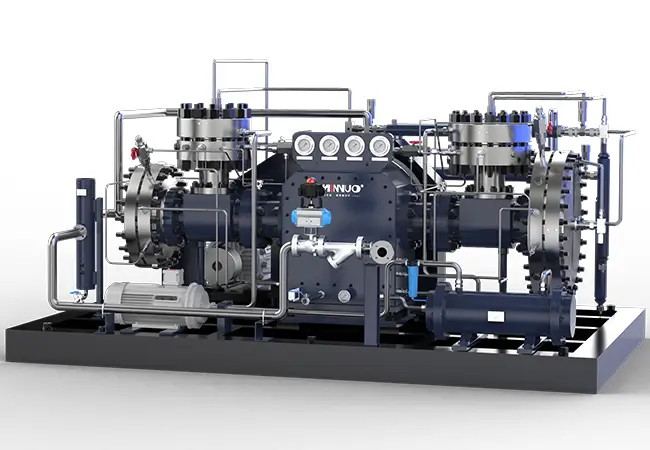
A1: Standard models range from 100-400 PSI, but custom configurations (using three or more compression stages) can reach up to 1000 PSI for specialized applications like high-pressure testing or aerospace component manufacturing.
Q2: Are high-pressure screw compressors oil-free?
A2: They’re available in both oil-flooded and oil-free designs. Oil-flooded models are more cost-effective for general industrial use, while oil-free models (using dry screw technology) are required for applications like food processing, pharmaceuticals, or electronics—where even trace oil contamination is a risk.
Q3: How often do high-pressure screw compressors need maintenance?
A3: Routine maintenance is minimal. Oil changes are needed every 2,000-4,000 hours (or 6-12 months), air filters every 1,000-2,000 hours, and oil filters every 2,000 hours. With predictive maintenance (via remote monitoring), you can address issues before they cause downtime—extending service intervals even further.
Conclusion: Invest in Power That Pays Off
For industries that rely on high-pressure compressed air, settling for outdated, inefficient solutions is no longer an option. High-pressure screw air compressors deliver the perfect trifecta: the power to meet your 100-400 PSI needs, the efficiency to cut energy costs, and the reliability to keep your operations running 24/7.
This isn’t just an equipment upgrade—it’s a strategic investment in productivity, cost savings, and operational resilience. Whether you’re in manufacturing, oil & gas, or aerospace, the right high-pressure screw compressor will adapt to your needs and grow with your business.
Ready to find the perfect high-pressure screw compressor for your operation?
Contact MINNUO today for a free, no-obligation High-Pressure Air Assessment. Our experts will analyze your pressure/flow requirements, audit your current energy use, and provide a customized recommendation—complete with projected savings, ROI timeline, and equipment specs tailored to your industry.
 Email
Email sales:+86 15366749631