Executive Summary
This article provides an objective technical analysis of diaphragm compressors—a specialized segment within the air compressor industry—tailored for decision-makers in the energy, chemical, and semiconductor sectors. Our goal is to help you identify technical boundaries for various operating conditions, mitigate downtime risks caused by improper selection, and calculate true Return on Investment (ROI) based on Life Cycle Cost (LCC).
The Bottom Line:
The diaphragm compressor is the ultimate solution for ultra-high pressure (up to 1,000+ bar), high-purity gas (zero contamination), and flammable/explosive gas compression. While initial capital expenditure (CAPEX) is typically 20%–40% higher than reciprocating piston compressors, its static seal structure ensures zero leakage. This makes its long-term safety and compliance advantages irreplaceable when handling hydrogen, specialty gases, or expensive rare gases.
In-Depth Analysis: The Status Quo and Benchmarks of Diaphragm & Air Compressors
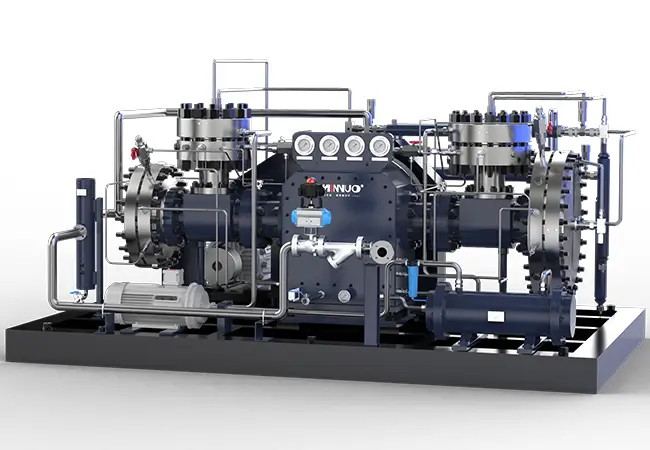
A diaphragm compressor is a specialized reciprocating compressor that utilizes a flexible diaphragm to move back and forth within a cylinder, changing the cylinder volume to compress and transport gas.
In industrial applications, these machines are categorized into three benchmark tiers based on pressure levels and application severity:
Core Parameter & Solution Comparison Table
| Dimension | Entry-Level (Industrial N2/Air) | Mid-Range (Industrial H2/Bottling) | High-End (Semiconductor/Lab/UHP H2) |
|---|---|---|---|
| Typical Pressure | 10 – 150 bar | 150 – 450 bar | 450 – 1000+ bar |
| Sealing Grade | Standard Static Seal | Severe-Duty Static Seal | Triple Diaphragm / Leak Alarm |
| Material Req. | Carbon Steel / SS | 316L SS / Anti-Hydrogen Embrittlement | Exotic Alloys / High-Polish Surfaces |
| Maintenance Cycle | 2,000 – 4,000 Hours | 1,500 – 3,000 Hours | < 2,000 Hours (Pressure dependent) |
| Estimated CAPEX | Low to Moderate | Moderate | Very High |
Decision Guide: Key Variables Affecting Cost and Performance
When selecting a diaphragm compressor, users often focus solely on discharge pressure while overlooking two critical variables: hydraulic drive efficiency and diaphragm longevity.
Common Pitfalls & Hidden Costs
- Ignoring “Clearance Volume” Efficiency: As compression ratios increase, the clearance volume in the diaphragm head causes volumetric efficiency to drop significantly. Without multi-stage compression optimization, electricity costs will far exceed expectations.
- Hydraulic Oil Contamination Risk: While the gas side is theoretically pure, a failure in the Leak Detection System (LDS) can allow hydraulic oil to contaminate expensive gas paths. Recommendation: Always opt for models equipped with a triple-diaphragm structure and integrated pressure monitoring alarms.
- Underestimating Foundation Requirements: Due to the inertia forces of reciprocating motion, improper base design leads to high-frequency vibrations, causing fatigue failure in pipe welds.
Expert FAQ (Expert Q&A)
Q1: Can a diaphragm compressor be used as a standard air compressor for long-term operation?
A: Technically yes, but economically no. Unless your air requirement demands extremely high pressure (>100 bar) and absolute oil-free conditions. For standard industrial power air, screw-type air compressors are far more cost-effective.
Q2: Why do diaphragms rupture frequently, and how can their lifespan be extended?
A: Diaphragm life is primarily affected by start-stop frequency, gas cleanliness (solid particles puncture the film), and thermal management. Maintaining stable hydraulic oil temperatures and installing fine filters (<5μm) can significantly extend lifespan to over 4,000 hours.
Q3: What is the primary advantage of diaphragm compressors in the hydrogen energy sector?
A: Primarily “Zero Leakage” and “High Pressure Ratio.” Hydrogen molecules are extremely small and flammable; the static seal of a diaphragm compressor eliminates crankcase leakage risks, making it the core equipment for hydrogen refueling stations and green hydrogen storage.
Industrial Applications and ROI Analysis
Scenario A: High-Purity Electronic Special Gas (ESG) Transport
- Configuration: All-stainless steel gas head + Automated control system + Online purity monitoring.
- ROI Analysis: Preventing a single batch of wafer scrap due to contamination covers the entire procurement cost of the unit.
Scenario B: High-Pressure Hydrogen Filling (Hydrogen Refueling Stations)
- Configuration: Multi-stage compression + Deep cooling system + Explosion-proof rating Ex d IIB+H2 T4.
- ROI Analysis: High volumetric efficiency reduces filling time, increasing the daily turnover rate of the station.
Conclusion
The diaphragm compressor is not just the “crown jewel” of high-pressure air compressor technology; it is the foundational infrastructure for modern clean energy and high-precision manufacturing. For operations demanding zero contamination, zero leakage, and ultra-high pressure, it remains the safest and lowest Total Cost of Ownership (TCO) solution on the market.
Recommended Next Step:
Before making a procurement decision, prepare a detailed gas composition analysis and a pressure-flow demand curve. If you require further selection support, we can provide performance simulations based on ISO 1217 standards.
Author Bio:
The author is a Senior Systems Engineer specializing in air compressors with over 15 years of R&D and field commissioning experience. He has led equipment selection for major petrochemical projects and hydrogen refueling stations and is an expert in API 618 and ASME standards.

 Email
Email sales:+86 15366749631