An air compressor that repeatedly trips its circuit breaker is more than an annoyance; it’s a critical safety warning and a sign of a serious problem. Forcing the system by resetting the breaker can damage the motor, start a fire, or cause injury.
This fault is typically caused by an electrical overload, where the compressor draws more current (amps) than the circuit is designed to handle. Finding the root cause requires a systematic approach. This guide walks you through the five most common reasons, from simple fixes to serious mechanical failures, so you can diagnose and resolve the issue safely.
Immediate Safety Actions Before You Begin
- Lock Out / Tag Out: Turn off and physically lock the main power disconnect switch to the compressor.
- Let Pressure Bleed: Ensure all air pressure is completely drained from the tank and system.
- Consult a Professional: If you are not qualified to work with electrical systems or complex machinery, stop here and call a licensed electrician or compressor technician. Electrical faults are hazardous.
Air Compressor Breaker Tripping: The 5 Most Common Causes & Solutions
Cause 1: An Undersized or Faulty Circuit
This is the first thing to check, especially if the compressor is new to the location.
- The Problem: The circuit’s ampacity (the maximum current it can safely carry) is too low for the compressor’s Full Load Amperage (FLA). This is a common mistake during installation.
- How to Diagnose:
- Find the compressor’s nameplate FLA.
- Check the circuit breaker rating (e.g., 20A, 30A).
- The breaker rating should be at least 125% of the FLA. (Example: A 20A FLA motor needs a 25A or 30A breaker).
- The Solution: A licensed electrician must upgrade the circuit with correctly sized wire, a new breaker, and potentially a new disconnect switch.
Cause 2: Voltage Drop or Low Voltage
Compressors are power-hungry. Low voltage forces the motor to draw higher amps to produce the same power, tripping the breaker.
- The Problem: Long wire runs, undersized wiring, or a weak grid supply cause voltage at the motor terminals to sag under load.
- How to Diagnose: With the compressor running under load, a qualified electrician should measure the voltage at the motor terminals. A drop greater than 5% from the nameplate voltage (e.g., below 114V on a 120V circuit) is problematic.
- The Solution: Shorten the circuit run, increase wire gauge, or address utility supply issues. This is strictly a job for an electrician.
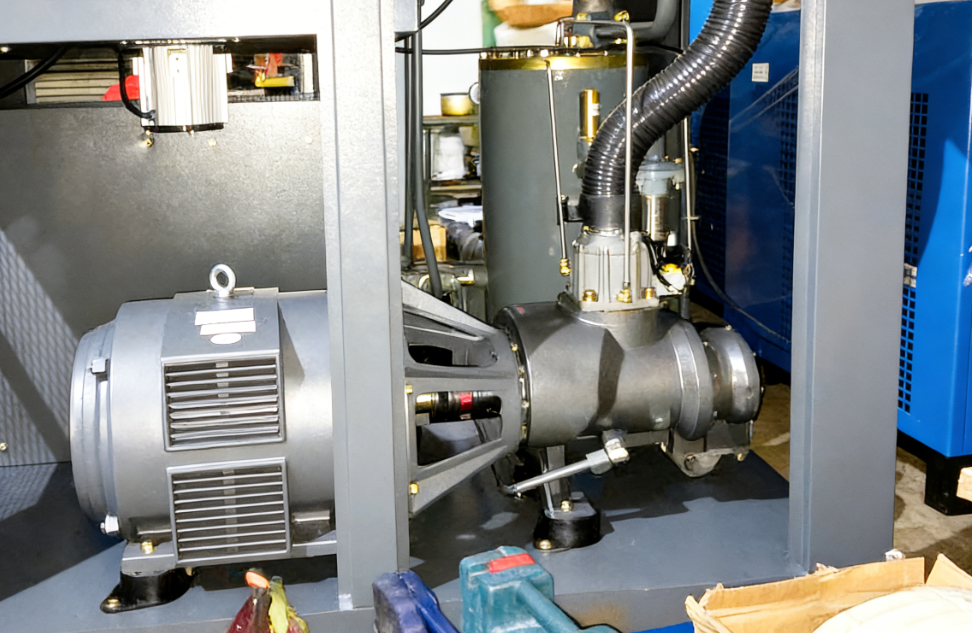
Cause 3: A Failing Motor or Starter
Electrical faults inside the motor or its starting components cause excessive current draw.
- The Problem:
- Worn Motor Windings: Insulation breaks down, causing shorts.
- Failing Start/Run Capacitors: (On single-phase motors) A weak capacitor prevents the motor from reaching proper speed, causing it to stay in high-amp “start” mode.
- Bad Starter Contacts: Pitted contacts create resistance and heat.
- How to Diagnose:
- Listen for a humming sound without startup (capacitor issue).
- Smell for burnt insulation.
- A technician can perform a megger test to check winding insulation and measure capacitor microfarads.
- The Solution: Component replacement by a qualified technician. A motor rewind or full replacement may be necessary.
Cause 4: Mechanical Binding or Overload
The motor is struggling to turn the pump due to physical resistance.
- The Problem:
- Low Oil or Wrong Oil: Causes increased friction and heat in the pump.
- Worn Bearings or Pistons: Creates drag and uneven load.
- Failed Unloader Valve: The compressor tries to start against full tank pressure (“hard start”), creating a massive current spike.
- How to Diagnose:
- Check oil level and condition.
- Manually rotate the pump flywheel (with power OFF) – it should turn smoothly. Any grinding or stiffness indicates internal problems.
- Listen for a hiss at the pressure switch when the compressor shuts off; no hiss suggests a faulty unloader.
- The Solution: Top up or change oil, service the unloader valve, or overhaul the pump. These are mechanical repairs.
Cause 5: A Ground Fault or Short Circuit
A dangerous condition where electricity is escaping the intended path.
- The Problem: Damaged wiring insulation or a moisture intrusion causes a “hot” wire to touch the ground wire or the compressor chassis.
- How to Diagnose: This often trips the breaker immediately, even without the motor starting. A GFCI breaker will trip instantly. Use a multimeter to check for continuity between power terminals and ground (with power OFF and disconnected).
- The Solution: Immediately stop using the compressor. This is a serious shock and fire hazard. An electrician must trace and repair the fault in the wiring, motor, or controls.
Diagnostic Flowchart: What to Check and When
Breaker Trips
    │
    ├─► Does it trip IMMEDIATELY on start? ──► Suspect Cause 5: Ground Fault/Short (Call Electrician)
    │
    ├─► Does it trip AFTER a few seconds of running? ──►
    │       │
    │       ├─► Check Oil Level & Condition ──► Low/Bad? (Cause 4)
    │       │
    │       └─► Listen: Humming sound? ──► Yes: Suspect Cause 3 (Bad Capacitor/Motor)
    │
    └─► Is the compressor NEW to this outlet? ──► Yes: Suspect Cause 1 (Undersized Circuit)
            │
            └─► No: Measure Voltage Under Load ──► Low? (Cause 2)
                     │
                     └─► Normal: Suspect Cause 3 or 4 (Mechanical/Internal Electrical)
FAQ: Breaker Tripping on Air Compressor
Q1: Can I just replace the breaker with a larger one to stop the tripping?
A1: Absolutely NOT. This is extremely dangerous. The breaker protects the wiring in your walls from overheating and catching fire. Larger breakers allow more current than the wires can handle. Always match the breaker to the wire size, not the appliance.
Q2: My compressor only trips when it’s hot outside. Why?
A2: This points to Cause 2: Voltage Drop. Electrical grids can experience lower voltage during peak summer demand. Additionally, higher ambient temperature reduces the motor’s cooling efficiency and increases electrical resistance, both leading to higher amp draw.
Q3: I hear a click from the pressure switch, then it trips. What does that mean?
A3: The “click” is the starter engaging. The immediate trip suggests the motor is trying to start but cannot. This is classic for Cause 4 (Mechanical Binding)—like a failed unloader valve—or Cause 3 (Failing Start Capacitor) on single-phase motors.
Q4: Is it safe to use an extension cord with my compressor?
A4: Rarely, and only with extreme caution. Most household extension cords are too thin (high gauge number) and cause severe voltage drop (Cause 2), leading to tripping and motor damage. If you must, use a heavy-duty cord (12-gauge or thicker) as short as possible, and only as a temporary measure.
Conclusion: Safety First, Then Systematic Diagnosis
A tripping breaker is your electrical system’s way of shouting that something is wrong. Ignoring it risks your equipment, your facility, and personal safety.
Start with the simplest checks (circuit size, oil level) but respect the complexity of electrical and mechanical systems. For most causes beyond a simple undersized circuit, the expertise of a licensed electrician or compressor technician is not just recommended—it’s essential for a safe and lasting repair.
Encountering a persistent tripping issue you can’t diagnose? Contact the MINNUO support team. Our technicians can help you troubleshoot over the phone or schedule an on-site electrical and mechanical inspection to identify the root cause and get your compressor running safely again.

 Email
Email sales:+86 15366749631