Introduction: Beyond Purchase Price, Building a High-Efficiency Industrial Power Heart
In modern manufacturing, the Industrial Air Compressor is often referred to as the “factory’s fourth utility.” However, many enterprises fall into the trap of “price-oriented” selection, overlooking energy efficiency and long-term operating costs. The core thesis of this guide is that the value of a Heavy Duty Industrial Air Compressor should not be measured by its initial acquisition cost, but defined by its reliability in extreme environments, isothermal efficiency, and Life Cycle Cost (LCC). Only by deeply matching technical parameters with actual production processes can an enterprise ensure increased production capacity while significantly reducing its carbon footprint.
Core Technical Analysis: Key Components and Performance Differentiators
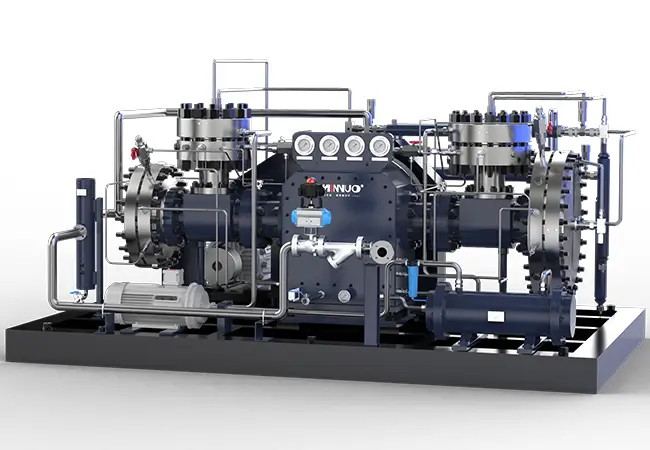
Screw vs. Centrifugal: Power Choices for Different Application Loads
For most industrial scenarios, Twin-Screw Compressors are the mainstream choice due to their continuous output capability under high pressure. However, according to performance verification standards by the Compressed Air and Gas Institute (CAGI), when flow demand exceeds , the multi-stage compression design of centrifugal compressors offers superior energy efficiency.
Material Science and Durability: The Foundation of “Heavy Duty”
A true heavy-duty compressor must be capable of handling a 100% continuous duty cycle. This typically involves:
- SKF-Grade High-Precision Bearings: Ensuring mechanical stability at speeds exceeding .
- Teflon (PTFE) Coated Rotors: Preventing air volume loss caused by corrosion in oil-free models.
- IP55/IP66 Rated Motors: Withstanding harsh factory dust and humid environments.
Economic and Efficiency Comparison: Data-Driven Decision Models
In the selection process, understanding Specific Power is central to measuring equipment energy savings. Research by the International Energy Agency (IEA) on industrial motor systems proves that approximately 80% of a compressed air system’s lifecycle cost stems from electricity, while equipment acquisition accounts for only about 10%.
Industrial Compressor Selection Comparison Table
| Metric | Oil-Injected Screw | Oil-Free Screw | Centrifugal |
|---|---|---|---|
| Main Applications | General Mfg, Auto, Assembly | Food, Pharma, Semiconductor | Chemical, Steel, Mining |
| Pressure Range | 5 – 15 bar | 7 – 10 bar | 2 – 20+ bar |
| Maintenance | Medium (Regular filters) | High (Coating inspections) | Low (Mainly gearbox) |
| Initial Investment | Low – Medium | High | Very High |
| Long-term Efficiency | Good | Excellent (ISO 8573-1) | Superior (High flow) |
FAQ: Common Concerns for Industrial Users
- Q: Does VFD (Variable Frequency Drive) technology actually save money?
- A: Yes. If your air demand fluctuates, evidence from the Carbon Trust shows that VFD technology can reduce energy consumption by up to 35%. However, at constant full-load operation, fixed-speed models are slightly more efficient.
- Q: How do I know if I need an “Oil-Free” compressor?
- A: If your end product has zero tolerance for oil mist (e.g., medical devices), you must choose a Class 0 certified oil-free machine. For general pneumatic tools, an oil-injected machine paired with high-efficiency filters is usually more economical.
Intelligent Monitoring and Best Practices: Enhancing System Reliability
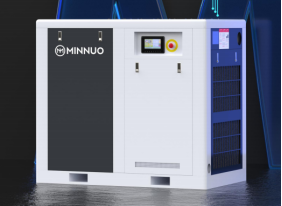
Modern heavy-duty industrial compressors are no longer isolated mechanical units. Integrating Industrial Internet of Things (IIoT) monitoring systems (such as Atlas Copco or Minnuo) has become the industry standard.
By monitoring discharge temperature, vibration frequency, and pressure fluctuations in real-time, companies can shift from “break-fix” to Predictive Maintenance. Long-term practice by industrial fluid machinery experts proves that vibration analysis can warn of bearing failure 2-4 weeks in advance, avoiding hundreds of thousands of dollars in lost production value from a single unplanned shutdown.
Conclusion: Building a Sustainable Compressed Air Strategy
In summary, selecting an excellent heavy-duty industrial compressor requires a comprehensive evaluation across three dimensions: technical specifications, energy costs, and intelligent maintenance.
Key Summary:
The key to optimizing a compressed air system lies in minimizing Total Cost of Ownership (TCO) rather than the unit price. Enterprises should prioritize high-efficiency models that comply with CAGI verified data sheets and introduce VFD technology for fluctuating loads. In high-precision industries, Class 0 Oil-Free certification is the authoritative standard for product compliance.
Actionable Advice:
- Conduct an Air Audit: Before purchasing, invite a third party to perform a 7-day energy efficiency audit of your existing pipe network.
- Verify Performance Curves: Require suppliers to provide measured performance data based on the ISO 1217 standard, rather than theoretical values.
- Focus on Post-Processing: Ensure that dryers and filters match the compressor’s output to protect expensive downstream automation equipment.
[Source Statement]
Author: Minnuo, Senior Industrial Energy Auditor and Electromechanical System Strategist, with over 15 years of experience in compressed air system architecture design.
Professional Credentials:
- Certification: Certified professional member of the Compressed Air and Gas Institute (CAGI).
- Experience: Led energy-saving air system renovation projects for over 20 large-scale automotive and petrochemical enterprises.
- Data Sources: Technical parameters refer to ISO 8573 Air Quality Standards, CAGI official performance databases, and the U.S. Department of Energy (DOE) Office of Industrial Technologies.


 Email
Email sales:+86 15366749631